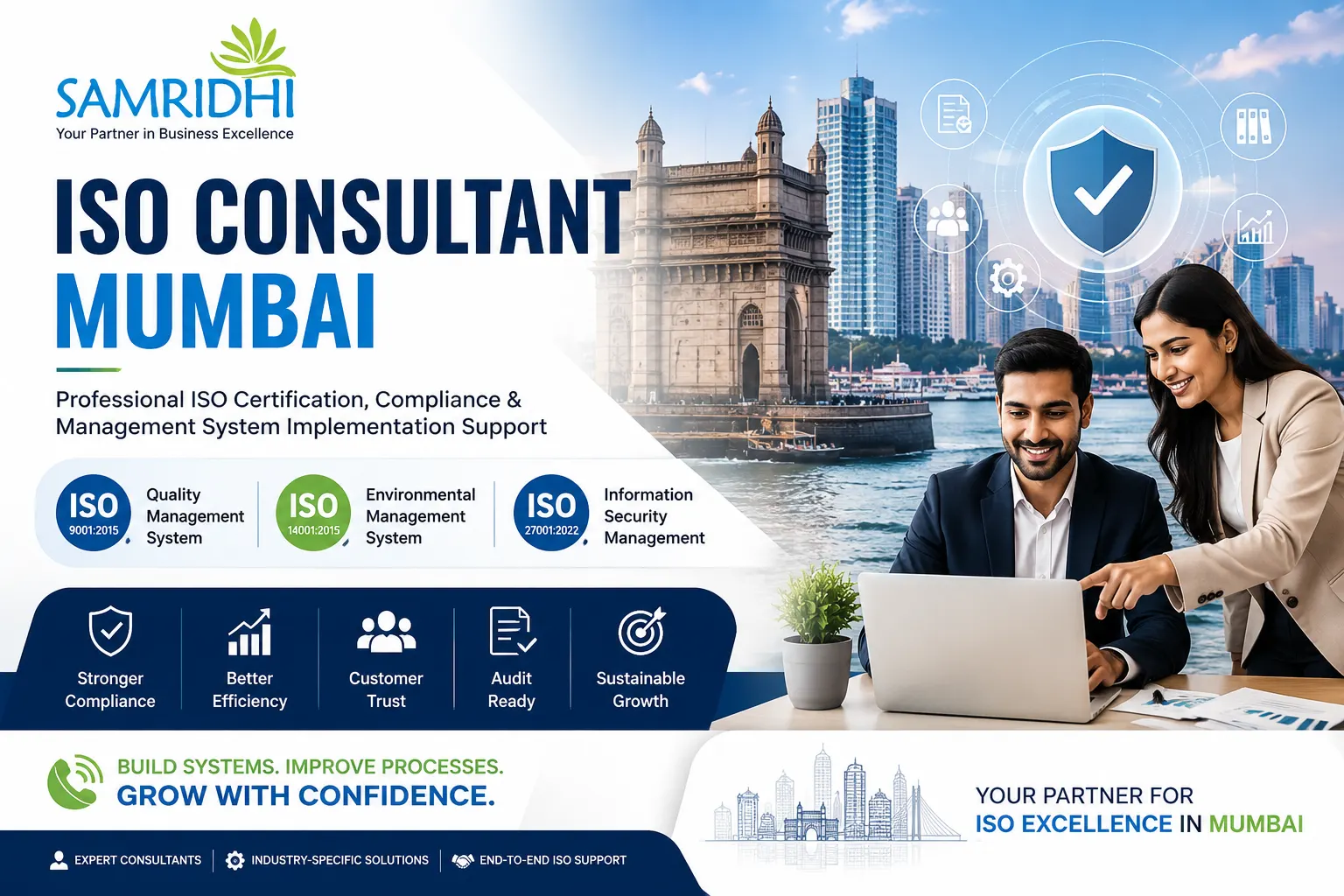
ISO Consultant Bangalore – ISO Certification, Compliance & Implementation Support
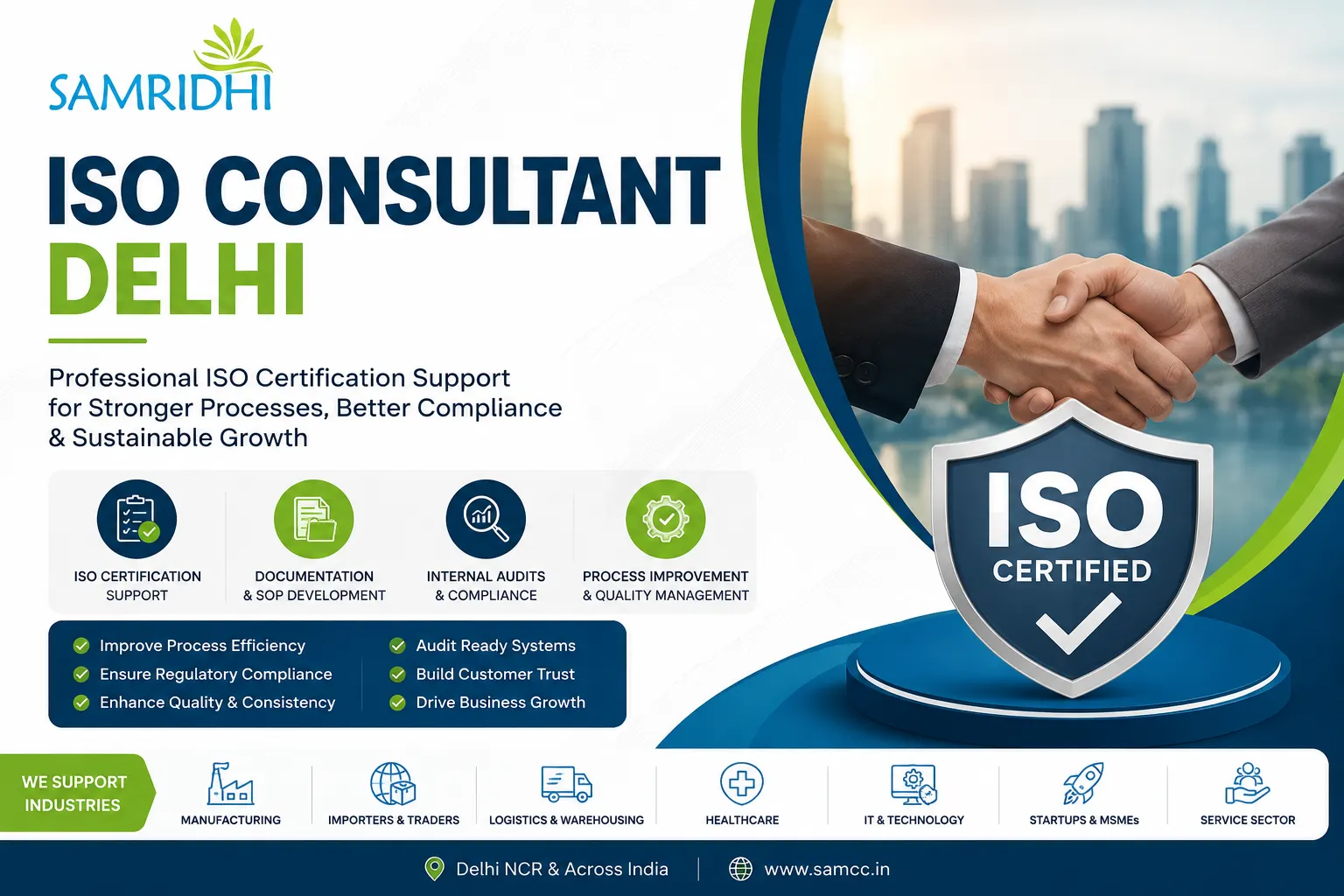
An ISO Consultant Bangalore helps businesses implement and maintain internationally recognized management systems such as ISO 9001, ISO 14001, and ISO 27001. These services support startups, IT companies, manufacturers, importers, healthcare organizations, and service providers by assisting with gap assessments, documentation development, process alignment, internal audits, certification preparation, and ongoing compliance activities. The primary outcome is a structured management system that improves operational consistency, risk management, process control, and business credibility while supporting certification readiness according to the applicable ISO standard and organizational requirements.
 Get Certified with Confidence – Your One-Stop Compliance Partner
From BIS, WPC, TEC, BEE, EPR, LMPC, CDSCO, FSSAI, ISO, MSME to PESO, NABL testing, Startup India, Make in India, and Lab Setup, we handle all your regulatory approvals, certifications, and documentation needs with precision and speed. Partner with Samridhi Compliance Certification and simplify your journey to full compliance—so you can focus on growing your business.
Understanding ISO Consultant Bangalore Requirements
Bangalore is home to one of India's most dynamic business ecosystems. The city hosts thousands of technology startups, software companies, SaaS providers, electronics manufacturers, engineering firms, healthcare organizations, educational institutions, and export-oriented businesses. As companies grow and compete in national and international markets, many begin exploring ISO certification as a way to strengthen operational processes, improve credibility, and align with recognized management standards.
This is where businesses often seek support from an ISO Consultant Bangalore.
Many organizations initially view ISO certification as a document or certificate requirement. In reality, ISO standards are primarily focused on building structured systems that help businesses manage quality, information security, environmental responsibilities, workplace safety, or other operational objectives more effectively.
What Is ISO Certification?
ISO certification is a formal assessment process that evaluates whether an organization's management systems align with the requirements of a specific international standard.
The applicable standard depends on the organization's activities and objectives.
Common examples include:
| ISO Standard |
Primary Focus |
| ISO 9001 |
Quality Management System |
| ISO 14001 |
Environmental Management System |
| ISO 27001 |
Information Security Management System |
| ISO 45001 |
Occupational Health & Safety |
| ISO 22000 |
Food Safety Management System |
Each standard addresses different business needs, which is why understanding applicability is often the first step in the certification journey.
Why Bangalore Businesses Pursue ISO Certification
Bangalore's business environment is highly competitive.
Organizations frequently work with:
- International clients
- Government projects
- Enterprise customers
- Global supply chains
- Export markets
In many cases, customers and procurement teams expect businesses to demonstrate structured operational controls.
For example, a software company handling sensitive client information may explore ISO 27001 Consultant Bangalore services to strengthen information security management practices.
Similarly, a manufacturing company seeking process consistency may pursue ISO 9001 certification in Bangalore to improve quality management systems.
Requirements Depend on Business Type
There is no single ISO certification requirement that applies to every organization.
Requirements vary based on:
- Industry sector
- Business size
- Number of employees
- Operational complexity
- Applicable ISO standard
- Existing management systems
A SaaS startup pursuing ISO 27001 will face different implementation requirements than a manufacturing company seeking ISO 9001 certification.
This is why businesses often begin with a gap assessment before developing certification plans.
Documentation Plays a Central Role
One of the most important aspects of ISO implementation is documentation.
Most ISO standards require businesses to establish and maintain documented processes relating to:
- Policies
- Procedures
- Risk management
- Operational controls
- Performance monitoring
- Continuous improvement
Many businesses already perform these activities informally.
The challenge is often documenting them in a structured and repeatable manner.
An ISO Certification Consultant Bangalore typically helps organizations align existing business practices with standard requirements rather than creating entirely new systems from scratch.
Process Alignment Is More Important Than Paperwork
A common misconception is that ISO certification is primarily about creating documents.
Experienced businesses quickly learn that certification bodies focus heavily on implementation.
Organizations are generally expected to demonstrate:
- Defined processes
- Employee awareness
- Operational consistency
- Internal controls
- Evidence of system effectiveness
A company may have extensive documentation, but if actual business practices do not align with those documents, certification readiness can become more challenging.
Information Security Requirements Continue Growing
For Bangalore's technology sector, information security has become a major focus area.
Software companies, cloud providers, fintech startups, SaaS businesses, and IT service organizations increasingly explore iso 27001 certification in bangalore due to customer expectations around data protection and risk management.
Many enterprise clients now evaluate information security frameworks during vendor selection processes.
As a result, ISO 27001 has become particularly relevant within Bangalore's technology ecosystem.
Manufacturing Businesses Focus on Quality & Process Control
Bangalore's manufacturing sector includes:
- Electronics manufacturers
- Industrial equipment companies
- Engineering businesses
- Automotive suppliers
- Hardware startups
These organizations often pursue ISO Consultant for Manufacturers Bangalore support to improve process consistency, customer satisfaction, and operational controls.
Quality management systems frequently become important as manufacturers scale production, expand supply chains, or enter new markets.
Internal Audits & Management Reviews Are Part of the Process
Many businesses assume certification is achieved immediately after documentation is completed.
In practice, ISO implementation often involves:
- Process development
- Employee training
- Internal audits
- Corrective actions
- Management reviews
- Certification assessments
These activities help organizations evaluate whether management systems are functioning effectively before external certification audits take place.
Operational Reality Businesses Eventually Discover
Most organizations begin the ISO journey expecting to obtain a certificate.
Over time, many realize that the greater value often comes from the process improvements developed during implementation.
Better documentation.
Clearer responsibilities.
Improved process control.
Stronger risk management.
More consistent operations.
This is why businesses across Bangalore increasingly engage an ISO Consultant Bangalore when exploring certification requirements. The goal is not simply obtaining certification, but understanding how management systems can support long-term operational effectiveness. Since every organization has unique processes, risks, and objectives, ISO implementation requirements remain highly dependent on business activities, certification scope, and the applicable standard being pursued.
Businesses evaluating ISO certification often explore ISO Certification, MSME Registration, and Startup India Certification alongside management system implementation. These services help organizations establish stronger operational foundations, improve documentation practices, and support long-term business growth objectives.
Why Businesses in Bangalore Need ISO Consultant Bangalore Support
Bangalore has evolved into one of India's most diverse business hubs. While the city is widely recognized for software development and technology innovation, it is also home to electronics manufacturers, engineering companies, telecom businesses, healthcare organizations, educational institutions, startups, industrial suppliers, and export-oriented enterprises.
As competition increases and customer expectations continue to evolve, businesses are placing greater emphasis on structured management systems, operational consistency, information security, quality control, and process improvement.
This is one of the primary reasons organizations seek support from an ISO Consultant Bangalore.
For many companies, ISO certification is not driven solely by compliance requirements. It is often linked to customer expectations, business growth objectives, tender eligibility, operational improvement initiatives, and international market opportunities.
Bangalore's Technology & Software Ecosystem
Bangalore's reputation as India's technology capital has created a strong demand for management system certifications, particularly within:
- IT companies
- Software development firms
- SaaS businesses
- Cloud service providers
- Fintech companies
- Technology consulting organizations
Many of these businesses manage large volumes of sensitive information and work with clients across multiple countries.
As a result, information security has become a significant business concern.
Organizations frequently pursue ISO 27001 Consultant Bangalore support to strengthen:
- Information security controls
- Risk management processes
- Data protection practices
- Client confidence
In many cases, enterprise customers increasingly evaluate information security frameworks before entering long-term business relationships.
Startup Ecosystem Creates New Certification Demand
Bangalore's startup culture continues to attract entrepreneurs across:
- Technology
- Artificial intelligence
- SaaS
- Consumer products
- Health technology
- Industrial innovation
Many startups initially focus on:
- Product development
- Market validation
- Funding
- Customer acquisition
As businesses mature, however, they often encounter new requirements from:
- Investors
- Enterprise customers
- Procurement teams
- Strategic partners
One SaaS startup discovered that potential enterprise clients were requesting information about information security controls and quality management practices during vendor evaluations.
The challenge was not technical capability.
The challenge was demonstrating structured business processes.
This is increasingly common within Bangalore's startup ecosystem.
Manufacturing Companies Need Process Consistency
Bangalore also hosts a large manufacturing base that includes:
- Electronics manufacturers
- Industrial equipment companies
- Automotive suppliers
- Engineering firms
- Hardware startups
- Component manufacturers
As production volumes grow, businesses often seek better control over:
- Quality management
- Operational efficiency
- Process consistency
- Customer satisfaction
This is where ISO Consultant for Manufacturers Bangalore support becomes particularly valuable.
Many manufacturers pursue iso 9001 certification in bangalore because quality management systems help establish structured approaches to monitoring, controlling, and improving business processes.
Electronics & Hardware Companies Face Growing Expectations
Electronics companies frequently work within highly competitive environments where customers expect:
- Reliable quality
- Consistent production
- Strong documentation
- Risk management practices
Organizations developing:
- Smart devices
- Consumer electronics
- IoT products
- Networking equipment
- Electronic components
often use ISO frameworks to improve internal process management and support long-term business growth.
As product portfolios expand, maintaining consistency across teams, suppliers, and production processes becomes increasingly important.
Telecom & Infrastructure Businesses Require Structured Systems
Bangalore's telecom and communication technology sector includes:
- Telecom equipment providers
- Infrastructure companies
- Network solution providers
- Communication technology firms
These organizations frequently manage complex projects involving multiple stakeholders and technical requirements.
Structured management systems help improve:
- Documentation controls
- Risk management
- Operational coordination
- Process accountability
For many businesses, certification becomes part of a broader operational improvement strategy rather than a standalone compliance activity.
Healthcare & Medical Organizations Pursue Process Excellence
Healthcare providers, diagnostic centers, medical technology companies, and healthcare service organizations increasingly explore ISO certification as part of their quality improvement initiatives.
Healthcare businesses often need stronger controls around:
- Service delivery
- Documentation
- Risk management
- Process consistency
As patient expectations and regulatory scrutiny increase, many healthcare organizations see value in internationally recognized management frameworks.
Export-Oriented Businesses Need International Credibility
Many Bangalore-based companies serve:
- International customers
- Overseas distributors
- Global supply chains
- Foreign procurement networks
In these environments, certification can help businesses demonstrate structured management practices to external stakeholders.
An export-focused manufacturer may find that prospective buyers request evidence of quality systems before entering long-term supply agreements.
Similarly, technology companies often encounter client requirements related to information security standards.
This is one reason ISO Certification Bangalore continues to gain importance across export-driven sectors.
Growing Businesses Need Scalable Processes
One challenge many Bangalore companies face is scaling operations efficiently.
As organizations grow:
- Teams expand
- Processes become more complex
- Risks increase
- Documentation requirements grow
What works for a ten-person startup may not work for a hundred-person organization.
ISO frameworks provide a structured approach for managing growth while maintaining operational consistency.
Many organizations pursue certification not because they have operational problems, but because they want to prevent future inefficiencies as they scale.
Customer & Tender Requirements Continue Increasing
Many businesses first explore certification because:
- Customers request it
- Tenders require it
- Procurement teams ask for it
- Corporate clients prefer certified vendors
In some industries, certification may not be legally mandatory but still provides a competitive advantage during business development and vendor selection activities.
As a result, organizations often seek ISO Certification Consultant Bangalore support to better understand customer-driven certification requirements.
Operational Reality Businesses Eventually Discover
Most organizations begin the certification journey believing ISO is primarily about obtaining a certificate.
Over time, they realize that the real value often lies in creating structured systems that support business growth.
Clear responsibilities.
Documented processes.
Improved consistency.
Better risk management.
More reliable operations.
These benefits become increasingly important as businesses scale within Bangalore's fast-moving and highly competitive economy.
This is why companies across technology, manufacturing, healthcare, telecom, education, and industrial sectors continue working with an ISO Consultant Bangalore. While certification objectives vary from one organization to another, the underlying goal is usually the same: building stronger management systems that support sustainable growth, operational effectiveness, and long-term business credibility. Since every organization operates differently, certification requirements, implementation activities, and timelines always remain dependent on business size, scope, industry, and the specific ISO standard being pursued.
Bangalore's technology companies, manufacturers, startups, and industrial businesses frequently combine ISO Certification with Startup India Certification and Make in India Certification initiatives. Together, these frameworks can help strengthen business credibility, operational maturity, and market readiness as organizations expand.
Step-by-Step Process for ISO Consultant Bangalore
Many businesses start their ISO certification journey with a simple objective: obtain certification and meet customer, tender, or business requirements.
However, organizations quickly discover that ISO certification is not simply a documentation exercise. It involves understanding business processes, identifying gaps, implementing management systems, conducting internal reviews, and demonstrating compliance with the requirements of the selected ISO standard.
The exact certification pathway varies depending on:
- Organization size
- Industry sector
- Number of locations
- Business complexity
- Existing management systems
- Applicable ISO standard
A software company pursuing ISO 27001 will follow a different implementation approach than a manufacturer seeking ISO 9001 certification.
Despite these differences, most organizations working with an ISO Consultant Bangalore generally move through a structured certification process.
1. Identify the Appropriate ISO Standard
The first step is determining which ISO standard aligns with the organization's objectives.
Different standards address different business priorities.
For example:
| ISO Standard |
Typical Objective |
| ISO 9001 |
Quality management |
| ISO 14001 |
Environmental management |
| ISO 27001 |
Information security |
| ISO 45001 |
Occupational health and safety |
| ISO 22000 |
Food safety management |
Many businesses initially assume they need a particular certification because competitors have it.
In practice, selecting the correct standard should be based on actual business needs and operational goals.
2. Conduct a Gap Assessment
Before implementation begins, businesses typically evaluate their current systems against the requirements of the chosen standard.
This assessment helps identify:
- Existing strengths
- Missing processes
- Documentation gaps
- Compliance risks
- Improvement opportunities
A Bangalore-based SaaS company may already have strong security practices in place but discover that formal documentation and risk assessment processes require additional development for ISO 27001 readiness.
The purpose of the gap assessment is not to identify failures but to understand what needs improvement.
3. Define Certification Scope
The certification scope determines which parts of the organization will be covered under the management system.
This may include:
- Specific departments
- Products
- Services
- Locations
- Business functions
The scope plays a critical role because certification activities, documentation requirements, and audits are generally aligned with the defined scope.
For growing organizations, establishing a realistic and practical scope often simplifies implementation efforts.
4. Develop Required Documentation
Once the scope is defined, businesses begin developing the documentation required under the applicable standard.
Depending on the certification, this may include:
- Policies
- Procedures
- Process maps
- Risk assessments
- Operational controls
- Work instructions
- Management records
An ISO Certification Consultant Bangalore often helps businesses align documentation with existing operations rather than creating unnecessary paperwork.
The objective is to document how the organization actually functions.
5. Implement the Management System
Documentation alone does not create certification readiness.
Organizations must implement the management system within day-to-day operations.
This typically involves:
- Employee awareness
- Process alignment
- Responsibility allocation
- Operational controls
- Monitoring activities
A manufacturing company pursuing iso 9001 certification in bangalore may focus on process consistency, quality monitoring, and corrective action management.
Meanwhile, an IT company implementing ISO 27001 may prioritize information security controls, access management, and risk monitoring.
Implementation requirements vary by standard and business activity.
6. Employee Training & Awareness
Most ISO standards require employees to understand their responsibilities within the management system.
Training activities may focus on:
- Policies
- Procedures
- Risk management
- Process controls
- Compliance expectations
Many organizations underestimate this stage.
In practice, employee awareness often determines how effectively a management system operates after implementation.
Even the most well-written procedures become ineffective if employees are unfamiliar with them.
7. Conduct Internal Audits
Before external certification audits take place, organizations generally conduct internal audits.
Internal audits help evaluate:
- Process effectiveness
- Documentation compliance
- Operational consistency
- Implementation status
- Improvement opportunities
The goal is not to find fault.
The goal is to identify issues early and strengthen the management system before certification assessments begin.
Most businesses discover valuable improvement opportunities during this stage.
8. Management Review Activities
ISO standards typically require senior management involvement.
Management reviews often focus on:
- System performance
- Risks
- Objectives
- Improvement opportunities
- Resource requirements
These reviews help ensure leadership remains actively engaged in the management system rather than treating certification as a departmental responsibility.
Strong leadership involvement often contributes significantly to long-term system effectiveness.
9. Certification Audit by Certification Body
Once implementation activities are completed, organizations proceed with certification audits conducted by an accredited certification body.
The audit generally evaluates:
- Documentation
- Process implementation
- Employee awareness
- System effectiveness
- Standard compliance
The outcome depends on audit findings and the organization's readiness at the time of assessment.
Because every organization operates differently, audit observations and recommendations vary by scope and implementation maturity.
10. Continuous Improvement & Ongoing Compliance
Many businesses view certification as the final step.
In reality, certification marks the beginning of an ongoing management system lifecycle.
Organizations are generally expected to:
- Maintain documented processes
- Conduct periodic audits
- Monitor objectives
- Address non-conformities
- Implement improvements
- Participate in surveillance activities
This is why many businesses continue working with an ISO Compliance Consultant Bangalore after certification.
Long-term value often comes from maintaining and improving the system rather than simply obtaining certification.
Common Challenges During the ISO Process
Organizations in Bangalore frequently encounter challenges such as:
- Incomplete documentation
- Process inconsistency
- Limited employee awareness
- Undefined responsibilities
- Resource constraints
- Risk management gaps
- Audit preparation concerns
These challenges are common and usually manageable when identified early in the implementation process.
Operational Reality Businesses Eventually Discover
Most organizations begin the ISO journey focused on achieving certification.
Over time, they realize that certification is only one outcome of a broader process.
The real benefits often emerge through:
- Better process control
- Improved accountability
- Stronger risk management
- More consistent operations
- Enhanced customer confidence
This is why businesses across Bangalore's technology, manufacturing, healthcare, telecom, and industrial sectors increasingly work with an ISO Consultant Bangalore. The goal is not merely obtaining a certificate but building management systems that support long-term operational effectiveness and business growth. Since every organization has unique objectives, risks, and operational structures, certification timelines, implementation activities, and audit outcomes always remain dependent on scope, readiness, and the specific ISO standard being pursued.
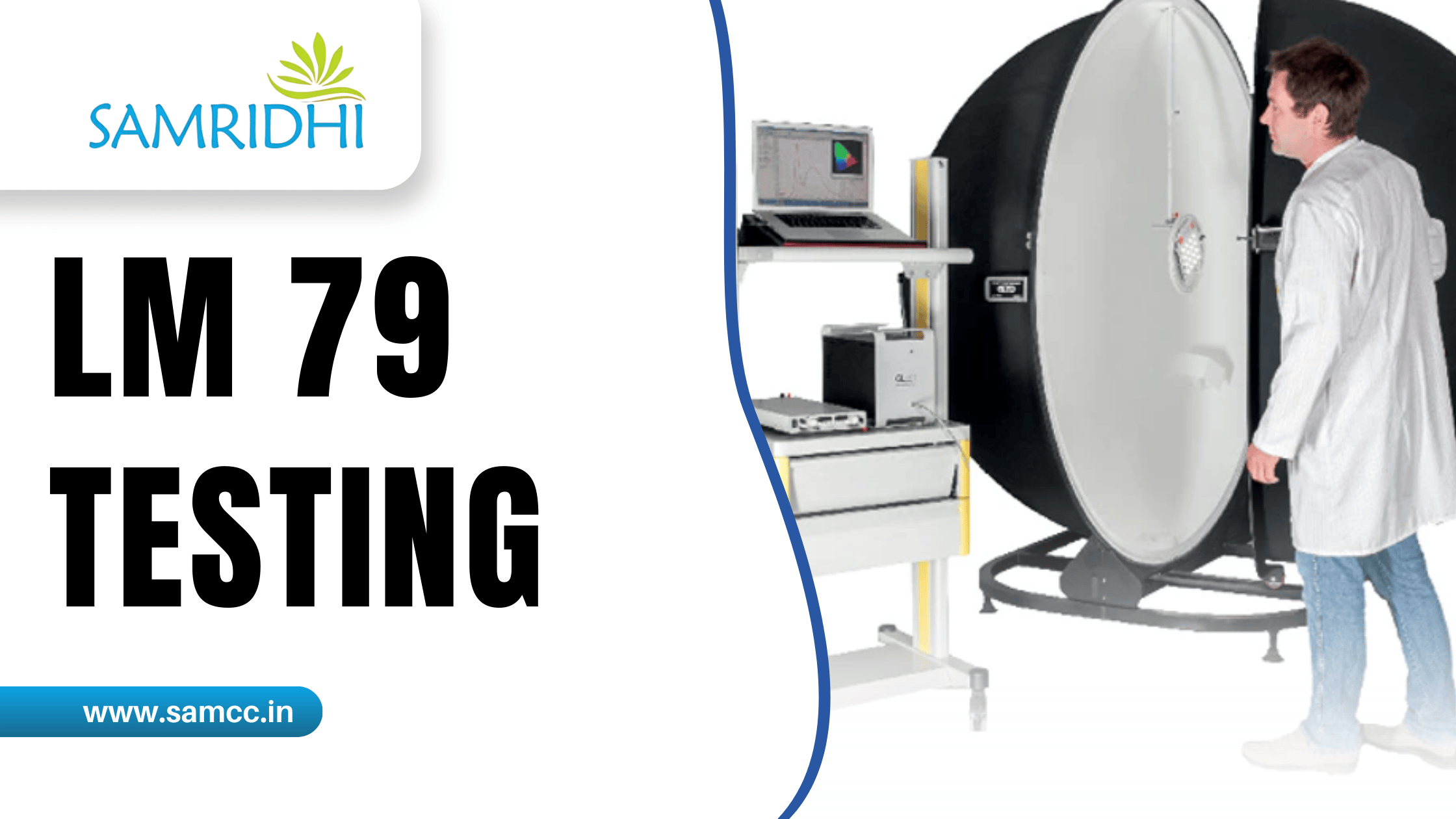
Many organizations pursuing ISO implementation also review NABL Testing, LM79 Testing, and Lab Setup and Equipment services where product quality validation and technical testing support broader operational and quality management objectives. These services often complement structured quality improvement initiatives.
Get Certified with Confidence – Your One-Stop Compliance Partner
From BIS, WPC, TEC, BEE, EPR, LMPC, CDSCO, FSSAI, ISO, MSME to PESO, NABL testing, Startup India, Make in India, and Lab Setup, we handle all your regulatory approvals, certifications, and documentation needs with precision and speed. Partner with Samridhi Compliance Certification and simplify your journey to full compliance—so you can focus on growing your business.
ISO Consultant Bangalore for Importers in Bangalore
Importers operating in Bangalore often focus on sourcing products, managing suppliers, handling logistics, and expanding distribution networks across India. However, as businesses grow, many discover that customers, procurement teams, distributors, government buyers, and international partners increasingly expect structured management systems and recognized quality standards.
This is where ISO certification often becomes relevant.
Whether an organization imports electronics, industrial equipment, consumer products, medical devices, technology products, or engineering components, ISO standards can help establish consistent business processes, improve documentation practices, and strengthen operational controls.
As a result, many businesses seek support from an ISO Consultant Bangalore to better align their operations with internationally recognized management system requirements.
Why Importers Pursue ISO Certification
Unlike product certifications that apply directly to imported goods, ISO certification focuses on the management systems used by the organization itself.
Importers often pursue certification to:
- Improve operational efficiency
- Strengthen supplier management
- Meet customer expectations
- Support tender participation
- Enhance documentation controls
- Improve business credibility
Many organizations initially explore certification after receiving requests from:
- Enterprise customers
- Government procurement teams
- Large distributors
- International business partners
In some cases, certification becomes a competitive advantage rather than a mandatory requirement.
Bangalore's Import Ecosystem Creates Unique Requirements
Bangalore supports a large network of businesses importing:
- Electronics
- Telecom equipment
- Industrial machinery
- Consumer products
- Medical equipment
- Technology hardware
- Engineering components
These businesses frequently coordinate with suppliers located in:
- China
- Taiwan
- South Korea
- Germany
- United States
- Southeast Asia
Managing multiple suppliers across different countries often creates challenges relating to:
- Documentation
- Product consistency
- Process control
- Communication
- Risk management
Many importers find that structured management systems help improve coordination across complex supply chains.
ISO 9001 Is Popular Among Importers
One of the most common certifications pursued by importers is ISO 9001.
Organizations seeking ISO 9001 Consultant Bangalore support often want to strengthen:
- Quality management processes
- Supplier evaluation systems
- Customer satisfaction practices
- Operational consistency
- Process monitoring
A distributor importing electronic products may have reliable suppliers but struggle with inconsistent internal processes.
ISO 9001 helps organizations establish frameworks for managing and improving those processes over time.
Information Security Is Increasingly Important
Many importers now manage:
- Online ordering systems
- Customer databases
- Supplier information
- Procurement platforms
- Business-critical digital records
As digital operations expand, information security becomes more important.
Importers handling sensitive customer information or commercial data often explore iso 27001 certification in bangalore to strengthen:
- Information security controls
- Risk management practices
- Data protection processes
This is particularly common among technology-focused importers and businesses serving enterprise customers.
Documentation Challenges Faced by Importers
One of the biggest operational challenges for importers is documentation management.
Businesses often maintain:
- Import records
- Supplier agreements
- Product information
- Quality records
- Customer documentation
However, these records are frequently stored across different systems and departments.
Common issues include:
| Documentation Challenge |
Operational Impact |
| Inconsistent records |
Process inefficiencies |
| Supplier documentation gaps |
Communication issues |
| Unclear responsibilities |
Operational delays |
| Poor document control |
Compliance risks |
| Version management issues |
Process confusion |
ISO management systems often help organizations create more structured document control processes.
Supplier Management Becomes More Important as Businesses Grow
A growing importer may work with:
- Multiple manufacturers
- Contract suppliers
- Logistics providers
- Warehousing partners
- Distribution networks
As the supplier base expands, maintaining consistency becomes more difficult.
One electronics importer found that product quality issues were often linked to communication gaps rather than manufacturing problems.
After implementing structured supplier evaluation and monitoring processes, the business gained better visibility into operational risks.
This type of improvement is often one of the practical outcomes organizations seek from certification initiatives.
Importers Serving Government & Enterprise Clients
Many Bangalore importers supply products to:
- Government agencies
- Public-sector organizations
- Large corporations
- Infrastructure projects
- Institutional buyers
These customers frequently evaluate:
- Quality systems
- Documentation practices
- Information security controls
- Operational reliability
In some procurement environments, ISO certification can help demonstrate that an organization has established management systems for maintaining consistency and accountability.
Startups Importing Products Face Similar Challenges
Bangalore's startup ecosystem includes many businesses importing products under private labels or proprietary brands.
Examples include:
- Consumer electronics startups
- Smart-device brands
- E-commerce companies
- Technology distributors
Many founders initially focus on:
- Product sourcing
- Market expansion
- Customer acquisition
As operations scale, process management becomes increasingly important.
Certification frameworks can help businesses establish structured systems before operational complexity becomes difficult to manage.
Risk Management Becomes Easier With Structured Systems
Importers frequently face risks such as:
- Supplier disruptions
- Product inconsistencies
- Documentation errors
- Customer complaints
- Information security concerns
Management systems do not eliminate these risks.
However, they help organizations identify, monitor, and respond to them more effectively.
This is particularly valuable for businesses operating across international supply chains where visibility is often limited.
Operational Reality Importers Eventually Discover
Most importers initially pursue certification because of customer expectations or tender requirements.
Over time, many realize the greatest benefits often come from operational improvements rather than the certificate itself.
Better documentation.
Improved supplier management.
Clearer responsibilities.
Stronger process control.
More consistent service delivery.
These outcomes become increasingly valuable as businesses grow and manage larger supplier networks.
This is why many organizations engage an ISO Consultant Bangalore when evaluating certification opportunities. The goal is not simply obtaining certification, but building management systems that support long-term operational stability, customer confidence, and business growth. Because every importer operates differently, implementation requirements, certification scope, and timelines remain dependent on business activities, organizational complexity, and the specific ISO standard being pursued.
Importers managing product quality, supplier performance, and regulatory compliance often evaluate BIS CRS Registration, BIS ISI Foreign Manufacturers, and BIS Consultant Bangalore services alongside ISO certification. A coordinated approach can help businesses align management systems with product compliance requirements.
Testing & Documentation Support for ISO Consultant Bangalore
Unlike product certifications such as BIS, TEC, or WPC, ISO certification is generally not centered around laboratory product testing. Instead, ISO certification focuses on evaluating how effectively an organization manages its processes, controls risks, maintains documentation, and operates its management systems.
For most businesses, documentation becomes one of the most important aspects of the ISO certification journey.
In fact, many certification delays occur not because organizations lack technical expertise or operational capability, but because business processes have not been documented in a structured and auditable manner.
This is one reason companies frequently engage an ISO Consultant Bangalore before beginning certification activities.
Why Documentation Is Critical for ISO Certification
Every ISO standard requires organizations to establish documented systems that demonstrate how business activities are planned, controlled, monitored, and improved.
Depending on the applicable standard, documentation may cover:
- Policies
- Procedures
- Risk management processes
- Operational controls
- Internal audit records
- Management review records
- Employee responsibilities
- Performance monitoring activities
The exact documentation requirements depend on the certification scope and standard being implemented.
A company pursuing ISO 9001 will focus on quality management processes, while an organization implementing ISO 27001 will emphasize information security controls and risk management practices.
Documentation Reflects How the Business Operates
One common misconception is that ISO documentation should be created solely for certification purposes.
In practice, certification bodies generally expect documentation to reflect actual business operations.
This means organizations often need to document:
- Existing workflows
- Approval processes
- Operational responsibilities
- Process controls
- Monitoring activities
An experienced ISO Certification Consultant Bangalore typically helps businesses align documentation with current operations rather than introducing unnecessary complexity.
The goal is to create systems that employees can realistically follow and maintain.
Quality Management Documentation for ISO 9001
Organizations pursuing iso 9001 certification in bangalore often need to document processes related to:
- Customer requirements
- Quality objectives
- Process monitoring
- Supplier management
- Corrective actions
- Performance evaluation
Many manufacturing and service businesses already perform these activities informally.
However, certification requires organizations to demonstrate that processes are:
- Defined
- Controlled
- Measured
- Continuously improved
The documentation serves as evidence that these systems exist and are functioning effectively.
Information Security Documentation for ISO 27001
Bangalore's technology ecosystem has created strong demand for ISO 27001 Consultant Bangalore support.
Software companies, SaaS businesses, cloud service providers, and IT organizations often need structured documentation relating to:
- Information security policies
- Risk assessments
- Access control procedures
- Incident management processes
- Asset management controls
- Security responsibilities
Many businesses already maintain strong security practices.
The challenge is often documenting those practices in a format that aligns with ISO 27001 requirements.
One software company discovered that its security controls were already mature, but formal risk assessment and documentation processes required additional work before certification readiness could be achieved.
Internal Audit Documentation Plays a Major Role
Most ISO standards require organizations to conduct internal audits before certification assessments.
Internal audit records typically help demonstrate:
- Process compliance
- System effectiveness
- Improvement opportunities
- Corrective actions
Many businesses underestimate the importance of audit documentation.
Certification bodies often review internal audit activities to understand how organizations evaluate and improve their own systems.
Well-maintained audit records generally contribute to smoother certification assessments.
Management Review Records Are Essential
ISO standards place significant emphasis on leadership involvement.
As a result, organizations often need documentation relating to:
- Management reviews
- Strategic objectives
- Performance evaluations
- Risk assessments
- Improvement initiatives
These records help demonstrate that management systems are actively monitored and supported by organizational leadership.
A certification body may evaluate not only whether reviews occur, but also whether meaningful decisions result from those reviews.
Employee Awareness & Training Records
Many businesses focus heavily on policies and procedures while overlooking employee awareness.
Certification auditors often seek evidence that employees understand:
- Their responsibilities
- Relevant procedures
- Organizational objectives
- Compliance expectations
For this reason, businesses frequently maintain records relating to:
- Training sessions
- Awareness programs
- Competency evaluations
- Employee communications
The objective is not simply maintaining records but demonstrating that management systems are effectively implemented throughout the organization.
Businesses Often Face Documentation Challenges
Organizations pursuing ISO Certification Bangalore frequently encounter practical challenges such as:
| Documentation Challenge |
Typical Impact |
| Undefined processes |
Implementation difficulties |
| Inconsistent procedures |
Operational confusion |
| Poor document control |
Version management issues |
| Missing records |
Audit preparation challenges |
| Limited employee awareness |
Implementation gaps |
| Incomplete risk assessments |
Certification delays |
These issues are common, especially among fast-growing organizations where operational practices evolve faster than documentation systems.
Startups & Growing Companies Need Structured Documentation
Bangalore's startup ecosystem moves quickly.
Businesses often prioritize:
- Product development
- Customer acquisition
- Market growth
- Investment activities
Documentation systems frequently develop later.
As organizations scale, however, the need for:
- Consistency
- Accountability
- Process control
- Risk management
becomes increasingly important.
Many startups pursue certification not because their operations are weak, but because structured documentation helps support sustainable growth.
Operational Reality Businesses Eventually Learn
Most organizations begin the certification journey believing documentation is created for auditors.
Over time, they discover that well-designed documentation benefits the business itself.
It helps:
- Standardize processes
- Clarify responsibilities
- Improve consistency
- Reduce operational confusion
- Support continuous improvement
This is why businesses across Bangalore's technology, manufacturing, healthcare, telecom, and industrial sectors often work with an ISO Compliance Consultant Bangalore when preparing for certification. While ISO standards generally do not require laboratory testing in the same way product certifications do, they place significant emphasis on documentation quality, implementation effectiveness, internal audits, and management system performance. Since every organization operates differently, documentation requirements remain dependent on certification scope, business activities, and the specific ISO standard being implemented.
Organizations focused on documentation accuracy and process validation frequently explore NABL Testing, NABL Testing Delhi, and NABL Testing Mumbai services. Reliable testing records and technical documentation often support quality management systems and continuous improvement programs.
ISO Consultant Bangalore Renewal & Ongoing Compliance Support in Bangalore
Many businesses believe that the ISO certification journey ends once the certificate is issued.
In reality, certification is only one stage in the lifecycle of an effective management system.
The real challenge often begins after certification, when organizations must maintain documented processes, conduct internal audits, monitor objectives, manage corrective actions, and demonstrate ongoing compliance during surveillance and recertification assessments.
This is why many companies continue working with an ISO Consultant Bangalore long after achieving certification.
The objective shifts from implementation to maintaining a management system that continues to support business operations as the organization grows and evolves.
ISO Certification Requires Continuous Maintenance
ISO standards are built around the principle of continual improvement.
Organizations are generally expected to:
- Maintain documented systems
- Review performance regularly
- Monitor business objectives
- Conduct internal audits
- Address identified issues
- Improve operational effectiveness
Certification bodies typically evaluate whether the management system remains active and effective over time.
As a result, businesses often need ongoing compliance support rather than treating certification as a one-time project.
Surveillance Audits Are Part of the Certification Lifecycle
After certification, organizations generally undergo periodic surveillance audits.
These audits help assess whether:
- Processes continue to operate effectively
- Documentation remains current
- Risks are being managed
- Objectives are being monitored
- Improvements are being implemented
Many businesses focus heavily on preparing for the initial certification audit but underestimate the importance of maintaining readiness afterward.
A well-maintained management system often makes surveillance activities significantly smoother.
Documentation Requires Ongoing Updates
Businesses rarely remain static.
Organizations frequently:
- Introduce new services
- Launch new products
- Expand locations
- Add employees
- Change operational processes
- Adopt new technologies
As these changes occur, documentation often requires revision.
One Bangalore-based software company obtained certification and later expanded into new service areas. While the certification remained valid, the management system documentation required updates to reflect changing business activities.
Situations like this are common across growing organizations.
Internal Audits Remain Important After Certification
Many businesses assume internal audits become less important after certification is achieved.
In reality, internal audits continue to play a critical role in:
- Identifying process gaps
- Monitoring compliance
- Evaluating effectiveness
- Supporting continual improvement
Organizations that conduct regular internal reviews often identify potential issues before they become larger operational challenges.
Internal audits are not designed to find fault.
Their purpose is to help businesses maintain and strengthen management systems over time.
Management Reviews Support Long-Term Effectiveness
ISO standards emphasize leadership involvement throughout the certification lifecycle.
Management reviews often focus on:
- Performance results
- Business objectives
- Risk assessments
- Resource requirements
- Improvement opportunities
As businesses grow, priorities change.
Regular management reviews help ensure that the management system evolves alongside the organization rather than becoming outdated.
This is particularly important for fast-growing startups and technology companies in Bangalore.
Ongoing Support for ISO 9001 Organizations
Businesses maintaining iso 9001 certification in bangalore often focus on:
- Quality objectives
- Customer satisfaction
- Supplier performance
- Process monitoring
- Corrective action management
As operations expand, maintaining consistency across departments becomes increasingly important.
Organizations frequently review quality management systems to ensure they continue supporting operational goals and customer expectations.
Ongoing Support for ISO 27001 Organizations
Information security management requires continuous attention.
Companies maintaining iso 27001 certification in bangalore often need to monitor:
- Security risks
- Information assets
- Access controls
- Incident management processes
- Security awareness programs
Technology companies, SaaS businesses, fintech firms, and IT service providers often experience frequent changes in infrastructure, personnel, and business operations.
As a result, information security systems must be reviewed and updated regularly.
An ISO 27001 Consultant Bangalore often assists organizations in maintaining alignment between evolving business operations and information security requirements.
Business Growth Can Affect Certification Scope
As organizations expand, certification scopes may require review.
Examples include:
- Opening additional locations
- Introducing new services
- Expanding product lines
- Entering new markets
- Acquiring new business units
One manufacturer initially certified a single production facility and later expanded operations across multiple locations.
The management system needed adjustments to reflect the broader operational scope.
Growth often creates new compliance considerations that did not exist during the initial certification phase.
Employee Turnover Creates Ongoing Training Needs
Businesses frequently experience changes in:
- Personnel
- Management teams
- Operational responsibilities
New employees may require training relating to:
- Policies
- Procedures
- Quality objectives
- Information security requirements
- Compliance responsibilities
Organizations that maintain strong awareness programs generally find it easier to sustain management system effectiveness over time.
Common Challenges During Ongoing Compliance
Businesses maintaining certification frequently encounter challenges such as:
| Ongoing Compliance Challenge |
Typical Impact |
| Outdated documentation |
Audit observations |
| Weak internal audit programs |
Reduced system visibility |
| Inconsistent implementation |
Process inefficiencies |
| Employee awareness gaps |
Operational risks |
| Unmanaged business changes |
Compliance concerns |
| Limited management involvement |
System effectiveness issues |
These challenges are common and often emerge gradually as organizations focus on day-to-day operations.
Operational Reality Businesses Eventually Discover
Most organizations initially pursue certification to satisfy customer requirements, tender conditions, or business objectives.
Over time, they realize that the real value comes from maintaining and improving the management system.
Better operational control.
Stronger accountability.
Improved risk management.
More consistent performance.
Enhanced customer confidence.
These benefits are sustained through ongoing compliance activities rather than the certificate itself.
This is why many businesses continue working with an ISO Compliance Consultant Bangalore after certification is achieved. Ongoing support helps organizations maintain management systems, prepare for surveillance activities, manage operational changes, and pursue continual improvement as the business evolves. Since every organization operates differently, ongoing compliance requirements remain dependent on business size, certification scope, operational complexity, and the specific ISO standard being maintained.
Businesses maintaining certified management systems often benefit from ongoing support through ISO Consultant Mumbai, ISO Consultant Delhi, and ISO Certification services. Regular reviews, audits, and documentation updates help organizations maintain effective management systems as operations evolve.
Documents Required for ISO Consultant Bangalore
One of the most common questions businesses ask before starting the certification process is:
"What documents are required for ISO certification?"
The answer depends on several factors, including the ISO standard being pursued, the certification scope, the size of the organization, and the complexity of its operations.
A software company pursuing ISO 27001 will typically require different documentation than a manufacturer implementing ISO 9001 or a business seeking ISO 14001 certification.
However, regardless of the standard, documentation remains one of the most important elements of the certification process.
Many organizations already have the information needed for certification.
The challenge is often organizing that information into a structured management system that aligns with ISO requirements.
This is one reason businesses frequently engage an ISO Consultant Bangalore before beginning implementation activities.
Why Documentation Matters in ISO Certification
ISO standards are designed to ensure that organizations operate through defined and controlled processes.
Certification bodies generally expect businesses to demonstrate:
- How activities are performed
- Who is responsible for them
- How risks are managed
- How performance is monitored
- How improvements are implemented
Documentation serves as evidence that these systems exist and are functioning effectively.
Without proper documentation, even well-managed businesses may struggle to demonstrate compliance during certification assessments.
Basic Company Documents Required
Most certification projects begin with business verification and organizational information.
Organizations are often required to provide documentation relating to:
- Company registration
- Business address
- GST registration
- PAN information
- Organizational structure
- Scope of business activities
These records help define the certification scope and establish the legal identity of the organization.
Whether the business is a startup, manufacturer, importer, software company, or service provider, organizational information forms the foundation of the certification process.
Scope Definition Documents
One of the most important steps in ISO certification is defining what will be covered under the management system.
Organizations typically prepare information relating to:
- Products
- Services
- Locations
- Departments
- Operational activities
The certification scope influences:
| Scope Element |
Importance |
| Products |
Defines operational coverage |
| Services |
Establishes certification boundaries |
| Locations |
Determines audit requirements |
| Departments |
Identifies applicable functions |
| Business activities |
Supports certification planning |
A clearly defined scope helps ensure the management system remains practical and relevant to the organization.
Quality Management Documents for ISO 9001
Businesses pursuing iso 9001 certification in bangalore often require documentation relating to:
- Quality policies
- Process workflows
- Customer requirements
- Supplier management
- Corrective action procedures
- Performance monitoring activities
Many organizations already perform these activities operationally.
Certification typically requires those activities to be documented, monitored, and reviewed systematically.
The objective is not creating paperwork for auditors but establishing consistency across business operations.
Information Security Documents for ISO 27001
Technology companies and SaaS businesses seeking iso 27001 certification in bangalore generally need more extensive information security documentation.
Common examples include:
- Information security policies
- Risk assessment records
- Asset inventories
- Access control procedures
- Incident management processes
- Business continuity plans
A growing software company may already have strong security practices in place but lack formal documentation demonstrating how those controls are managed.
This is often where an ISO 27001 Consultant Bangalore provides significant value.
Policies & Procedures
Most ISO standards require organizations to establish documented policies and procedures.
These documents help explain:
- Organizational objectives
- Employee responsibilities
- Process controls
- Operational requirements
- Compliance expectations
The exact number and complexity of documents depend on:
- Business size
- Certification scope
- Industry sector
- Operational risks
A startup may require a simpler documentation structure than a multi-location manufacturing company.
Risk Management Documentation
Risk management has become a central element of modern ISO standards.
Organizations are typically expected to identify:
- Business risks
- Operational risks
- Information security risks
- Compliance risks
- Process-related risks
Documentation often includes:
- Risk assessments
- Risk treatment plans
- Monitoring activities
- Review mechanisms
The depth of these assessments depends on the applicable standard and business environment.
Employee & Organizational Records
Certification bodies often evaluate how effectively employees understand and implement management system requirements.
Organizations may need records relating to:
- Training activities
- Employee competency
- Awareness programs
- Roles and responsibilities
- Organizational charts
These records help demonstrate that management systems are supported throughout the organization rather than existing only at the documentation level.
Internal Audit & Management Review Records
Most ISO certifications require evidence that the organization actively evaluates and improves its management system.
Common records include:
- Internal audit reports
- Audit findings
- Corrective actions
- Management review meeting records
- Improvement plans
Many organizations underestimate the importance of these records.
In practice, they often play a major role during certification and surveillance audits.
Common Documentation Challenges Businesses Face
Organizations pursuing ISO Certification Bangalore frequently encounter issues such as:
- Undefined processes
- Inconsistent documentation
- Missing records
- Outdated procedures
- Weak document control systems
- Limited evidence of implementation
These challenges are particularly common among fast-growing organizations where operational activities evolve faster than formal documentation systems.
Documentation Requirements Vary by Industry
Different industries often require different supporting records.
For example:
- IT companies focus heavily on information security and access controls.
- Manufacturers emphasize quality management and process monitoring.
- Healthcare organizations often require stronger documentation around service delivery and risk management.
- Service businesses frequently focus on customer satisfaction and operational consistency.
This is why certification documentation should always reflect actual business operations rather than generic templates.
Operational Reality Businesses Eventually Discover
Most organizations initially view ISO documentation as a certification requirement.
Over time, many realize it also becomes a valuable business management tool.
Clear documentation helps:
- Standardize processes
- Reduce confusion
- Improve accountability
- Support employee training
- Strengthen operational consistency
The businesses that benefit most from ISO certification are often those that treat documentation as part of everyday operations rather than an audit exercise.
This is why many organizations work with an ISO Compliance Consultant Bangalore when preparing certification systems. Proper documentation not only supports certification assessments but also helps businesses create structured, repeatable, and scalable management processes. Since every organization has different objectives, risks, and operational structures, documentation requirements remain dependent on certification scope, business complexity, and the specific ISO standard being implemented.
Many organizations strengthen certification readiness by maintaining structured business records through MSME Registration, Trademark Registration, and Startup India Certification. Well-organized business documentation often supports smoother management system implementation and audit preparation.
Common Compliance Challenges Businesses Face in Bangalore
Many organizations begin their ISO certification journey expecting the biggest challenge to be the certification audit itself.
In reality, most businesses in Bangalore discover that the real difficulties emerge much earlier during implementation, documentation alignment, employee involvement, process standardization, and ongoing management system maintenance.
Whether the organization is a technology startup, software company, electronics manufacturer, engineering business, importer, healthcare provider, or service company, similar operational challenges often appear throughout the certification process.
The good news is that most of these challenges are manageable when identified early.
The challenge is that many businesses do not recognize them until implementation is already underway.
Documentation Exists, But It Is Not Structured
One of the most common issues businesses face is believing they have all the required documentation.
In many cases, the information does exist.
However, it may be:
- Stored across multiple departments
- Maintained in different formats
- Inconsistently updated
- Missing version controls
- Not linked to actual processes
A growing software company may have security policies, operational procedures, and employee guidelines spread across shared drives, emails, and internal tools.
The information is available.
The management system structure is not.
This is one of the most common reasons organizations seek support from an ISO Consultant Bangalore during implementation.
Fast-Growing Startups Often Lack Process Formalization
Bangalore's startup ecosystem is known for speed and innovation.
Many startups focus heavily on:
- Product development
- Fundraising
- Customer acquisition
- Market expansion
During early growth stages, teams often rely on informal communication and flexible decision-making.
While this approach may work initially, it can create challenges when implementing structured management systems.
One SaaS startup discovered that different departments were following different methods for handling the same operational activity.
The business was functioning successfully.
However, process consistency was difficult to demonstrate during certification preparation.
Employee Awareness Is Frequently Underestimated
Many organizations invest significant effort in preparing documentation but overlook employee engagement.
Certification auditors often evaluate whether employees understand:
- Policies
- Procedures
- Responsibilities
- Objectives
- Management system requirements
A common situation occurs when management teams are highly familiar with the implementation project while operational staff have limited awareness.
This creates a gap between documentation and practical implementation.
Even well-designed systems can face challenges if employees are not actively involved.
Information Security Challenges for Technology Companies
Bangalore's technology sector has created strong demand for ISO 27001 Consultant Bangalore services.
However, many organizations encounter difficulties related to:
- Asset management
- Access controls
- Risk assessments
- Vendor management
- Information classification
One technology company discovered that while security controls were technically strong, asset ownership responsibilities had never been formally documented.
The issue was not security.
The issue was governance.
These types of gaps are common during ISO 27001 implementation projects.
Quality Management Challenges in Manufacturing
Manufacturers pursuing iso 9001 certification in bangalore often face a different set of challenges.
Common issues include:
- Inconsistent work instructions
- Supplier performance monitoring gaps
- Production record inconsistencies
- Corrective action tracking weaknesses
- Quality objective measurement difficulties
Many manufacturing businesses already maintain quality-focused operations.
The challenge is often demonstrating consistency through documented evidence and measurable performance indicators.
Importers Frequently Face Supplier Documentation Issues
Importers working with international suppliers often encounter difficulties obtaining consistent information.
Common examples include:
| Importer Challenge |
Typical Impact |
| Incomplete supplier records |
Documentation gaps |
| Unclear process ownership |
Implementation delays |
| Inconsistent product information |
Operational confusion |
| Weak supplier evaluations |
Risk management concerns |
| Limited process visibility |
Audit preparation issues |
Many importers discover that supplier management becomes one of the most important aspects of certification readiness.
This is particularly true when products are sourced from multiple countries and suppliers.
Process Ownership Is Often Unclear
One of the most overlooked implementation challenges involves responsibility allocation.
Businesses frequently have processes that work effectively but lack clearly assigned ownership.
Questions such as:
- Who reviews performance?
- Who updates procedures?
- Who manages risks?
- Who tracks corrective actions?
are not always clearly answered.
Certification projects often reveal these gaps because management systems require defined accountability.
Internal Audits Are Often Delayed
Many organizations postpone internal audits until shortly before certification assessments.
This can create unnecessary pressure.
Internal audits are intended to:
- Identify weaknesses
- Evaluate implementation
- Support improvements
- Prepare the organization for certification
When audits are delayed, businesses have less time to address issues before external assessments occur.
Organizations that conduct audits early typically gain better visibility into potential improvement areas.
Business Growth Creates New Compliance Challenges
Bangalore companies often experience rapid expansion.
Growth can include:
- New employees
- Additional offices
- Expanded services
- New technologies
- Additional product lines
While growth is positive, it can also affect management systems.
One IT company obtained certification and then doubled its workforce within eighteen months.
Processes that worked effectively for a smaller team required revision to support a larger organization.
Management systems must evolve alongside the business.
Maintaining Certification After Initial Success
Another challenge many organizations face is sustaining momentum after certification.
Teams often focus heavily on achieving certification and then gradually reduce attention to:
- Internal audits
- Management reviews
- Process monitoring
- Documentation updates
- Employee awareness
Over time, management systems can become outdated if they are not actively maintained.
This is one reason ongoing support from an ISO Compliance Consultant Bangalore remains valuable after certification is achieved.
Operational Reality Businesses Eventually Discover
Most organizations begin certification projects expecting technical requirements to be the primary challenge.
What they often discover instead is that the biggest obstacles involve people, processes, documentation, and consistency.
Undefined responsibilities.
Incomplete records.
Weak communication.
Limited employee awareness.
Unmanaged business changes.
These issues are far more common than audit failures.
The organizations that experience the smoothest certification journeys are rarely those with the most documentation. They are usually the businesses that integrate management systems into everyday operations. This is why many companies across Bangalore's technology, manufacturing, healthcare, telecom, startup, and industrial sectors work with an ISO Consultant Bangalore to identify challenges early, strengthen operational controls, and build management systems that remain effective long after certification is achieved.
Organizations facing documentation gaps, process inconsistencies, or regulatory coordination challenges often review BIS Consultant Bangalore, EPR Consultant Bangalore, and Make in India Certification services. These complementary compliance initiatives can help businesses develop stronger governance and operational controls.
Industries We Support in Bangalore
Bangalore has developed into one of India's most diverse business centers. While the city is globally known for software development and technology innovation, it also supports a strong ecosystem of electronics manufacturers, engineering companies, telecom businesses, industrial suppliers, healthcare organizations, startups, exporters, and product-driven enterprises.
As customer expectations, procurement standards, and operational requirements continue evolving, businesses across these industries are increasingly adopting structured management systems through ISO certification.
The specific certification requirements may vary depending on the organization's activities, risks, customer expectations, and business objectives. However, the need for stronger process control, documentation management, risk management, and continual improvement remains common across most sectors.
This is why organizations from a wide range of industries seek support from an ISO Consultant Bangalore when planning certification initiatives.
IT Companies & Software Development Firms
Bangalore remains India's largest technology hub and is home to thousands of:
- Software companies
- SaaS businesses
- IT service providers
- Cloud solution providers
- Technology consulting firms
- Enterprise software companies
Many of these organizations manage sensitive customer information, intellectual property, and business-critical systems.
As a result, certifications such as:
have become increasingly relevant.
Many technology companies pursue ISO 27001 Consultant Bangalore support to strengthen information security management systems while improving customer confidence and operational governance.
SaaS Startups & Technology Startups
Bangalore's startup ecosystem continues to attract entrepreneurs developing:
- SaaS platforms
- Artificial intelligence solutions
- Fintech applications
- Health technology products
- Cloud-based services
- Enterprise software solutions
Startups often experience rapid growth, which creates increasing demands for:
- Process consistency
- Information security
- Documentation controls
- Risk management
One SaaS company initially operated with a small team and informal processes. As enterprise customers began evaluating vendor capabilities, the organization realized that structured management systems were becoming an important part of business development conversations.
This is a common situation across Bangalore's startup ecosystem.
Electronics Manufacturers & Hardware Companies
Bangalore has become a major center for:
- Electronics manufacturing
- Consumer electronics
- Embedded systems
- Hardware development
- Electronic component production
- Smart device manufacturing
These businesses often require stronger controls around:
- Product quality
- Supplier management
- Process monitoring
- Production consistency
As organizations scale operations, many seek ISO Consultant for Manufacturers Bangalore support to implement quality management systems that help improve operational reliability and customer satisfaction.
IoT Companies & Smart Device Manufacturers
The city's growing IoT ecosystem includes businesses developing:
- Smart-home products
- Industrial IoT solutions
- Connected devices
- Automation technologies
- Sensor-based products
These organizations frequently operate within complex development and manufacturing environments where documentation, risk management, and process consistency become increasingly important.
As products become more sophisticated and customer expectations increase, many IoT businesses adopt structured management systems to support long-term growth.
Telecom & Communication Technology Companies
Bangalore hosts numerous businesses involved in:
- Telecom infrastructure
- Communication technologies
- Networking equipment
- Wireless solutions
- Telecom software
These organizations often manage highly technical operations involving multiple stakeholders and project dependencies.
Management systems can help improve:
- Documentation control
- Operational coordination
- Risk management
- Service consistency
As a result, ISO certification frequently becomes part of broader operational improvement initiatives within the telecom sector.
Engineering & Industrial Manufacturing Companies
The city's industrial ecosystem includes:
- Engineering firms
- Industrial equipment manufacturers
- Precision component suppliers
- Automation companies
- Machinery manufacturers
Many of these businesses operate within highly competitive markets where process efficiency and product consistency directly influence customer satisfaction.
Organizations pursuing iso 9001 certification in bangalore often focus on:
- Quality management
- Process standardization
- Supplier performance
- Operational efficiency
Structured management systems help businesses create repeatable processes while supporting continual improvement efforts.
Importers & Product Distribution Businesses
Bangalore supports a large importer and distribution network dealing with:
- Electronics
- Technology products
- Industrial equipment
- Consumer goods
- Medical devices
Many importers seek certification to:
- Strengthen supplier management
- Improve documentation controls
- Enhance operational consistency
- Meet customer expectations
As supply chains become more complex, structured management systems often provide greater visibility and accountability across business operations.
Healthcare Organizations & Medical Businesses
Healthcare providers, diagnostic centers, healthcare technology companies, and medical service organizations increasingly pursue ISO certification as part of quality improvement initiatives.
These organizations often focus on:
- Service consistency
- Risk management
- Process control
- Documentation accuracy
As healthcare environments become more complex, management systems help support structured operational practices and continual improvement.
Educational Institutions & Training Organizations
Bangalore's education sector includes:
- Universities
- Colleges
- Technical institutes
- Professional training organizations
- Skill development centers
Many educational institutions pursue management system certifications to improve:
- Operational processes
- Service delivery
- Student experience
- Documentation management
Structured systems can help organizations establish consistency across academic and administrative functions.
Export-Oriented Businesses
Many Bangalore companies serve international markets through:
- Manufacturing exports
- Technology exports
- Global service delivery
- International supply chains
Foreign customers often evaluate:
- Quality management systems
- Information security controls
- Operational reliability
- Process consistency
Certification can help organizations demonstrate structured business practices while supporting customer confidence in international markets.
Service Industry Organizations
Service-sector businesses represent a significant portion of Bangalore's economy.
This includes:
- Consulting firms
- Professional service providers
- Business process outsourcing companies
- Digital service organizations
- Marketing agencies
Although these businesses may not manufacture products, they often benefit from management systems that improve:
- Service quality
- Customer satisfaction
- Process consistency
- Performance monitoring
Many service providers discover that certification helps strengthen internal operations while supporting long-term business growth.
Operational Reality Across Industries
While each industry has unique objectives and operational challenges, many organizations face similar business requirements.
They need:
- Better process control
- Stronger documentation systems
- Improved risk management
- Consistent service delivery
- Greater operational visibility
Whether the organization is a technology startup, electronics manufacturer, telecom company, importer, healthcare provider, engineering firm, educational institution, or exporter, structured management systems can help support these goals.
This is why businesses across Bangalore's diverse commercial ecosystem continue working with an ISO Consultant Bangalore. The certification standard may differ from one industry to another, but the underlying objective remains similar: creating systems that improve operational effectiveness, support customer confidence, and enable sustainable business growth. Since every organization has unique processes, risks, and business objectives, implementation approaches remain dependent on industry, certification scope, and organizational complexity.
Manufacturers, electronics companies, telecom businesses, and technology firms frequently require support across multiple compliance areas, including BIS CRS Registration, TEC MTCTE Approval, and WPC ETA Approval. These certifications often work alongside ISO management systems to support product compliance and operational excellence.
Why Professional ISO Consultant Bangalore Support Helps Businesses in Bangalore
Many businesses begin their ISO certification journey believing that certification is primarily about completing documentation and passing an audit.
However, organizations often discover that successful certification depends on much more than preparing policies and procedures. It involves understanding business processes, identifying operational gaps, aligning employees with management system requirements, conducting internal audits, managing risks, and maintaining compliance over time.
For many companies, these activities are not part of daily operations.
This is why businesses across Bangalore's technology, manufacturing, healthcare, telecom, startup, and industrial sectors often seek support from an ISO Consultant Bangalore.
The objective is not simply obtaining a certificate. The goal is to develop a management system that aligns with business operations and remains practical to maintain as the organization grows.
Helping Businesses Understand Certification Requirements
One of the biggest challenges organizations face is understanding what certification actually requires.
Many businesses initially assume:
- Certification is only documentation-driven.
- Certification can be achieved through templates alone.
- All ISO standards follow the same implementation process.
- Existing business practices automatically meet standard requirements.
In reality, every organization has unique operational structures, risks, objectives, and compliance needs.
Professional guidance often helps businesses understand:
- Applicable ISO standards
- Certification scope
- Implementation requirements
- Documentation expectations
- Audit readiness activities
This early clarity frequently prevents unnecessary delays later in the project.
Supporting Gap Analysis & Implementation Planning
Most organizations already have processes in place before they begin certification.
The challenge is determining whether those processes align with the selected ISO standard.
A structured gap assessment can help identify:
- Missing controls
- Documentation gaps
- Process inconsistencies
- Risk management weaknesses
- Training requirements
For example, a software company pursuing ISO 27001 Consultant Bangalore support may already have strong technical security controls but limited documentation around risk assessment and governance.
Identifying such gaps early often makes implementation more efficient.
Reducing Documentation Confusion
Documentation is often one of the most time-consuming parts of certification.
Many businesses struggle with:
- Creating procedures
- Managing document versions
- Defining responsibilities
- Organizing records
- Aligning documentation with actual operations
A common mistake is adopting generic templates that do not reflect how the business actually functions.
Professional support helps organizations develop documentation that remains practical, relevant, and aligned with day-to-day activities.
The objective is not creating more paperwork.
The objective is creating documentation that supports operational consistency.
Supporting Employee Awareness & Adoption
Management systems are only effective when employees understand them.
Many organizations focus heavily on leadership discussions and documentation development while overlooking employee involvement.
Certification auditors frequently evaluate whether employees understand:
- Their responsibilities
- Relevant procedures
- Organizational objectives
- Compliance expectations
Professional implementation support often helps businesses improve awareness across departments, reducing the gap between documented processes and operational reality.
Helping Manufacturers Improve Process Consistency
Manufacturers pursuing ISO Consultant for Manufacturers Bangalore services often seek greater control over:
- Production processes
- Quality management
- Supplier performance
- Corrective actions
- Customer satisfaction
As organizations scale production, maintaining consistency becomes increasingly important.
Professional guidance can help businesses create systems that support monitoring, measurement, and continual improvement without unnecessarily disrupting operations.
Supporting Information Security Management
Bangalore's technology ecosystem has created significant demand for iso 27001 certification in bangalore.
Many software companies, SaaS businesses, fintech firms, and IT service providers operate in environments where information security expectations continue increasing.
Professional support often helps organizations:
-
Get Certified with Confidence – Your One-Stop Compliance Partner
From BIS, WPC, TEC, BEE, EPR, LMPC, CDSCO, FSSAI, ISO, MSME to PESO, NABL testing, Startup India, Make in India, and Lab Setup, we handle all your regulatory approvals, certifications, and documentation needs with precision and speed. Partner with Samridhi Compliance Certification and simplify your journey to full compliance—so you can focus on growing your business.


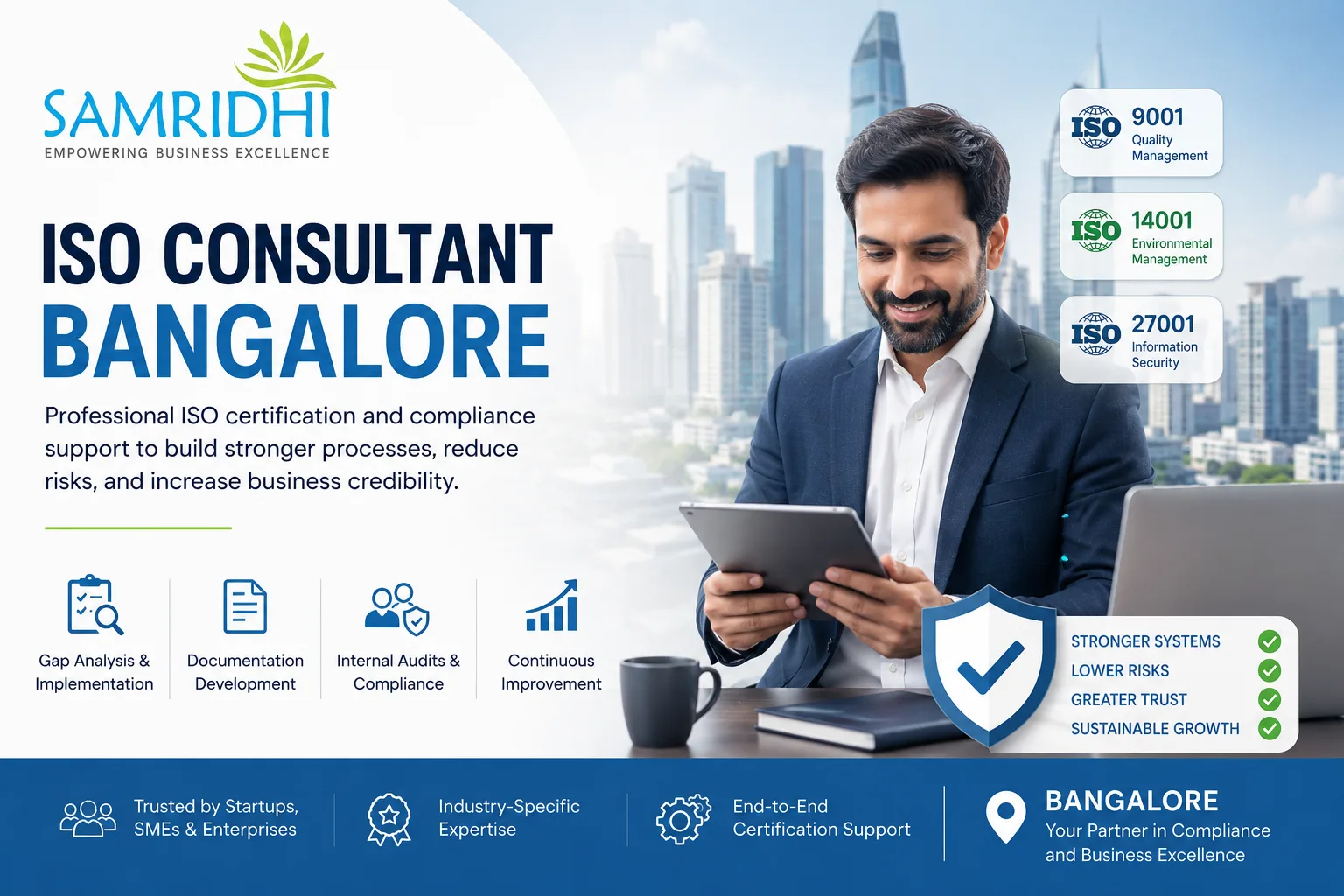
 Grab Your Certified Now
 +91 8799708673
 WhatsApp