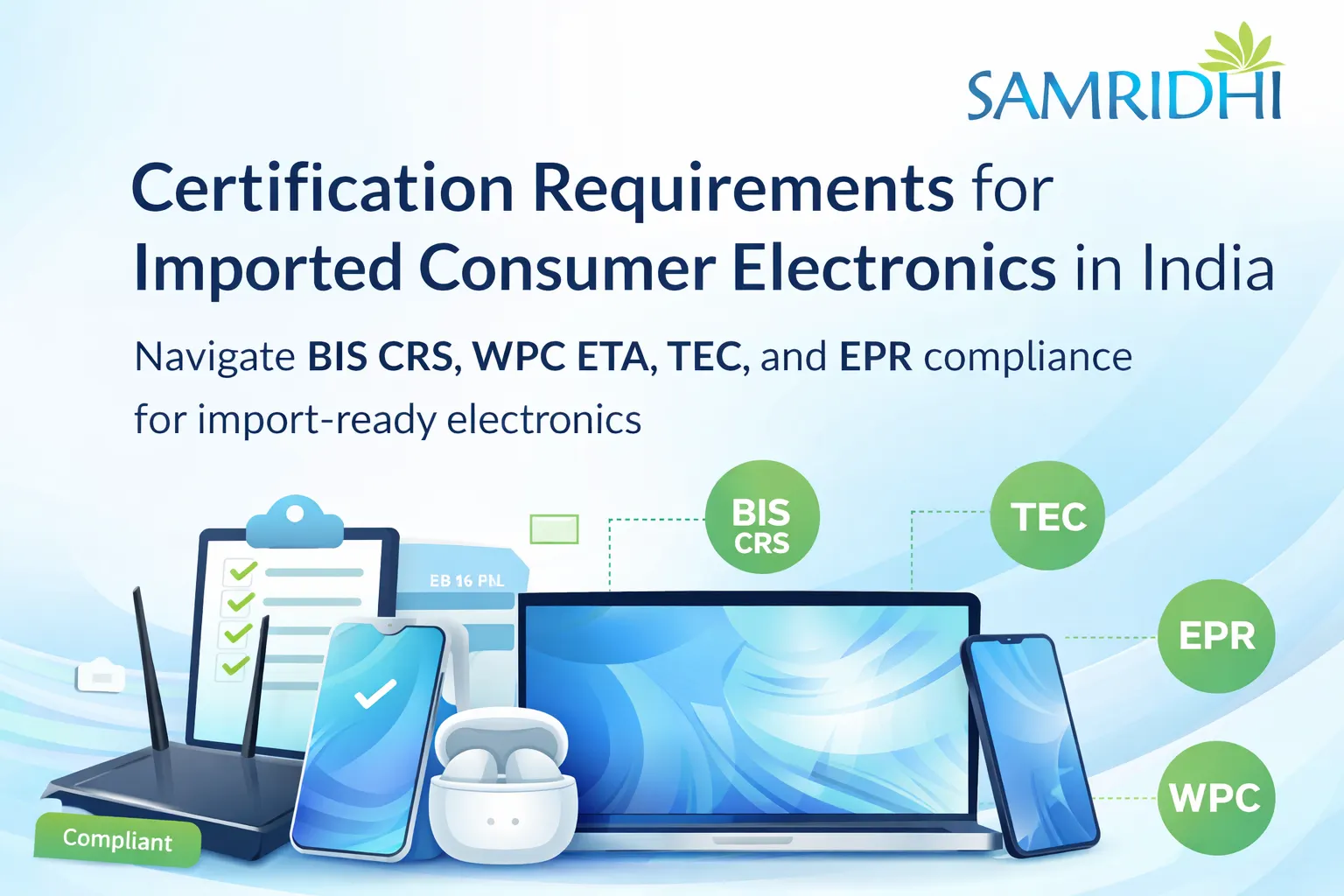
What Certifications Are Required for Imported Consumer Electronics in India
Most importers don’t face problems because they want to avoid compliance.
They face problems because they assume one approval will cover everything.
That’s where certification requirements for imported electronics in India start becoming confusing.
Unlike some countries where a single certification may be enough, India follows a function-based regulatory system. This means approvals are not based only on product category, but on what the device actually does.
Why One Product Can Need Multiple Certifications
A consumer electronic product today is rarely simple.
It may include:
- Power supply and internal circuitry
- Wireless connectivity (WiFi, Bluetooth)
- Network or telecom interaction
- Data processing or storage
Each of these functions introduces a different regulatory concern.
So instead of one authority handling everything, India distributes electronics import compliance India across multiple bodies. This ensures deeper evaluation, but also means multiple certifications may apply to a single product.
Core Certifications You Should Expect
Let’s look at the main approvals that usually come into play.
BIS Certification (CRS) – Safety and Product Compliance
For most electronic products, BIS certification for imported electronics is the first requirement.
Under BIS CRS certification for electronics India, products are tested against Indian Standards to ensure safety and performance.
This typically applies to:
- IT equipment
- Mobile devices
- LED products
- Power supplies and adapters
Without bis crs registration India, importing notified products is not permitted.
But BIS focuses mainly on safety and quality. It does not cover communication or environmental aspects.
WPC ETA Approval – Wireless Functionality
If the product uses any form of wireless communication, WPC ETA approval for imported devices becomes relevant.
This includes devices with:
- WiFi
- Bluetooth
- RF modules
WPC evaluates:
- Frequency bands
- Transmission limits
- Interference risks
Even if BIS is already completed, wireless capability introduces additional compliance requirements for importing electronics in India.
TEC Certification – Telecom Network Compliance
For products that connect directly to telecom infrastructure, TEC certification requirements for telecom devices India may apply.
This is typically relevant for:
- Routers and modems
- Communication devices
- Certain IoT products
TEC ensures that devices do not negatively impact telecom networks.
Not every product needs this, but when applicable, it becomes a critical part of import certification for consumer electronics India.
EPR Registration – Environmental Responsibility
This is where many importers get delayed later.
Under EPR registration for electronic products India, businesses are responsible for managing e-waste generated by their products.
This involves:
- Collection mechanisms
- Recycling systems
- Compliance reporting
EPR is not a product approval, but it is a mandatory part of electronics import compliance India for many categories.
Why Applicability Always Depends on the Product
There is no universal checklist.
Two products that look similar may require different certifications depending on:
- Connectivity features
- Power specifications
- Intended use
- Component design
That’s why electronics testing and certification India is always case-specific.
The Ground Reality
Most issues don’t come from the certification process itself.
They come from assumptions like:
- “BIS is enough”
- “Wireless module is already approved”
- “EPR can be done later”
In practice, these gaps show up during import clearance or market entry.
The Practical Takeaway
The certification requirements for imported electronics in India are layered for a reason.
Each approval:
- Addresses a specific risk
- Is handled by a different authority
- Depends on product functionality
Understanding this early helps avoid delays, rework, and compliance issues later in the process.
BIS CRS Registration is the primary requirement for most imported electronics to ensure compliance with Indian safety standards.
How BIS Certification (CRS) Applies to Imported Consumer Electronics
If you’re importing electronics into India, this is usually the first checkpoint you’ll encounter.
And honestly, most delays start here… not because BIS is complicated, but because it’s often misunderstood.
BIS CRS certification for electronics India is not optional for notified products. It’s a mandatory requirement before those products can be imported, sold, or even listed in the market.
What BIS CRS Actually Covers
Under the Compulsory Registration Scheme (CRS), BIS focuses on one core aspect — product safety and standard compliance.
In simple terms, it answers:
“Is this product safe to use as per Indian Standards?”
This applies to a wide range of consumer electronics, including:
- Mobile phones and tablets
- LED lights and drivers
- Power adapters and chargers
- IT and electronic equipment
- Audio-video devices
If your product falls under notified categories, BIS certification for imported electronics becomes a basic entry requirement.
Why BIS Certification Is Mandatory for Import
This is where many importers get caught off guard.
They assume certification can be completed after the product reaches India. But in most cases, that’s not how it works.
Without bis crs registration India:
- Customs clearance can get restricted
- Import documentation may not be accepted
- Market entry becomes difficult
So, BIS doesn’t just support compliance. It directly impacts your ability to import and distribute products.
How the BIS CRS Process Works for Importers
The process itself is structured, but execution depends on preparation.
Typically, it involves:
- Identifying applicable IS standard for the product
- Product testing in BIS-recognized labs
- Application submission through BIS portal
- Registration under the manufacturer’s name (not the importer)
This last point is important.
For imported products, the license is issued to the foreign manufacturer, not the importer. The importer usually acts as an authorized representative or distributor.
That’s why coordination becomes critical in electronics testing and certification India.
Product Categories and Scope Limitations
Not every electronic product falls under CRS.
BIS periodically notifies specific categories.
So applicability:
- Depends on product type
- Varies by notification updates
- Is subject to BIS guidelines
This is why compliance requirements for importing electronics in India are always case-specific.
A small variation in product design can sometimes change applicability.
Where Importers Usually Face Issues
In real scenarios, most problems don’t come from BIS itself.
They come from:
- Incorrect product classification
- Testing done on a non-final product version
- Documentation mismatch between test reports and application
- Assuming similar products have the same compliance requirement
These gaps often lead to rework or delays.
How BIS Fits Into the Overall Compliance Structure
BIS is just one part of the overall system.
It handles safety and quality.
But if your product has:
- Wireless features → WPC may apply
- Telecom connectivity → TEC may apply
- Environmental impact → EPR may apply
So while BIS CRS certification for electronics India is foundational, it is not the only requirement in electronics import compliance India.
The Practical Takeaway
Think of BIS as the first filter, not the final one.
It ensures your product meets Indian safety standards. But full compliance depends on other factors as well.
For importers, the key is not just getting BIS done, but getting it done correctly and at the right stage.
Because once shipments are planned or dispatched, fixing compliance gaps becomes much more complicated than preparing for them early.
Testing through NABL Testing labs supports accurate BIS CRS Registration and helps avoid delays in certification.
When WPC, TEC, and Other Approvals Are Required for Imported Devices
This is where most importers pause and rethink everything.
They complete BIS and assume compliance is sorted… until someone asks,
“Does your product have WiFi or telecom functionality?”
That one question can change the entire compliance requirement.
Because beyond safety, India also regulates how devices communicate. And that’s where approvals like WPC ETA approval for imported devices and TEC certification requirements for telecom devices India come into the picture.
The Trigger Point: Connectivity
Unlike basic electronics, modern devices are connected.
They may:
- Use WiFi or Bluetooth
- Connect to telecom networks
- Communicate with other devices or servers
And each of these functions introduces a different regulatory concern.
So instead of one approval covering everything, compliance requirements for importing electronics in India expand based on connectivity.
When WPC ETA Approval Becomes Applicable
If your device uses wireless communication, even in a basic way, WPC usually applies.
This includes:
- WiFi-enabled products
- Bluetooth devices
- RF-based remote-controlled electronics
Under WPC ETA approval for imported devices, the focus is on:
- Frequency bands used
- Transmission power
- Interference with other spectrum users
Even if the wireless module is pre-certified, integration into your product may still require evaluation or documentation.
That’s where many importers assume less work than actually required.
When TEC Certification Is Required
Now, if the device goes a step further and connects to telecom networks, TEC may come into scope.
TEC certification requirements for telecom devices India typically apply to:
- Routers and modems
- Communication equipment
- IoT devices with telecom functionality
- Devices interacting with public telecom infrastructure
TEC focuses on ensuring that devices do not disrupt network performance or create compatibility issues.
This is more than just wireless communication. It’s about network-level interaction.
Why These Approvals Are Separate from BIS
This is something many businesses don’t realize early.
BIS ensures product safety.
WPC ensures wireless compliance.
TEC ensures telecom compatibility.
Each authority is solving a different problem.
That’s why even after completing BIS certification for imported electronics, additional approvals may still be required.
This layered structure is what defines electronics import compliance India.
Real-World Scenario Importers Often Face
A common situation looks like this:
- Product is BIS-approved
- Shipment is ready
- Then someone identifies wireless functionality
At that point:
- WPC approval is missing
- Import gets delayed
- Documentation needs to be reworked
In some cases, TEC may also apply, adding another layer.
This is where planning becomes more important than execution.
The Practical Takeaway
Approvals like WPC and TEC are not additional… they are conditional.
They:
- Depend on product functionality
- Vary by scope
- Are evaluated independently
That’s why electronics testing and certification India is always feature-driven, not category-driven.
For importers, the key shift is simple:
Don’t just ask, “What is my product?”
Ask, “What does my product do?”
Because that answer defines your entire compliance path.
WPC ETA Approval is required for wireless-enabled devices to ensure compliance with frequency and transmission regulations in India.
Step-by-Step Process for Electronics Import Certification in India
Most importers expect a straight path — submit documents, get approvals, clear customs.
But the electronics testing and certification India process rarely moves in a straight line.
It’s structured, yes. But it’s also interconnected. Each step affects the next, and small gaps early on tend to show up later during approvals.
That’s why understanding the flow matters more than just knowing the checklist.
Step 1: Identify Applicable Certifications
Everything starts here… and this is where most mistakes happen.
Before anything else, you need to determine:
- Whether BIS certification for imported electronics applies
- If the product has wireless features → WPC ETA approval for imported devices
- If telecom connectivity exists → TEC certification requirements for telecom devices India
- If environmental compliance is required → EPR registration for electronic products India
This step depends entirely on product features. It’s always case-specific.
If applicability is misjudged here, the rest of the process becomes reactive.
Step 2: Documentation Preparation and Alignment
Once certifications are identified, documentation becomes the next focus.
Typical requirements include:
- Product specifications and technical details
- Circuit diagrams or block diagrams
- Test sample details
- Manufacturer and importer information
- Authorization documents (if applicable)
What matters most is consistency.
The same product must be described identically across all documents. Even small variations can lead to queries later in the compliance requirements for importing electronics in India.
Step 3: Product Testing in Recognized Labs
Testing is the technical backbone of the entire process.
Depending on certification requirements:
- BIS testing follows applicable IS standards
- WPC requires RF-related data or reports
- TEC may require telecom-specific validation
Testing must be done on final or production-level samples.
If the tested product differs from the actual product, it can trigger re-testing. And that’s where delays usually begin in electronics import compliance India.
Step 4: Application Filing Across Authorities
After testing and documentation are ready, applications are submitted.
But here’s the important part:
There is no single application portal for everything.
Each authority operates independently:
- BIS → CRS registration portal
- WPC → ETA application system
- TEC → separate certification platform
- EPR → environmental compliance portal
So instead of one submission, you’re managing multiple parallel processes.
That’s why coordination becomes critical.
Step 5: Review, Queries, and Approval
Once applications are submitted, authorities review them individually.
This stage may involve:
- Clarifications
- Additional document requests
- Minor corrections
Response time matters here.
Delays in responding or inconsistent replies can slow down approvals.
Since each authority works independently, approvals are subject to their respective review processes.
Step 6: Post-Approval Compliance and Import Readiness
Even after approvals, the process doesn’t completely end.
Importers need to ensure:
- Correct labeling and marking (like BIS marking)
- Alignment of approved specifications with actual product
- Availability of compliance documents during import
For certain products, ongoing responsibilities like EPR registration for electronic products India also continue after market entry.
Where the Process Becomes Challenging
On paper, this looks manageable.
In reality, challenges usually come from:
- Misidentifying required certifications
- Inconsistent documentation
- Testing done on incorrect samples
- Poor coordination between stakeholders
These are the points where electronics testing and certification India becomes complex.
The Practical Takeaway
The process is not difficult, but it is sensitive to errors.
Each step:
- Depends on the previous one
- Requires consistency
- Is evaluated independently
That’s why certification requirements for imported electronics in India should be planned early, ideally before manufacturing or shipment.
Because once the product is ready and gaps are discovered… fixing them is never as simple as it sounds.
NABL Testing ensures reliable test results and supports smooth execution of electronics certification processes in India.
Common Compliance Challenges in Importing Consumer Electronics and How to Avoid Them
Most importers don’t struggle because the rules are unclear.
They struggle because the execution looks simple… until it actually starts.
That’s the reality of electronics import compliance India.
On paper, it feels like a checklist. In practice, it becomes a coordination exercise across testing labs, authorities, and internal teams. And this is where small gaps begin to create bigger delays.
Documentation Errors That Slow Everything Down
This is probably the most common issue.
The same product ends up being described slightly differently across:
- Test reports
- Application forms
- Technical documents
Individually, these differences seem minor. But during review, they raise questions.
Once queries start, each response must align perfectly across all submissions.
This is where compliance requirements for importing electronics in India become sensitive. Even small inconsistencies can lead to resubmissions or delays.
How to avoid it:
Maintain a single, final version of product specifications and ensure all documents are derived from that.
Multiple Approvals and Misaligned Planning
Another common challenge is underestimating the number of approvals required.
Many businesses assume:
- BIS will cover everything
- Wireless approval can be handled later
- EPR is not urgent
In reality:
- BIS certification for imported electronics handles safety
- WPC ETA approval for imported devices handles wireless
- EPR registration for electronic products India handles lifecycle responsibility
Missing even one can delay the entire process.
How to avoid it:
Map all applicable certifications at the beginning, based on product features, not assumptions.
Testing Issues and Re-Testing Situations
Testing looks straightforward… until it isn’t.
Common problems include:
- Testing done on non-final product versions
- Parameters not matching Indian Standards
- Sample mismatch with production units
Once re-testing is required:
- Costs increase
- Timelines shift
- Documentation needs revision
This directly impacts electronics testing and certification India.
How to avoid it:
Ensure the tested sample is identical to the final production model and aligned with applicable standards.
Delays Due to Coordination Gaps
This is where things start getting real.
You’re dealing with:
- Multiple authorities
- Different application systems
- Separate review timelines
If coordination is weak, delays are almost inevitable.
Typical issues include:
- Late responses to queries
- Incomplete submissions
- Internal miscommunication between teams
Since approvals are subject to authority review, delays can extend across stages.
How to avoid it:
Centralize communication and keep one point of coordination for all certifications.
Last-Minute Compliance Planning
This is the biggest pattern seen across importers.
Compliance is often treated as a final step, after:
- Product is manufactured
- Shipment is planned
- Launch timelines are fixed
At that stage, discovering missing certifications becomes a serious issue.
This is where import certification for consumer electronics India turns reactive instead of planned.
How to avoid it:
Start compliance planning at the product selection or design stage, not after shipment readiness.
The Practical Takeaway
The challenges in electronics import compliance India are not unusual.
They come from:
- Assumptions
- Misalignment
- Late planning
And once delays begin, they tend to affect everything — timelines, costs, and market entry.
The difference usually comes down to one thing:
Early clarity.
Because when certification requirements are identified and aligned from the beginning, the process becomes far more manageable… even if it’s never completely simple.
EPR E-Waste Registration is essential for managing post-import compliance and environmental responsibilities for electronic products.


 Get Certified with Confidence – Your One-Stop Compliance Partner
 Grab Your Certified Now
 +91 8799708673
 WhatsApp