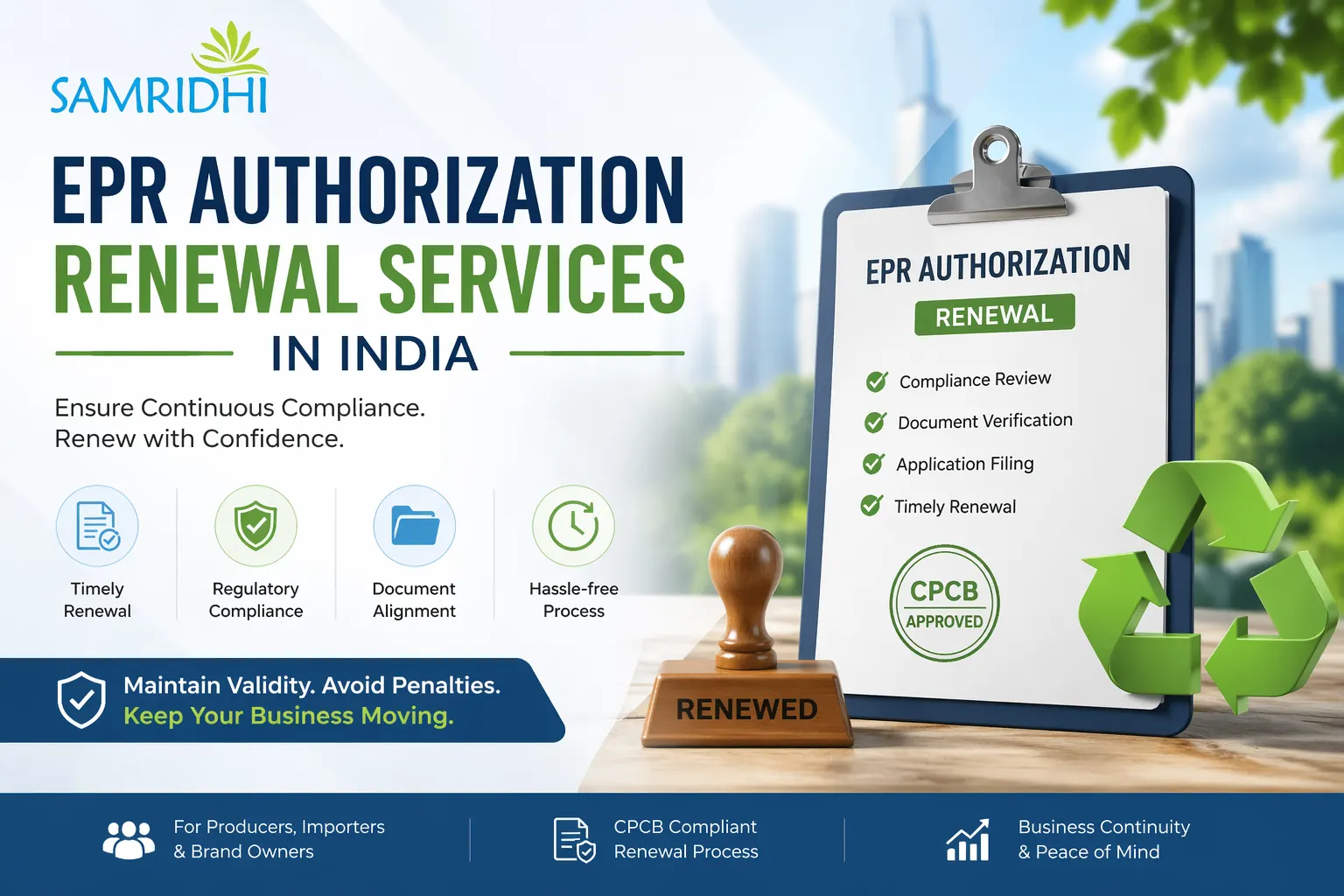
EPR Authorization Renewal in India – CPCB Process, Requirements & Compliance Continuity
Most businesses don’t think about renewal… until it’s close.
Or already due.
That’s usually when EPR authorization renewal India shifts from a routine task to something more urgent.
Because renewal is not just an extension.
It’s a checkpoint.
At a basic level, EPR certificate renewal CPCB ensures that your existing authorization remains valid so you can continue operating without interruption. But in practice, renewal is not only about validity.
It reflects how well your compliance has been maintained over time.
And that’s where things start getting layered.
What renewal actually involves
On paper, the idea is simple.
Your authorization has a defined validity. Before it expires, you apply for renewal through the CPCB system.
But the process is not isolated.
It connects with:
- Your past compliance performance
- Reporting consistency
- Documentation alignment
- Whether obligations have been fulfilled correctly
If these don’t align, renewal becomes more than just a formality.
Why renewal becomes a challenge for many businesses
Most companies don’t ignore renewal.
They underestimate preparation.
Data may not be fully aligned with past filings.
Documentation may need revalidation.
Compliance gaps may need explanation.
Nothing major individually.
But when renewal is initiated, these details come together.
That’s when delays or additional effort usually begin.
The shift from registration to continuity
Initial registration is about entering the compliance system.
Renewal is about staying within it.
And EPR authorization renewal India sits exactly at that point.
It ensures:
- Your authorization remains active
- Your compliance history is consistent
- Your documentation supports continuation
Without this continuity, even previously compliant businesses can face operational disruption.
How CPCB views renewal
From a regulatory perspective, renewal is not just administrative.
Authorities may look at:
- Whether your reporting has been consistent
- If obligations have been fulfilled as required
- Whether documentation supports your claims
Not every renewal is examined in the same way.
But when it is, gaps from earlier periods can surface.
That’s why renewal is often more connected to past compliance than expected—case-specific and subject to authority review.
Why timing matters more than expected
Many businesses approach renewal close to expiry.
It works… sometimes.
But when documentation or compliance alignment is required, time becomes a constraint.
And once timelines tighten, flexibility reduces.
That’s where most pressure builds.
What makes renewal more manageable
There’s no fixed method that guarantees smooth renewal.
But businesses that handle EPR authorization renewal India better usually:
- Track compliance continuously, not just at renewal stage
- Keep documentation aligned with filings
- Review past records before applying
- Address gaps early instead of later
Even then, some uncertainty remains.
Because in the end, renewal is not just about continuing your authorization.
It’s about whether your compliance record is strong enough…
to continue without friction.
 Get Certified with Confidence – Your One-Stop Compliance Partner
From BIS, WPC, TEC, BEE, EPR, LMPC, CDSCO, FSSAI, ISO, MSME to PESO, NABL testing, Startup India, Make in India, and Lab Setup, we handle all your regulatory approvals, certifications, and documentation needs with precision and speed. Partner with Samridhi Compliance Certification and simplify your journey to full compliance—so you can focus on growing your business.
What is EPR Authorization Renewal and Why It is Important
Most businesses don’t think much about renewal when they first get registered.
That comes later.
Usually when the validity period is close… or already approaching its end.
That’s when EPR authorization renewal India becomes relevant.
At a basic level, EPR certificate renewal CPCB means extending your existing authorization so your operations remain compliant. But in practice, renewal is not just about extending validity.
It reflects whether your compliance has been maintained properly over time.
What renewal actually means in real terms
On paper, the process looks simple.
Your authorization has a defined validity. Before it expires, you apply for renewal through the CPCB system.
But renewal is not a standalone action.
It connects directly with:
- Your past compliance filings
- Fulfillment of EPR obligations
- Documentation consistency
- Alignment between what was reported and what was executed
If these don’t align, renewal becomes more than just a submission.
Why renewal is more important than it appears
Many businesses assume renewal is routine.
It isn’t always.
Because EPR authorization renewal India ensures that your compliance doesn’t break in between cycles.
Without renewal:
- Your authorization may lapse
- Ongoing operations can be affected
- Future filings may become complicated
So renewal is less about extension… and more about continuity.
The part most businesses don’t expect
Renewal doesn’t just look forward.
It looks back.
While applying for EPR certificate renewal CPCB, authorities may consider:
- Whether your reporting has been consistent
- If obligations have been fulfilled properly
- Whether documentation supports your claims
Not every application is reviewed in the same depth. But when it is, past gaps tend to surface.
Why timing becomes critical
Some businesses apply well before expiry.
Others wait until the last phase.
Both approaches work… depending on how prepared your data and documentation are.
If everything is aligned, renewal can move smoothly.
If not, even small gaps can take time to address.
And that’s where delays usually begin.
What makes renewal manageable
There’s no fixed checklist that guarantees approval.
Because outcomes can vary—depending on product type, waste category, and compliance history. It’s always subject to authority review.
But in practice, businesses that handle EPR authorization renewal India better tend to:
- Maintain consistency in reporting
- Keep documentation updated throughout the year
- Review past compliance before applying
- Avoid last-minute preparation
Even then, some uncertainty remains.
Because in the end, EPR certificate renewal CPCB is not just about extending your authorization.
It’s about whether your compliance record supports that extension… without questions.
Before applying for renewal, your original registration must be correctly aligned. If you are unsure about your initial approval stage, services like EPR Registration for Plastic Waste, EPR E-Waste Registration, and EPR Battery Waste Registration help ensure your foundation is strong before renewal.
Get Certified with Confidence – Your One-Stop Compliance Partner
From BIS, WPC, TEC, BEE, EPR, LMPC, CDSCO, FSSAI, ISO, MSME to PESO, NABL testing, Startup India, Make in India, and Lab Setup, we handle all your regulatory approvals, certifications, and documentation needs with precision and speed. Partner with Samridhi Compliance Certification and simplify your journey to full compliance—so you can focus on growing your business.
EPR Authorization Validity and Renewal Timeline in India
Most businesses don’t track validity actively.
They assume the authorization is still valid… until someone checks the date.
That’s when EPR authorization renewal India becomes urgent.
How EPR authorization validity actually works
Under CPCB, your EPR authorization is issued for a defined period.
Not indefinite.
This period—often several years depending on category and approval—defines your EPR license validity CPCB.
After that, renewal is required to continue operations without interruption.
Simple in theory.
But in practice, many businesses lose track of this timeline because renewal doesn’t come up often.
Why renewal timelines are often missed
The issue is not awareness.
It’s timing.
EPR compliance involves:
- Regular reporting
- Target fulfillment
- Documentation maintenance
Renewal sits in the background… until it doesn’t.
And when the EPR renewal due date India approaches, businesses often realize:
- Documents need updating
- Past compliance needs review
- Data alignment may be required
That’s when time starts becoming limited.
What “due date” really means in renewal
There isn’t always a single universal deadline.
Your renewal timeline depends on:
- The validity period of your authorization
- The waste category involved
- Your original approval conditions
So EPR renewal due date India is not fixed across all businesses.
It’s specific to your case.
And once your authorization approaches expiry, the window for smooth renewal starts narrowing.
Why applying early makes a difference
Some businesses wait until the last phase.
It works… if everything is already aligned.
But if:
- Documentation needs correction
- Compliance records need validation
- Past gaps need explanation
Then even a small delay becomes significant.
That’s where most pressure builds.
What CPCB may consider during renewal timing
Renewal is not just about submitting before expiry.
Authorities may look at:
- Whether your compliance has been continuous
- If reporting and fulfillment are consistent
- Whether documentation supports your renewal request
Not every case is evaluated in the same way.
But when it is, timing and preparation both matter—subject to authority review.
What helps manage renewal timelines better
There’s no fixed rule that guarantees smooth timing.
But businesses that handle EPR authorization renewal India better usually:
- Track validity periods actively
- Start reviewing documents before expiry
- Keep compliance records aligned throughout the year
- Avoid last-minute preparation
Even then, some variation remains.
Because in the end, EPR license validity CPCB is not just about how long your authorization lasts.
It’s about whether you’re prepared…
before it runs out.
Tracking compliance timelines becomes easier when your business registrations are structured properly. Many companies combine EPR planning with MSME Registration or Startup India Certification to maintain better visibility over compliance cycles and deadlines.
Get Certified with Confidence – Your One-Stop Compliance Partner
From BIS, WPC, TEC, BEE, EPR, LMPC, CDSCO, FSSAI, ISO, MSME to PESO, NABL testing, Startup India, Make in India, and Lab Setup, we handle all your regulatory approvals, certifications, and documentation needs with precision and speed. Partner with Samridhi Compliance Certification and simplify your journey to full compliance—so you can focus on growing your business.
EPR Authorization Renewal Process in India – Step-by-Step CPCB Procedure
Most businesses assume the EPR license renewal process India is just a portal activity.
Login. Upload. Submit.
In reality, the portal is the final step.
What matters more is everything that happens before you reach it.
Because the CPCB EPR authorization renewal process depends on how well your past compliance, documentation, and data are aligned—not just whether you complete the form.
What the renewal process actually involves
At a surface level, the process looks structured.
Apply before expiry. Upload documents. Wait for approval.
But in practice, renewal moves through three layers:
- Compliance review
Whether your past reporting and fulfillment align with requirements
- Documentation validation
Whether records support what has been declared earlier
- Application submission on CPCB portal
The final step where everything is presented
If the first two layers are not aligned, the portal step simply reflects those gaps.
Where most businesses face delays
Not at submission.
Before it.
A report may not match earlier filings.
A document may need updating.
A category classification may need correction.
These are not major issues individually.
But when renewal starts, they come together.
And that’s when timelines begin to tighten.
Step-by-Step Guide to Renew EPR Authorization on CPCB Portal
When preparation is properly handled, the process becomes more predictable.
Still not fixed. But manageable.
1. Review existing authorization details
Start by checking your current authorization:
- Validity period
- Waste category scope
- Compliance history
This helps identify what needs to be aligned before renewal.
2. Evaluate past compliance and filings
Review previous submissions:
- Reporting consistency
- Target fulfillment status
- Documentation accuracy
This step often reveals gaps that need correction before applying.
3. Prepare updated documentation
Gather and align required documents:
- Authorization details
- Compliance records
- Supporting data
Make sure everything is consistent with earlier filings.
4. Login to CPCB portal
Access your account on the Central Pollution Control Board portal.
This is where the CPCB EPR authorization renewal process officially begins.
5. Fill renewal application details
Enter updated information:
- Business details
- Product and waste category scope
- Compliance-related inputs
Accuracy here is critical. Small mismatches can create issues later.
6. Upload supporting documents
Attach all required documents:
- Compliance records
- Certificates
- Any additional supporting information
Incomplete or inconsistent uploads often slow down the process.
7. Review and validate before submission
This step is often rushed.
It shouldn’t be.
Cross-check whether:
- Data matches previous filings
- Documents align with declared information
- No gaps exist in submission
8. Submit the renewal application
Once submitted, the application moves for review.
Outcome depends on:
- Data consistency
- Documentation alignment
- Case-specific evaluation
What this process does not guarantee
Even when every step is followed carefully, outcomes can vary.
Requirements evolve. Interpretation differs. Documentation may still need clarification.
That’s why renewal is always subject to authority review.
Because in the end, the EPR license renewal process India is not just about completing steps.
It’s about whether everything you submit…
still holds together when reviewed.
For products falling under electronics or telecom categories, approvals like BIS CRS Registration, WPC ETA Approval, and TEC MTCTE Approval may also be required alongside EPR renewal to ensure complete regulatory compliance across all approvals.
Documents Required for EPR Authorization Renewal in India
Most businesses assume documentation is already “done” because they filed everything during registration.
That assumption usually gets tested during renewal.
Because EPR authorization renewal India is not just about resubmitting old documents.
It’s about whether those documents still align with your current compliance position.
What CPCB actually expects from renewal documents
At a basic level, documents required for EPR renewal CPCB include records that prove your compliance has been consistent over time.
Not just that you were registered.
But that you have:
- Reported correctly
- Fulfilled obligations
- Maintained proper records
So documentation is not just collected.
It’s evaluated.
Core documents typically required for renewal
While requirements can vary depending on waste category and case-specific conditions, most renewal applications involve:
- Existing EPR Authorization Certificate
Your current approval details, including scope and validity
- Compliance Reports / Returns
Records of past reporting submitted during the validity period
- Fulfillment Documentation
Recycler certificates or proof of obligation fulfillment
- Sales / Import Data Records
Data showing products introduced into the market
- Waste Category Classification Details
Mapping of products into applicable categories
- Updated Company Details (if applicable)
Any changes in business structure, address, or operations
- Supporting Internal Records
Documents that connect reporting, fulfillment, and data logically
Where documentation usually becomes an issue
Not because documents are missing.
Because they don’t fully match.
A company may have:
- Proper reports
- Valid certificates
- Complete data
But when everything is reviewed together:
- Quantities may not align
- Categories may differ slightly
- Records may not connect clearly
These small inconsistencies often create friction in documents required for EPR renewal CPCB.
The difference between having documents and validating them
This is where most businesses get caught off guard.
Having documents is one thing.
Being able to justify them is another.
During renewal, authorities may look at:
- Whether documents support previous filings
- If fulfillment matches declared obligations
- Whether records are consistent across periods
Not every application is reviewed in detail.
But when it is, gaps become visible quickly—subject to authority review.
Why document preparation takes time
Many businesses prepare documents at the time of renewal.
That approach works… if everything is already aligned.
But if:
- Data needs reconciliation
- Certificates need verification
- Records need restructuring
Then preparation takes longer than expected.
And timelines start tightening.
What helps in smoother documentation
There’s no fixed checklist that guarantees acceptance.
Because requirements can vary depending on product type, category, and compliance history.
But in practice, businesses that handle EPR authorization renewal India better usually:
- Maintain documentation continuously, not just at renewal
- Align reports with fulfillment data regularly
- Verify certificates before relying on them
- Keep records structured and accessible
Even then, some uncertainty remains.
Because in the end, documents required for EPR renewal CPCB are not just about what you submit.
They’re about whether everything you submit…
makes sense together.
Strong documentation is the backbone of smooth renewal. Businesses often rely on ISO Certification and Trademark Registration to maintain structured records and standardized documentation practices across multiple compliance areas.
EPR Renewal for Different Waste Categories (Plastic, E-Waste, Battery)
At a glance, EPR authorization renewal India looks like a single process.
Same portal. Same authority. Same intent.
But once you begin preparing the renewal… the differences between waste categories start showing up.
Because plastic, e-waste, and battery compliance don’t follow identical patterns.
And those differences directly affect how renewal is handled.
Why category-wise renewal matters
Each waste category comes with its own:
- Compliance structure
- Reporting expectations
- Fulfillment patterns
- Documentation requirements
So even if your authorization looks unified, renewal often depends on how each category has been managed individually.
That’s where many businesses start facing unexpected gaps.
Plastic waste EPR authorization renewal
In plastic waste EPR authorization renewal India, the main challenge is not availability of data.
It’s classification and volume consistency.
Plastic compliance typically involves:
- Multiple categories (rigid, flexible, multilayered)
- High-volume transactions
- Category-wise fulfillment tracking
During renewal, authorities may look at whether:
- Reported quantities align with fulfillment
- Category classification has remained consistent
- Certificates support declared data
Even small mismatches across categories can create friction.
E-waste renewal certificate process
The EPR e-waste renewal certificate India process shifts the focus.
Here, it’s less about volume… and more about traceability.
E-waste obligations are linked closely to product categories like:
- IT equipment
- Consumer electronics
- Electrical items
So renewal depends on whether:
- Product categories have been correctly mapped
- Fulfillment aligns with those categories
- Recycler documentation matches reported data
And not all recyclers handle all categories.
That’s where alignment becomes important.
Battery waste EPR renewal services
Battery compliance is more structured… but also less flexible.
In battery waste EPR renewal services India, expectations are often clearer:
- Defined battery types (portable, automotive, industrial)
- Specific collection and recycling targets
- More system-driven reporting
This structure helps.
But it also means mismatches become easier to detect.
If quantities or certificates don’t align precisely, the gap becomes visible quickly.
At the same time, the ecosystem is still evolving, so processes may vary depending on the case.
The common pattern across all categories
Despite these differences, one thing remains consistent.
EPR authorization renewal India is not just about extending approval.
It’s about whether each category’s compliance holds up individually.
Authorities may look at:
- Category-wise reporting consistency
- Fulfillment alignment
- Documentation accuracy
If even one category is misaligned, it can affect the overall renewal outcome—subject to authority review.
What helps manage category-wise renewal better
There’s no single approach that works for all.
But businesses that handle renewal more smoothly usually:
- Track compliance separately for each category
- Maintain category-wise documentation
- Align fulfillment with reporting throughout the year
- Review each category before applying for renewal
Even then, some variation remains.
Because in EPR authorization renewal India, the challenge is not just renewing the license.
It’s making sure every category behind it…
is ready to be renewed.
Each waste category requires proper initial registration before renewal. Depending on your product type, services like EPR Tyre Waste Registration and EPR Used Oil Registration may also apply for category-specific compliance.
Common Issues in EPR Renewal and How to Avoid Delays
Most renewal delays don’t come from one big mistake.
They build up from smaller gaps that weren’t visible earlier.
That’s why EPR authorization renewal India often feels smooth at first… and then suddenly slows down.
The kind of issues that don’t look serious initially
Nothing usually looks “wrong.”
Documents are available. Reports are filed. Certificates exist.
But when renewal begins, these pieces are reviewed together.
And that’s when small inconsistencies start showing up.
A number doesn’t match exactly.
A category feels slightly off.
A certificate covers most—but not all—of the obligation.
Individually manageable.
Together… they create delays.
Common issues businesses face during renewal
Over time, certain patterns keep repeating in the CPCB EPR authorization renewal process:
- Mismatch between past filings and current data
Earlier reports don’t fully align with current documentation
- Incomplete or inconsistent recycler certificates
Certificates exist, but don’t cover full obligations or categories
- Incorrect waste category classification
Products mapped differently across reporting cycles
- Delayed documentation preparation
Records are gathered only at the time of renewal
- Changes in business details not updated earlier
Company structure, address, or operations differ from previous records
The issue most businesses overlook
Assuming renewal is routine.
Because the process looks similar to registration, it’s easy to think it will move the same way.
But renewal is different.
It connects with your past compliance.
And if that history has gaps, they tend to surface here.
Why delays become difficult to manage
Because by the time renewal starts, timelines are already tight.
There’s limited room to:
- Reconcile data
- Correct documentation
- Address compliance gaps
And once the EPR renewal due date India approaches, flexibility reduces.
That’s when pressure builds.
How to avoid most of these delays
There’s no guaranteed method.
Because outcomes can vary depending on product type, waste category, and case-specific review.
But in practice, businesses that handle EPR authorization renewal India more smoothly tend to:
- Review past compliance before initiating renewal
- Align documentation with previous filings
- Validate recycler certificates in advance
- Update business details regularly
- Avoid last-minute preparation
Even then, not everything is predictable.
Because in the end, renewal delays are rarely caused by missing documents.
They’re caused by documents that don’t fully align…
when someone looks at them together.
Similar challenges are seen across different compliance areas. Whether it’s EPR renewal or approvals like CDSCO Certification and PESO Certification, misaligned documentation and delayed preparation often lead to avoidable delays.
EPR Authorization Renewal Cost and Key Factors
The first question most businesses ask isn’t about the process.
It’s about cost.
“How much will EPR authorization renewal India actually cost us?”
There isn’t a fixed number.
Because renewal pricing doesn’t come from the form you submit. It comes from everything that needs to be aligned before you submit it.
Why renewal costs vary so much
On the surface, EPR certificate renewal CPCB looks like a continuation task.
Update details. Upload documents. Apply.
But in reality, renewal depends on how clean your compliance history is.
If everything is already aligned, effort stays limited.
If not… preparation expands.
And that’s where cost changes.
Key factors that influence renewal cost
Instead of looking for a flat fee, it helps to understand what actually drives pricing:
- Compliance history
If past reporting and fulfillment are consistent, renewal is smoother
If gaps exist, they need to be addressed before applying
- Waste category involved
Plastic, e-waste, and battery each have different documentation and review complexity
- Data and document alignment
Well-structured records reduce effort
Misaligned data increases time required for correction
- Changes in business scope
Updates in product categories, operations, or structure may require additional adjustments
- Scope of service required
Basic renewal filing vs. complete support (review, correction, documentation alignment)
- Number of categories covered
Multiple categories increase coordination and validation effort
Each of these varies depending on the case.
The cost that’s often overlooked
It’s not just about renewal.
It’s about correction.
Some businesses try to minimize cost by applying directly without reviewing past compliance.
It works… until something doesn’t align.
A mismatch in data.
A missing document.
An inconsistency in category.
Fixing these later usually takes more effort than preparing them early.
That’s where actual cost shows up.
What a realistic expectation looks like
There’s no universal price range for EPR authorization renewal India.
Costs are:
- case-specific
- dependent on compliance history
- influenced by category and documentation complexity
- subject to authority review if additional clarification is required
A well-prepared case may stay straightforward.
A complex case with multiple gaps… requires more effort.
One thing becomes clear after a few renewal cycles.
You’re not just paying to extend your authorization.
You’re paying for how well your compliance holds together…
when it’s reviewed again.
Cost planning improves when compliance is handled holistically. Businesses often align EPR renewal with Make in India Certification or other regulatory frameworks to optimize long-term compliance investments.
How Professional EPR Renewal Services Help Maintain Compliance Continuity
Most businesses don’t think about continuity… until something breaks.
An authorization lapses.
A renewal gets delayed.
A compliance gap suddenly becomes visible.
That’s when EPR authorization renewal India stops feeling like a routine process.
And starts affecting operations.
What actually changes with professional support
Professional EPR renewal services India don’t just handle the application.
They step into the part most businesses overlook—preparation before renewal.
Instead of treating renewal as a last-minute activity, the focus shifts to alignment:
- Review of past compliance before applying
Reports, fulfillment, and documentation are checked together
- Early identification of gaps
Small mismatches are addressed before they become issues
- Structured documentation alignment
Records are organized in a way that supports continuity
- Clear renewal planning
Avoiding last-minute pressure as expiry approaches
The part most businesses underestimate
Renewal is not isolated.
It connects directly with your compliance history.
And that’s where internal teams often face challenges.
Data sits across departments.
Documentation is spread across timelines.
Past filings may not fully align with current records.
Trying to bring everything together at the last moment usually creates delays.
Professional support reduces that friction.
Not by simplifying the regulation… but by structuring the process earlier.
Does it eliminate all renewal challenges?
Not completely.
Even with structured support:
- Requirements may evolve
- Documentation may still need clarification
- Outcomes can vary depending on the case
Renewal always remains subject to authority review.
But the difference is in how prepared you are before that review happens.
Where the real value shows up
It’s not just in submitting the renewal.
It’s in reducing:
- Last-minute document corrections
- Data inconsistencies across filings
- Delays caused by incomplete preparation
- Risk of avoidable queries
Over time, this makes EPR authorization renewal India more predictable.
Not easier.
Just… more controlled.
Because in the end, renewal is not just about extending validity.
It’s about making sure your compliance continues…
without interruption.
A structured compliance approach often includes multiple services working together—EPR renewal, BIS ISI Certification (Domestic or Foreign Manufacturers), and Testing services like NABL Testing or LM79 Testing—ensuring smoother operations and reduced regulatory risk.


 Grab Your Certified Now
 +91 8799708673
 WhatsApp