Why One Certification Is No Longer Enough for Modern Electronics Products in India
For years, many electronics businesses approached compliance with a relatively simple assumption:
get one approval, complete the import process, launch the product.
That model is slowly breaking apart.
Modern electronics products no longer operate inside one regulatory category anymore. A connected device today may simultaneously behave like:
- a consumer electronic product
- a wireless communication device
- a telecom-enabled system
- an energy-regulated appliance
- an AI-connected IoT platform
And once those layers combine inside one product ecosystem, one certification usually stops being sufficient.
This is becoming the central operational reality behind:
- multi-certification products India electronics
especially for smart appliances, AI-enabled devices, connected consumer electronics, wireless systems, and telecom-integrated products entering the Indian market.
Modern Electronics Products Are Becoming Multi-Function Ecosystems
Earlier, electronics products were easier to classify operationally.
A television followed one compliance structure.
A wireless router followed another.
A telecom device operated separately.
Today those boundaries overlap constantly.
A modern smart appliance may now include:
- WiFi connectivity
- Bluetooth communication
- AI-based automation
- cloud synchronization
- energy-efficiency functionality
- telecom-style remote interaction
Operationally, one product may simultaneously trigger:
- BIS certification
- WPC ETA applicability
- TEC telecom review
- BEE energy-efficiency obligations
depending on:
- product architecture
- communication functionality
- wireless capability
- power-consumption classification
And honestly, many businesses still underestimate how interconnected these compliance frameworks have become.
BIS Certification Alone Is Often No Longer Enough
This is one of the biggest mindset shifts happening for electronics importers and manufacturers.
Many businesses still assume:
- BIS approval means the product is fully compliant for India.
Increasingly, that assumption creates operational problems.
A connected electronics product may hold:
- valid BIS CRS certification
while still requiring:
- wireless approval review
- telecom applicability assessment
- energy-rating obligations
because the product contains:
- RF communication modules
- telecom-network functionality
- smart-energy management systems
- connected-device architecture
This directly affects:
- BIS CRS WPC ETA TEC MTCTE requirements India
- and broader
- multi-compliance approvals for electronics India
The product itself has become more complex than the original certification model many businesses still follow internally.
Wireless Connectivity Is Expanding WPC ETA Applicability
This is happening across almost every modern electronics category now.
Products increasingly contain:
- embedded WiFi systems
- Bluetooth modules
- RF communication architecture
- IoT wireless connectivity
- smart synchronization capability
Even devices not marketed as communication products often operate through wireless ecosystems internally.
That creates growing overlap involving:
- telecom and wireless compliance for electronics India
- and
- WPC ETA review requirements.
A smart appliance today may communicate continuously with:
- mobile applications
- cloud platforms
- wireless networks
- remote monitoring systems
The compliance trigger increasingly comes from:
- how the product communicates technically
- not only how it is commercially categorized.
Telecom Functionality Is Quietly Expanding TEC Applicability
This is becoming more visible with connected electronics and IoT products.
Many modern devices now integrate:
- SIM functionality
- machine-to-machine communication
- telecom-network interaction
- cloud-linked remote access systems
That creates additional operational complexity involving:
- TEC MTCTE applicability review.
The challenge is that telecom functionality is not always obvious early during product planning.
A product initially viewed as:
may gradually evolve into:
- a telecom-connected product ecosystem
through:
- firmware expansion
- communication-feature updates
- cloud integration
Then businesses suddenly discover:
- additional certification coordination requirements
- late in the launch process.
BEE Compliance Is Expanding for Smart Appliances
Energy-efficiency regulation is also becoming more interconnected with electronics compliance planning.
Many smart appliances now involve:
- AI-driven power optimization
- connected energy-management systems
- intelligent operational control
- remote energy monitoring capability
This creates increasing relevance for:
- BEE BIS compliance for smart appliances India
especially for products where:
- energy consumption classification
- smart-control systems
- connected operating behavior
influence regulatory applicability.
Earlier, energy compliance and electronics compliance were often managed separately.
Now connected smart appliances increasingly blur those boundaries operationally.
AI and IoT Devices Are Creating Overlapping Regulatory Pressure
This may be one of the biggest reasons multi-certification complexity is increasing so quickly.
Modern AI and IoT products often combine:
- wireless communication
- telecom functionality
- smart processing systems
- connected-device ecosystems
- cloud synchronization
- energy-management capability
inside one product environment.
That directly affects:
- AI and IoT device certification requirements India
- and broader
- smart electronics multi-certification compliance India
The product itself may operate simultaneously across:
- safety regulation
- wireless regulation
- telecom regulation
- energy-efficiency regulation
And each framework evaluates different technical aspects.
That creates coordination pressure operationally.
Customs Scrutiny Is Increasing Because of Certification Overlap
Importers are increasingly experiencing:
- customs clarification requests
- shipment delays
- documentation-review pressure
- RF verification scrutiny
- certification cross-checking
because customs authorities now frequently evaluate:
- BIS alignment
- WPC applicability
- telecom functionality
- product-classification consistency
together.
Earlier, businesses could often manage approvals sequentially.
That approach is becoming harder operationally.
Especially for:
- connected devices
- smart appliances
- AI-powered electronics
- wireless consumer products
where multiple regulatory frameworks may apply simultaneously.
Supplier Coordination Is Becoming More Difficult
This is creating real operational strain for importers.
Suppliers frequently:
- update wireless modules
- revise firmware
- modify communication systems
- alter power-management architecture
without fully synchronizing:
- certification records
- RF reports
- technical documentation
- energy-compliance references
Then importers face:
- documentation mismatches
- unclear applicability
- overlapping certification uncertainty
during:
- customs review
- testing coordination
- compliance filing
And honestly, many businesses still lack centralized systems for managing multi-certification documentation continuity.
One Product Now Often Requires Parallel Compliance Planning
This is the operational reality many businesses are slowly realizing.
Earlier:
- certification happened after product development.
Now compliance increasingly affects:
- hardware selection
- wireless-module planning
- telecom functionality design
- energy-management architecture
- sourcing decisions
- import timelines
Because the product may require:
together—not sequentially.
And if businesses discover overlap late, operational disruption grows quickly.
India’s Compliance Ecosystem Is Becoming More Integrated
This may be the biggest structural shift underneath everything else.
Historically:
- BIS handled electronics conformity
- WPC handled wireless communication approval
- TEC handled telecom functionality
- BEE handled energy-efficiency regulation
Modern connected electronics increasingly operate across all these systems simultaneously.
That is gradually creating:
- an
- integrated electronics compliance framework India
whether businesses are operationally ready for it or not.
The product categories themselves are evolving faster than traditional regulatory separation models.
The Practical Takeaway
One certification is no longer enough for many modern electronics products in India because connected devices increasingly combine wireless communication, telecom functionality, AI integration, smart features, and energy-efficiency systems within a single operational ecosystem.
- BIS certification alone is often insufficient for connected electronics
- Wireless functionality is expanding WPC ETA applicability
- Telecom-enabled devices are creating TEC overlap
- Smart appliances increasingly involve BEE obligations
- AI and IoT ecosystems are triggering multi-framework compliance requirements
- Customs scrutiny is increasing because of overlapping certification expectations
And since:
- certification applicability depends heavily on product functionality, communication capability, and technical architecture
- compliance obligations vary by wireless systems, telecom interaction, and energy-efficiency classification
- final regulatory interpretation remains subject to authority review
businesses increasingly need integrated compliance planning much earlier during product design, sourcing, testing, and import-management stages.
Because for modern electronics products now…
compliance is no longer a single approval process.
It is becoming a coordinated regulatory ecosystem.
BIS CRS Registration supports mandatory product safety certification and regulatory planning for regulated electronics and smart consumer devices in India.
How BIS, WPC, TEC, and BEE Compliance Overlap Is Changing Electronics Imports in India
Electronics imports into India are no longer moving through one predictable approval pathway.
That is the biggest change businesses are quietly dealing with right now.
Earlier, compliance obligations were comparatively isolated:
- BIS handled product safety
- WPC handled wireless approvals
- TEC handled telecom equipment
- BEE handled energy-efficiency regulation
Most products fell into one category clearly enough.
Modern electronics products rarely do.
A connected smart device today may simultaneously involve:
- wireless communication
- telecom-network interaction
- AI-enabled functionality
- energy-management systems
- cloud synchronization capability
And once that happens, importers increasingly face:
- overlapping compliance obligations
- multi-agency coordination pressure
- certification sequencing challenges
- customs-verification complexity
This is becoming the operational reality behind:
- BIS WPC TEC BEE compliance overlap India
especially for smart appliances, AI-enabled electronics, IoT devices, connected consumer products, and telecom-integrated electronics imports.
Electronics Products Are Becoming Harder to Categorize
This is where many compliance problems begin.
Earlier, classification felt more stable operationally.
A refrigerator remained an appliance.
A router remained a wireless device.
A telecom unit remained telecom equipment.
Now one product may behave like all three.
For example:
- a smart air conditioner may contain WiFi connectivity
- an AI surveillance system may operate through telecom-style remote access
- a connected appliance may include cloud-linked power optimization
- an IoT product may continuously exchange RF and telecom data
Operationally, the product itself crosses multiple regulatory environments simultaneously.
That creates growing complexity involving:
- product classification
- certification applicability
- technical-document alignment
- customs interpretation
And honestly, many businesses still evaluate products based on marketing categories—not technical functionality.
Regulators increasingly do the opposite.
BIS Compliance Is Now Interacting With Other Regulatory Frameworks
This is one of the biggest operational shifts affecting electronics imports.
Many businesses still approach:
as the primary approval layer.
Increasingly, connected products require much more coordination beyond BIS alone.
A product may successfully obtain:
while still requiring:
- WPC ETA approval
- telecom applicability review
- energy-efficiency compliance assessment
because of:
- wireless modules
- RF communication capability
- telecom interaction
- smart-energy functionality
This directly affects:
- multi-compliance approvals for electronics India
- and broader
- smart electronics multi-certification compliance India
The product itself may comply technically in one framework while remaining incomplete operationally in another.
Wireless Connectivity Is Expanding WPC Overlap
This issue now touches almost every smart-device category.
Modern electronics increasingly contain:
- Bluetooth systems
- WiFi communication
- RF transmitters
- wireless synchronization modules
- mesh-network architecture
Even products not marketed primarily as wireless devices often contain RF functionality internally.
That creates growing overlap involving:
- WPC ETA review
- and broader
- telecom and wireless compliance for electronics India
The challenge is that wireless functionality is sometimes:
- underestimated
- poorly documented
- incompletely disclosed
especially when suppliers focus more heavily on:
- smart features
- AI capability
- automation functionality
than communication architecture.
Operationally, customs and regulators increasingly evaluate:
- what the product technically transmits
- not only what the product commercially claims to be.
Telecom Applicability Is Becoming More Difficult to Interpret
This is creating real operational uncertainty.
Modern connected devices increasingly interact with:
- telecom networks
- remote monitoring systems
- machine-to-machine communication ecosystems
- cloud-linked communication platforms
That creates expanding overlap involving:
- TEC MTCTE applicability review.
The challenge is that telecom functionality often evolves gradually.
A product initially designed as:
- a connected consumer device
may later integrate:
- remote-access capability
- SIM-based communication
- telecom-network interaction
through:
- firmware changes
- architecture revisions
- software expansion
Then businesses suddenly discover:
- additional certification obligations
- much later in the product cycle.
BEE Compliance Is Becoming More Relevant for Smart Appliances
This trend is accelerating quietly.
Many smart appliances now include:
- intelligent power management
- AI-based energy optimization
- remote energy monitoring
- adaptive operating systems
That creates increasing overlap involving:
- BEE BIS compliance for smart appliances India
especially where:
- energy efficiency
- connected-device functionality
- smart operational systems
interact together.
Earlier, energy compliance often existed separately from electronics-certification planning.
Now those systems increasingly overlap operationally for connected appliances and smart consumer products.
Customs Scrutiny Is Increasing Because of Certification Overlap
Importers are increasingly experiencing:
- shipment delays
- technical clarification requests
- certification cross-checking
- wireless-function scrutiny
- documentation-verification pressure
because customs authorities increasingly evaluate:
- BIS applicability
- WPC alignment
- telecom capability
- energy-regulation relevance
together.
Earlier, businesses often handled approvals sequentially:
- BIS first
- WPC later
- telecom review if needed
That approach is becoming operationally risky.
Especially for:
- AI-enabled electronics
- connected appliances
- wireless devices
- IoT systems
- telecom-integrated products
where multiple frameworks may apply simultaneously.
Supplier Coordination Is Becoming Much More Difficult
This is one of the most underestimated operational problems.
Suppliers frequently:
- update wireless modules
- revise chipsets
- modify firmware
- alter energy-management systems
- expand communication capability
without fully updating:
- certification references
- RF reports
- technical documentation
- energy-compliance records
Then importers face:
- mismatched documentation
- uncertain applicability
- overlapping approval gaps
during:
- customs verification
- testing coordination
- compliance filing
And honestly, many businesses still lack centralized systems capable of managing multi-certification continuity across rapidly evolving electronics products.
AI and IoT Products Are Accelerating Compliance Overlap
This may be the biggest reason the multi-certification problem is growing so quickly.
AI-enabled and IoT products increasingly combine:
- RF communication
- telecom interaction
- cloud ecosystems
- smart processing systems
- energy-management functionality
inside one operational environment.
That directly affects:
- AI and IoT device certification requirements India
- and broader
- connected devices regulatory approvals India
The product itself no longer fits neatly into one regulatory framework.
Which means importers increasingly require:
- integrated compliance planning
- parallel certification coordination
- synchronized technical documentation
much earlier during sourcing and product-development stages.
One Product Now Often Requires Parallel Compliance Planning
This is the operational adjustment many businesses are still learning.
Earlier:
- certification planning happened after product development.
Now compliance increasingly affects:
- hardware selection
- wireless architecture
- telecom functionality design
- energy-management systems
- firmware planning
- supplier coordination
Because one product may require:
simultaneously—not sequentially.
And discovering overlap late creates operational disruption quickly.
India’s Electronics Compliance Ecosystem Is Becoming More Integrated
This is the structural shift underneath everything else.
Historically:
- regulatory systems operated relatively independently.
Modern electronics products increasingly force these systems to intersect operationally.
That is gradually creating:
- an
- integrated electronics compliance framework India
where:
- wireless capability
- telecom interaction
- energy efficiency
- connected-device functionality
are evaluated together more frequently.
The technology ecosystem itself has evolved faster than traditional regulatory separation models.
The Practical Takeaway
BIS, WPC, TEC, and BEE compliance overlap is changing electronics imports in India because modern connected products increasingly combine wireless communication, telecom capability, AI-driven functionality, smart features, and energy-management systems within one product ecosystem.
- Electronics products are becoming harder to classify operationally
- BIS certification increasingly overlaps with other frameworks
- Wireless connectivity is expanding WPC applicability
- Telecom-enabled products are creating TEC overlap
- Smart appliances increasingly involve BEE obligations
- Customs scrutiny is increasing because of multi-certification expectations
And since:
- compliance applicability depends heavily on communication functionality, wireless capability, telecom interaction, and energy-efficiency classification
- certification obligations vary by product architecture and technical behavior
- final regulatory interpretation remains subject to authority review
businesses increasingly need integrated compliance planning much earlier during sourcing, product development, testing coordination, and electronics-import management processes.
Because for modern electronics imports now…
the challenge is no longer getting one approval.
It is managing several interconnected approvals at the same time.
WPC ETA Approval supports wireless compliance, RF coordination, and regulatory planning for connected electronics and IoT products in India.
Multi-Compliance Approval Challenges for Smart Electronics, AI Devices, and IoT Products
The compliance difficulty around modern electronics products is no longer only about getting approvals.
It is about coordinating approvals that were never originally designed to work together this closely.
That is where many businesses are struggling now.
AI-enabled electronics, connected smart devices, and IoT ecosystems increasingly combine:
- wireless communication
- telecom interaction
- cloud synchronization
- intelligent automation
- energy-management systems
- remote-access capability
inside one product architecture.
Operationally, that means one device may trigger:
- BIS certification
- WPC ETA review
- TEC telecom applicability
- BEE energy obligations
at the same time.
And honestly, most businesses still plan compliance as if these approvals can be handled independently.
Increasingly, they cannot.
This is becoming the central operational challenge behind:
- multi-compliance approvals for electronics India
- and broader
- AI and IoT device certification requirements India
especially for smart appliances, connected consumer electronics, AI surveillance systems, telecom-enabled IoT devices, and wireless automation products.
AI and IoT Products Are No Longer Simple Electronics Devices
This is probably the biggest shift underneath everything else.
Earlier, electronics products usually had:
- one core operational purpose.
Modern AI and IoT devices behave differently.
A single smart product may simultaneously:
- communicate wirelessly
- connect with telecom infrastructure
- exchange cloud-based data
- optimize energy usage dynamically
- operate through mobile applications
- receive firmware-driven functionality updates
The product itself becomes:
- a connected ecosystem—not just hardware.
And once products behave this way, multiple compliance frameworks begin overlapping operationally.
RF Testing Coordination Has Become Much More Complicated
This is one of the first pressure points businesses usually encounter.
Modern connected devices increasingly contain:
- Bluetooth modules
- WiFi communication systems
- RF transmitters
- mesh-network architecture
- wireless synchronization capability
That creates growing operational complexity involving:
- RF testing coordination
- wireless-module mapping
- frequency verification
- technical conformity review
The problem is that many businesses still rely heavily on:
- supplier-side RF documentation
- generic module declarations
- incomplete communication architecture descriptions
Then during:
- customs review
- WPC scrutiny
- testing coordination
inconsistencies start appearing.
And recently, customs and regulators appear much more sensitive to RF-document alignment than before.
Wireless-Module Review Is Becoming Operationally Critical
This issue is growing quickly for smart-device manufacturers and importers.
Suppliers frequently:
- revise wireless chipsets
- replace RF modules
- alter antenna structures
- update wireless functionality
without fully updating:
- technical records
- RF reports
- approval references
- import documentation
Then businesses unknowingly import:
- revised wireless architecture
- modified communication capability
- undocumented RF functionality
while still relying on:
- older compliance records.
Operationally, this creates:
- wireless-module inconsistencies
- WPC ETA applicability uncertainty
- customs clarification pressure
Especially for:
- connected electronics
- smart appliances
- AI-powered consumer products
- IoT ecosystems
Telecom Compliance Overlap Is Expanding Quietly
This is becoming more visible across connected-product categories.
Many AI and IoT products now include:
- remote-access systems
- telecom-network interaction
- machine-to-machine communication
- cloud-linked communication capability
- SIM-based architecture
The challenge is that telecom applicability is often discovered late.
A product initially treated as:
may gradually trigger:
- TEC MTCTE applicability review
because of:
- communication functionality
- telecom integration
- firmware-enabled remote operation
And honestly, businesses often identify telecom overlap only after:
- product sourcing
- shipment scheduling
- hardware finalization
have already happened.
That creates operational pressure quickly.
BEE Obligations Are Increasing for Smart Appliances
This is another layer businesses sometimes underestimate.
Modern appliances increasingly include:
- AI-based power optimization
- adaptive energy management
- smart operating systems
- cloud-controlled performance adjustment
That creates growing relevance for:
- BEE energy-efficiency obligations.
Earlier, energy regulation and connected-device compliance operated relatively separately.
Now smart appliances increasingly blur those boundaries.
A connected appliance today may simultaneously involve:
- BIS conformity
- wireless compliance
- telecom functionality review
- energy-performance obligations
depending on:
- operating capability
- communication architecture
- product classification
The overlap itself creates planning complexity.
Certification Sequencing Has Become Difficult
This is where many operational delays begin.
Businesses often ask:
- Which approval should happen first?
Increasingly, there is no universally clean answer.
Because applicability now overlaps.
For example:
- RF testing may influence WPC coordination
- telecom functionality may affect technical architecture review
- energy-performance systems may impact appliance classification
- BIS documentation may require synchronization with wireless specifications
And if one technical parameter changes midway:
- module revisions
- firmware updates
- architecture modifications
multiple compliance layers may require re-evaluation.
That creates:
Especially for rapidly evolving AI products and connected IoT systems.
Customs Scrutiny Is Increasing for Multi-Certification Products
Importers increasingly face:
- shipment holds
- technical clarification requests
- wireless-function review
- certification cross-checking
- product-classification scrutiny
because customs authorities now frequently evaluate:
- BIS alignment
- WPC applicability
- telecom capability
- energy-related relevance
together.
This directly affects:
- connected devices regulatory approvals India
- and broader
- integrated electronics compliance framework India
Earlier, customs review often focused more heavily on:
- invoices
- shipment value
- product declarations
Now the technical behavior of the product matters much more.
Supplier Coordination Is Becoming One of the Biggest Risks
This problem keeps expanding operationally.
Suppliers continuously update:
- communication systems
- firmware
- wireless architecture
- AI functionality
- energy-management behavior
without always synchronizing:
- compliance documentation
- RF specifications
- certification records
- technical construction files
Then importers discover:
- applicability gaps
- mismatched records
- overlapping approval uncertainty
during:
- testing coordination
- customs verification
- product-launch planning
And by that stage, operational flexibility is already shrinking.
AI Products Evolve Faster Than Compliance Systems
This is an uncomfortable reality many businesses are now facing.
AI-enabled electronics products increasingly:
- change behavior through firmware
- expand communication capability
- evolve through cloud ecosystems
- activate new features remotely
The physical hardware may remain identical.
But compliance applicability may shift underneath the system architecture.
That creates long-term complexity involving:
- conformity continuity
- RF alignment
- telecom functionality review
- wireless applicability management
Especially for:
- AI surveillance products
- connected automation systems
- smart consumer electronics
- adaptive IoT platforms
Multi-Compliance Planning Is Now Starting Earlier
This may be the biggest operational change for electronics businesses.
Earlier:
- compliance planning often started after product finalization.
Now businesses increasingly require:
- RF applicability review
- telecom-function assessment
- wireless-module verification
- energy-obligation evaluation
- integrated documentation planning
during:
- hardware selection
- sourcing coordination
- architecture design
- supplier onboarding
Because once products move into:
- testing
- import scheduling
- customs review
late-stage compliance discovery becomes operationally expensive.
The Practical Takeaway
Multi-compliance approval challenges for smart electronics, AI devices, and IoT products are increasing in India because modern connected products now operate simultaneously across wireless, telecom, safety, energy-efficiency, and cloud-connected regulatory environments.
- RF testing coordination is becoming more technically sensitive
- Wireless-module review is increasingly operationally critical
- Telecom compliance overlap is expanding for connected devices
- Smart appliances are creating additional BEE obligations
- Certification sequencing is becoming unstable for evolving products
- Customs scrutiny is increasing for multi-certification electronics ecosystems
And since:
- certification applicability depends heavily on communication architecture, wireless capability, telecom interaction, and energy-management functionality
- approval requirements vary by product behavior, firmware capability, and technical configuration
- final regulatory interpretation remains subject to authority review
businesses increasingly need integrated compliance planning much earlier during product development, sourcing, testing coordination, and import-management stages.
Because for modern smart electronics now…
the challenge is no longer managing one approval pathway.
It is managing several interconnected compliance systems evolving at the same time.
TEC MTCTE Approval supports telecom compliance assessment and technical coordination for connected electronics and communication-enabled smart devices.
Why Connected Consumer Electronics Are Facing Integrated Regulatory Scrutiny in India
Connected consumer electronics are no longer being evaluated as isolated hardware products.
Increasingly, regulators are viewing them as interconnected digital ecosystems.
That shift changes everything operationally.
A smart product today may:
- communicate wirelessly
- connect with telecom infrastructure
- exchange cloud-based data
- receive firmware updates remotely
- optimize energy consumption dynamically
- interact continuously with mobile applications
And once products behave this way, multiple regulatory authorities begin evaluating different parts of the same device simultaneously.
This is becoming the core operational reality behind:
- connected devices regulatory approvals India
- and the broader emergence of an
- integrated electronics compliance framework India
especially for AI-enabled electronics, IoT products, connected appliances, wireless consumer devices, and telecom-integrated smart systems.
Connected Electronics Are Blurring Traditional Regulatory Boundaries
Earlier, product categories felt more predictable.
A television remained a television.
A router remained a wireless product.
An appliance followed appliance-specific rules.
Modern connected electronics no longer fit neatly inside those boundaries.
A smart appliance today may simultaneously involve:
- RF communication systems
- telecom-network interaction
- AI-powered functionality
- cloud-connected architecture
- energy-management software
Operationally, one device may trigger:
- BIS applicability
- WPC ETA scrutiny
- TEC telecom review
- BEE obligations
at the same time.
And honestly, this overlap is increasing faster than many businesses expected.
Customs Authorities Are Becoming More Technically Focused
This is one of the biggest shifts happening underneath electronics imports right now.
Earlier, customs scrutiny often focused heavily on:
- invoices
- shipment classification
- commercial declarations
- import value
Now connected products increasingly face:
- wireless-function verification
- RF-document review
- telecom applicability assessment
- certification cross-checking
- technical-document validation
because the product itself now operates across multiple regulatory environments.
This creates growing operational pressure involving:
- customs scrutiny
- and broader
- multi-agency compliance coordination.
Especially for:
- smart consumer electronics
- AI-powered products
- wireless appliances
- IoT ecosystems
- cloud-connected electronics
where functionality itself has become more dynamic.
Certification Sequencing Is Becoming Increasingly Difficult
This is where many businesses lose operational clarity.
Earlier, approvals often followed relatively linear pathways.
Now the sequence itself is becoming uncertain.
For example:
- BIS review may depend on finalized hardware architecture
- WPC applicability may depend on RF functionality
- telecom review may emerge because of communication capability
- BEE obligations may depend on smart operational behavior
The challenge is that:
- product functionality keeps evolving during development.
A firmware update may:
- activate wireless capability
- modify communication behavior
- expand telecom interaction
- alter energy-management systems
Then businesses suddenly discover:
- new applicability layers
- midway through product planning or import coordination.
And operationally, that creates sequencing instability.
Firmware Updates Are Quietly Changing Compliance Risk
This is becoming one of the least visible—but most important—compliance issues for connected electronics.
Earlier, compliance evaluation focused mostly on:
Modern connected products evolve continuously through:
- firmware updates
- AI-driven feature expansion
- cloud-based system upgrades
- remote functionality activation
The physical product may remain identical externally.
But technically:
- communication capability may expand
- RF behavior may change
- telecom interaction may increase
- energy-consumption patterns may shift
That creates growing operational complexity involving:
- conformity continuity
- regulatory applicability
- certification relevance
- technical-document alignment
Especially for:
- AI-powered devices
- connected IoT systems
- adaptive smart appliances
- cloud-linked electronics ecosystems
Technical-Document Mismatches Are Increasing
This problem appears constantly during electronics imports and compliance review.
Suppliers frequently:
- revise chipsets
- replace wireless modules
- update firmware
- alter communication architecture
- modify energy-management functionality
without fully synchronizing:
- RF reports
- technical files
- certification references
- customs documentation
Then businesses unknowingly submit:
- outdated technical records
- inconsistent product specifications
- mismatched wireless-module details
- incomplete communication architecture descriptions
during:
- customs verification
- certification review
- testing coordination
And increasingly, regulators are cross-checking technical consistency much more carefully than before.
Regulatory Authorities Are Coordinating More Indirectly
This is another important shift.
Historically:
operated relatively independently operationally.
Connected products are forcing overlap naturally.
A wireless smart appliance may now simultaneously involve:
- electrical safety concerns
- RF communication scrutiny
- telecom-functionality review
- energy-performance obligations
That creates operational environments where:
- documentation consistency across agencies matters much more.
Even if authorities are not formally merged, businesses increasingly experience:
- interconnected regulatory scrutiny operationally.
One inconsistency in:
- RF architecture
- product labeling
- wireless declarations
- telecom functionality
can influence multiple compliance pathways simultaneously.
AI and IoT Products Are Accelerating Integrated Scrutiny
This is probably the biggest reason regulatory overlap is increasing so quickly.
AI-enabled and IoT devices increasingly behave like:
- adaptive communication systems—not static electronics products.
These products may:
- exchange cloud data continuously
- communicate wirelessly across ecosystems
- evolve functionality remotely
- integrate telecom interaction dynamically
The challenge is that traditional compliance systems were designed for:
- relatively stable hardware products.
Modern AI and IoT ecosystems evolve much faster operationally.
That directly affects:
- applicability interpretation
- certification sequencing
- technical-document continuity
- conformity-management expectations
Especially for:
- smart surveillance products
- connected automation systems
- wireless AI devices
- cloud-controlled consumer electronics
Importers Are Facing Growing Coordination Pressure
This operational burden is becoming difficult for many businesses.
Importers increasingly need coordination between:
- suppliers
- testing teams
- RF specialists
- telecom reviewers
- customs documentation teams
- certification consultants
because one product may now require:
- multiple overlapping technical reviews.
The problem is not always missing approvals.
Increasingly, the challenge is:
- keeping all documentation synchronized while the product itself continues evolving.
And honestly, fast-moving product cycles are making that harder every year.
Compliance Planning Is Moving Earlier Into Product Development
This may be the biggest operational adjustment for electronics businesses.
Earlier:
- compliance was often treated as a post-development process.
Now businesses increasingly require:
- wireless applicability assessment
- telecom-function review
- firmware-impact analysis
- RF planning
- integrated documentation coordination
during:
- hardware selection
- architecture design
- supplier onboarding
- product-development stages
Because once connected products reach:
- customs review
- testing coordination
- market-launch planning
late-stage compliance discovery becomes operationally expensive very quickly.
India’s Electronics Compliance Environment Is Becoming More Integrated
This is the structural change underneath everything else.
Connected electronics are gradually forcing India’s regulatory ecosystem to become:
- more interconnected
- more technically aligned
- more functionality-focused
because products themselves now operate across:
- wireless
- telecom
- AI
- energy-management
- cloud-connected ecosystems simultaneously.
That is gradually creating:
- an integrated compliance environment for modern electronics products.
Whether businesses are fully prepared for that shift yet is another question.
The Practical Takeaway
Connected consumer electronics are facing integrated regulatory scrutiny in India because modern smart devices increasingly combine wireless communication, telecom functionality, AI capability, cloud connectivity, and energy-management systems inside one evolving product ecosystem.
- Customs authorities are performing deeper technical scrutiny
- Certification sequencing is becoming operationally unstable
- Firmware updates are creating new compliance risks
- Technical-document mismatches are increasing
- Regulatory frameworks are overlapping more frequently
- AI and IoT products are accelerating integrated compliance pressure
And since:
- regulatory applicability depends heavily on communication functionality, RF architecture, telecom interaction, and evolving firmware behavior
- compliance obligations vary by product capability and technical configuration
- final regulatory interpretation remains subject to authority review
businesses increasingly need integrated compliance planning much earlier during product design, sourcing, testing coordination, and import-management stages.
Because for connected electronics now…
regulators are no longer evaluating only the hardware.
They are increasingly evaluating the entire connected ecosystem behind the product.
BEE Star Rating Approval supports energy-efficiency compliance planning for smart appliances and connected consumer electronics products in India.
Common Compliance Problems Businesses Face While Managing Multiple Electronics Certifications in India
Most electronics businesses do not struggle because they completely ignore compliance.
They struggle because modern compliance systems now overlap faster than internal operations can adapt.
That difference matters.
A connected electronics product today may simultaneously involve:
- BIS certification
- WPC ETA approval
- TEC MTCTE applicability
- BEE energy obligations
- customs scrutiny
- RF validation requirements
And operationally, managing all of these together is becoming one of the biggest pressure points for importers, manufacturers, startups, and electronics brands in India.
Especially for:
- AI-enabled devices
- IoT systems
- smart appliances
- wireless consumer electronics
- telecom-integrated products
This is becoming the real operational challenge behind:
- BIS CRS WPC ETA TEC MTCTE requirements India
- and broader
- telecom and wireless compliance for electronics India
Delayed Approvals Are Becoming More Common
A few years ago, businesses often planned certifications sequentially.
One approval first.
Then the next.
Modern connected products increasingly break that workflow.
Because:
- RF applicability may affect WPC coordination
- telecom functionality may trigger TEC review
- wireless-module architecture may influence BIS documentation
- energy-management systems may create BEE obligations
And if one technical parameter changes midway:
- firmware updates
- module revisions
- communication-feature expansion
multiple approval layers may suddenly require re-evaluation.
That creates operational delays businesses rarely expect early in product planning.
Especially for startups working against aggressive launch schedules.
Certification Gaps Often Appear Late in the Process
This is probably one of the most expensive operational problems.
Many businesses assume:
- supplier-side approvals already exist
- module certifications automatically cover finished products
- one approval framework fully covers connected functionality
Increasingly, those assumptions create risk.
A smart product may:
while still requiring:
- WPC ETA review
- telecom applicability assessment
- RF-document coordination
because of:
- embedded wireless systems
- cloud-connected architecture
- telecom-style communication behavior
The challenge is that these gaps are often discovered:
- after sourcing
- after hardware finalization
- sometimes after shipments are already moving.
By then, flexibility becomes limited.
Supplier Documentation Inconsistencies Are Creating Major Problems
This issue keeps growing operationally.
Suppliers frequently:
- replace chipsets
- update wireless modules
- revise firmware
- modify antennas
- expand communication functionality
without fully synchronizing:
- RF reports
- technical files
- approval references
- compliance declarations
Then importers unknowingly submit:
- outdated technical records
- mismatched wireless specifications
- inconsistent module details
- incomplete communication architecture descriptions
during:
- customs review
- certification filing
- testing coordination
And increasingly, regulators are cross-checking technical consistency much more carefully than before.
RF Declaration Problems Are Becoming Operationally Sensitive
Wireless functionality is now embedded almost everywhere.
Even products marketed primarily as:
- appliances
- automation systems
- AI devices
- consumer electronics
may internally contain:
- WiFi systems
- Bluetooth modules
- RF transmitters
- wireless synchronization architecture
The problem is that businesses sometimes:
- underestimate RF applicability
-
Frequently Asked Questions
Many modern electronics products now combine wireless communication, telecom functionality, smart automation, cloud connectivity, and energy-management systems within one device. Because of this overlap, products may simultaneously require BIS certification, WPC ETA approval, TEC applicability review, or BEE compliance evaluation. Final certification requirements depend on product architecture, communication capability, wireless functionality, and operational behavior under applicable Indian regulatory frameworks.
Connected consumer electronics, AI-enabled devices, smart appliances, IoT systems, wireless automation products, telecom-enabled electronics, and cloud-connected devices frequently face overlapping compliance obligations in India. Products containing WiFi, Bluetooth, RF communication systems, telecom-network interaction, or intelligent energy-management functionality are increasingly subject to multi-agency review. Applicability varies by product category, wireless capability, and technical configuration.
In some cases, yes. Firmware updates may modify wireless behavior, telecom interaction, RF functionality, cloud connectivity, or energy-management systems within connected electronics products. Even when hardware remains unchanged, compliance applicability may evolve operationally depending on the nature of the update. Whether additional review becomes necessary depends on product functionality, communication architecture, and authority interpretation during technical assessment.
Typical documentation may include BIS certificates, RF test reports, WPC ETA records, telecom-related technical files, product datasheets, wireless-module specifications, energy-performance records, authorization documents, firmware-related technical information, and supplier declarations. Exact requirements vary by product functionality and regulatory applicability. Connected electronics and AI-enabled products usually require more extensive technical-document coordination compared to conventional electronics products.
Delays often happen because modern connected products evolve faster than documentation and approval coordination systems. Businesses commonly face RF declaration issues, supplier-document inconsistencies, wireless-module revisions, telecom applicability confusion, and certification-sequencing problems during imports or product launches. Operationally, managing BIS, WPC, TEC, and BEE obligations together has become more complex for AI-powered, wireless, and cloud-connected electronics products in India.


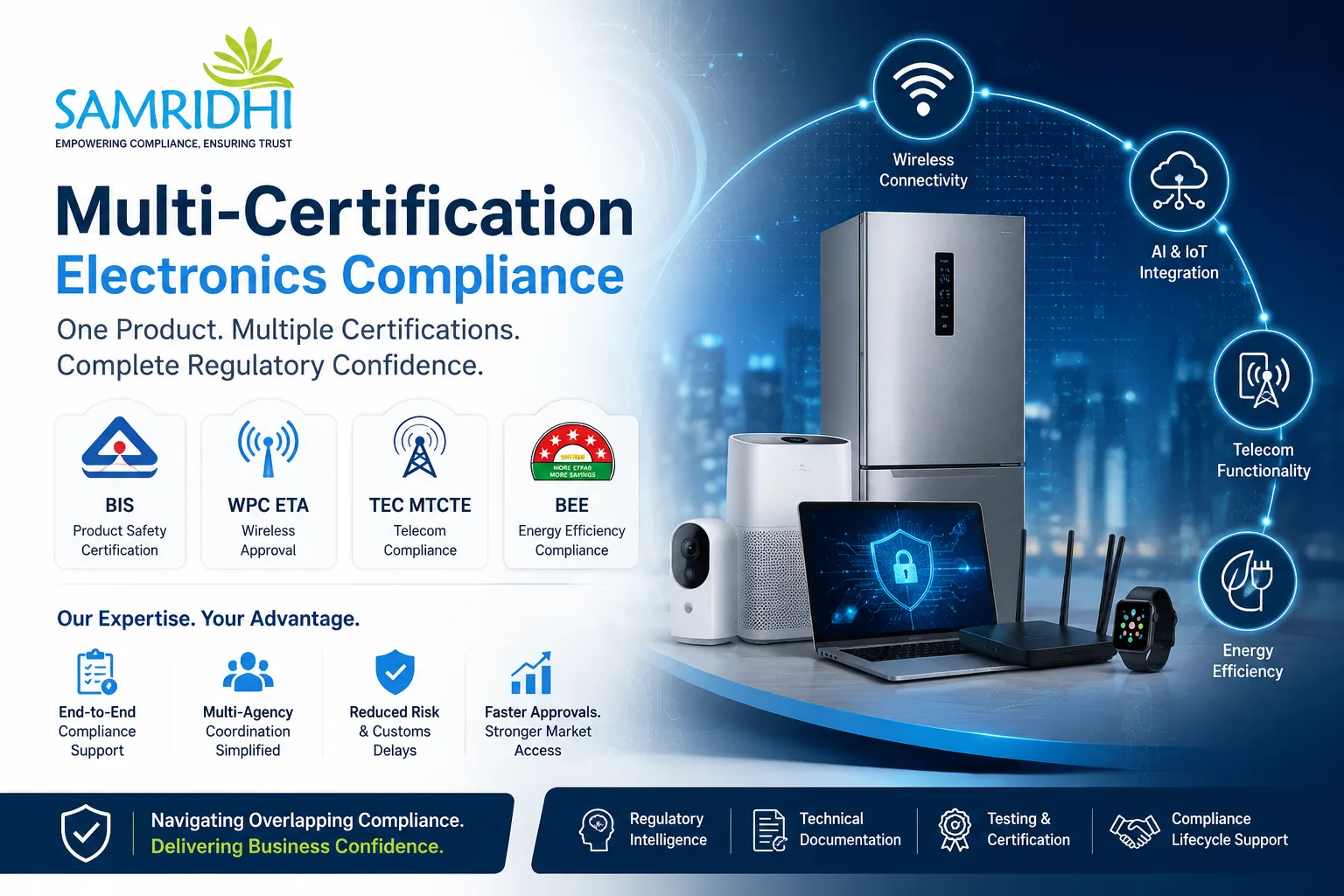
 Get Certified with Confidence – Your One-Stop Compliance Partner
 Grab Your Certified Now
 +91 8799708673
 WhatsApp