BIS vs ISI vs CRS vs FMCS: What Is the Difference and Which Certification Does Your Product Need?
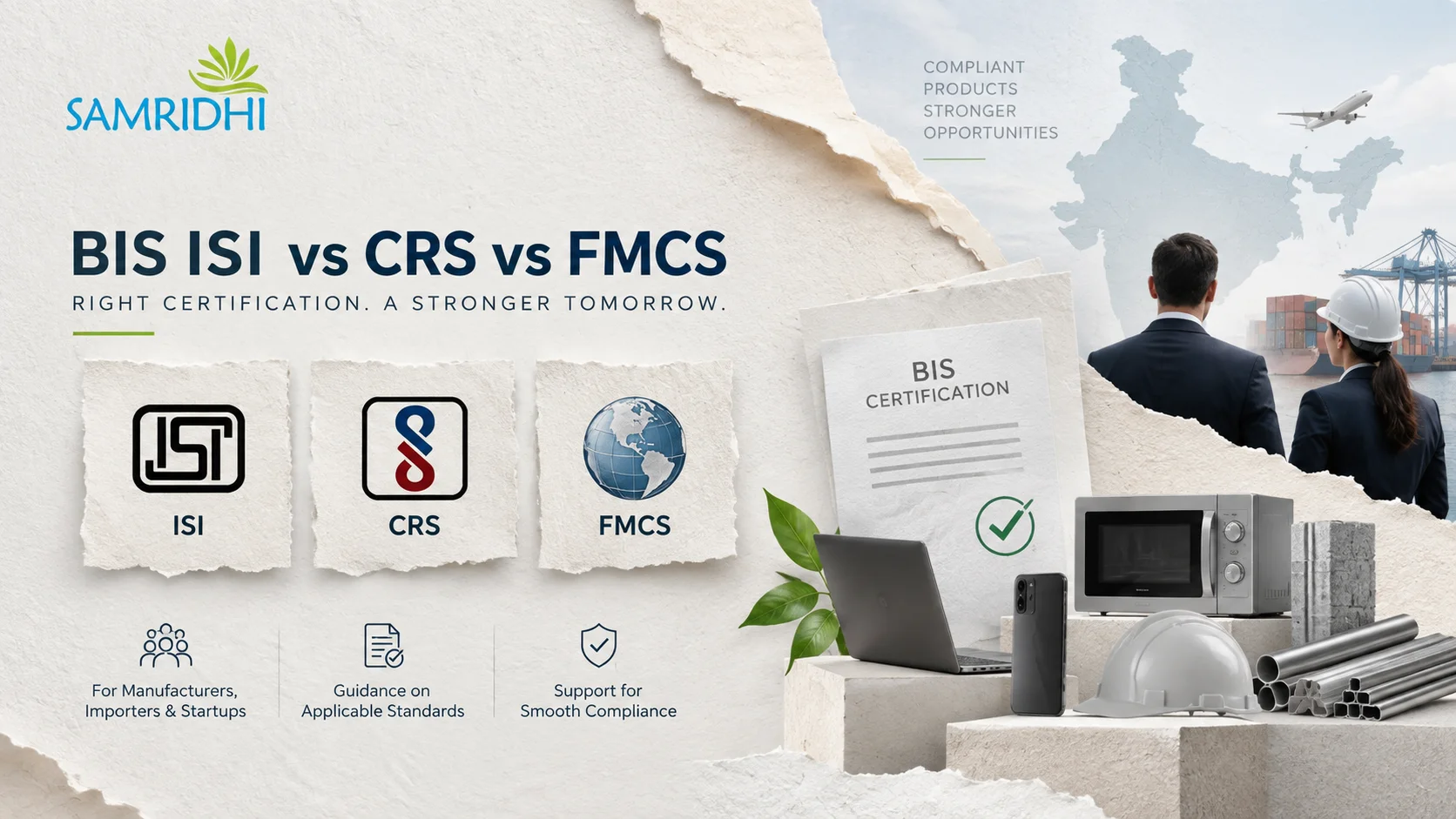
One common source of confusion in Indian product compliance is treating BIS, ISI, CRS and FMCS as four interchangeable certifications. They are not. BIS is the Bureau of Indian Standards, while ISI, CRS and FMCS refer to different certification or registration routes operating under the BIS framework. The right route depends mainly on the product category, applicable Indian Standard, manufacturer location and relevant government notification.
What is BIS certification and where does ISI fit?
When people say BIS certification, they often mean the BIS licence that permits a manufacturer to use the ISI/BIS Standard Mark on a product. Under Scheme-I, BIS assesses the manufacturer's manufacturing infrastructure, process controls, quality-control arrangements and testing capability, while conformity of the product is established through applicable testing.
Understanding the difference between BIS certification routes is particularly important for businesses that are still determining the correct compliance pathway for their products. Indian manufacturers can explore BIS ISI Domestic Manufacturers, while companies manufacturing outside India may need to evaluate BIS ISI Foreign Manufacturers. For applicable electronics and IT products, BIS CRS Registration may be the relevant route, whereas certain other regulated products can fall under BIS Scheme X Certification. Businesses seeking location-based compliance assistance may also consider a BIS Consultant in Delhi, Mumbai or Bangalore, depending on their requirements.
The ISI Mark therefore is not a separate authority from BIS. It is the Standard Mark used under the applicable BIS product-certification arrangement. Whether it is mandatory depends on the product and whether the Government has made compliance compulsory through a QCO.
What is BIS CRS certification?
The BIS Compulsory Registration Scheme (CRS) is a different route, primarily covering notified Electronics and IT Goods. Instead of following the conventional ISI Mark certification route, applicable products are registered under Scheme-II based on conformity to the relevant Indian Standards and the requirements notified for that product category.
BIS is only one part of the regulatory picture for some electronic and electrical products. Depending on the product and its intended use, businesses may also need to evaluate WPC ETA Approval, TEC MTCTE Approval, BEE Star Rating Approval or applicable environmental compliance such as EPR E-Waste Registration. Testing remains an important part of product conformity, making NABL Testing relevant where applicable. These approvals should be assessed separately because one certification does not automatically replace another.
Therefore, searching for a BIS CRS certificate, BIS CRS registration or BIS CRS licence generally points to an electronics/IT product covered by the CRS framework. A product being electronic does not by itself mean CRS applies; the specific notified product category must be checked.
What is BIS FMCS?
FMCS BIS is the Foreign Manufacturers Certification Scheme. It is intended for manufacturers whose factories are located outside India and who need BIS certification for eligible products. BIS states that FMCS can cover products for which an Indian Standard exists and which are amenable to certification, except Electronics and IT products notified under CRS.
Foreign manufacturers entering the Indian market should look beyond BIS alone and identify all product-specific regulatory requirements before shipping. Depending on what is being imported or marketed, separate compliance may involve CDSCO Certification, PESO Certification or an FSSAI License, while ISO Certification may support broader organisational quality-management practices. Where product testing is required, NABL Testing can also be evaluated. These requirements are product-specific and should not be treated as automatic extensions of FMCS.
Under FMCS, the foreign manufacturing unit must demonstrate conformity with the applicable Indian Standard and meet manufacturing, testing and quality requirements. A separate application is required for each product/Indian Standard and manufacturing location.
BIS vs ISI vs CRS vs FMCS at a glance
| Route |
Mainly applies to |
Main outcome |
| BIS / ISI certification |
Products covered by applicable BIS product-certification requirements |
BIS licence and use of Standard Mark |
| CRS |
Notified Electronics & IT Goods |
BIS registration under Scheme-II |
| FMCS |
Eligible foreign manufacturing units |
BIS licence for foreign-manufactured products |
| QCO |
Government-notified products |
Makes specified BIS conformity requirements compulsory |
The important point is that QCOs determine when compliance is compulsory for specified products; they are not themselves a separate certification scheme. BIS explains that compulsory requirements are imposed by the Central Government for notified products, with the applicable Standard Mark or Certificate of Conformity depending on the scheme.
How should you identify the correct certification?
Start with the product, not the name of the certification. First identify the applicable Indian Standard and check whether the product is covered by a current compulsory requirement. BIS specifically recommends identifying the standard first and then reviewing manufacturing, quality-control and testing requirements.
The choice between CRS and FMCS is primarily product- and manufacturer-specific, but businesses entering India may have broader commercial and regulatory considerations as well. Indian businesses can also explore MSME Registration, while eligible startups may consider Startup India Certification as part of their business setup. Trademark Registration can address brand protection, and businesses participating in appropriate domestic manufacturing initiatives may also review Make in India Certification. These services support broader business compliance and market positioning rather than replacing BIS requirements.
Next, determine whether the manufacturer is located in India or overseas and whether the product falls into the CRS category. An Indian manufacturer supplying a conventional BIS-regulated product may follow the applicable ISI certification route, while an eligible overseas manufacturer may need BIS FMCS. A notified Electronics or IT product may instead require BIS CRS Certification.
So, the correct answer is not simply “BIS or ISI.” The applicable route is product-specific, manufacturer-specific and dependent on the current regulatory framework. Before applying for a BIS licence or registration, verify the latest Indian Standard, QCO and product-specific BIS requirements because the scope can change and remains subject to the applicable authority requirements.
BIS CRS Certification vs ISI Mark: Key Differences in Products, Testing, Registration and Marking
BIS CRS Certification and ISI Mark certification are both part of the Bureau of Indian Standards framework, but they are not the same compliance route. The difference becomes important when a manufacturer is deciding whether to apply for BIS CRS Registration, a BIS licence under Scheme-I, or another product-specific conformity route. The correct option depends primarily on the product category, applicable Indian Standard and current government notification.
BIS CRS and ISI Mark are meant for different product categories
The BIS Compulsory Registration Scheme (CRS) is primarily used for notified Electronics and Information Technology Goods. BIS lists products such as certain televisions, laptops, tablets, microwave ovens, UPS/inverters, CCTV equipment and other notified electronic products under Scheme-II. The exact list is periodically amended, so product applicability should always be checked against the current BIS notification.
Once the applicable BIS route has been identified, manufacturers should also review the testing infrastructure and any additional product-specific compliance obligations. Businesses considering an internal testing facility can evaluate Lab Setup and Equipment, while lighting manufacturers may have a specific need for LM79 Testing where applicable. Depending on the product and business activity, environmental obligations may also involve EPR Registration for Plastic Waste, EPR Battery Waste Registration, EPR Tyre Waste Registration or EPR Used Oil Registration. These obligations should be assessed independently according to the applicable rules.
The ISI Mark, on the other hand, is associated with BIS Scheme-I product certification. It covers a wide range of products where BIS grants a licence to the manufacturer to use the Standard Mark after assessment of manufacturing capabilities and product conformity. BIS's Scheme-I list includes products such as cement and many other regulated categories.
So, an electronics product is not automatically an ISI product, and a product requiring BIS compliance is not automatically covered under CRS. The product's notification determines the route.
The testing approach is also different
Under Scheme-I, BIS evaluates the manufacturer's manufacturing infrastructure, production controls, quality-control arrangements and testing capabilities. Product conformity can be established through third-party laboratory testing, testing at the manufacturing premises, or a combination of both.
BIS certification is only one part of compliance for businesses whose products create regulated waste streams. Depending on the nature of the product and the entity's role in the market, additional obligations can include EPR Annual Return Filing, EPR Compliance Reporting & Documentation, EPR Target Fulfillment Support and EPR Authorization Renewal Services. These requirements are separate from BIS certification and should be evaluated according to the applicable environmental regulations.
The CRS framework works around self-declaration of conformity and registration for notified products. The manufacturer must demonstrate conformity to the applicable Indian Standard through the prescribed testing route and then obtain BIS registration before using the registration mark as required.
This distinction is operationally important. A manufacturer should not assume that having a laboratory test report automatically means an ISI licence or a BIS CRS certificate has been obtained. Testing is only one part of the applicable conformity process.
Registration and licence are not interchangeable
Another practical difference is terminology.
For Scheme-I, BIS grants a licence to use the ISI/Standard Mark for the certified product. BIS assesses the factory and product before granting the licence, and ongoing surveillance can be carried out during the licence period.
For CRS, the manufacturer obtains BIS registration under Scheme-II. BIS describes the marking for products covered under the compulsory registration scheme as a Registration Mark, rather than the ISI Mark.
Therefore, terms such as BIS CRS certificate, BIS CRS licence and BIS CRS registration certificate should not be used interchangeably with an ISI licence.
How should a manufacturer choose the correct route?
The safest approach is to start with the product itself. First identify the applicable Indian Standard, then check the current BIS product list and notification. BIS's application guidance specifically starts with identification of the Indian Standard and then requires the manufacturer to assess the relevant manufacturing, quality-control and testing capabilities.
As a practical distinction:
| Area |
BIS ISI / Scheme-I |
BIS CRS / Scheme-II |
| Main route |
Product certification |
Product registration |
| Common coverage |
Various regulated products |
Notified Electronics & IT Goods |
| Mark |
ISI / Standard Mark |
Registration Mark |
| Factory assessment |
Applicable |
Different registration-based framework |
| Product testing |
As prescribed under applicable scheme/product manual |
As prescribed for notified CRS product |
| Outcome |
BIS licence |
BIS registration |
Both routes can be compulsory where the Government has notified the relevant product under a QCO or registration order. BIS explains that compulsory requirements are imposed for specified products through government notifications.
The key takeaway is simple: BIS CRS Certification is not another name for ISI certification. CRS and ISI are different BIS conformity routes with different product coverage, procedures and marking requirements. Before applying for BIS CRS Registration or an ISI licence, manufacturers should verify the latest product notification, Indian Standard and applicable BIS scheme because requirements vary by product and scope and remain subject to the applicable authority requirements.
BIS FMCS vs ISI Certification: What Foreign Manufacturers Need to Know Before Supplying Products in India
For an overseas manufacturer, the terms BIS FMCS and ISI Certification can be confusing because FMCS is itself a BIS certification route through which a foreign manufacturing unit can obtain a BIS licence to use the Standard Mark. The real distinction is therefore between the manufacturer's location and the applicable certification route, rather than treating FMCS and ISI as completely separate certifications. BIS states that FMCS grants a licence to foreign manufacturers for products conforming to relevant Indian Standards.
When does a foreign manufacturer need BIS certification?
The starting point is the product. BIS certification is generally voluntary, but the Central Government can make certification compulsory for specified products through applicable Quality Control Orders. Where a regulated product is being imported into India, the relevant BIS requirement must be satisfied before it can be placed on the Indian market.
The applicable BIS route can change substantially depending on the product, which is why manufacturers should assess product-specific requirements rather than relying on a generic BIS checklist. For example, businesses dealing with LED lights, cables, cement, ceiling fans, water heaters, electric motors, helmets, PVC pipes, steel products and toys should review the relevant Indian Standard and product-specific certification requirements. Similar considerations apply to businesses seeking ISI Certification for Manufacturers, Startups or MSMEs, where factory capability, testing and product scope can differ.
A foreign manufacturer should therefore identify the Indian Standard, check the current compulsory-certification requirement and determine which BIS scheme applies. FMCS is used for eligible products manufactured outside India; BIS separately operates CRS for notified Electronics and IT Goods.
What is the relationship between FMCS and the ISI Mark?
Under FMCS, BIS grants the foreign manufacturer a licence to use the BIS Standard Mark on products manufactured at the approved overseas manufacturing premises and conforming to the relevant Indian Standard. In common industry usage, this may be referred to as obtaining an ISI Mark for the applicable product. The important point is that the licence is tied to the specified manufacturing premises, product and approved scope.
So, a foreign manufacturer does not normally apply for a separate generic “foreign ISI certificate” apart from FMCS. The appropriate BIS route depends on the product and regulatory framework.
What is different for a foreign manufacturer?
The biggest operational difference is the additional FMCS requirements. A foreign manufacturer must have the required manufacturing machinery and facilities at the factory, suitable testing equipment and arrangements, and competent personnel capable of conducting the required tests against the applicable Indian Standard. The manufacturer must also accept the applicable Scheme of Inspection and Testing and licence conditions.
Businesses often need to manage multiple compliance layers rather than a single certificate. Depending on the product and business model, this may include BIS certification, WPC, TEC, BEE, PESO, CDSCO, FSSAI, ISO and EPR compliance. Testing and laboratory requirements may also need separate attention. The appropriate combination depends on the product, manufacturing model, intended market and applicable regulations, so each requirement should be assessed independently.
A separate application is required for each product/Indian Standard and each manufacturing location. This is important for companies with several factories or multiple product standards.
Why is an Authorized Indian Representative required?
One of the key FMCS requirements is the nomination of an Authorized Indian Representative (AIR). The AIR must be an Indian resident and accepts responsibility for compliance with the BIS Act, rules, regulations and licence conditions connected with the foreign manufacturer's BIS licence. Where the manufacturer has an Indian branch or office, an appropriate employee may be nominated; otherwise, another legally appointed person may be used subject to BIS requirements.
The AIR is not simply a contact person. BIS can require the representative to appear before it, facilitate compliance-related activities and support market-sample arrangements.
How does the FMCS process differ from domestic ISI certification?
The basic conformity principle is similar: the manufacturer must demonstrate that its product and production system meet the applicable Indian Standard. BIS's general Scheme-I process involves assessment of manufacturing infrastructure, process controls, quality control and testing capabilities, with conformity established through third-party testing, factory testing or a combination, depending on the applicable requirements.
For FMCS, however, the assessment takes place at the foreign manufacturing premises, and the AIR requirement becomes an additional part of the compliance framework. BIS also states that FMCS applications are now accepted only through the online portal from 1 June 2026.
What should foreign manufacturers prepare first?
Before applying for BIS Certification for Foreign Manufacturers, an overseas company should confirm the applicable Indian Standard, product scope, QCO requirements, factory capabilities, testing arrangements, quality-control procedures and AIR appointment.
The practical mistake is starting with paperwork before confirming whether the product, standard and certification route are correct. BIS itself recommends identifying the Indian Standard first and then analysing the required manufacturing infrastructure, process controls, quality control and testing capabilities.
In simple terms, FMCS is the BIS certification route for eligible foreign manufacturing units, while the ISI/Standard Mark is the mark associated with the applicable product certification licence. The exact certification route, testing scope, documentation, fees and licence requirements vary by product and scope and remain subject to current BIS rules and authority assessment.
BIS CRS vs FMCS: Which Certification Route Applies to Foreign Manufacturers?
For a foreign manufacturer, choosing between BIS CRS Certification and BIS FMCS Certification starts with one basic question: what product are you supplying to India? The manufacturing location alone does not decide the route. BIS operates FMCS for foreign manufacturers for eligible products, while CRS is specifically operated for notified Electronics and IT Goods.
When does BIS FMCS apply?
The Foreign Manufacturers Certification Scheme (FMCS) is the BIS route for manufacturers whose factory is located outside India. BIS grants a licence under FMCS for products that conform to the applicable Indian Standard. The scheme applies to products other than Electronics and IT Goods notified under the CRS framework.
For example, if an overseas manufacturer produces a product covered by a mandatory BIS requirement and that product is not within the notified CRS categories, BIS FMCS may be the appropriate route. The foreign factory must have the required manufacturing machinery, testing arrangements and competent testing personnel at its premises. A separate application is required for each product/Indian Standard and each manufacturing location.
When does BIS CRS apply?
The Compulsory Registration Scheme (CRS) is primarily for Electronics and IT Goods notified under the relevant government orders. BIS's current CRS list includes categories such as laptops, tablets, televisions, microwave ovens, certain display equipment, power adaptors and other notified electronics and IT products. The exact product list should always be checked because notifications and standards can be amended.
For a foreign manufacturer, this means an electronics or IT product covered by the CRS notification is generally assessed through BIS CRS registration, rather than FMCS. It is therefore incorrect to select FMCS simply because the factory is outside India.
The biggest difference is certification versus registration
The two routes also differ in their compliance mechanism.
Under FMCS, BIS grants a licence to use the Standard Mark for products manufactured at the approved foreign premises and conforming to the relevant Indian Standard.
CRS is operated under Scheme-II and is based on registration/self-declaration of conformity for notified Electronics and IT Goods. Products covered by CRS must comply with the applicable Indian Standard and carry the prescribed BIS marking and registration details.
So, a search for a BIS CRS certificate should not lead a manufacturer to assume that the same process applies to every foreign-made product.
What happens with factory assessment and testing?
FMCS involves a direct assessment of the foreign manufacturing unit. BIS requires the applicant to have manufacturing facilities, testing equipment and competent personnel at the factory. BIS evaluates the manufacturer's infrastructure, quality controls and conformity of the product before granting the licence.
CRS follows a different registration framework for notified electronic and IT products. The manufacturer must establish conformity through the prescribed testing and documentation route before seeking registration. Therefore, foreign manufacturers should review the applicable CRS product requirements rather than trying to apply FMCS procedures to a CRS product.
Is an Authorized Indian Representative required?
FMCS has a specific Authorized Indian Representative (AIR) requirement. The AIR must be an Indian resident and is responsible for compliance-related obligations connected with the foreign manufacturer's BIS licence. BIS can require the AIR to facilitate regulatory activities and market-sample collection, and the AIR's details are endorsed on the licence.
This makes AIR selection an important part of an FMCS application. It should not be treated merely as an administrative formality.
How should a foreign manufacturer choose the correct route?
A practical decision process is:
Product → Indian Standard → Current BIS notification → Product category → Applicable scheme
First identify the Indian Standard and determine whether the product is covered by a compulsory requirement. BIS itself recommends identifying the applicable standard first and then assessing manufacturing infrastructure, process controls, quality control and testing capabilities.
If the product is a notified Electronics and IT Good under CRS, BIS CRS Registration is the relevant route. For other eligible products manufactured outside India, BIS FMCS may apply.
One more point is important: FMCS and CRS are not simply optional alternatives chosen by the exporter. The product's regulatory classification determines the applicable route. The exact requirements, testing, documentation, fees and marking obligations vary by product and remain subject to the current BIS notification and authority requirements.
How to Choose Between BIS ISI, CRS and FMCS: Check Product Category, Manufacturer Location and Compliance Requirements
Choosing between BIS ISI, CRS and FMCS is not simply a matter of selecting the certification that sounds most relevant. The correct route is determined by the product category, applicable Indian Standard, manufacturer location and current regulatory notification. BIS operates different conformity-assessment frameworks, and the applicable route can change depending on how the product is regulated.
Start with the product category
The first step is to identify the exact product and the Indian Standard (IS) applicable to it. BIS's product-specific information includes Product Manuals, Scheme of Inspection and Testing, grouping guidelines and guidance for different certification schemes.
This is important because products with similar commercial names can have different standards or certification requirements. For products covered under Scheme-I, BIS grants a licence for use of the ISI Mark after evaluating the manufacturer's production, quality-control and testing capabilities and establishing conformity with the applicable standard.
When is the ISI route appropriate?
The BIS ISI certification route generally refers to Scheme-I product certification. It is used across a wide range of products, including many regulated industrial and consumer products. BIS maintains a product-specific list showing which standards and products fall under the Scheme-I framework.
Under this route, the manufacturer needs suitable production infrastructure, process controls, quality-control arrangements and testing capabilities. BIS may establish conformity through testing at the factory, third-party laboratory testing or a combination, depending on the product requirements.
When should you consider CRS?
The Compulsory Registration Scheme (CRS) is a separate BIS registration framework primarily applicable to notified Electronics and IT Goods. Products covered under CRS use a Registration Mark, rather than the conventional ISI Mark used under Scheme-I.
Therefore, an electronic product should not automatically be sent through the ISI route simply because it is subject to BIS compliance. The manufacturer must check whether that particular product appears in the current CRS notification and whether the applicable Indian Standard is included.
When does FMCS apply?
The Foreign Manufacturers Certification Scheme (FMCS) becomes relevant when the manufacturing premises are located outside India and the product is eligible for this route. BIS states that FMCS can grant a BIS licence to foreign manufacturers for products conforming to relevant Indian Standards, except Electronics and IT products notified under CRS.
So, a foreign factory producing a conventional BIS-regulated product may need FMCS BIS, while an overseas manufacturer of a notified CRS electronics product would follow the CRS framework instead.
Manufacturer location changes the compliance route
Manufacturer location is therefore the second major checkpoint.
An Indian manufacturer seeking a conventional product certification licence will generally evaluate the applicable Scheme-I/ISI requirements. A foreign manufacturer must additionally consider FMCS or, where applicable, CRS.
This distinction becomes particularly important for companies operating multiple factories. BIS states that FMCS certification is granted for products manufactured at a specified manufacturing premises, and separate applications are required for each product/Indian Standard and manufacturing location.
Check whether certification is compulsory
The third checkpoint is the current government regulation. BIS explains that certification is basically voluntary, but the Central Government can make compliance compulsory for specified products through Quality Control Orders (QCOs). For such products, the applicable BIS licence, registration or Certificate of Conformity becomes part of the regulatory requirement.
That means a manufacturer should not decide based only on whether an Indian Standard exists. The current QCO, notification and implementation requirements must also be checked.
A simple way to select the correct route
| Check |
Question |
Likely direction |
| 1 |
What product is being manufactured? |
Identify applicable IS |
| 2 |
Is it a notified Electronics/IT product? |
Check CRS |
| 3 |
Is the factory outside India? |
Check FMCS |
| 4 |
Is it under Scheme-I? |
Consider ISI certification |
| 5 |
Is certification compulsory? |
Check current QCO |
| 6 |
What testing is prescribed? |
Review Product Manual/SIT |
The practical sequence is therefore Product → Indian Standard → Regulatory notification → Manufacturer location → Applicable BIS scheme → Testing and documentation.
This avoids one of the most common compliance mistakes: starting the application before confirming the correct scheme. The exact requirements, testing arrangements, documentation, fees and marking obligations vary by product and scope and remain subject to current BIS requirements and authority assessment.


 Get Certified with Confidence – Your One-Stop Compliance Partner
 Grab Your Certified Now
 +91 8799708673
 WhatsApp