How to Identify the Correct Indian Standard for Your Helmet: Understanding IS 4151, Two-Wheeler Helmets, Helmet Types, Sizes, Visors and Product Applicability Before BIS ISI Certification
Before starting ISI Certification for Helmets, manufacturers should first establish exactly what type of helmet they are producing and whether it falls within the scope of the applicable Indian Standard. Choosing the standard based only on the commercial description—such as “bike helmet” or “motorcycle helmet”—can create problems later with testing, model coverage and certification documentation.
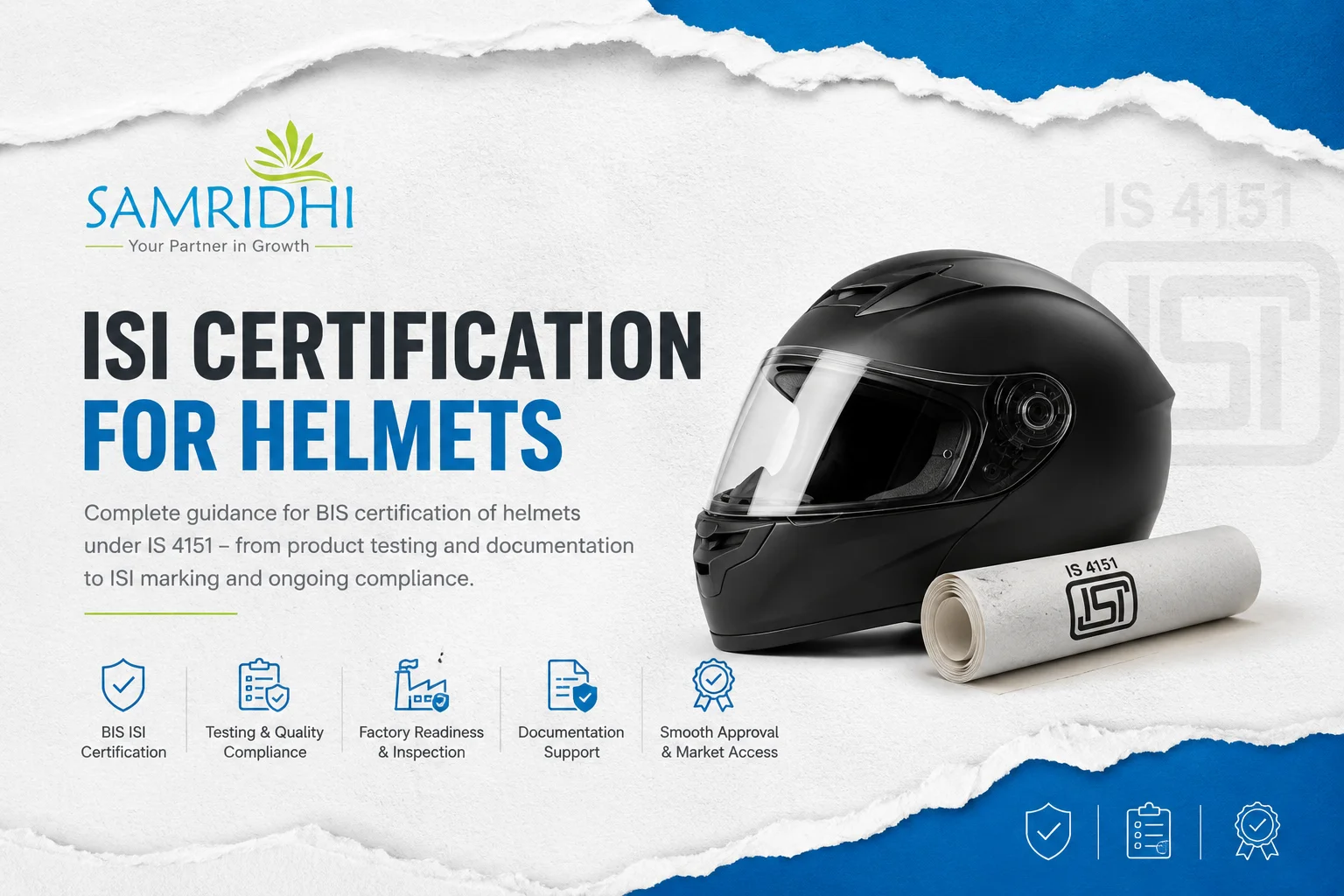
For protective helmets intended for motorcycle riders, IS 4151:2015 — Protective Helmets for Motorcycle Riders — Specification is the key Indian Standard. BIS identifies it as the fourth revision of the standard.
BIS requirements vary according to the product and its applicable Indian Standard. Manufacturers can also explore related guides on ISI Certification for LED Lights, BIS ISI Certification for Cables and BIS Certification for Cement to understand how product-specific ISI certification requirements differ across industries.
Start With the Intended Use
The first question is straightforward:
Who is the helmet designed for and how will it be used?
IS 4151:2015 addresses protective helmets for motorcycle/two-wheeler riders. BIS's product manual identifies the product as “Protective Helmet for Two Wheeler Riders.”
This distinction matters because India has different standards for different types of protective headgear. A motorcycle helmet should not automatically be assessed against a standard intended for an industrial safety helmet, sports helmet or another specialized product.
Therefore, manufacturers should document the intended application before beginning certification planning.
Understand the Helmet Construction
The next step is to examine the actual construction.
A typical protective helmet can include:
- Outer shell
- Protective padding
- Comfort padding
- Retention system
- Chin strap
- Visor
- Lower face cover
- Other permitted components
BIS's product information describes IS 4151 as covering requirements relating to materials, construction, workmanship, finish, mass and performance.
The presence or absence of particular features can also matter when defining the certification scope.
For example, BIS's product manual specifically allows the licence scope to identify helmets with or without a lower face cover and with or without a visor.
The applicable BIS requirements depend on the product category, Indian Standard and regulatory framework. For comparison, businesses can also read about ISI Certification for Ceiling Fans and ISI Certification for Water Heaters to understand how mandatory ISI certification can vary between electrical products.
Helmet Type and Product Variants Matter
Manufacturers often have several versions of what appears to be the same helmet:
- Open-face configuration
- Helmet with lower face cover
- Helmet without lower face cover
- Helmet with visor
- Helmet without visor
- Different shell designs
- Different sizes
These should not simply be treated as identical products for certification purposes.
BIS's product grouping guidance for IS 4151 states that each variety of helmet shall be tested to cover that variety in the licence. The product manual also specifies a sample size of eight helmets for the listed testing arrangement.
This makes model and variety mapping an important step before submitting an application.
For businesses planning BIS certification for regulated helmets, the applicable certification route should be assessed according to the manufacturing location and product scope. Indian manufacturers can explore BIS ISI Domestic Manufacturers, while overseas manufacturers can refer to BIS ISI Foreign Manufacturers for the relevant foreign-manufacturer certification framework.
Size Is a Certification Parameter
Size is not merely a marketing option.
BIS's product manual specifically provides for product size within the licence scope, while size itself is also identified as a test requirement.
A manufacturer should therefore prepare a clear product matrix showing:
Model → Helmet type → Size → Visor configuration → Lower face cover → Design/variety
This makes it easier to understand which products need to be represented during testing.
For manufacturers offering many sizes, the applicable BIS grouping requirements should be reviewed rather than assuming that one tested size automatically covers every size.
What About the Visor?
A visor is another detail that should be identified at the beginning.
The BIS product manual expressly recognizes helmets with or without visor within the product scope.
BIS laboratory information for IS 4151 also identifies the visor among the product/material characteristics considered during testing.
Therefore, manufacturers should accurately document whether the certified helmet is supplied with a visor and ensure that the product configuration submitted for certification corresponds with the version intended for commercial production.
A Practical Product-to-Standard Framework
Before pursuing BIS Certification for Helmets, manufacturers can use this simple sequence:
1. Intended use
Is the product designed as a protective helmet for two-wheeler/motorcycle riders?
↓
2. Standard applicability
Check whether IS 4151:2015 is the applicable Indian Standard.
↓
3. Helmet construction
Identify shell, protective padding, retention system and other components.
↓
4. Product type
Record whether it has a lower face cover and/or visor.
↓
5. Size range
List every proposed size and relevant headform/designation.
↓
6. Varieties
Separate technically different helmet configurations.
↓
7. Testing scope
Determine the samples and tests required for each applicable variety.
↓
8. Licence scope
Ensure the proposed BIS licence accurately represents the products intended for sale.
Before manufacturing, importing or commercially supplying a regulated helmet, businesses should establish the applicable BIS certification route and product scope. BIS ISI Domestic Manufacturers supports the domestic-manufacturer certification context, while BIS ISI Foreign Manufacturers is relevant for overseas manufacturing units supplying products to India.
Why Choosing the Wrong Standard Creates Problems
Selecting the standard too early—or selecting it based only on a keyword—can create downstream issues.
For example, a manufacturer may prepare testing for one helmet configuration but later discover that another variety needs separate consideration. Similarly, a product may have a visor or lower-face-cover configuration that changes the proposed certification scope.
BIS's product manual makes the variety issue particularly important because each variety is to be tested for coverage in the licence.
The consequences can include:
- Incorrect testing plans
- Additional samples
- Documentation revisions
- Scope clarification
- Delayed certification planning
- Reassessment of product variants
The exact treatment remains product-specific and subject to BIS review.
Check the Current BIS Position Before Applying
Manufacturers should also avoid relying entirely on old articles or consultant checklists.
BIS continues to identify IS 4151:2015 as the standard for protective helmets for motorcycle riders, and the Ministry of Road Transport and Highways made BIS certification mandatory for this product through the Helmet for Riders of Two Wheeler Motor Vehicles (Quality Control) Order, 2020.
At the same time, BIS product and laboratory information should be checked for the current testing, sampling, marking and implementation requirements applicable when the application is prepared.
For ISI Certification for Helmets, the correct starting point is not the application form—it is product classification.
Manufacturers should first establish:
Intended use → helmet type → construction → lower face cover → visor → size → variety → applicable Indian Standard → testing scope.
For two-wheeler and motorcycle protective helmets, IS 4151:2015 is the principal standard to examine. BIS's certification documentation specifically distinguishes helmet varieties, sizes and configurations, including helmets with or without lower face covers and visors.
Getting this classification right at the beginning helps manufacturers build a more accurate testing and certification plan. The exact applicability, model coverage and sample requirements depend on the product configuration, current BIS documentation and certification scope, and should be verified before applying for BIS ISI Certification for Helmets.
Does Your Helmet Need Mandatory BIS ISI Certification Before Manufacturing, Importing or Selling in India?
For manufacturers and businesses entering the Indian helmet market, BIS ISI Certification for Helmets is not simply a voluntary quality badge. Protective helmets for two-wheeler riders are covered by a mandatory Quality Control Order, which requires conformity to the applicable Indian Standard and use of the BIS Standard Mark under a valid licence. The key standard specified for this product is IS 4151:2015.
Is BIS Certification Mandatory for Two-Wheeler Helmets?
Yes, for helmets covered by the Helmet for Riders of Two Wheeler Motor Vehicles (Quality Control) Order, 2020, BIS certification is mandatory.
The QCO was notified on 26 November 2020 and came into force on 1 June 2021. It specifies IS 4151:2015 — Protective Helmet for Two Wheeler Riders as the applicable Indian Standard and requires covered helmets to conform to the standard and bear the Standard Mark under a BIS licence.
This means manufacturers cannot treat BIS Certification for Helmets as an optional commercial decision when their product falls within the QCO.
Helmet certification involves product-specific testing and appropriate laboratory arrangements. Businesses can explore NABL Testing for applicable testing requirements and Lab Setup and Equipment when establishing or strengthening in-house testing infrastructure and quality-control facilities.
What Does the Helmet QCO Cover?
The QCO specifically identifies:
Helmet for riders of Two Wheeler Motor Vehicles → IS 4151:2015
The order also states that the latest version of the Indian Standard, including amendments notified by BIS, applies from the date of such notification.
Therefore, manufacturers should verify the current BIS position when preparing an application rather than relying only on an old certification checklist.
BIS currently identifies IS 4151:2015 — Protective helmets for motorcycle riders — Specification (Fourth Revision) on its website.
Does Every Helmet Need IS 4151 Certification?
Not necessarily.
The critical question is whether the product falls within the specific scope of the QCO and IS 4151.
For example, manufacturers may deal with different types of protective headgear intended for motorcycle riding, industrial safety, sports or other applications. A product should therefore be classified according to its intended use and technical characteristics, rather than simply being called a “helmet.”
For two-wheeler rider helmets covered by the QCO, IS 4151 is the relevant standard to assess.
The exact applicability can be product-specific and subject to the applicable regulatory requirements.
What If You Manufacture Helmets in India?
An Indian manufacturer producing helmets covered by the QCO needs to obtain the applicable BIS licence before commercially supplying the regulated product.
BIS explains that manufacturers applying for product certification need appropriate manufacturing infrastructure, process controls, quality control and testing capabilities, and the product must conform to the relevant Indian Standard. BIS assesses these capabilities as part of the certification process.
The overall certification effort depends on the number of helmet varieties, testing scope, sample requirements and factory preparedness. Manufacturers can review BIS ISI Domestic Manufacturers for the broader BIS certification framework, while NABL Testing and Lab Setup and Equipment are relevant when assessing external testing and laboratory infrastructure requirements.
For helmet manufacturers, this means certification planning should begin before commercial production and market launch—not after finished stock has already been manufactured.
The factory should be prepared for:
- Product testing
- Quality control
- Required testing equipment
- Calibration
- Technical documentation
- Sample preparation
- Manufacturing-process assessment
- Applicable inspection requirements
What About Imported Helmets?
Importers should be particularly careful.
A business importing helmets cannot simply assume that the Indian importer itself can obtain a BIS licence for a foreign manufacturer's product.
BIS states that product certification licences are issued to manufacturing units, rather than dealers, importers, retailers, wholesalers or distributors. Businesses in the supply chain must ensure that regulated products are sourced from an appropriately licensed manufacturing unit.
For an overseas helmet manufacturer, the applicable foreign-manufacturer certification route needs to be assessed based on the BIS framework.
Therefore, before placing an import order, businesses should verify:
- Manufacturer identity
- Manufacturing location
- Applicable Indian Standard
- BIS licence status
- Certified product scope
- Model/design coverage
- Size and type coverage
- Marking requirements
This due diligence is particularly important for BIS Certification for Motorcycle Helmets because the certification scope can be linked to specific product varieties.
What Happens If You Want to Sell Without BIS Certification?
If a helmet falls under the QCO, commercial sale or supply without complying with the mandatory certification requirements creates a regulatory risk.
The QCO specifically requires covered helmets to conform to the applicable Indian Standard and bear the Standard Mark under a BIS licence.
The issue therefore goes beyond whether a helmet has passed an internal safety test.
A manufacturer or importer needs to establish that the product, manufacturing unit, certification scope and marking are aligned with the applicable BIS requirements.
Potential business problems can include:
- Product launch interruptions
- Procurement rejection
- Inventory complications
- Additional testing
- Documentation corrections
- Regulatory action
- Reassessment of product scope
The exact consequences depend on the applicable law and circumstances.
Product Variants Need Attention Before Certification
Another important consideration is model and variety coverage.
The BIS product manual for IS 4151 states that each model/design, type and size of helmet is to be tested to cover that variety in the licence. The manual also identifies an eight-helmet sample size for the specified testing arrangement.
This can have a direct effect on certification planning.
For example, a manufacturer may produce:
- Several helmet designs
- Different sizes
- Helmets with or without a visor
- Helmets with or without a lower face cover
These should be mapped carefully against the applicable BIS product scope.
A company should not assume that testing one commercially similar helmet automatically covers every design and size it sells.
When Should Manufacturers Start BIS Certification?
The safest practical approach is to start before commercial manufacturing and market entry.
A useful sequence is:
Product classification
↓
IS 4151 applicability check
↓
Model/design/size mapping
↓
Factory and testing assessment
↓
Technical documentation
↓
BIS application
↓
Testing and conformity assessment
↓
Factory assessment, where applicable
↓
Licence
↓
Commercial production and marking within approved scope
This allows technical issues to be identified before the business commits significant resources to production.
What Does BIS Look for in the Factory?
BIS's general product-certification guidance states that manufacturers need appropriate infrastructure, process controls, quality control and testing capabilities. Conformity may be established through third-party laboratory testing, testing at the manufacturing premises, or a combination, depending on the applicable certification arrangement.
For a helmet manufacturer, preparation should therefore cover more than documentation.
The factory should consider:
- Testing equipment
- Competent personnel
- Calibration arrangements
- Quality-control procedures
- Production controls
- Test records
- Sample identification
- Material controls
- Technical drawings and specifications
The precise requirements vary by certification scope and applicable BIS documentation.
After certification, manufacturers need to maintain product conformity, testing records, production controls and appropriate ISI marking practices. Businesses can refer to BIS ISI Domestic Manufacturers for BIS-related certification requirements and explore ISO Certification for broader quality-management processes that may support internal compliance systems. Overseas manufacturers can also review BIS ISI Foreign Manufacturers where applicable.
A Practical Market-Entry Checklist
Before manufacturing, importing or selling a regulated two-wheeler helmet, check:
| Requirement |
What to verify |
| Product |
Is it a two-wheeler rider helmet? |
| Standard |
Does IS 4151 apply? |
| QCO |
Is the product covered by the current QCO? |
| Manufacturer |
Is the manufacturing unit correctly identified? |
| Models |
Are all intended designs mapped? |
| Sizes |
Are proposed sizes covered? |
| Types |
Are visor/lower-face-cover configurations identified? |
| Testing |
Are required tests planned? |
| Factory |
Is the manufacturing facility ready? |
| Documentation |
Do specifications match the actual product? |
| Licence |
Is the appropriate BIS licence in place? |
| Marking |
Is the Standard Mark being used according to requirements? |
For BIS Certification for Helmets, the answer is clear for products covered by the Helmet for Riders of Two Wheeler Motor Vehicles QCO: certification is mandatory, and the applicable standard specified in the QCO is IS 4151:2015. The QCO has been effective since 1 June 2021.
Manufacturers should therefore determine applicability before commercial production, while importers should verify the certification status and scope of the foreign manufacturing unit before bringing regulated helmets into India.
The important point is that certification does not depend only on the word “helmet.” The actual intended use, model/design, type, size, product configuration, applicable standard and QCO need to be assessed.
The BIS product manual specifically requires each model/design, type and size to be considered for licence coverage, making early product-scope planning particularly important.
The exact certification route, testing requirements and scope depend on the product configuration and current BIS requirements and remain subject to authority review.
What Testing and Factory Facilities Are Required for BIS Certification of Helmets? Understanding Impact Absorption, Penetration, Rigidity, Retention System, Chin Strap, Audibility and Other Safety Tests
For manufacturers seeking BIS Certification for Helmets, factory readiness is not limited to having a production line and basic quality-control instruments. Under IS 4151:2015, protective helmets for motorcycle riders are subject to a range of construction, performance and safety tests. The manufacturer's testing arrangement, equipment, calibration and competent personnel should be planned around the applicable certification scope. BIS currently lists IS 4151:2015 as the specification for protective helmets for motorcycle riders.
Impact Absorption Is a Core Safety Test
Impact absorption is one of the most important tests because the helmet's primary purpose is to reduce the severity of impact transmitted to the rider's head.
BIS's IS 4151 product documentation identifies impact absorption testing under Clause 7.2 as part of the helmet testing programme. The standard's technical description also highlights impact points, a kerb-stone anvil, impact velocity and head injury criteria.
A manufacturer therefore needs an appropriate impact-testing arrangement rather than relying on routine production checks. The exact apparatus and test conditions should follow the applicable version of IS 4151 and current BIS testing requirements.
Testing requirements are product-specific and can differ significantly depending on the applicable Indian Standard. Businesses can compare the technical and factory considerations covered in ISI Certification for LED Lights, BIS ISI Certification for Cables and ISI Certification for Water Heaters.
Penetration and Rigidity Need Separate Attention
Helmet performance is not judged by impact absorption alone.
The BIS testing framework also addresses rigidity and, where applicable under the relevant testing arrangement, resistance to projections and surface friction. BIS laboratory records identify rigidity testing under Clause 7.3 and projections and surface-friction testing under Clause 7.4.
These tests examine different aspects of helmet construction. A helmet can therefore not be considered compliant simply because it performs satisfactorily in one impact test.
Manufacturers should map every applicable test to the equipment, sample and acceptance requirement before beginning certification.
Retention System Testing
A helmet must remain securely positioned during an accident.
IS 4151 therefore includes dynamic testing of the retention system, along with retention testing of the helmet itself. BIS's product manual identifies a dedicated dynamic retention test under Clause 7.5 and a retention/detaching test under Clause 7.7.
The testing arrangement involves specified headforms and loading conditions. For example, the BIS product manual identifies a headform with a specified mass and a falling mass arrangement for the dynamic retention-system test.
This means the factory laboratory needs specialized equipment rather than ordinary dimensional or electrical testing instruments.
Chin Strap Testing Is Also Important
The chin strap forms part of the retention system and has its own testing requirements.
BIS identifies:
- Micro-slip testing of the chin strap
- Resistance to abrasion
- Retention-system testing
- Quick-release mechanism testing, where applicable
The product manual specifies dedicated equipment for micro-slip and abrasion testing, including a reciprocating clamp and suitable abrasion/slippage apparatus.
For manufacturers using quick-release systems, additional checks can include inadvertent release by pressure, ease of release and durability of the quick-release mechanism.
The exact tests depend on the helmet's construction and retention mechanism.
Certification effort depends on product variants, technical specifications, testing scope and factory readiness rather than a single standard cost. Related guides on ISI Certification for Electric Motors and ISI Certification for Ceiling Fans provide useful comparisons of how product configuration can influence BIS certification planning.
Audibility and Peripheral Vision
Safety also includes the rider's ability to remain aware of the surrounding environment.
IS 4151 includes an audibility test, and BIS laboratory records list audibility testing as a specific test under Clause 7.6.
The product manual also identifies peripheral vision as a construction/performance consideration, with headforms of different sizes and equipment for checking the relevant angle.
This is an important reminder that certification covers more than shell strength. Helmet design has to satisfy several safety and usability characteristics together.
Factory Laboratory Equipment
Depending on the certification scope, a helmet manufacturer may need access to equipment for:
- Impact absorption
- Rigidity
- Retention-system testing
- Chin-strap testing
- Audibility
- Peripheral vision
- Dimensional checks
- Mass measurement
- Material and construction checks
- Quick-release mechanism testing, where applicable
BIS's laboratory database shows separate testing charges and facilities for these different tests, demonstrating that helmet certification involves a substantial range of technical assessments.
The manufacturer should therefore create a test-to-equipment matrix before investing in laboratory infrastructure.
Calibration and Competent Personnel
Equipment alone does not establish factory readiness.
The manufacturer should maintain appropriate calibration, test procedures, equipment identification and records. Personnel conducting the tests should understand the applicable method and safety requirements.
ISI certification remains an ongoing compliance responsibility after the licence is issued. Manufacturers can also explore BIS Certification for Cement and ISI Certification for Electric Motors to understand how testing, product changes, certification scope and ongoing compliance can differ across certified products.
A practical laboratory file should include:
Equipment → Calibration → Test procedure → Sample identification → Test result → Acceptance decision → Record
This makes the testing process traceable and easier to review during certification or subsequent compliance activities.
Can Every Test Be Done In-House?
Not necessarily.
The applicable BIS product manual and certification arrangement should be checked to determine which tests are required at the manufacturer's premises and whether particular tests can be subcontracted.
BIS's product documentation distinguishes testing facilities and requirements, while its laboratory system identifies recognized testing facilities for IS 4151.
Therefore, manufacturers should classify each requirement as:
In-house required → External testing permitted → Not applicable
rather than assuming that every possible test must be established internally.
Testing Samples and Product Variants
Sample planning becomes important when a manufacturer produces different helmet designs, sizes or configurations.
The BIS product manual states that each variety is to be tested for coverage in the licence.
A manufacturer should therefore map:
Model → Design → Type → Size → Visor configuration → Lower-face-cover configuration
before finalizing its testing plan.
This prevents a situation where a factory has tested one helmet but later discovers that another variety requires separate consideration.
The Practical Takeaway
BIS Certification for Helmets requires manufacturers to look beyond basic production quality checks. IS 4151 includes a broad safety-testing framework covering impact absorption, rigidity, projections and surface friction, dynamic retention, audibility, helmet retention, chin-strap micro-slip and abrasion, and quick-release mechanisms where applicable.
The factory should therefore assess its laboratory equipment, calibration system, personnel, test procedures and record-keeping before beginning certification.
The exact testing arrangement depends on the helmet type, variety, size, design, applicable IS 4151 requirements and current BIS certification documents. Where external testing is permitted, the manufacturer should establish the appropriate laboratory arrangement rather than unnecessarily duplicating every facility in-house.
A practical preparation sequence is:
Identify product scope → map varieties and sizes → identify applicable tests → assess laboratory equipment → verify calibration → train personnel → prepare records → arrange permitted external testing → proceed with BIS assessment.
This approach gives helmet manufacturers a much clearer understanding of what BIS ISI Certification for Helmets requires at the factory level without assuming that one generic testing checklist applies to every product configuration.
What Determines the Cost and Timeline of BIS ISI Certification for Helmets? Understanding Helmet Varieties, Sizes, Testing Samples, Laboratory Requirements, Factory Readiness and Documentation
The cost and timeline of BIS ISI Certification for Helmets are not determined by a single BIS fee. For manufacturers of two-wheeler helmets, the actual effort depends on the number of varieties, sizes and configurations being covered, testing requirements, sample quantities, laboratory arrangements, factory readiness and the quality of technical documentation.
For IS 4151:2015, BIS's product manual states that each variety of helmet is to be tested to cover that variety in the licence, with the published product manual specifying eight helmets as the sample size for all tests. BIS subsequently issued a revised product manual in December 2024 changing the surveillance sample quantity to 9 helmets + 3 m chin straps.
Helmet Varieties Can Change the Certification Scope
A manufacturer may have a seemingly simple product range but several technically different helmet varieties.
For example, products may differ by:
- Helmet design
- Type
- Size
- Visor configuration
- Lower-face-cover configuration
- Retention system
- Construction
BIS's product manual specifically states that each variety should be tested for coverage in the licence. This makes product classification one of the first things a manufacturer should settle before estimating certification costs.
A manufacturer with a small, clearly defined product range may therefore have a very different certification workload from one offering dozens of designs and configurations.
Size Matters More Than Manufacturers Often Expect
Size is not simply a catalogue option.
The BIS product manual includes size as part of the product requirements, while BIS laboratory listings also identify size testing under IS 4151.
If a manufacturer offers several sizes, it should prepare a clear matrix showing:
Model → Design → Type → Size → Visor → Lower face cover
This allows the certification scope and sample requirements to be evaluated properly.
Manufacturers should not assume that testing one size automatically establishes coverage for every size unless the applicable BIS grouping provisions support that treatment.
Testing Is a Major Cost Component
Helmet certification involves considerably more than a basic shell inspection.
BIS laboratory records for IS 4151 list testing such as:
- Impact absorption
- Rigidity
- Projections and surface friction
- Dynamic retention-system testing
- Audibility
- Helmet retention
- Chin-strap micro-slip
- Chin-strap abrasion
- Quick-release mechanism tests, where applicable
- Size and construction checks
The exact testing scope depends on the product configuration and applicable requirements.
The published BIS LIMS database also shows that testing charges vary between laboratories. For example, current listings show overall IS 4151 testing charges of ₹14,000, ₹14,200, ₹37,350 and ₹55,000 at different laboratories, excluding applicable taxes and subject to each laboratory's listed scope and conditions.
These figures should not be treated as a universal BIS certification price. They illustrate why laboratory selection and testing scope can materially affect the overall budget.
Individual Tests Can Also Have Different Charges
The same BIS laboratory records show substantial differences between individual tests.
At one listed laboratory, for example, the charges include approximately:
- Impact absorption — ₹1,500
- Rigidity — ₹500
- Projections and surface friction — ₹1,500
- Dynamic retention system — ₹500
- Audibility — ₹900
- Retention test — ₹1,000
- Chin-strap micro-slip — ₹1,000
- Chin-strap abrasion — ₹1,000
Other laboratories list substantially different charges for comparable testing.
Therefore, asking for a generic “BIS Certification Cost for Helmets” without defining the product scope can produce a misleading estimate.
Sample Quantity Can Affect the Practical Budget
Sample requirements should be considered early.
The original product manual states eight helmets for all tests for IS 4151:2015.
More recently, BIS issued a December 2024 circular concerning surveillance and stated that the sample quantity had been modified to 9 helmets + 3 m chin strap. It also instructed offices to ensure adequate quantities were drawn during surveillance.
This illustrates an important point: sample planning can change according to the stage of certification and the applicable current BIS instructions.
Manufacturers should therefore verify the latest product manual rather than budgeting based on an old sample requirement.
Laboratory Readiness Influences Both Cost and Time
A factory that already has appropriate testing facilities and competent personnel may be better positioned for certification preparation than a manufacturer starting laboratory arrangements from scratch.
The manufacturer should review:
- Testing equipment
- Calibration
- Test procedures
- Competent personnel
- Sample handling
- Test records
- Equipment maintenance
- External laboratory arrangements where applicable
For some businesses, establishing or upgrading testing infrastructure can become a larger project than the certification application itself.
Documentation Can Create Avoidable Delays
Technical documentation should accurately describe the helmets being submitted.
Important information can include:
- Model number
- Helmet type
- Size
- Design
- Visor configuration
- Lower face cover
- Materials
- Drawings
- Manufacturing details
- Testing information
- Quality-control procedures
If the product submitted for testing does not clearly match the documentation, clarification or additional work may be required.
This is particularly risky when manufacturers use the same commercial name for multiple technically different variants.
Factory Readiness Should Be Checked Before Application
A useful internal review should answer:
Can the factory manufacture the submitted helmet consistently?
Can it demonstrate the required quality controls?
Are the necessary testing arrangements available?
Are instruments calibrated?
Are production and test records maintained?
Can samples be identified by model and batch?
This preparation is important because certification is not just about testing a finished helmet. The manufacturing system must support continued conformity with the applicable requirements.
What Actually Determines the Timeline?
There is no responsible fixed timeline for every BIS Certification for Helmet Manufacturers project.
The practical sequence can look like:
Product classification
→ Variety and size mapping
→ Testing plan
→ Sample preparation
→ Laboratory testing
→ Documentation and application
→ Factory assessment/other applicable conformity activities
→ Resolution of observations or queries
→ Certification decision
Any weakness at an earlier stage can affect the subsequent steps.
For example, if the manufacturer has not finalized which helmet varieties are being covered, the testing plan may need to be revised before meaningful progress can be made.
New Designs Can Increase the Workload
Suppose a manufacturer wants to certify:
- 3 helmet designs
- 4 sizes
- With and without visor
- With and without lower face cover
That is not necessarily a simple “12-model” calculation. The applicable BIS grouping provisions need to determine how the varieties should be treated.
This is why manufacturers should not estimate cost merely by counting SKUs in an online catalogue.
The relevant question is:
How many technically distinct varieties need to be represented within the proposed BIS licence scope?
A Practical Cost-and-Timeline Checklist
| Factor |
Why it matters |
| Helmet variety |
Each variety can affect testing and licence coverage |
| Size |
Size forms part of the product scope |
| Design |
Different designs may require separate consideration |
| Visor |
Configuration should be identified |
| Lower face cover |
Can affect product variety |
| Samples |
Required quantity affects testing preparation |
| Testing |
Different tests carry different costs |
| Laboratory |
Charges vary between laboratories |
| Factory |
Equipment and readiness affect preparation |
| Calibration |
Required for reliable testing |
| Documentation |
Inaccuracies can lead to clarification |
| Product changes |
New varieties may require reassessment |
| Surveillance |
Ongoing sample requirements must be considered |
The cost and timeline of ISI Certification for Helmets depend largely on the scope of the product being certified and the manufacturer's readiness.
BIS's own documentation makes helmet variety particularly important: each variety is to be tested for licence coverage, while the product manual identifies sample requirements. BIS's December 2024 communication further demonstrates that surveillance sampling requirements can be revised, with the stated quantity changed to 9 helmets plus 3 m chin strap.
Laboratory costs also vary significantly. Current BIS LIMS listings show different charges for IS 4151 testing across laboratories, reinforcing that there is no single universal testing price.
The most practical approach is:
Define the helmet varieties → map sizes and configurations → determine sample requirements → identify applicable tests → assess laboratory and factory readiness → prepare accurate documentation → then estimate the overall certification effort.
The exact cost, testing scope and processing time depend on the helmet configuration, number of varieties, applicable BIS requirements, laboratory arrangements and factory readiness. Any timeline or cost estimate should therefore be treated as case-specific rather than a guaranteed figure.
What Happens After BIS Certification for Helmets? Understanding ISI Marking, Routine Testing, Model and Design Changes, Surveillance Samples, Production Records and Licence Renewal
Getting BIS ISI Certification for Helmets is not the end of the compliance process. Once a manufacturer receives the licence, the focus shifts to maintaining conformity throughout production. For helmets covered by IS 4151:2015, this means controlling the certified product scope, following the applicable Scheme of Inspection and Testing, maintaining records, using the ISI Mark correctly, managing product changes and remaining prepared for BIS surveillance. BIS currently identifies IS 4151:2015 as the specification for protective helmets for motorcycle riders.
ISI Marking Must Match the Licensed Product
The ISI Mark cannot simply be placed on every helmet manufactured by a company. The helmet being marked must conform to the applicable specification and fall within the scope of the BIS licence.
The current IS 4151 product manual states that the Standard Mark must be incorporated clearly and indelibly on each helmet, provided the marked product conforms to the specification. It also specifies marking requirements under Clause 9 of IS 4151:2015.
Where a visor is supplied, the product manual also provides additional traceability requirements for the visor, including manufacturer/trade-mark identification, year of manufacture and identification coding.
This makes marking control important when a manufacturer has several helmet models, sizes or configurations.
Routine Testing Continues After Certification
A BIS licence does not remove the manufacturer's responsibility for production quality control.
The applicable Scheme of Inspection and Testing (SIT) establishes the testing and inspection controls that the licence holder must follow. BIS's product manual specifically identifies the SIT as part of the certification framework for IS 4151.
For helmet manufacturers, production controls can involve characteristics relating to:
- Dimensions and size
- Construction
- Peripheral vision
- Workmanship and finish
- Mass
- Retention system
- Other applicable safety characteristics
The exact frequency and method should be taken from the current product-specific requirements rather than an old generic checklist.
Production Records Need to Remain Traceable
Once certification is granted, manufacturers should be able to demonstrate what was produced, tested and marked.
A practical record system should connect:
Raw materials → Production batch → Helmet model/variety → Testing → Quality decision → ISI marking → Dispatch
This becomes particularly useful when a test result is unsatisfactory or when BIS asks for production information during surveillance.
BIS's general operation-of-licence guidance states that surveillance visits can involve verification of licence operation against the accepted SIT, factory testing, collection of production and dispatch details of Standard-Marked goods and sample collection for independent testing.
Surveillance Does Not End With the Initial Assessment
Manufacturers should expect continued compliance monitoring after certification.
BIS surveillance can include a factory visit, verification of the licence's operation, testing at the factory, review of production and dispatch information and sample collection for independent laboratory testing. Market surveillance may also involve samples collected from the market.
For IS 4151 specifically, BIS issued a revised product-manual communication in December 2024 because inadequate quantities of helmet samples were being drawn during surveillance. The communication changed the sample quantity to 9 helmets + 3 metres of chin strap and instructed offices to ensure adequate samples were collected.
This is a useful reminder that manufacturers should maintain adequate production and sample availability rather than preparing only when an assessment is expected.
Different Helmet Varieties Need Careful Control
The original IS 4151 product manual states that each variety of helmet shall be tested to cover that variety in the licence. It also identifies licence scope in terms of product type and size, including helmets with or without a lower face cover and with or without a visor.
Therefore, manufacturers should maintain an updated list of:
- Certified models
- Helmet varieties
- Sizes
- Visor configurations
- Lower-face-cover configurations
- Applicable licence scope
A new commercial SKU should not automatically be assumed to be covered simply because it carries the same brand name.
What If the Manufacturer Changes the Helmet Design?
Design changes should be reviewed before production.
Examples include changes to:
- Shell construction
- Protective padding
- Retention system
- Chin strap
- Visor
- Lower face cover
- Dimensions
- Materials
- Manufacturing process
The important question is not whether the change appears minor commercially. The question is whether it affects the product's conformity or the scope of the existing licence.
BIS provides a specific process for change in scope of licence, and its product manuals contain product-specific grouping guidelines.
Therefore, manufacturers should assess significant model or design changes before assuming the existing licence covers the modified product.
New Models Should Be Reviewed Before Launch
Suppose a manufacturer already has BIS certification for three helmet models and develops a fourth design.
The correct approach is not:
“The company already has a BIS licence, so the new model is automatically covered.”
Instead, the manufacturer should check:
- Is the new design within the existing scope?
- Does its type match the certified configuration?
- Is the size already covered?
- Has the visor configuration changed?
- Has the lower-face-cover arrangement changed?
- Does the applicable grouping guidance permit the model to be included?
- Is additional testing or a scope change required?
The answer is case-specific and subject to the applicable BIS requirements.
Non-Conforming Helmets Need Controlled Handling
Not every helmet produced in a factory should automatically receive the ISI Mark.
The current product manual states that production conforming to the Indian Standard and covered by the licence is to be marked with the Standard Mark. It also requires non-conforming production to be disposed of in a manner that avoids violation of the BIS Act.
Manufacturers should therefore have a clear system for:
Identify → Segregate → Investigate → Correct → Re-test where applicable → Release or reject
This is much safer than allowing rejected production to enter normal dispatch channels.
Licence Renewal Requires Advance Planning
BIS certification is maintained through the applicable licence-renewal process.
BIS currently states that renewal can be requested for a period of minimum one year and up to five years, with the applicable application fee, licence fee, advance minimum marking fee and outstanding dues submitted through the online portal.
Manufacturers should therefore review their licence well before expiry rather than treating renewal as an administrative formality at the last moment.
A useful renewal review includes:
- Current licence scope
- Certified helmet models
- Production records
- Testing records
- Marking practices
- Surveillance observations
- Product changes
- Calibration status
- Current BIS product manual
- Applicable standard updates
Keep the Current BIS Documents Under Review
BIS maintains product-specific technical information, including product manuals, Scheme of Inspection and Testing and grouping guidelines. BIS also provides separate guidelines for licence renewal, change of scope, surveillance and handling product non-conformity.
This matters because manufacturers sometimes continue using an old internal checklist long after BIS has updated its product-specific documentation.
For IS 4151, the December 2024 surveillance communication is a good example of why current documents matter: BIS specifically revised the sample quantity and issued instructions regarding surveillance sampling.
Practical Post-Certification Checklist
| Area |
What to maintain |
| ISI Marking |
Use only on conforming products within licence scope |
| Routine testing |
Follow the applicable SIT |
| Models |
Maintain an updated certified-model list |
| Sizes |
Track covered sizes accurately |
| Design changes |
Review before commercial production |
| New models |
Assess scope and grouping |
| Production |
Maintain batch and dispatch records |
| Laboratory |
Maintain required equipment and calibration |
| Surveillance |
Keep factory and samples ready |
| Non-conformity |
Segregate and control rejected production |
| Licence |
Monitor validity and renewal requirements |
| BIS documents |
Check current product manual and applicable guidance |
BIS Certification for Helmets is an ongoing compliance responsibility, not a one-time approval.
After certification, manufacturers need to ensure that every Standard-Marked helmet remains within the approved scope and conforms to the applicable requirements. They also need to maintain testing and production records, control model and design changes, preserve factory readiness and remain prepared for BIS surveillance.
For IS 4151, BIS's product-specific documentation makes model/variety coverage and testing particularly important, while the December 2024 surveillance communication demonstrates that sample requirements and operational instructions can be updated.
Manufacturers should therefore follow a simple principle:
Maintain the certified scope → control production → perform applicable testing → mark only conforming products → document changes → remain surveillance-ready → renew the licence on time.
The exact testing frequency, surveillance arrangements, model coverage, marking requirements and treatment of product changes depend on the current BIS product manual, SIT, licence scope and applicable certification requirements.


 Get Certified with Confidence – Your One-Stop Compliance Partner
 Grab Your Certified Now
 +91 8799708673
 WhatsApp