RoHS Certification in India: Requirements, Process, Testing and Compliance Explained
RoHS Certification is commonly used by businesses to describe evidence that an electrical or electronic product complies with restrictions on hazardous substances. In India, the relevant framework is primarily the E-Waste (Management) Rules, 2022, which require applicable producers to comply with prescribed hazardous-substance limits and maintain supporting compliance information. The rules also require compliance information to be provided through self-declaration rather than treating RoHS as a universal BIS product licence.
What does RoHS compliance mean in India?
RoHS stands for Restriction of Hazardous Substances, and the Indian e-waste framework addresses the reduction of specified hazardous substances in electrical and electronic equipment. For covered equipment, the producer must ensure that applicable limits are met and provide information on the equipment's constituents along with a declaration of conformity in product documentation.
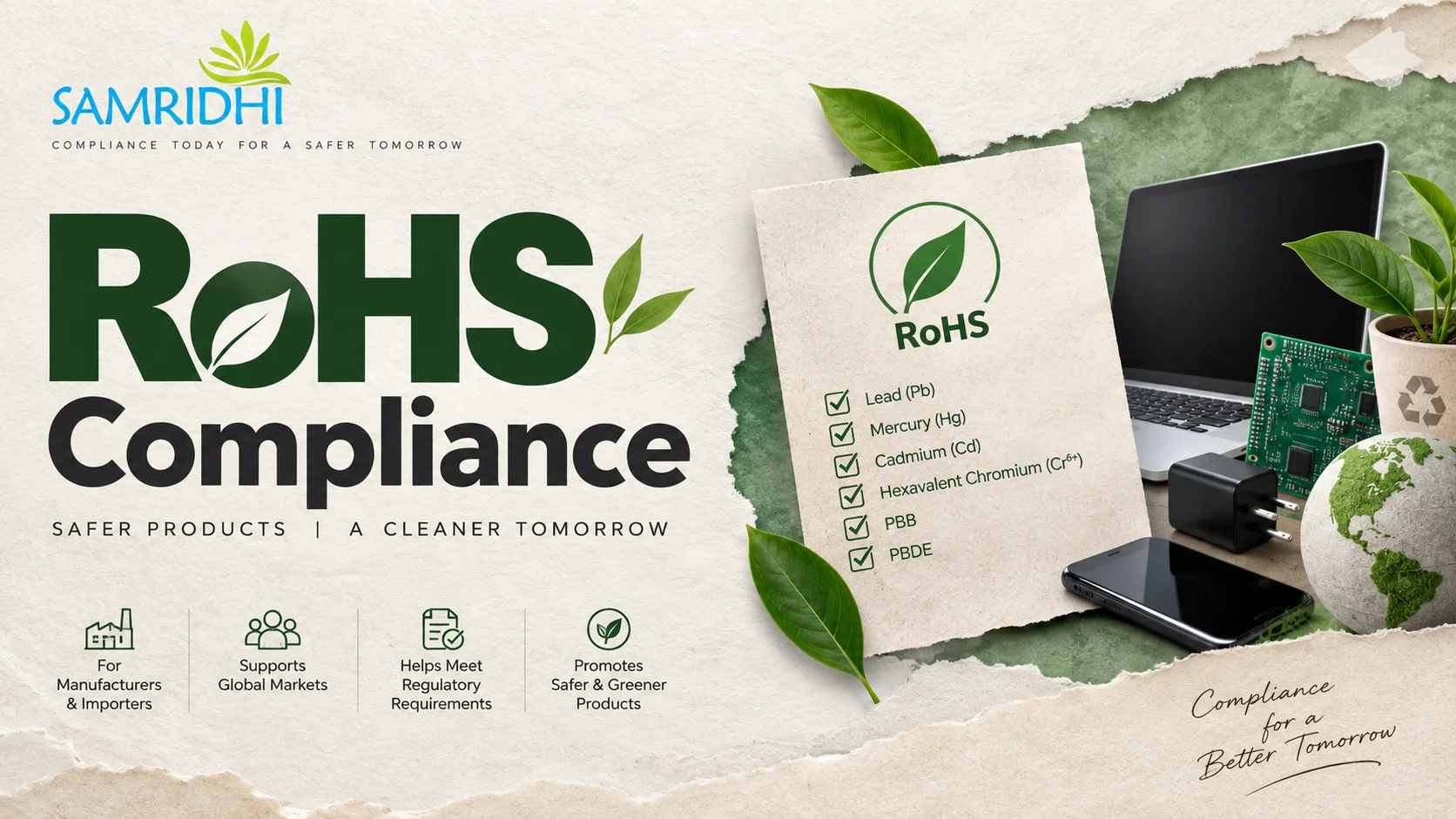
The commonly referenced limits include lead, mercury, cadmium, hexavalent chromium, PBB and PBDE, although specific exemptions and permitted limits can apply to particular applications. CPCB guidance identifies limits of 0.1% by weight in homogeneous material for lead, mercury, hexavalent chromium, PBB and PBDE, and 0.01% for cadmium, subject to the applicable rules and exemptions.
Which products are covered?
The E-Waste Rules apply to electrical and electronic equipment listed in Schedule I, along with their relevant components, consumables, parts and spares. The schedule includes categories such as information technology equipment, consumer equipment, large and small electrical appliances, lighting equipment, toys and sports equipment, medical equipment and laboratory equipment.
That means a manufacturer or producer should first confirm whether its actual product falls within the applicable scope before assuming that a RoHS compliance certification is required.
RoHS compliance is one part of the broader regulatory framework applicable to electrical and electronic products. Depending on the product, businesses may also need to evaluate BIS CRS Registration, BIS ISI Domestic Manufacturers, or BIS ISI Foreign Manufacturers, while other products may fall under a different BIS conformity route. Manufacturers can also review ISO Certification for organisational quality-management practices and NABL Testing when independent laboratory testing is relevant. Product-specific requirements can differ significantly for lighting, cables, appliances, motors and toys.
What is the RoHS compliance process?
The practical process starts with identifying the product and its components, then checking materials against the applicable restricted-substance requirements. Manufacturers and producers should collect technical information from component suppliers and maintain appropriate evidence supporting conformity.
Under the E-Waste Rules, producers must provide information on compliance through self-declaration. They must also provide detailed information on the constituents of equipment, components, consumables, parts or spares with a declaration of conformity in the product documentation.
Is RoHS testing required?
RoHS testing may be used to verify the presence and concentration of restricted substances, particularly where material declarations alone do not provide sufficient confidence. CPCB states that it can conduct random sampling of electrical and electronic equipment to monitor and verify compliance, with the producer bearing the applicable sampling and testing cost. CPCB also has provisions for identifying laboratories for hazardous-substance analysis.
The exact testing approach depends on the product, materials, components and compliance evidence available. Businesses should therefore avoid assuming that every product requires an identical laboratory test package.
What documentation should businesses maintain?
Documentation is a major part of RoHS compliance testing and verification. Producers should maintain technical information demonstrating how the product meets the applicable hazardous-substance requirements. CPCB guidance has also referred to technical documentation based on EN 50581 / EN IEC 63000:2018 for demonstrating RoHS compliance.
Good documentation can include material declarations, supplier information, component records, test reports and a signed compliance declaration, depending on the product and applicable requirements.
What happens if a product fails compliance checks?
Non-compliance should not be treated as a documentation issue alone. The E-Waste Rules provide that when a product does not comply with the reduction-of-hazardous-substances provisions, the producer must take corrective measures and, where required under the applicable guidelines, withdraw or recall the product from the market.
For this reason, RoHS Certification India should be approached as an ongoing product-compliance process rather than simply obtaining a certificate once and considering the matter closed.
For electrical and electronic products, compliance requirements can differ significantly based on the product category, construction and applicable Indian Standard. Manufacturers of ISI Certification for LED Lights and BIS ISI Certification for Cables may need to assess product-specific BIS standards and testing requirements, while businesses producing ISI Certification for Ceiling Fans, ISI Certification for Water Heaters and ISI Certification for Electric Motors should review the standards and conformity requirements applicable to their respective products. Similarly, manufacturers of toys can explore ISI Certification for Toys to understand the relevant product safety and certification considerations before proceeding with compliance planning.
Final compliance check
Before arranging RoHS testing or documentation, businesses should verify:
Product scope → Restricted substances → Applicable exemptions → Supplier/material evidence → Testing requirements → Technical documentation → Self-declaration
One important distinction is worth remembering: RoHS compliance in India is not the same thing as BIS certification. BIS operates separate product-certification schemes, while RoHS obligations for covered electrical and electronic equipment arise under the environmental rules administered through the applicable framework.
The exact RoHS compliance requirements, testing scope and supporting documentation vary by product and materials, so the final assessment should be based on the current E-Waste Rules, applicable exemptions and authority requirements.
RoHS Compliance Testing: Restricted Substances, Limits, Samples and Laboratory Requirements
RoHS compliance testing is used to verify whether electrical and electronic equipment meets applicable restrictions on hazardous substances. In India, these requirements are primarily addressed through the E-Waste (Management) Rules, 2022, rather than through a universal BIS licence called a “RoHS certificate.” The rules require applicable producers to ensure that covered new electrical and electronic equipment complies with specified substance limits and to maintain supporting compliance information.
Which substances are checked during RoHS testing?
Under the Indian E-Waste Rules, the restricted substances include Lead (Pb), Mercury (Hg), Cadmium (Cd), Hexavalent Chromium (Cr⁶⁺), Polybrominated Biphenyls (PBBs) and Polybrominated Diphenyl Ethers (PBDEs). For covered equipment, the prescribed maximum concentration is generally 0.1% by weight in homogeneous material for lead, mercury, hexavalent chromium, PBB and PBDE, while cadmium has a lower limit of 0.01% by weight. Applicable exemptions under the rules also need to be considered.
The phrase homogeneous material matters. Testing is not simply based on the total weight of a finished product. Components or materials within the equipment may need to be evaluated individually depending on the applicable compliance approach.
How are samples selected for RoHS testing?
Sample selection should reflect the actual construction of the product. A manufacturer should identify materials and components that could potentially contain restricted substances, such as plastics, coatings, solders, cables, metal finishes and electronic assemblies.
The appropriate sample size and preparation method depend on the product and laboratory testing method. CPCB's framework provides for sampling and analysis of hazardous substances and empowers CPCB to conduct random sampling of electrical and electronic equipment placed on the market. Testing costs for such regulatory samples are borne by the producer.
For a manufacturer's own RoHS compliance testing, the objective should be representative evidence across relevant materials, components and product variants rather than testing one convenient sample and assuming that every model is automatically compliant.
What documents support RoHS compliance?
A laboratory report is useful, but compliance evidence can involve more than one document. CPCB guidance identifies a technical-documentation approach that can include a general product description, material and component information, supplier declarations, material declarations and analytical test results. The guidance also refers to analytical methods described or referenced in EN 62321.
This is particularly useful where a manufacturer has many purchased components. Supplier declarations can support the technical file, while laboratory testing can provide additional evidence for materials where supplier information is insufficient or risk is higher.
What should a RoHS testing laboratory provide?
A suitable RoHS testing lab should be capable of analysing the relevant restricted substances using appropriate analytical methods and should provide a report that clearly identifies the sample, materials tested, methods used and results.
The laboratory arrangement should be selected according to the product and the required analytical scope. Businesses should not assume that every laboratory report labelled “RoHS” automatically satisfies every customer, regulatory or export requirement. The testing method, laboratory capability and documentation need to match the intended compliance purpose.
What happens if testing shows a substance above the limit?
A non-compliant result should trigger a technical investigation rather than simply a new certificate request. The manufacturer should identify the affected material or component, determine the source of the substance, assess whether an applicable exemption exists and implement corrective action where required.
Under the E-Waste Rules, if a product does not comply with the reduction-of-hazardous-substances provisions, the producer must take corrective measures and, where applicable, withdraw or recall the product according to the prescribed framework.
Practical RoHS testing workflow
A sensible RoHS compliance certification workflow is:
Product assessment → component/material mapping → restricted-substance review → representative sampling → laboratory testing → technical documentation → compliance declaration
This approach is more reliable than treating RoHS as a one-time certificate. The exact RoHS testing requirements, sample strategy, laboratory scope and documentation vary by product, materials and intended market, so the final compliance assessment should be based on the applicable E-Waste Rules, exemptions and current authority requirements.
RoHS Certification Cost in India: Complete Fee Guide for Testing, Documentation and Certificate at ₹12,000
The RoHS Certification Cost in India depends on what is included in the compliance work. Businesses often search for a single RoHS certificate cost, but there can be separate expenses for compliance assessment, laboratory testing, technical documentation and certification support. At Samridhi Compliance Certification (SAMCC), the service price for RoHS compliance certification support is ₹12,000. This is a service charge, not a government fee or a universal laboratory-testing fee.
What is included in the ₹12,000 RoHS service?
The ₹12,000 SAMCC service can cover the compliance-support activities required to prepare the relevant RoHS documentation and certification file. The exact work depends on the product and information supplied by the manufacturer or producer.
The service can include product and component information review, compliance documentation preparation, assessment of restricted-substance requirements and preparation of the applicable declaration or certificate documentation.
This distinction is important because India's E-Waste (Management) Rules, 2022 require applicable producers to ensure compliance with hazardous-substance limits and provide information about equipment and components along with a declaration of conformance. The rules also provide for self-declaration of compliance.
Is laboratory testing included in the ₹12,000 cost?
Laboratory testing should be treated separately unless specifically included in the agreed service scope. The RoHS testing cost depends on the number and type of samples, materials being tested and laboratory selected.
For example, C-MET currently lists RoHS analysis charges of ₹3,000 plus GST per metallic sample and ₹4,000 plus GST per plastic sample for its stated analysis package, with discounts available for larger sample quantities.
Therefore, a manufacturer should not assume that a ₹12,000 service price represents the total possible expense for every product. If laboratory analysis is required, the testing charge can be an additional cost.
What determines RoHS testing requirements?
Testing requirements depend on the product's construction and materials. India's rules specify maximum concentration values for lead, mercury, cadmium, hexavalent chromium, PBB and PBDE in applicable homogeneous materials. The general limits are 0.1% by weight for lead, mercury, hexavalent chromium, PBB and PBDE, and 0.01% for cadmium, subject to applicable provisions and exemptions.
A product containing many different materials may therefore require a broader evidence or testing approach than a simpler product.
What documentation affects RoHS compliance cost?
Documentation is another important part of the RoHS compliance certification process. Depending on the product, businesses may need product descriptions, component information, supplier declarations, material information, test reports and a declaration of conformity.
CPCB guidance and the regulatory framework place importance on maintaining evidence that supports compliance, particularly because producers can be subject to random sampling and testing.
Good documentation can also make it easier to identify which components require further investigation when supplier information is incomplete.
What can increase the overall RoHS certificate cost?
The final expense can increase where a product has multiple models, many materials, numerous samples, additional laboratory tests or incomplete technical information. Overseas-market requirements may also ask for specific testing formats or documentation beyond the Indian compliance framework.
For this reason, RoHS Certification Cost should be estimated after reviewing the actual product rather than treating ₹12,000 as a universal all-inclusive figure.
Practical cost structure
A manufacturer's potential budget can be understood as:
SAMCC service fee: ₹12,000
+ Laboratory testing: if required
+ Additional sample/testing charges: if applicable
+ Product-specific documentation or compliance work: where required
The ₹12,000 SAMCC fee gives businesses a clear starting point for professional RoHS compliance support, while testing and additional requirements remain product-specific and case-specific.
The most sensible approach is to determine the product scope, applicable restricted substances, testing needs and available technical evidence before finalising the complete budget. Requirements and costs vary by product and scope and remain subject to the applicable regulatory framework, laboratory requirements and authority review.
RoHS Certificate vs RoHS Compliance: Is Certification Mandatory and What Documents Prove Compliance?
The terms RoHS Certificate and RoHS Compliance are often used as if they mean the same thing, but they describe two different things. In India, businesses dealing with covered electrical and electronic equipment should focus on demonstrating compliance with the applicable hazardous-substance requirements under the E-Waste (Management) Rules, 2022, rather than assuming that India requires a universal government-issued “RoHS certificate.” The rules came into force on 1 April 2023 and apply to specified electrical and electronic equipment listed in Schedule I, subject to the rules and applicable exemptions.
Is a RoHS certificate mandatory in India?
There is an important distinction here. The Indian framework requires applicable producers to comply with the reduction-of-hazardous-substances provisions and maintain supporting evidence, but it does not create one universal RoHS certification issued by BIS for every electrical or electronic product.
CPCB's guidance specifically requires producers seeking EPR registration to provide a self-declaration of RoHS compliance and a declaration confirming that technical RoHS documents are available for verification when required.
Therefore, a commercial document titled “RoHS Certificate” may be useful for customers or supply chains, but it should not automatically be described as a government certification equivalent to a BIS licence.
What does RoHS compliance actually require?
For covered equipment, the rules restrict specified hazardous substances within prescribed concentration limits. CPCB identifies lead, mercury, cadmium, hexavalent chromium, PBB and PBDE among the restricted substances. The generally applicable limits are 0.1% by weight in homogeneous material for lead, mercury, hexavalent chromium, PBB and PBDE, and 0.01% for cadmium, subject to applicable exemptions.
This means compliance is ultimately about the composition of relevant materials and components, not simply possessing a certificate with the word “RoHS” printed on it.
Which documents can prove RoHS compliance?
A strong RoHS compliance file should contain evidence that allows the manufacturer or producer to demonstrate how conformity was established. Depending on the product and available evidence, this can include:
- Product and equipment description
- Material and component information
- Supplier declarations
- Material declarations
- Contracts or specifications requiring restricted substances to remain within permitted levels
- Applicable laboratory test reports
- RoHS self-declaration
- Technical documentation supporting the compliance assessment
CPCB guidance identifies supplier declarations, material declarations and analytical test results as possible elements of technical documentation. It also refers to analytical methods described or referenced in EN 62321.
Is laboratory testing always necessary?
Not necessarily in the same way for every product. The evidence required depends on the product, materials, components and confidence in supplier information. A manufacturer may use reliable supplier declarations and technical material information as part of its compliance evidence, while RoHS compliance testing can provide analytical verification where required or appropriate.
CPCB also has provisions for sampling and testing to verify compliance, meaning producers should maintain evidence that can withstand regulatory or customer scrutiny rather than relying solely on an informal declaration.
What happens when a product changes?
RoHS compliance needs to be considered when materials, components, suppliers or product designs change. Replacing a component with a different supplier, changing a plastic formulation or modifying a coating can affect the available compliance evidence.
For this reason, manufacturers should maintain updated supplier information, technical documentation and test evidence rather than treating RoHS compliance certification as a document that never needs review.
RoHS certificate or compliance file: What should a business maintain?
A practical documentation chain looks like:
Product assessment → component/material identification → supplier evidence → risk-based testing → technical file → RoHS declaration
The important takeaway is that RoHS compliance is the underlying requirement; a RoHS certificate is not automatically a universal government-issued certification in India. CPCB specifically refers to self-declarations and availability of technical documentation for applicable producers.
The exact RoHS certification India requirements, documentation, testing scope and applicable exemptions depend on the product and regulatory status. Businesses should therefore verify the current E-Waste Rules, applicable schedules and amendments before finalising their compliance approach, as requirements are product-specific and subject to the applicable regulatory framework and authority requirements.
RoHS Compliance List: Which Hazardous Substances Are Restricted and How Manufacturers Can Check Their Products
For manufacturers of electrical and electronic equipment, understanding the RoHS compliance list is more useful than simply obtaining a document called a “RoHS certificate.” In India, RoHS requirements are primarily addressed under Rule 16 of the E-Waste (Management) Rules, 2022, which applies to new electrical and electronic equipment and specified components, consumables, parts and spares listed in Schedule I. (cpcb.nic.in)
Which substances are restricted under Indian RoHS requirements?
The Indian framework currently identifies six principal restricted substances:
| Restricted substance |
General maximum concentration |
| Lead (Pb) |
0.1% by weight in homogeneous material |
| Mercury (Hg) |
0.1% |
| Cadmium (Cd) |
0.01% |
| Hexavalent Chromium (Cr⁶⁺) |
0.1% |
| Polybrominated Biphenyls (PBB) |
0.1% |
| Polybrominated Diphenyl Ethers (PBDE) |
0.1% |
These limits are calculated by weight in homogeneous materials, meaning the assessment is not simply based on the total weight of the finished electronic product. Cadmium has the stricter 0.01% threshold, while the other five listed substances have a general 0.1% limit. Applicable exemptions must also be checked before deciding that a particular material automatically fails compliance. (cpcb.nic.in)
Why does “homogeneous material” matter?
This is one of the details manufacturers frequently overlook during RoHS compliance testing. A finished product can contain plastics, solder, coatings, wires, metal finishes, electronic components and other materials. The concentration limit is assessed at the homogeneous-material level rather than simply diluting a restricted substance across the complete product.
For example, a restricted substance present in a small plastic component cannot necessarily be averaged against the weight of the whole appliance to determine compliance. Manufacturers therefore need to understand the material composition of relevant components before deciding what evidence or testing is appropriate.
Which products are covered?
The RoHS provisions apply to applicable electrical and electronic equipment listed in Schedule I of the E-Waste (Management) Rules, 2022, along with specified components and parts. The schedule covers several equipment categories, including information technology equipment, consumer equipment, electrical appliances, lighting equipment, medical equipment, laboratory equipment and other listed categories. (moef.gov.in)
Manufacturers should therefore confirm that their actual product falls within the applicable scope before beginning a RoHS certification India exercise.
How can manufacturers check their products?
The practical approach is to create a material and component inventory first. Identify plastics, soldering materials, cables, coatings, finishes, electronic assemblies and other parts that could contain restricted substances.
Next, collect compliance information from suppliers. Depending on the product, useful evidence can include material declarations, supplier declarations, component specifications and laboratory reports. CPCB guidance has specifically referred to maintaining technical documentation for RoHS compliance and making it available for verification. (cpcb.nic.in)
Where supplier information is incomplete or the material risk is higher, RoHS testing can provide analytical evidence.
Are there exemptions?
Yes. The E-Waste Rules contain specific exemptions for certain applications and materials. The rules also have provisions dealing with particular equipment and components under the relevant schedules. For example, amendments have introduced or modified exemptions covering specified applications involving solar equipment and medical devices. (egazette.gov.in)
This means a material exceeding a general threshold should not automatically be classified as non-compliant without checking whether an applicable exemption covers that particular use.
What should businesses maintain as evidence?
A practical RoHS compliance file can include:
Product details → component/material list → supplier declarations → material information → test reports where required → technical documentation → compliance declaration
Under the current framework, producers are required to provide information concerning RoHS compliance through self-declaration, while technical RoHS documents must be available for verification in accordance with the applicable requirements. (cpcb.nic.in)
The key point is that RoHS compliance is about controlling restricted substances and maintaining evidence, not merely possessing a certificate. The applicable substance limits, exemptions, testing approach and documentation depend on the product and material composition. Manufacturers should therefore review the current E-Waste Rules and applicable CPCB requirements before finalising their compliance assessment.


 Get Certified with Confidence – Your One-Stop Compliance Partner
 Grab Your Certified Now
 +91 8799708673
 WhatsApp