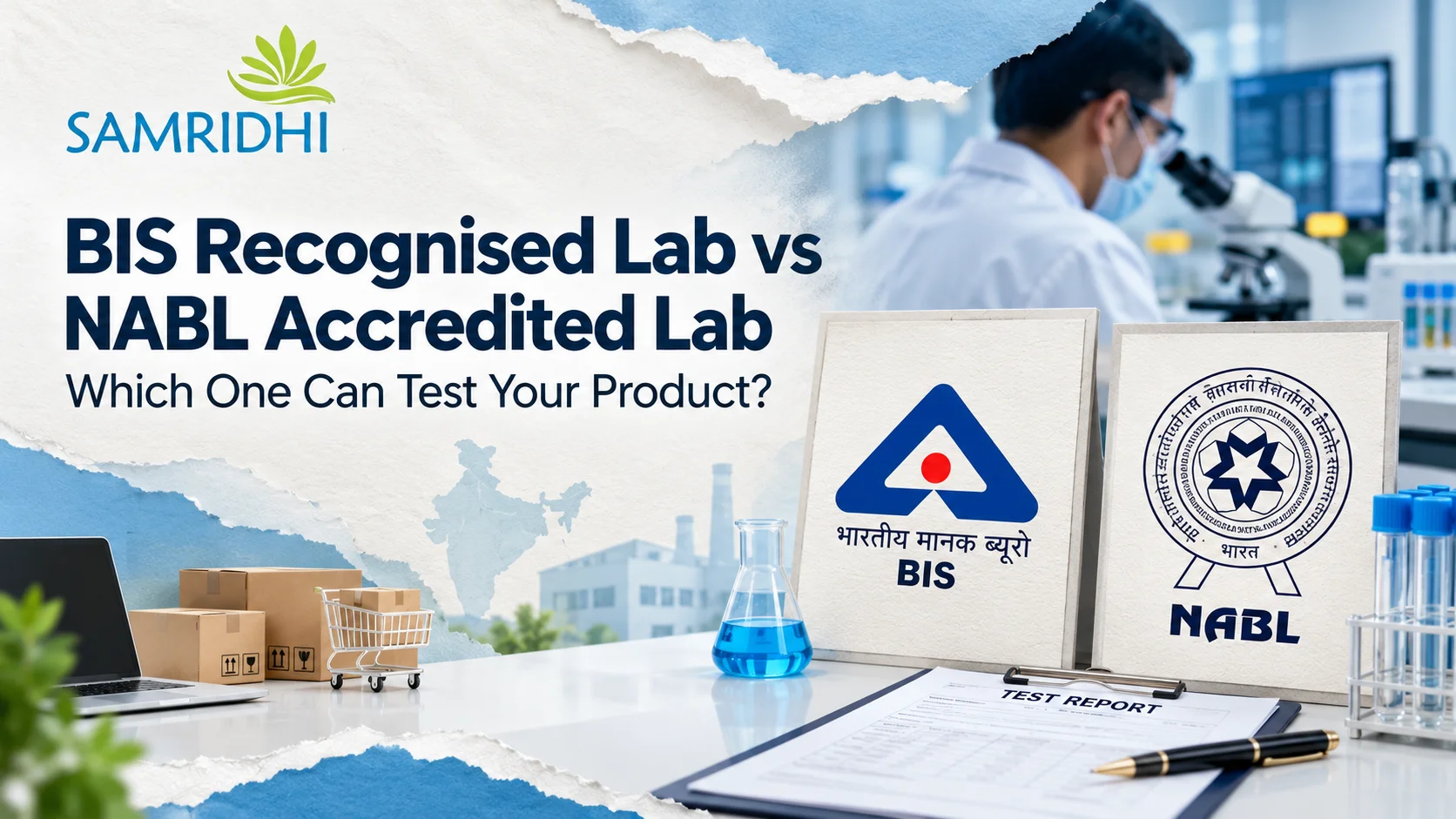
BIS Recognised Laboratory vs NABL Accredited Laboratory: Key Differences, Roles, and Acceptance Criteria
Choosing the right laboratory is an important step when preparing a product for BIS certification or registration in India. Manufacturers and importers often assume that a NABL accredited laboratory can automatically conduct every test required for BIS compliance. However, accreditation and BIS recognition serve different purposes, and the distinction can affect whether a test report is accepted for a particular certification process.
What Is a BIS Recognised Laboratory?
A BIS recognised laboratory is a laboratory recognised by the Bureau of Indian Standards (BIS) to conduct testing within its approved scope. These laboratories support BIS conformity assessment activities by evaluating products against applicable Indian Standards.
Recognition depends on factors such as testing infrastructure, technical competence, qualified personnel, and compliance with the applicable BIS Laboratory Recognition Scheme. Laboratories must have the necessary facilities and meet the relevant recognition criteria for the products and tests concerned.
For manufacturers, the key consideration is whether the laboratory is currently recognised for the particular Indian Standard and the required test parameters. A laboratory may be equipped to test a product generally without being recognised for every test required under its applicable certification scheme.
What Is a NABL Accredited Laboratory?
A NABL accredited laboratory has been assessed by the National Accreditation Board for Testing and Calibration Laboratories (NABL) for its technical competence and quality management systems within a defined scope of accreditation.
For testing and calibration laboratories, accreditation is based on ISO/IEC 17025. The scope identifies the specific testing disciplines, methods, or activities for which the laboratory has demonstrated competence. NABL accreditation therefore provides evidence of competence within that defined scope, rather than blanket authorisation to conduct every type of regulatory test.
For example, a laboratory may hold NABL accreditation for certain electrical tests but not for every parameter required by the Indian Standard applicable to a particular appliance.
Understanding the difference between BIS recognition and NABL accreditation is an important step in selecting a suitable testing facility. Manufacturers should review the applicable BIS certification testing requirements, confirm the relevant BIS certification requirements, and explore NABL testing services when evaluating laboratory competence and testing scope. The appropriate route depends on the product and applicable certification scheme.
BIS Recognition vs NABL Accreditation: Key Differences
The main difference lies in the purpose of each status. NABL accreditation evaluates a laboratory's competence within its accredited scope, while BIS recognition establishes that the laboratory meets the relevant BIS requirements for specified testing activities.
The two are related, but they are not interchangeable. BIS's Laboratory Recognition Scheme includes accreditation requirements and expects the relevant test parameters to be covered within the laboratory's accreditation scope, subject to applicable provisions and exceptions.
A laboratory can therefore be NABL accredited without necessarily being recognised by BIS for the specific product test a manufacturer needs. Conversely, the acceptance of a laboratory's report depends on the applicable BIS scheme and the laboratory's current recognised scope.
Which Laboratory Should Manufacturers Choose?
Before selecting a BIS product testing laboratory, manufacturers should verify three things:
-
The laboratory's current status in the relevant official BIS listing.
-
Whether the applicable Indian Standard and required test parameters fall within its recognised scope.
-
Whether the laboratory and report meet the requirements of the specific BIS certification or registration scheme.
The official BIS laboratory services page and BIS Laboratory Information Management System provide information to help users identify laboratories and review their testing facilities. BIS also publishes its Laboratory Recognition Scheme, which explains relevant recognition criteria.
Why Acceptance Criteria Matter
Sending a sample to a laboratory without checking its status and scope can lead to avoidable delays, additional testing, or the need to clarify whether the report meets the applicable requirements. Requirements vary by product, standard, and certification scheme.
SAMCC assists manufacturers and importers with certification planning, documentation alignment, and testing coordination across India. Before arranging testing, confirm the appropriate laboratory and applicable acceptance criteria with the relevant BIS office or certification process. A laboratory's accreditation or recognition alone does not guarantee product conformity or certification approval.
Before submitting a product sample, manufacturers should confirm the accepted testing route, applicable Indian Standard, and documentation requirements for their certification scheme. Reviewing the BIS certification process and documents required for BIS certification can help businesses prepare for testing. For products covered by the Compulsory Registration Scheme, explore the requirements for BIS CRS registration.
Which Laboratory Is Accepted for BIS Certification? Requirements Manufacturers Must Check Before Testing
Choosing the right laboratory is a practical decision that can affect your BIS certification process, testing expenses, and project planning. Manufacturers and importers often search for a BIS approved testing laboratory in India but may be unsure whether they can use any NABL accredited laboratory or must select one specifically recognised by the Bureau of Indian Standards (BIS).
The correct choice depends on the product, applicable Indian Standard, certification scheme, and the laboratory's current recognition and testing scope.
Which Laboratory Is Accepted for BIS Certification?
BIS uses its own laboratories, laboratories recognised under its Laboratory Recognition Scheme, and certain government laboratories empanelled for specific testing purposes. The appropriate laboratory must be selected according to the requirements of the applicable conformity assessment scheme.
For manufacturers, this means that general testing capability is not enough. Before submitting a sample, verify whether the laboratory is listed for the relevant Indian Standard and whether it can conduct the required tests.
For products covered under the Compulsory Registration Scheme (CRS), applicants must follow the designated registration process and select an approved laboratory through the applicable portal procedure.
Check the Laboratory's Recognition Status
The first step is to verify the laboratory's current status through the official BIS Laboratory Information Management System (LIMS). Do not rely solely on an old certificate, a third-party directory, or a laboratory's claim that it is BIS approved.
The BIS LIMS portal allows users to search laboratories and look up testing facilities by Indian Standard number. It also displays information about laboratory categories and their testing scopes.
Check that the laboratory's status is current and that the specific product or standard is covered. Recognition can be limited by scope, and laboratory status may change.
Finding a laboratory is only the first step. Manufacturers must also confirm that the required product standard and test parameters fall within the laboratory's applicable scope. Learn more about BIS certification testing and NABL testing services when reviewing testing options. Businesses planning their own testing facilities can also explore laboratory setup and equipment, where relevant to their operational needs.
Confirm the Required Indian Standard and Test Parameters
A product may need to satisfy several requirements under one Indian Standard. A laboratory's ability to perform one test does not necessarily mean it can complete every test needed for certification.
Before booking, confirm:
-
The correct Indian Standard and its applicable version.
-
The product category, model, and relevant specifications.
-
The test parameters required under the certification scheme.
-
Whether the laboratory's recognised scope covers those parameters.
-
Whether any test requires a separate facility or special arrangement.
For example, an electrical appliance may require safety and performance evaluations. If the selected laboratory does not cover a required parameter within its applicable scope, further coordination may be necessary.
Is NABL Accreditation Enough?
Not necessarily. NABL accreditation demonstrates a laboratory's competence within its defined accreditation scope. It does not automatically mean that the laboratory is accepted for every BIS certification test.
BIS's Laboratory Recognition Scheme includes accreditation and technical competence requirements. However, manufacturers must still confirm BIS recognition or acceptance for the particular test and applicable scheme.
This distinction is important when comparing a NABL accredited testing lab in India with a BIS recognised laboratory. Check both the accreditation scope and the relevant BIS requirements rather than assuming the two statuses are interchangeable.
Confirm Sample Submission and Documentation
Once the laboratory is verified, confirm the sample quantity, packaging, identification, test request procedure, required documents, and applicable charges directly with the laboratory or through the relevant BIS portal.
For CRS applications, the official registration portal describes the process for generating a test request, selecting an approved laboratory, submitting the sample, and using the test report in the registration process.
Keep product specifications, manufacturer details, model information, and relevant technical documents consistent. Differences between the sample and submitted documentation may require clarification.
Make the Laboratory Decision Before Testing
A suitable BIS product testing laboratory should have the appropriate status, facilities, and scope for your product and certification route. Confirming these details before sample submission helps reduce avoidable rework and uncertainty.
SAMCC assists manufacturers and importers with certification planning, documentation alignment, and testing coordination across India. Since acceptance is case-specific, verify the current requirements with BIS and the selected laboratory before proceeding. Laboratory selection alone does not guarantee a successful test report or certification approval.
 Get Certified with Confidence – Your One-Stop Compliance Partner
From BIS, WPC, TEC, BEE, EPR, LMPC, CDSCO, FSSAI, ISO, MSME to PESO, NABL testing, Startup India, Make in India, and Lab Setup, we handle all your regulatory approvals, certifications, and documentation needs with precision and speed. Partner with Samridhi Compliance Certification and simplify your journey to full compliance—so you can focus on growing your business.
How to Find a BIS Recognised Laboratory in India and Verify Its Product Testing Scope
Finding a laboratory for BIS product testing involves more than choosing a facility near your manufacturing unit or selecting one based on price. Manufacturers and importers need to confirm that the laboratory is recognised for the relevant Indian Standard and can perform the tests required for their product and certification scheme.
The most reliable starting point is the official BIS Laboratory Information Management System (LIMS), which provides searchable laboratory listings and information about testing scope.
Step 1: Identify the Applicable Indian Standard
Before searching for a BIS recognised laboratory, establish which Indian Standard applies to your product. The correct standard depends on the product category, specifications, intended use, and applicable certification requirements.
For example, an electrical appliance and an industrial component may require completely different testing methods, even if both are manufactured from similar materials. Check the applicable standard and relevant product manual before contacting a laboratory.
If you are unsure which standard applies, clarify this before submitting a test request. Choosing a laboratory first and identifying the standard later can lead to unnecessary coordination or testing expenses.
Step 2: Search the Official BIS Laboratory List
Visit the BIS LIMS portal. You can search for laboratories by name or use the option to search by Indian Standard number. The portal also provides details about laboratory status and testing scope.
When reviewing the BIS recognised laboratory list, consider laboratories that are relevant to your product category and testing requirements. You can compare their locations, contact information, recognition validity, and available facilities before contacting them.
Do not depend solely on search engine listings, older PDF directories, or information shared by third parties. Laboratory recognition can change, so verify the current status using official BIS information.
NABL accreditation demonstrates laboratory competence within a defined scope, but it does not automatically establish acceptance for every BIS certification test. Manufacturers should compare the laboratory's accreditation scope with the applicable BIS certification requirements. Depending on the business and product, the relevant certification route may involve BIS ISI certification for domestic manufacturers or BIS ISI certification for foreign manufacturers.
Step 3: Verify the Laboratory's Product Testing Scope
Finding a laboratory in the directory is only the beginning. You must also check whether its recognised scope covers the specific tests your product needs.
Review the laboratory's scope against these details:
-
The applicable Indian Standard number and relevant version.
-
The product type, grade, size, model, or designation, where applicable.
-
The required test parameters and testing methods.
-
Any limitations or exclusions in the listed scope.
-
The laboratory's current recognition validity and status.
A laboratory may be recognised for one product or a limited set of parameters without being authorised to conduct every test under a related standard. The LIMS portal also cautions that scope information submitted by laboratories is subject to verification by BIS.
Step 4: Confirm Sample Submission Requirements
After verifying the scope, contact the laboratory to confirm sample quantity, packaging, identification, required documents, testing charges, and expected testing arrangements.
Ask whether the laboratory can complete all required tests or whether additional facilities may be needed. Also clarify how the test report will be issued and whether the process follows the applicable BIS certification or registration procedure.
For products covered by the Compulsory Registration Scheme (CRS), consult the official CRS laboratory list and follow the relevant portal requirements.
Step 5: Check NABL Accreditation Separately
A NABL accredited testing laboratory in India may have demonstrated technical competence within a defined accreditation scope. However, NABL accreditation alone does not automatically establish acceptance for every BIS certification test.
Confirm the laboratory's BIS recognition or acceptance requirements for the specific product and scheme, along with the relevant testing scope.
Make an Informed Laboratory Choice
The right laboratory is one whose current recognition, testing scope, and facilities match your product's applicable requirements. SAMCC assists manufacturers and importers with certification planning, documentation alignment, and testing coordination across India. Since requirements vary by product and scheme, verify the details before sending samples. Laboratory selection supports the compliance process but does not guarantee a passing report or certification approval.
Planning for BIS product testing requires attention to documentation, laboratory charges, sample preparation, and the expected testing schedule. Manufacturers can review the BIS certification cost in India, understand the factors affecting the BIS certification timeline, and prepare the documents required for BIS certification. Actual costs and timelines vary according to the product, testing scope, and applicable certification procedure.
Can an NABL Accredited Testing Lab Test Your Product for BIS Certification? Common Misunderstandings Explained
Yes, an NABL accredited testing laboratory may be able to test a product for BIS certification, but acceptance depends on the applicable Indian Standard, product category, and specific BIS certification scheme. NABL accreditation alone does not guarantee that every test report will be accepted by BIS.
Manufacturers and importers should verify the laboratory's accreditation scope and the applicable BIS testing requirements before sending product samples. This simple check can help avoid unnecessary testing expenses and procedural complications.
Misunderstanding 1: Every NABL Accredited Lab Is Accepted by BIS
NABL accreditation demonstrates a laboratory's technical competence for specified tests within its approved scope. Testing laboratories are assessed against ISO/IEC 17025, which addresses technical competence and consistent laboratory operations.
However, regulatory acceptance is a separate consideration. BIS has its own Laboratory Recognition Scheme and maintains listings of recognised and empanelled laboratories. Some product-specific requirements may also permit testing through other laboratories with valid NABL accreditation. Therefore, manufacturers must check the applicable scheme rather than assume that one rule applies to every product.
Misunderstanding 2: NABL Accreditation Automatically Covers Every Product Test
A laboratory's accreditation applies only to its defined scope. That scope identifies relevant products, test parameters, methods, and other technical details. If a required test is outside the laboratory's accredited scope, the laboratory's general accreditation does not automatically cover that test.
For example, a laboratory may be accredited for certain electrical measurements but not for every safety or performance test required for a particular appliance.
Before selecting a BIS product testing laboratory, compare the required Indian Standard and test parameters with the laboratory's current scope.
Misunderstanding 3: A Laboratory Listed by BIS Can Perform Every Required Test
BIS maintains an official Laboratory Information Management System (LIMS) where users can search laboratories and review submitted scope information. However, the portal itself cautions that scope information submitted by laboratories is subject to verification against the scope of recognition granted by BIS.
Check the laboratory's current status, applicable product standard, recognition conditions, and any limitations. If a test parameter is not covered, ask the laboratory or relevant BIS office how that requirement should be fulfilled.
You can begin your search through the official BIS LIMS portal.
Misunderstanding 4: One Testing Route Applies to Every BIS Scheme
The correct laboratory and testing procedure depend on the product and certification route. Requirements for a product covered under the Compulsory Registration Scheme (CRS) may differ from those under the ISI certification process or another BIS conformity assessment scheme.
Some product manuals expressly permit subcontracted tests through a BIS-recognised or empanelled laboratory, or another laboratory holding valid NABL accreditation under ISO/IEC 17025. Such provisions are product-specific and should not be treated as universal permission.
Always review the applicable Indian Standard, product manual, and current scheme requirements before arranging testing.
What Manufacturers Should Verify Before Sending Samples
Use this checklist before committing to a laboratory:
-
Confirm the applicable Indian Standard and certification scheme.
-
Check the laboratory's current NABL accreditation or BIS recognition status, as relevant.
-
Verify that the specific tests and methods fall within the appropriate scope.
-
Ask whether the laboratory's reports are accepted for your intended BIS process.
-
Confirm sample quantity, documentation, charges, and testing arrangements.
How SAMCC Can Help
SAMCC assists manufacturers and importers with certification planning, documentation alignment, and testing coordination across India. Support may include reviewing the applicable testing route, identifying laboratory-scope questions, and organising the information needed before sample submission.
The important distinction is that NABL accreditation demonstrates technical competence within a defined scope, while BIS acceptance depends on the applicable regulatory and certification requirements. Confirming both before testing helps businesses make informed decisions, although neither laboratory selection nor a test report guarantees certification approval.
Get Certified with Confidence – Your One-Stop Compliance Partner
From BIS, WPC, TEC, BEE, EPR, LMPC, CDSCO, FSSAI, ISO, MSME to PESO, NABL testing, Startup India, Make in India, and Lab Setup, we handle all your regulatory approvals, certifications, and documentation needs with precision and speed. Partner with Samridhi Compliance Certification and simplify your journey to full compliance—so you can focus on growing your business.
BIS Product Testing Requirements: Documents, Costs, Timelines, and Mistakes to Avoid When Choosing a Lab
Selecting a laboratory for BIS product testing involves more than comparing prices or choosing the nearest facility. Manufacturers and importers must confirm the applicable Indian Standard, laboratory acceptance requirements, documentation, and testing scope before submitting samples. A mistake at this stage can result in additional testing, avoidable expenses, or delays in the certification process.
Understanding these requirements helps businesses plan testing more effectively and make informed decisions before committing resources.
Documents Required for BIS Product Testing
The documents required depend on the product, certification scheme, and laboratory's procedures. Before arranging testing, manufacturers should prepare the information needed to identify the product and establish the applicable testing requirements.
Commonly required information may include:
-
Manufacturer and factory details.
-
Product name, model number, and technical specifications.
-
Applicable Indian Standard and relevant test requirements.
-
Product photographs, labels, and rating information, where applicable.
-
Sample identification details and the laboratory's test request.
-
Supporting technical documents required under the relevant scheme.
For products covered under the Compulsory Registration Scheme (CRS), applicants must follow the prescribed portal procedure to generate a test request and select an approved laboratory. The required documentation may include business or manufacturing records, depending on the application stage.
Always confirm the current document checklist with the relevant laboratory or official portal before dispatching a sample.
What Does BIS Product Testing Cost?
There is no single testing charge applicable to every product. BIS product testing costs depend on the applicable Indian Standard, the number and complexity of required tests, sample requirements, and the laboratory's applicable charges.
A product requiring several performance and safety evaluations may involve different testing costs from a product with a smaller set of requirements. Additional expenses may arise from sample preparation, transportation, repeat testing, or corrective changes if the product does not meet the specified requirements.
The BIS Laboratory Information Management System (LIMS) provides information about recognised laboratories, their testing facilities, and applicable testing charges. Manufacturers can consult the official BIS laboratory services page and the BIS LIMS portal to identify relevant facilities and check available information.
Request a case-specific estimate before submitting samples. Remember that laboratory testing charges and the overall cost of obtaining BIS certification are different expenses.
How Long Does BIS Product Testing Take?
Testing timelines vary by product, test complexity, sample condition, laboratory workload, and whether additional evaluation is required. Delays can also occur when samples are incomplete, technical specifications are unclear, or the laboratory needs further information.
Rather than relying on a general online estimate, ask the selected laboratory about its expected testing schedule and the conditions that could affect completion. Also distinguish between laboratory testing time and the overall certification timeline, which may involve application review, factory assessment, documentation checks, and other requirements.
Mistakes to Avoid When Choosing a Laboratory
Several common mistakes can create unnecessary complications:
-
Choosing a laboratory based only on price: Confirm its acceptance and scope first.
-
Assuming NABL accreditation is sufficient: Verify the laboratory requirements under the applicable BIS scheme.
-
Ignoring the Indian Standard: Ensure the correct standard and relevant test parameters are covered.
-
Sending an incorrectly prepared sample: Follow the laboratory's identification, packaging, and submission instructions.
-
Using inconsistent product details: Keep model numbers, specifications, labels, and supporting records aligned.
-
Overlooking current laboratory status: Check the official BIS listing before proceeding.
BIS publishes recognised and empanelled laboratory information and Indian Standard-wise testing facilities to help applicants identify suitable laboratories.
Prepare Before You Submit Your Product
A well-planned testing process starts with the correct standard, suitable laboratory, complete documentation, and a realistic understanding of costs and timelines.
SAMCC assists manufacturers and importers across India with certification planning, documentation alignment, and testing coordination. Since requirements are product-specific and subject to the applicable certification scheme, verify the details before submitting your sample. Selecting the right laboratory helps establish a clearer path through the testing process, but does not guarantee a passing report or certification approval.


 Grab Your Certified Now
 +91 8799708673
 WhatsApp