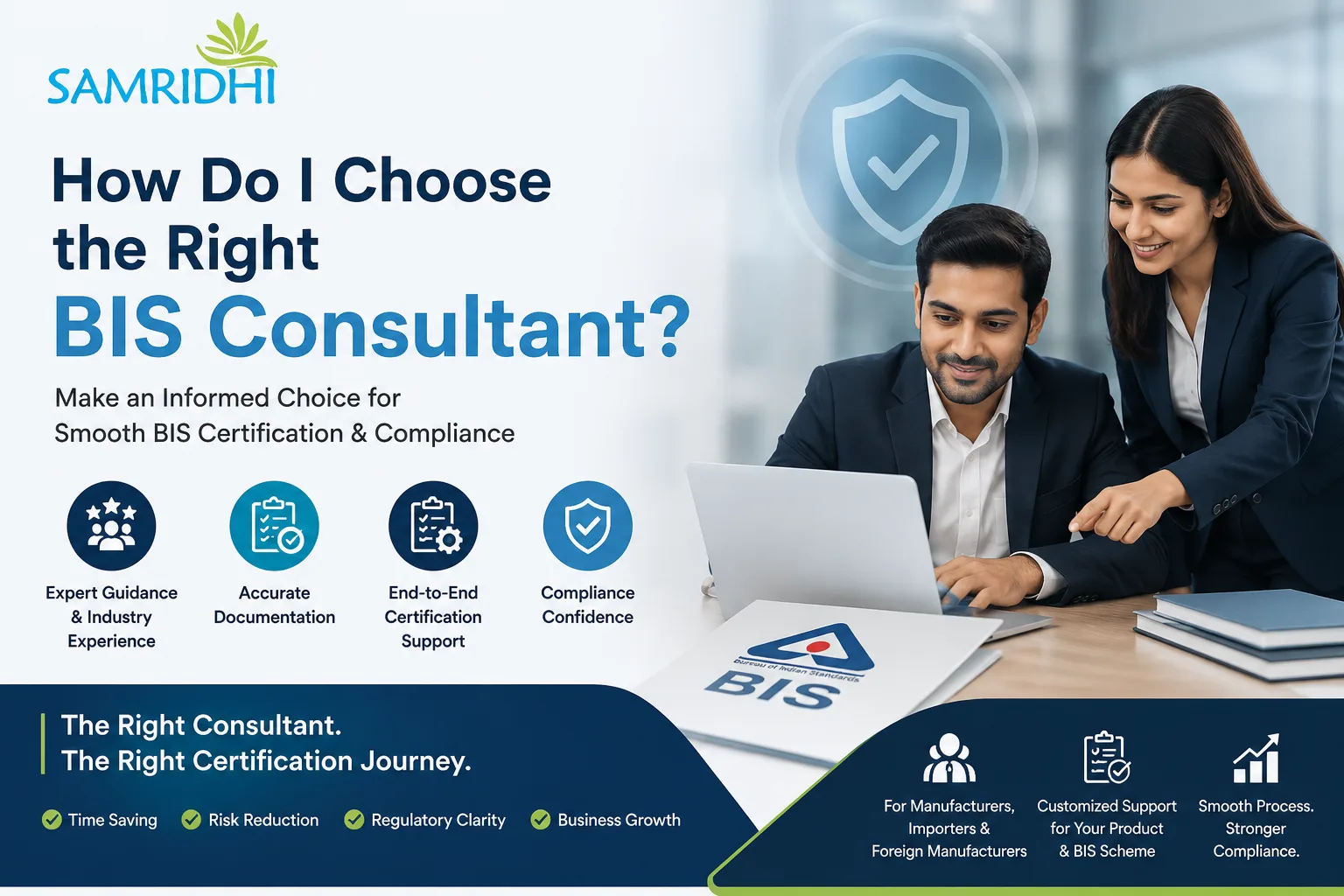
How to Choose the Right BIS Consultant for Your Product Certification and Compliance Requirements
Choosing a BIS consultant is often one of the first major decisions businesses make when preparing for product certification in India. Whether the requirement involves BIS CRS Registration, ISI Certification, FMCS certification for foreign manufacturers, or BIS Scheme X compliance, the consultant selected can significantly influence how efficiently the certification process is managed.
Many manufacturers and importers initially focus on cost or promises of fast approvals when comparing consultants. In practice, however, the more important factors are experience, technical understanding, documentation capabilities, testing coordination expertise, and familiarity with the specific BIS scheme applicable to the product. A consultant should be viewed as a compliance partner who helps organize the certification process rather than someone who can guarantee certification outcomes.
Start by Understanding Your Certification Requirement
Before evaluating any consultant, businesses should first understand their own certification needs.
Different products may fall under different BIS frameworks, including:
- BIS CRS Registration
- BIS ISI Certification
- BIS FMCS for Foreign Manufacturers
- BIS Scheme X Certification
- Product-specific Indian Standards
A consultant who regularly handles consumer electronics may not necessarily have the same experience with industrial machinery, pressure equipment, construction materials, or foreign manufacturer certifications.
One of the most important steps in how to choose a BIS consultant is ensuring that the consultant has experience relevant to the specific product category and certification scheme involved.
Evaluate Industry-Specific Experience
BIS certification requirements vary significantly across industries.
For example:
- Electronics products often require testing coordination and CRS-related documentation.
- Foreign manufacturers may require support with authorized representative arrangements and factory-related documentation.
- Industrial products may involve more complex technical standards and compliance reviews.
Businesses should ask prospective consultants about their experience working with similar products rather than simply asking how many certifications they have handled overall.
Practical product-specific experience often provides greater value than broad but generalized certification experience.
Assess Documentation Management Capabilities
One of the most common reasons certification projects encounter delays is incomplete or inaccurate documentation.
A reliable BIS Registration Consultant India should be able to guide businesses through:
- Technical documentation preparation
- Product information reviews
- Application documentation requirements
- Labeling requirements
- Manufacturer declarations
- Supporting compliance records
Strong documentation management skills are often more important than marketing claims because documentation quality directly affects certification readiness.
Understand Their Testing Coordination Experience
Most BIS certification pathways involve product testing.
Depending on the product category, businesses may need support with:
- Laboratory selection
- Sample preparation
- Testing coordination
- Technical clarification management
- Test report review
An experienced BIS Compliance Consultant India understands how testing activities fit within the broader certification process and can help businesses prepare accordingly.
Testing requirements are typically product-specific and subject to applicable standards and laboratory evaluations.
Ask How They Handle Complex Cases
Not every certification project follows a straightforward path.
Businesses should understand how the consultant manages situations such as:
- Product modifications
- Documentation gaps
- Technical clarification requests
- Testing-related issues
- Compliance interpretation questions
A consultant's ability to navigate challenges often provides more insight into their expertise than a simple list of completed projects.
This is particularly important for importers, foreign manufacturers, and businesses dealing with technically complex products.
Evaluate Communication and Transparency
One of the most overlooked factors when selecting a consultant is communication quality.
Businesses should look for consultants who:
- Explain requirements clearly
- Identify potential challenges early
- Provide realistic expectations
- Communicate process requirements transparently
Reliable consultants generally focus on process management and compliance preparation rather than making unrealistic commitments.
Certification outcomes ultimately remain subject to testing results, documentation reviews, and authority evaluation.
Consider Experience With Manufacturers and Importers
The compliance challenges faced by manufacturers and importers are often very different.
Manufacturers may require support with:
- Factory documentation
- Production information
- Technical specifications
- Internal compliance systems
Importers often face challenges related to:
- Overseas supplier coordination
- Technical documentation collection
- Product information verification
- Regulatory planning
Businesses should evaluate whether the consultant has experience relevant to their operational model.
A BIS Consultant for Manufacturers and Importers should understand both perspectives and the unique compliance challenges associated with each.
Ask About Ongoing Compliance Support
Certification is not always a one-time activity.
Businesses may later require assistance with:
- Certification renewals
- Product updates
- Additional product models
- Compliance reviews
- Regulatory changes
A consultant who supports long-term compliance planning can often provide more value than one focused solely on application submission activities.
This becomes increasingly important for companies managing multiple products or expanding product portfolios.
Watch for Unrealistic Claims
Businesses should be cautious when evaluating consultants who advertise:
- Guaranteed approvals
- Guaranteed timelines
- Guaranteed outcomes
- Fixed certification durations for every project
BIS certification requirements vary based on the product, testing scope, documentation quality, and regulatory review process.
Experienced consultants typically discuss project realities rather than making promises that may not reflect the actual certification process.
Questions Businesses Should Ask Before Hiring a Consultant
When comparing options, businesses may benefit from asking:
- Have you worked with products similar to ours?
- Which BIS schemes do you regularly handle?
- How do you manage testing coordination?
- What documentation support do you provide?
- How do you handle technical clarification requests?
- Do you support foreign manufacturers and importers?
- How do you assist with ongoing compliance activities?
The answers often provide valuable insight into the consultant's practical experience and operational capabilities.
Choosing a Consultant Based on Capability Rather Than Claims
The best consultant is not necessarily the one making the biggest promises. In most cases, the right choice is a consultant who understands the applicable certification scheme, communicates clearly, supports documentation preparation, coordinates testing activities effectively, and helps businesses navigate compliance requirements realistically.
Organizations evaluating How to Choose a BIS Consultant, Best BIS Certification Consultant India, Choosing the Right BIS Registration Consultant, BIS Consultant India, and How to Find a Reliable BIS Consultant should focus on experience, transparency, technical understanding, and process management capabilities. Since certification requirements vary by product category, certification scheme, testing scope, and regulatory expectations, every BIS certification project remains case-specific and subject to authority review, technical evaluation, and applicable compliance requirements.
Before selecting a consultant, businesses should understand which certification scheme applies to their product. Requirements may vary significantly between BIS CRS Registration, BIS ISI Certification, and BIS Scheme X Certification, making product-specific expertise an important evaluation factor when choosing a compliance partner.
What Qualities Should You Look for in a Reliable BIS Certification Consultant?
Selecting a BIS consultant is often more important than businesses initially realize. Many manufacturers, importers, startups, and foreign product owners approach BIS certification believing the process is mainly about submitting forms and obtaining approvals. In reality, BIS certification frequently involves technical documentation, product testing coordination, compliance interpretation, regulatory communication, and ongoing certification management.
Because of this, the quality of the consultant can have a direct impact on how efficiently a certification project is managed. The right consultant helps businesses understand requirements, prepare documentation correctly, coordinate testing activities, and reduce avoidable compliance risks. The wrong consultant may create confusion, overlook critical requirements, or provide unrealistic expectations that lead to unnecessary delays.
When evaluating How to Find a Reliable BIS Consultant, businesses should focus on practical capabilities rather than marketing claims.
Experience With Relevant BIS Certification Schemes
Not all BIS certifications follow the same process.
A consultant may have extensive experience in one certification scheme but limited exposure to another.
For example:
- BIS CRS Registration
- BIS ISI Certification
- BIS FMCS for Foreign Manufacturers
- BIS Scheme X Certification
each have different requirements, documentation expectations, and compliance considerations.
A reliable BIS Consultant India should be able to demonstrate experience handling certification projects that are relevant to the specific product category and certification scheme being considered.
Businesses should always evaluate experience in relation to their own compliance requirements rather than relying on generic claims of industry experience.
Strong Understanding of Product Compliance Requirements
One of the most valuable qualities in a consultant is the ability to understand technical product requirements.
Different products may require different approaches depending on factors such as:
- Product functionality
- Applicable standards
- Testing requirements
- Regulatory obligations
- Manufacturing arrangements
A knowledgeable consultant helps businesses identify compliance requirements before problems arise rather than reacting to issues later in the process.
This proactive approach often improves project planning and documentation readiness.
Ability to Manage Documentation Effectively
Documentation is one of the most important aspects of any BIS certification project.
Businesses often need assistance with:
- Technical specifications
- Product documentation
- Application records
- Labeling requirements
- Manufacturer declarations
- Compliance-related documentation
A reliable BIS Registration Consultant India understands how documentation supports the certification process and can help businesses prepare accurate and complete records.
Poor documentation management remains one of the most common causes of compliance-related delays.
Practical Testing Coordination Experience
Many BIS certification schemes involve product testing.
As a result, consultants often play an important role in coordinating activities between businesses and testing laboratories.
A consultant with testing coordination experience can help with:
- Testing scope planning
- Sample preparation guidance
- Laboratory communication
- Technical clarification management
- Testing documentation reviews
Since testing requirements vary by product and certification scheme, businesses should assess whether a consultant has practical experience managing similar testing projects.
Transparency and Realistic Communication
A reliable consultant typically focuses on providing realistic information rather than making ambitious promises.
Businesses should be cautious when consultants advertise:
- Guaranteed approvals
- Guaranteed success rates
- Fixed timelines for every project
- Risk-free certification outcomes
Certification projects are influenced by factors such as testing results, documentation quality, technical reviews, and authority assessments.
Experienced consultants generally explain these realities clearly and help businesses understand potential challenges before they occur.
Experience Supporting Importers and Foreign Manufacturers
Importers and foreign manufacturers often face compliance challenges that differ from those encountered by domestic manufacturers.
These challenges may include:
- Overseas documentation collection
- Authorized representative requirements
- Technical information verification
- Cross-border coordination
- Communication with foreign factories
A BIS Certification Consultant for Importers or BIS Consultant for Foreign Manufacturers should understand these operational realities and provide guidance that reflects the complexities of international compliance projects.
Problem-Solving Capability
Certification projects do not always proceed exactly as planned.
Common challenges include:
- Missing documentation
- Product modifications
- Testing observations
- Technical clarification requests
- Supplier coordination issues
A reliable consultant should demonstrate the ability to manage unexpected situations effectively.
Problem-solving skills often become most valuable when businesses encounter challenges that were not anticipated during initial planning.
Long-Term Compliance Perspective
BIS certification is not always a one-time activity.
Businesses may later require support for:
- Certification renewals
- Additional product models
- Product updates
- Compliance reviews
- Regulatory changes
Consultants who understand the long-term compliance lifecycle can help businesses build stronger compliance systems rather than focusing solely on the immediate application process.
This approach is particularly valuable for organizations planning future product expansion.
Strong Project Management Skills
Many certification projects involve multiple stakeholders.
A consultant may need to coordinate with:
- Manufacturers
- Importers
- Testing laboratories
- Product engineers
- Quality teams
- Compliance managers
Effective project management helps ensure that information flows efficiently between all parties involved.
Businesses often underestimate the importance of coordination until documentation requests, testing schedules, and compliance reviews begin overlapping.
Reputation Built on Expertise Rather Than Marketing
One of the most useful indicators of consultant quality is the ability to explain certification requirements clearly and accurately.
Businesses should look for consultants who:
- Answer technical questions confidently
- Explain compliance requirements practically
- Discuss limitations honestly
- Provide process clarity
In many cases, expertise becomes evident through conversations about real compliance scenarios rather than promotional materials.
A consultant's ability to educate and guide businesses often reflects a deeper understanding of the certification process.
Choosing a Consultant Based on Capability and Trust
The best consultant is rarely the one making the biggest promises. Instead, businesses often benefit most from consultants who combine technical understanding, documentation expertise, testing coordination experience, strong communication skills, and practical compliance knowledge. Certification projects can involve many moving parts, and a reliable consultant helps businesses navigate those requirements with greater confidence and clarity.
Organizations evaluating Best BIS Certification Consultant India, BIS Consultant for Manufacturers and Importers, Choosing the Right BIS Registration Consultant, Questions to Ask a BIS Consultant, and BIS Compliance Consultant India should focus on experience, transparency, project management capabilities, and product-specific expertise. Since BIS certification requirements vary by product category, certification scheme, testing scope, and regulatory expectations, every certification project remains case-specific and subject to authority review, technical evaluation, and applicable compliance requirements.
A reliable consultant should understand documentation requirements, testing coordination, applicable standards, and certification workflows. Businesses pursuing product approvals often benefit from working with professionals who have experience supporting BIS certification projects alongside NABL Testing and regulatory compliance activities.
 Get Certified with Confidence – Your One-Stop Compliance Partner
From BIS, WPC, TEC, BEE, EPR, LMPC, CDSCO, FSSAI, ISO, MSME to PESO, NABL testing, Startup India, Make in India, and Lab Setup, we handle all your regulatory approvals, certifications, and documentation needs with precision and speed. Partner with Samridhi Compliance Certification and simplify your journey to full compliance—so you can focus on growing your business.
Common Mistakes Businesses Make When Selecting a BIS Registration Consultant in India
For many manufacturers, importers, startups, and foreign product owners, BIS certification may be an unfamiliar process. As a result, businesses often focus heavily on selecting a consultant who can "get the certification done" rather than evaluating whether that consultant has the expertise, systems, and experience required to manage the project effectively.
This approach can create challenges later in the certification journey. In many cases, delays, documentation issues, testing complications, and communication problems can be traced back to consultant selection decisions made at the beginning of the project.
Understanding the common mistakes businesses make when choosing a BIS Registration Consultant India can help organizations make more informed decisions and reduce avoidable compliance risks.
Choosing a Consultant Based Only on Price
One of the most common mistakes is selecting a consultant primarily because they offer the lowest quotation.
While budget considerations are important, BIS certification projects often involve:
- Technical documentation
- Product testing coordination
- Compliance reviews
- Regulatory communication
- Ongoing certification support
A lower-cost proposal may not always include the same level of service, expertise, or project management support.
Businesses that focus exclusively on cost sometimes discover later that important activities require additional effort, coordination, or external support.
The goal should be evaluating overall capability rather than comparing pricing alone.
Assuming All BIS Consultants Have the Same Expertise
Many businesses assume that every consultant handles all BIS certification schemes equally well.
In reality, consultants often develop expertise in specific areas such as:
- BIS CRS Registration
- BIS ISI Certification
- BIS FMCS
- BIS Scheme X Certification
- Industry-specific compliance requirements
A consultant experienced with consumer electronics may not necessarily have extensive experience with industrial products, construction materials, pressure equipment, or foreign manufacturer certifications.
Failing to verify product-specific expertise is one of the most common consultant selection mistakes.
Not Verifying Experience With Similar Products
Certification requirements often depend on product characteristics.
Businesses sometimes ask:
"How many BIS projects have you completed?"
A more useful question is:
"How many projects have you completed for products similar to ours?"
Different products may involve different:
- Testing requirements
- Documentation expectations
- Regulatory interpretations
- Compliance challenges
Selecting a consultant without confirming relevant product experience can create unnecessary uncertainty later in the process.
Believing Guaranteed Approval Claims
Businesses should exercise caution when consultants advertise:
- Guaranteed certification
- Guaranteed approvals
- Guaranteed success rates
- Guaranteed timelines
BIS certification outcomes depend on multiple factors, including:
- Product compliance
- Testing results
- Documentation quality
- Regulatory review
- Applicable standards
No consultant controls every aspect of the certification process.
Reliable consultants generally focus on preparation, coordination, and compliance management rather than making promises regarding outcomes that remain subject to authority review.
Overlooking Documentation Management Capabilities
Documentation is often one of the most important parts of any certification project.
However, businesses frequently focus on application submission while overlooking documentation support.
A strong consultant should be able to assist with:
- Technical documentation review
- Product specifications
- Labeling requirements
- Manufacturer declarations
- Supporting records
Poor documentation preparation can create delays even when products are technically compliant.
Businesses should therefore assess documentation capabilities before selecting a consultant.
Ignoring Testing Coordination Experience
Many certification pathways require product testing.
Yet businesses often fail to ask how a consultant manages testing activities.
Important areas include:
- Laboratory coordination
- Sample preparation guidance
- Testing scope planning
- Technical clarification management
- Test report review
A consultant who understands testing processes can often help businesses prepare more effectively and avoid common testing-related challenges.
This is especially important for technically complex products.
Choosing a Consultant Without Evaluating Communication Quality
Communication problems can become a significant issue during certification projects.
Some businesses select consultants without assessing:
- Response times
- Communication clarity
- Technical explanation skills
- Project reporting practices
Poor communication often leads to misunderstandings regarding documentation requirements, testing activities, and certification expectations.
Reliable consultants typically maintain clear and transparent communication throughout the project lifecycle.
Failing to Understand the Scope of Services
Businesses sometimes assume that all consultants provide the same level of support.
In reality, service offerings may vary significantly.
Some consultants focus mainly on:
Others may also assist with:
- Documentation preparation
- Testing coordination
- Compliance reviews
- Renewal support
- Regulatory guidance
Failing to understand the scope of services before engagement can create confusion later in the project.
Organizations should clearly understand which activities are included and which may require additional support.
Not Asking About Importer and Foreign Manufacturer Experience
Importers and foreign manufacturers often face unique compliance challenges.
These may include:
- Overseas documentation collection
- Authorized representative requirements
- Factory coordination
- International communication
Businesses involved in global supply chains sometimes select consultants who primarily work with domestic manufacturers.
As a result, the consultant may have limited experience addressing importer-specific or foreign manufacturer-related requirements.
This can affect project efficiency and compliance planning.
Ignoring Long-Term Compliance Needs
Many businesses focus only on obtaining their initial certification.
However, certification often involves ongoing responsibilities such as:
- Renewals
- Product updates
- Additional models
- Compliance reviews
Selecting a consultant who only supports the application stage may create challenges when future compliance needs arise.
Businesses should consider whether the consultant is capable of supporting long-term compliance management rather than just the initial certification project.
Choosing Based on Marketing Rather Than Capability
A polished website or strong marketing presence does not automatically indicate technical expertise.
Businesses sometimes place excessive emphasis on:
- Advertising claims
- Promotional content
- Sales presentations
while spending less time evaluating:
- Technical knowledge
- Product experience
- Documentation expertise
- Compliance understanding
The most effective way to evaluate a consultant is often through detailed discussions about actual compliance scenarios rather than marketing materials.
Why Consultant Selection Requires Careful Evaluation
The consultant selection process deserves the same level of attention as the certification process itself. Many certification challenges arise not because of the product but because businesses engage consultants without properly evaluating their experience, communication style, testing knowledge, documentation capabilities, and compliance expertise.
Organizations researching How to Choose a BIS Consultant, Choosing the Right BIS Registration Consultant, How to Find a Reliable BIS Consultant, BIS Registration Consultant India, and BIS Consultant for Manufacturers and Importers should focus on practical experience, transparency, product-specific expertise, and long-term compliance support. Since BIS certification requirements vary by product category, certification scheme, testing scope, and regulatory expectations, every certification project remains case-specific and subject to technical evaluation, documentation review, testing outcomes, and authority assessment.
One common mistake is choosing a consultant without verifying experience in the relevant certification scheme. For example, products requiring WPC ETA Approval, TEC MTCTE Approval, or BEE Star Rating Approval often involve different compliance requirements that may require specialized knowledge and coordination.
Questions Every Manufacturer and Importer Should Ask Before Hiring a BIS Consultant
Many businesses begin searching for a BIS consultant only after discovering that their product requires certification before being sold in India. At that stage, the focus is often on finding someone who can manage the process quickly. However, choosing a consultant without asking the right questions can create challenges later in the certification journey.
Manufacturers and importers frequently encounter differences in consultant expertise, documentation support, testing coordination capabilities, communication standards, and industry experience. Asking the right questions before engagement can help businesses evaluate whether a consultant is genuinely equipped to support their specific certification requirements.
The objective should not be finding a consultant who makes the biggest promises. Instead, businesses should focus on identifying a consultant who understands the product, certification scheme, and practical compliance challenges involved.
Have You Handled Products Similar to Ours Before?
This is often the most important question businesses can ask.
Many consultants work across multiple industries, but certification requirements vary significantly depending on the product category.
For example:
- Consumer electronics
- Electrical appliances
- Industrial equipment
- Construction materials
- Automotive products
- Telecom devices
may all involve different standards, testing requirements, and compliance obligations.
A consultant who has previously managed projects involving similar products is often better positioned to anticipate challenges and provide practical guidance.
Rather than asking how many certifications a consultant has completed overall, businesses should focus on product-specific experience.
Which BIS Certification Schemes Do You Regularly Handle?
Not all consultants specialize in the same certification pathways.
Businesses should understand whether the consultant has experience with:
- BIS CRS Registration
- BIS ISI Certification
- BIS FMCS for Foreign Manufacturers
- BIS Scheme X Certification
- Product-specific BIS requirements
Different certification schemes involve different documentation processes, testing requirements, and compliance considerations.
A consultant familiar with the applicable certification framework can often provide more accurate guidance throughout the project.
How Do You Manage Product Testing Coordination?
Testing is a key component of many BIS certification projects.
Manufacturers and importers should ask how the consultant supports activities such as:
- Laboratory coordination
- Sample preparation
- Testing scope identification
- Technical clarifications
- Test report reviews
Testing requirements depend on the product and certification scheme involved.
Consultants who understand laboratory processes can often help businesses prepare more effectively and reduce avoidable delays.
What Documentation Support Do You Provide?
Documentation quality plays a major role in certification readiness.
Businesses should clearly understand whether the consultant assists with:
- Technical documentation reviews
- Product specifications
- Manufacturer declarations
- Labeling requirements
- Application preparation
- Supporting compliance records
Incomplete or inaccurate documentation is one of the most common reasons certification projects encounter difficulties.
A consultant's ability to support documentation preparation often has a significant impact on project efficiency.
Have You Worked With Importers or Foreign Manufacturers?
This question is particularly important for companies sourcing products internationally.
Importers and foreign manufacturers frequently face challenges such as:
- Overseas supplier coordination
- Technical documentation collection
- Authorized representative requirements
- Factory-related documentation
- International communication
A BIS Certification Consultant for Importers or BIS Consultant for Foreign Manufacturers should understand these practical realities and be able to explain how they typically manage such situations.
How Do You Handle Technical Clarification Requests?
Certification projects sometimes generate technical questions from laboratories, certification authorities, or compliance reviewers.
Businesses should understand:
- How the consultant responds to technical queries
- Who manages clarification requests
- What level of support is provided during reviews
The ability to manage technical discussions effectively can be extremely valuable, particularly for products involving complex specifications or advanced technologies.
What Challenges Do Businesses Commonly Face During Certification?
This question often reveals more about a consultant's experience than questions about success rates or project volume.
Experienced consultants are usually able to discuss common challenges such as:
- Documentation gaps
- Product classification issues
- Testing-related observations
- Supplier coordination problems
- Regulatory interpretation questions
Their responses can provide insight into how they approach real-world compliance situations.
What Is Included in Your Scope of Support?
Many misunderstandings occur because businesses assume all consultants provide the same services.
Before engagement, organizations should clarify whether support includes:
- Compliance planning
- Documentation preparation
- Testing coordination
- Application management
- Follow-up activities
- Renewal assistance
Understanding the service scope helps businesses avoid unexpected gaps later in the certification process.
How Do You Communicate Project Progress?
Certification projects often involve multiple stakeholders, including manufacturers, importers, engineers, laboratories, and compliance teams.
Businesses should understand:
- How updates are provided
- How frequently communication occurs
- Who serves as the primary contact
- How issues are escalated
Strong communication practices often improve project visibility and reduce misunderstandings.
Do You Support Certification Renewals and Future Compliance Requirements?
Many organizations focus only on obtaining their initial certification.
However, certification often involves ongoing responsibilities such as:
- Renewals
- Product updates
- Additional product models
- Regulatory changes
- Compliance reviews
A consultant who provides long-term support can often help businesses manage future requirements more effectively.
This is especially valuable for companies planning product expansion or ongoing market growth.
How Do You Set Expectations Regarding Timelines and Outcomes?
Businesses should pay close attention to how consultants discuss certification timelines and outcomes.
Reliable consultants typically explain that certification depends on factors such as:
- Product category
- Testing requirements
- Documentation quality
- Regulatory review processes
- Certification scheme requirements
They generally avoid making guarantees regarding approvals or fixed timelines because many aspects of the process remain subject to technical evaluation and authority review.
Asking Better Questions Leads to Better Decisions
The quality of the questions businesses ask often determines the quality of the consultant they ultimately select. Manufacturers and importers who evaluate consultants based on experience, communication, documentation capabilities, testing knowledge, and product-specific expertise are often better positioned to make informed decisions.
Organizations researching Questions to Ask a BIS Consultant, How to Choose a BIS Consultant, Choosing the Right BIS Registration Consultant, BIS Consultant for Manufacturers and Importers, and How to Find a Reliable BIS Consultant should focus on understanding how a consultant manages real compliance challenges rather than relying solely on promotional claims. Since BIS certification requirements vary by product category, testing scope, certification scheme, and regulatory expectations, every project remains case-specific and subject to technical evaluation, documentation review, testing outcomes, and authority assessment.
Manufacturers and importers should ask whether a consultant has experience handling testing coordination, technical documentation reviews, and certification support for domestic and foreign manufacturing operations. This becomes particularly important for BIS ISI Domestic Manufacturers and BIS ISI Foreign Manufacturers certification projects.
Get Certified with Confidence – Your One-Stop Compliance Partner
From BIS, WPC, TEC, BEE, EPR, LMPC, CDSCO, FSSAI, ISO, MSME to PESO, NABL testing, Startup India, Make in India, and Lab Setup, we handle all your regulatory approvals, certifications, and documentation needs with precision and speed. Partner with Samridhi Compliance Certification and simplify your journey to full compliance—so you can focus on growing your business.
DIY BIS Certification vs Professional BIS Consultant Support: Which Option Makes More Sense for Your Business?
One of the most common questions businesses ask before starting a certification project is whether they should manage BIS certification themselves or seek professional support. On paper, the BIS certification process may appear straightforward. Businesses review requirements, prepare documentation, coordinate testing, submit applications, and respond to any additional requirements that arise during the process.
In practice, however, the answer is rarely the same for every company. The right approach depends on factors such as product complexity, internal expertise, available resources, certification scheme requirements, documentation readiness, and prior compliance experience.
For some organizations, a self-managed approach may be practical. For others, professional support can help reduce administrative burden and improve project coordination. Understanding the advantages and limitations of both options can help businesses make a more informed decision.
Understanding the DIY BIS Certification Approach
A self-managed or DIY approach means the business handles certification activities internally.
This may include:
- Reviewing applicable BIS requirements
- Identifying relevant standards
- Preparing documentation
- Coordinating product testing
- Managing application submissions
- Responding to technical clarifications
- Tracking certification progress
Businesses choosing this route maintain direct control over the entire process and often develop a deeper understanding of their compliance obligations.
For organizations with experienced compliance teams and prior certification experience, this approach may be a reasonable option.
When DIY Certification May Be Practical
Self-managed certification is often more realistic when a business has:
- Dedicated compliance personnel
- Internal regulatory expertise
- Strong documentation systems
- Experience with similar certification programs
- Sufficient time and resources
Large organizations frequently maintain internal teams that regularly manage regulatory and certification projects.
Because these teams are already familiar with compliance processes, they may be comfortable handling certain BIS certification activities independently.
However, even experienced organizations sometimes seek external guidance for specialized certification requirements.
Challenges Businesses Often Face With DIY Certification
While managing certification internally can appear cost-effective initially, businesses often encounter operational challenges during the process.
Common issues include:
- Identifying applicable standards
- Understanding documentation requirements
- Coordinating laboratory testing
- Managing technical clarifications
- Tracking certification milestones
- Interpreting compliance requirements
Many businesses underestimate the amount of coordination involved, particularly when multiple stakeholders, suppliers, laboratories, and internal departments are involved.
These challenges become more noticeable when certification is not a regular business activity.
The Learning Curve Can Be Significant
For first-time applicants, one of the biggest challenges is understanding the certification framework itself.
Different products may fall under:
- BIS CRS Registration
- BIS ISI Certification
- BIS FMCS
- BIS Scheme X Certification
Each certification pathway may involve different requirements, documentation expectations, testing procedures, and compliance considerations.
Organizations without prior experience often spend considerable time researching and interpreting these requirements before the application process can begin.
What Professional BIS Consultant Support Typically Involves
A BIS Certification Consultant India generally assists businesses with organizing and managing the certification process.
Support may include:
- Compliance planning
- Documentation reviews
- Testing coordination
- Application management
- Technical clarification support
- Certification tracking
The consultant's role is not to guarantee certification outcomes but to help businesses navigate the process more effectively.
Certification decisions remain subject to testing results, documentation reviews, and authority assessment.
Professional Support Can Reduce Administrative Burden
Many businesses pursue certification while simultaneously managing production, procurement, sales, logistics, and product development activities.
As a result, certification projects often compete with other operational priorities.
Professional support can help reduce the internal workload associated with:
- Documentation management
- Laboratory coordination
- Compliance tracking
- Process monitoring
This allows business teams to remain focused on their core operational responsibilities.
Importers Often Face Additional Complexity
For importers, certification projects frequently involve coordination with overseas manufacturers.
Common challenges include:
- Collecting technical documentation
- Verifying product specifications
- Obtaining declarations
- Managing supplier communication
- Coordinating testing information
A BIS Certification Consultant for Importers often helps businesses manage these activities more efficiently, particularly when suppliers are located in different countries or time zones.
Foreign Manufacturers May Benefit From Specialized Guidance
Foreign manufacturers frequently encounter requirements that differ from those faced by domestic manufacturers.
Examples may include:
- Authorized representative arrangements
- Factory documentation
- International coordination
- Regulatory communication
Organizations unfamiliar with Indian certification processes often seek professional support to better understand these obligations.
The value of consultant involvement generally depends on the complexity of the certification project and the organization's internal capabilities.
Comparing Control Versus Support
One advantage of the DIY approach is direct control.
Businesses manage:
- Documentation
- Communication
- Testing activities
- Application progress
However, this control comes with increased responsibility and time investment.
Professional support, on the other hand, often provides:
- Process guidance
- Project coordination
- Documentation assistance
- Compliance expertise
The trade-off is that businesses rely on external expertise while still remaining responsible for providing accurate product information and supporting records.
Which Option Makes More Sense?
There is no universal answer.
A self-managed approach may make sense when:
- Internal compliance expertise exists
- Certification experience is already available
- Documentation systems are mature
- Internal resources can support the project
Professional support may provide greater value when:
- Certification is being pursued for the first time
- Products are technically complex
- Internal compliance resources are limited
- Importers or foreign manufacturers are involved
- Multiple certification requirements must be managed simultaneously
The right choice depends on the organization's experience, product category, certification pathway, and operational priorities.
The Goal Is Effective Compliance Management
The decision between DIY certification and professional support should not be viewed as a question of right or wrong. Instead, it is a business decision based on resources, expertise, risk tolerance, and project complexity. Some organizations successfully manage certification internally, while others benefit from external support that helps structure and coordinate the process.
Businesses evaluating How to Choose a BIS Consultant, BIS Certification Consultant Benefits, BIS Consultant for Manufacturers and Importers, BIS Certification Without Consultant, and Choosing the Right BIS Registration Consultant should focus on understanding their own compliance capabilities before making a decision. Since certification requirements vary by product category, testing scope, documentation readiness, certification scheme, and regulatory expectations, every BIS certification project remains case-specific and subject to technical evaluation, testing outcomes, documentation review, and authority assessment.
Businesses managing certification internally must coordinate documentation, testing, and compliance activities independently. Professional support may become valuable when projects involve multiple approvals, technical testing requirements, or quality management systems such as ISO Certification and laboratory coordination services.


 Grab Your Certified Now
 +91 8799708673
 WhatsApp