


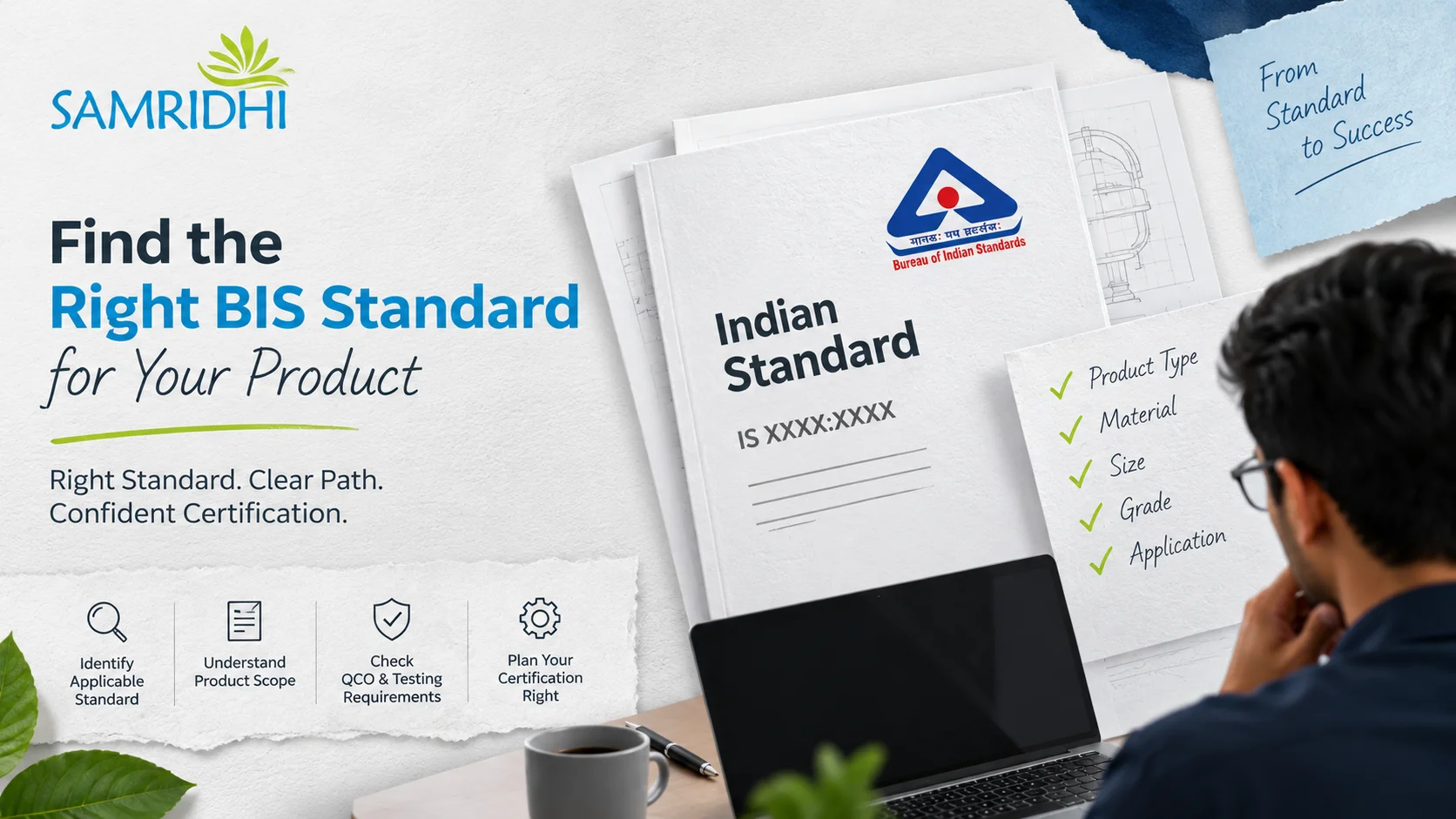
How to Find the Correct Indian Standard for Your Product Before BIS Certification: A Practical Step-by-Step Guide
Choosing the right BIS Indian Standard is one of the most important steps before starting a BIS application. A product name alone is often not enough. Similar products can fall under different standards depending on their construction, material, rating, intended use and technical characteristics. BIS itself recommends identifying the applicable Indian Standard before applying for product certification.
1. Start with the exact product, not just its market name
Begin by describing what the product actually is, what it is made of and how it is used. For example, “electric appliance” or “plastic pipe” may be too broad to identify the correct standard. Product type, material, capacity, voltage, dimensions, grade and application can influence which BIS standard applies.
This step prevents a common problem: finding an Indian Standard that sounds relevant but does not actually cover your product's technical scope.
2. Search the BIS Standard List
BIS provides its Know Your Standard facility, where users can search by an IS number or keyword such as a product name. The portal provides access to the relevant Indian Standard, amendments, Gazette notifications, Scheme of Testing and Inspection, licences, laboratories and other standard-related information.
Start with several sensible product keywords rather than relying on one phrase. Search variations can help you identify related standards that may have different scopes.
The first step is always to identify the exact product before selecting an Indian Standard. The same broad category can contain very different standards depending on construction, material, application and technical specifications. For example, manufacturers of LED lights, cables, cement, ceiling fans, water heaters and electric motors need to identify the standard applicable to their specific product rather than relying only on its commercial name. Reviewing the relevant product-specific certification requirements can help narrow down the correct BIS pathway.
3. Read the scope of the Indian Standard
Finding an IS number is only the beginning. The next step is to read the scope of that standard carefully. Check whether your exact product type, construction, material, performance characteristics or intended application falls within it.
Do not assume that because another manufacturer uses a particular IS number, your product automatically qualifies under the same standard. BIS certification is granted against a specified standard and product scope. BIS also states that separate applications are required for different products and Indian Standards, even when they are manufactured at the same factory.
4. Check the latest edition and amendments
Standards can be revised or amended. The BIS Indian Standards portal provides access to the standard itself as well as associated amendments and notifications.
This matters because using an old edition during certification planning can lead to incorrect testing, documentation or product specifications. Before budgeting for BIS certification cost, confirm the currently applicable edition and related requirements.
5. Check whether BIS certification is actually mandatory
An Indian Standard existing for a product does not automatically mean BIS certification is compulsory. BIS explains that products become subject to compulsory certification when the Central Government notifies them under the applicable legal framework.
Therefore, after identifying the standard, check the current BIS certification product list, Quality Control Order or other applicable notification. This distinction is important when deciding whether certification is legally required or being pursued voluntarily for market or customer requirements.
Searching the BIS database becomes more useful when the manufacturer already understands the technical identity of the product. Product categories such as ceiling fans, water heaters, electric motors and helmets can have specific standards that define their scope, testing parameters and applicable product characteristics. Checking the relevant service page alongside the BIS standard information can help manufacturers understand what technical details need to be matched before selecting an IS number.
6. Review the Product Manual and testing requirements
Once the standard is identified, review the related Product Manual, Scheme of Inspection and Testing (SIT), grouping guidelines and marking-fee information. BIS provides these under its Product Specific Information section.
These documents help you understand the practical requirements for manufacturing, testing, product scope and certification. They can also reveal that several variants cannot simply be treated as one product without considering the applicable grouping provisions.
7. Check whether another BIS route applies
Some products may fall under a different BIS framework rather than the conventional ISI route. For example, notified Electronics and IT products may fall under BIS CRS Certification. Therefore, identifying the standard should be followed by checking the applicable conformity-assessment scheme.
If the standard or product applicability remains unclear, BIS advises manufacturers to raise the matter with the concerned technical department.
A product's common name rarely tells the complete compliance story. Materials, dimensions, grades, product classes and intended applications can change the applicable standard or certification scope. This is particularly important for helmets, PVC pipes and steel products, where technical characteristics can play a major role in determining the relevant Indian Standard. Manufacturers should therefore compare their actual specifications with the scope of the applicable standard before arranging testing or preparing a BIS application.
Final practical check
Before proceeding with BIS Product Certification, verify these five points:
Product → Indian Standard → Scope → Current notification → Product-specific certification requirements
Doing this research before arranging testing or preparing the application can prevent avoidable changes later. The correct Indian Standard, testing scope, certification route and BIS certification cost are product-specific and can vary by scope, so the final determination should always be based on the latest BIS information and applicable regulatory requirements.
BIS Standard List Explained: How to Search Your Product, Find the Correct IS Number and Confirm Its Scope
Finding the correct BIS Standard List entry is an important step before starting BIS product certification. The challenge is that a commercial product name does not always match the terminology used in an Indian Standard. A manufacturer may search for a familiar product name and find several standards, but only one may actually cover the product's construction, application or technical characteristics. BIS itself says the certification process begins with identifying the Indian Standard applicable to the product.
Start by searching the BIS Standard List
BIS provides a Know Your Standard facility that allows users to search by entering either an Indian Standard (IS) number or a keyword, such as the product name. It acts as a central source for information connected with the selected standard, including the standard document, amendments, Gazette notifications, Scheme of Testing and Inspection, applicable licences, laboratories and classification information.
Finding an Indian Standard is only one part of the compliance assessment. Manufacturers should also determine whether the product is covered by a mandatory BIS requirement and which certification route applies. This distinction is especially useful for toys and other regulated consumer products, where identifying the relevant standard should be followed by checking the applicable regulatory framework. Businesses should also consider whether they are operating as an established manufacturer, startup or MSME because their certification planning and preparation needs may differ.
When you do not know the IS number, begin with several practical descriptions of the product. For example, instead of searching only the brand or marketing name, try the product type, material or commonly used technical description. This increases the chance of finding the relevant standard.
Finding an IS number is not enough
A search result should not immediately be treated as confirmation that you have found the correct BIS standard. Open the standard details and examine its title, scope and technical description.
The scope is particularly important because it explains what the standard is intended to cover. A product that looks similar to another certified product may still fall outside a particular standard because of differences in material, design, dimensions, rating, capacity, application or intended use.
After identifying a possible IS number, manufacturers should review the applicable Product Manual, testing requirements, grouping provisions and regulatory notification before beginning certification. This step is particularly important for MSMEs, which may need to assess testing infrastructure, documentation and factory readiness based on their actual product scope. Reviewing the product-specific certification route alongside the standard can help businesses determine the practical requirements before committing to testing or application preparation.
BIS also provides standard details through its standards portal, where information can include the type of standard, revisions, amendments, classification and other associated information.
Check the latest revision and amendments
Indian Standards can be revised, reaffirmed or amended. Therefore, finding an old IS number through a third-party website does not necessarily mean it is the version you should use for current BIS certification planning.
The BIS “Know Your Standard” facility provides access to amendments and related documents, while the Product Specific Information section provides guidance for implementing revisions or amendments to Indian Standards.
This check is particularly important before paying for product testing. Testing against an outdated requirement can create unnecessary work when the applicable certification requirements have changed.
Confirm the product's certification scope
After identifying the standard, review the relevant Product Manual. BIS states that Product Manuals provide practical information including the description of scope, sampling guidelines, testing-equipment requirements and Scheme of Inspection and Testing.
The Product Specific Information section also provides Product Manuals, Scheme of Inspection and Testing and Grouping Guidelines for applicable products.
This is where manufacturers should check whether multiple sizes, grades, models or variants can be covered under the same licence. The scope is not automatically expanded simply because the products belong to the same commercial category.
Check whether BIS certification is actually required
Another common mistake is assuming that the presence of an Indian Standard automatically means that BIS product certification is compulsory.
The existence of an IS number and the legal requirement to obtain BIS certification are separate questions. After finding the standard, manufacturers should check whether the product is covered by the applicable compulsory-certification framework or whether certification is being pursued voluntarily.
The BIS application guidance specifically recommends identifying the standard first and then analysing the required manufacturing infrastructure, process controls, quality control and testing capabilities.
Review testing and laboratory information
Once the standard and scope are confirmed, the next step is understanding testing requirements. BIS provides IS-wise laboratory information, while Product Manuals identify relevant testing equipment and testing arrangements for applicable products.
This helps a manufacturer determine whether testing needs to be performed internally, through an eligible laboratory, or through a combination of permitted arrangements, depending on the product requirements.
A practical checklist before applying
Before moving ahead with India BIS Certification, confirm:
Product → IS number → Scope → Latest revision → QCO/applicability → Product Manual → Testing requirements → Licence scope
If any of these remains unclear, it is better to resolve the uncertainty before preparing samples or submitting an application. BIS itself advises manufacturers who cannot identify the relevant Indian Standard to contact the concerned BIS technical department for clarification.
In practical terms, the BIS Standard List is only the starting point. The real decision comes from matching your actual product with the standard's scope and then checking the current certification requirements. The applicable BIS certification, testing requirements and BIS certification cost vary by product and scope, so the final assessment should always be based on current BIS information and applicable authority requirements.
 Get Certified with Confidence – Your One-Stop Compliance Partner
 Grab Your Certified Now
 +91 8799708673
 WhatsApp