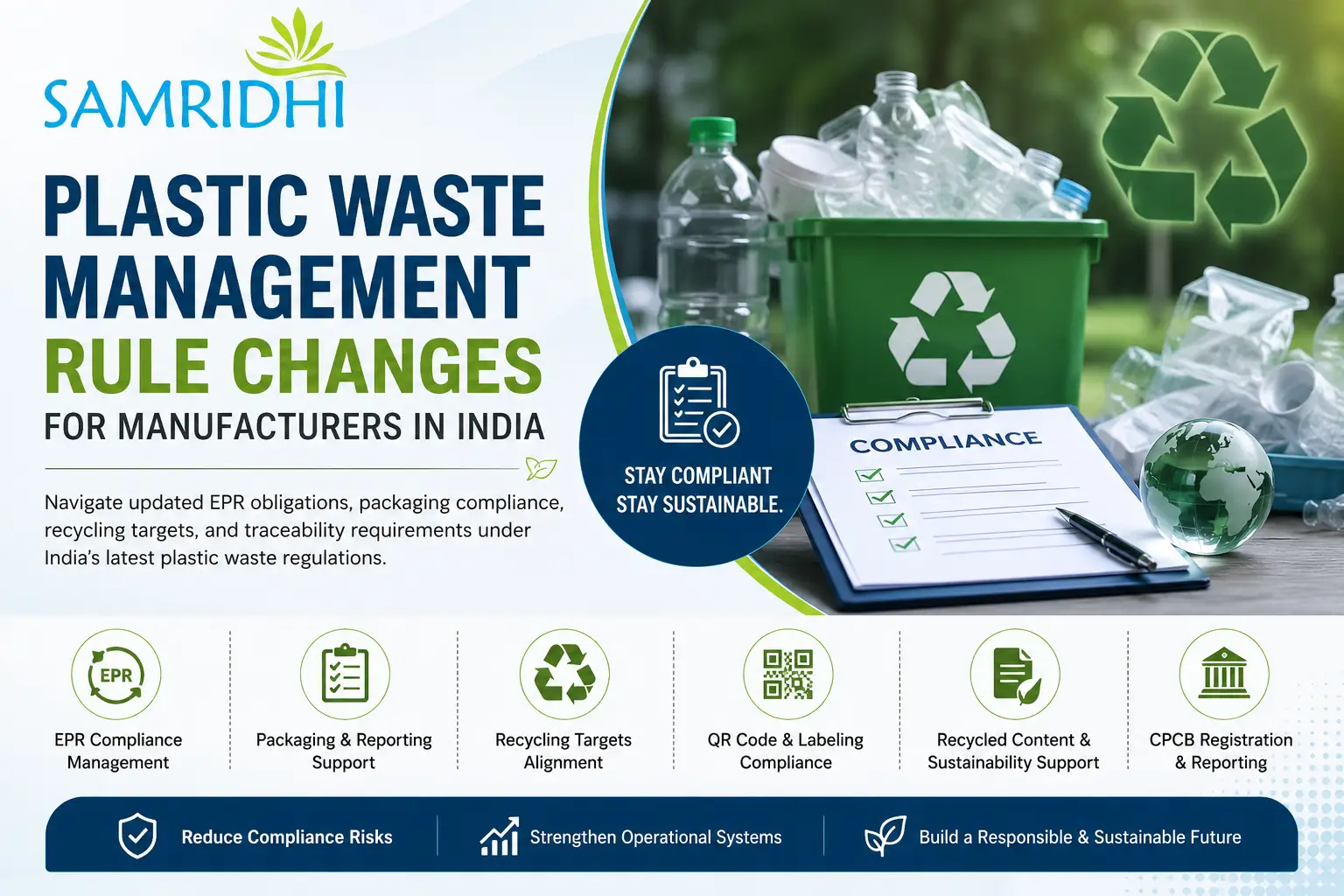
What Are the Latest Plastic Waste Management Rule Changes for Manufacturers in India
Plastic packaging regulations in India are no longer limited to waste disposal discussions.
Over the past few years, the compliance framework has shifted toward accountability, traceability, and measurable recycling obligations.
That shift is exactly why many businesses are now closely monitoring plastic waste management rule changes for manufacturers India.
For manufacturers, the focus is no longer only on producing packaging.
Authorities increasingly expect businesses to also manage what happens after that packaging enters the market.
Why the Plastic Waste Rules Are Changing
India’s updated plastic waste framework is largely driven by growing concerns around:
- Packaging waste generation
- Recycling efficiency
- Traceability of plastic materials
- Environmental accountability
As a result, the government has introduced amendments that place greater responsibility on businesses involved in plastic packaging production and usage.
This forms the core of the new plastic waste management rules India 2025 for manufacturers discussion.
EPR Has Become Central to Manufacturer Compliance
One of the biggest regulatory changes is the expansion of Extended Producer Responsibility (EPR).
Manufacturers are now expected to:
- Track packaging introduced into the market
- Meet recycling obligations
- Maintain compliance records
- Coordinate with authorized recyclers
This is a major part of EPR compliance changes for plastic manufacturers India.
The responsibility continues even after packaging leaves the factory.
Manufacturers Are Being Categorized More Clearly
The updated framework places stronger emphasis on identifying the role of businesses within the packaging ecosystem.
Authorities may classify entities as:
- Producers
- Importers
- Brand Owners (PIBOs)
This classification affects compliance obligations, reporting requirements, and target calculations.
Packaging Categories Now Matter More Than Before
Another major shift is the increased focus on packaging classification.
Plastic packaging is generally categorized into:
- Rigid plastic packaging
- Flexible plastic packaging
- Multi-layered plastic packaging
- Compostable plastic packaging
These categories directly affect compliance obligations under plastic packaging compliance rules for manufacturers India.
Different categories may involve different recycling targets and reporting expectations.
Recycling Targets Are Becoming More Structured
Manufacturers are increasingly expected to participate in measurable recycling systems.
This includes:
- Packaging quantity declarations
- Waste recovery obligations
- Recycling target fulfillment
- Traceable recycler coordination
This is closely linked with plastic packaging recycling targets India manufacturers requirements.
Authorities are moving toward data-driven compliance tracking rather than basic registration systems.
QR Code and Labeling Requirements Are Gaining Importance
Traceability is becoming a major regulatory focus area.
Recent amendments have increased discussions around:
- QR code systems
- Packaging identification mechanisms
- Labeling disclosures
- Packaging traceability standards
This connects directly with QR code and labeling rules for plastic packaging India.
The objective is to improve packaging visibility and recycling accountability throughout the supply chain.
Recycled Content Expectations Are Also Increasing
Another important development is the growing emphasis on recycled plastic usage.
Manufacturers may increasingly need to evaluate:
- Recycled material incorporation
- Packaging sustainability planning
- Traceability of recycled content usage
This forms part of recycled content requirements for plastic packaging India.
Applicability may vary depending on packaging category and operational scope.
CPCB Registration and Reporting Expectations Continue Expanding
The compliance framework is now far more operational than before.
Manufacturers may need to manage:
- CPCB registration activities
- Packaging data reporting
- Annual compliance updates
- Recycler documentation coordination
This is directly related to CPCB plastic waste registration requirements for manufacturers.
Why Manufacturers Are Facing Compliance Challenges
Many businesses are still adapting to the operational side of EPR compliance.
Common issues include:
- Incorrect packaging classification
- Lack of packaging quantity tracking
- Confusion around recycler coordination
- Documentation inconsistencies
- Reporting system gaps
These challenges often arise because packaging compliance is now tied to ongoing operational data—not just one-time registration.
The Practical Takeaway
India’s updated plastic waste rules are changing how manufacturers manage packaging responsibility.
- EPR obligations are expanding
- Recycling targets are becoming measurable
- Packaging traceability is increasing
- Reporting and documentation expectations are growing
And since:
- Requirements depend on packaging category
- Compliance scope varies by operational structure
- Obligations remain subject to authority review
manufacturers should integrate EPR planning, packaging tracking, and compliance reporting into regular business operations.
Because under the updated plastic waste framework…
manufacturing responsibility no longer ends when the product is sold.
EPR Registration for Plastic Waste supports CPCB compliance for manufacturers managing packaging responsibility and recycling obligations.
How New EPR Compliance Rules Affect Plastic Packaging Manufacturers
For many plastic packaging manufacturers, the biggest change in recent years is this:
Compliance is no longer limited to manufacturing quality or packaging production capacity.
Now, manufacturers are increasingly expected to track what happens to plastic packaging even after it enters the market.
That shift has made EPR compliance changes for plastic manufacturers India a major operational issue—not just a regulatory formality.
EPR Responsibility Is Expanding Beyond Production
Under the updated framework, manufacturers are expected to participate in the full lifecycle of plastic packaging compliance.
This may include responsibilities related to:
- Packaging quantity declarations
- Recycling obligations
- Waste recovery tracking
- Compliance reporting
- Recycler coordination
This forms a major part of manufacturer responsibilities under plastic waste management rules India.
The focus is now on measurable environmental accountability.
Packaging Data Tracking Has Become Essential
One of the most significant changes is the growing importance of packaging data management.
Manufacturers may need to maintain records regarding:
- Packaging material usage
- Packaging category classification
- Product-wise packaging quantities
- Annual packaging introduction data
This directly affects plastic packaging compliance rules for manufacturers India.
Without accurate packaging tracking systems, reporting obligations become difficult to manage.
Packaging Categories Influence Compliance Obligations
Authorities increasingly evaluate compliance based on the type of plastic packaging introduced into the market.
Packaging is generally categorized into:
- Rigid plastic packaging
- Flexible plastic packaging
- Multi-layered plastic packaging
- Compostable plastic packaging
These categories affect recycling targets and reporting requirements under the plastic waste management amendment rules India for producers framework.
Recycling Obligations Are Becoming Measurable
One of the biggest operational shifts is the move toward target-based recycling compliance.
Manufacturers may now need to demonstrate:
- Packaging recovery efforts
- Authorized recycling coordination
- Waste processing records
- Fulfillment of recycling obligations
This is closely linked with plastic packaging recycling targets India manufacturers.
Authorities are placing more emphasis on traceable recycling systems and measurable compliance evidence.
CPCB Registration and Reporting Requirements Are Expanding
Manufacturers are increasingly required to manage ongoing compliance activities through CPCB systems.
This may involve:
- Registration updates
- Packaging quantity declarations
- Annual reporting
- Recycler documentation management
These activities are directly related to CPCB plastic waste registration requirements for manufacturers.
The system is becoming more operational and data-intensive over time.
Producer Classification Now Matters More
Businesses are also facing greater scrutiny regarding their classification within the EPR framework.
Authorities may assess whether the entity operates as:
- Producer
- Importer
- Brand Owner (PIBO)
- Packaging manufacturer
This classification affects how obligations are calculated and reported.
QR Codes and Traceability Expectations Are Increasing
Recent rule changes are also pushing manufacturers toward stronger packaging traceability systems.
There is increasing discussion around:
- QR code implementation
- Packaging identification systems
- Labeling disclosures
- Supply-chain traceability
This aligns with QR code and labeling rules for plastic packaging India.
The overall direction is toward improved packaging accountability.
Recycled Content Expectations Are Influencing Packaging Design
Manufacturers are also beginning to evaluate packaging sustainability more closely.
This includes reviewing:
- Recycled material incorporation
- Packaging redesign strategies
- Material recovery considerations
These developments are connected with recycled content requirements for plastic packaging India.
Applicability may vary depending on packaging type and operational scope.
Why Manufacturers Commonly Face Compliance Problems
Many businesses struggle because EPR compliance now requires coordination across multiple departments.
Common challenges include:
- Inconsistent packaging data
- Poor internal tracking systems
- Recycler coordination issues
- Reporting mismatches
- Incorrect packaging classification
These problems often create delays during compliance reporting or CPCB review stages.
The Practical Takeaway
The updated EPR framework is changing how plastic packaging manufacturers operate.
- Packaging production now carries post-market responsibility
- Data tracking has become essential
- Recycling obligations are measurable
- Reporting expectations are increasing
- Packaging traceability is becoming more important
And since:
- Requirements depend on packaging category
- Obligations vary by business structure
- Compliance remains subject to authority review
manufacturers should treat EPR as an ongoing operational compliance system—not a one-time registration activity.
Because under India’s updated plastic waste rules…
manufacturers are increasingly being evaluated not only for what they produce…
but also for what happens to that packaging afterward.
EPR Compliance Reporting & Documentation helps manufacturers manage packaging data, compliance records, and CPCB reporting workflows.
New Packaging, Labeling, and QR Code Rules Under Plastic Waste Regulations
Plastic packaging compliance in India is moving beyond basic registration and recycling declarations.
Authorities are now placing stronger emphasis on packaging traceability.
That means businesses are increasingly expected not only to report packaging quantities… but also to improve how packaging is identified, tracked, and monitored throughout the supply chain.
This is why QR code and labeling rules for plastic packaging India are becoming an important discussion for manufacturers and brand owners.
Why Traceability Is Becoming Important
One of the biggest challenges in plastic waste management is tracking packaging movement after products enter the market.
Without traceability, it becomes difficult to:
- Verify packaging sources
- Monitor recycling obligations
- Identify packaging categories accurately
- Track compliance accountability
The newer regulatory direction focuses on creating more transparent packaging systems.
This forms an important part of evolving plastic waste management rule changes for manufacturers India.
Packaging Labeling Expectations Are Increasing
Manufacturers are increasingly expected to maintain clearer packaging-related disclosures.
Depending on the product and packaging category, businesses may need to evaluate:
- Packaging identification markings
- Material disclosure information
- Packaging category declarations
- Recycling-related labeling practices
These requirements are connected with broader plastic packaging compliance rules for manufacturers India.
QR Codes Are Being Discussed as a Traceability Tool
Recent regulatory developments have increased focus on digital traceability systems.
QR codes are being viewed as a possible way to improve:
- Packaging identification
- Supply-chain traceability
- Recycling verification
- Product-level packaging tracking
This is especially relevant under updated new plastic waste management rules India 2025 for manufacturers discussions.
The objective is to improve packaging transparency across the lifecycle of the product.
Traceability Supports EPR Compliance Monitoring
EPR systems increasingly rely on measurable and verifiable data.
Better packaging identification may help authorities and businesses:
- Track packaging quantities more accurately
- Improve recycling reporting
- Verify packaging responsibility
- Strengthen waste recovery systems
This aligns closely with EPR compliance changes for plastic manufacturers India.
The compliance model is gradually shifting toward data-backed accountability.
Packaging Category Identification Is Becoming More Important
One practical reason for stronger labeling requirements is the growing complexity of packaging classifications.
Authorities often categorize packaging into:
- Rigid plastic packaging
- Flexible plastic packaging
- Multi-layered plastic packaging
- Compostable packaging
Proper identification helps improve compliance management under the plastic waste management amendment rules India for producers framework.
Recycled Content Disclosure Expectations Are Increasing
Another emerging area is recycled-content transparency.
Businesses may increasingly need to evaluate:
- Recycled material declarations
- Sustainability-related packaging disclosures
- Material composition traceability
This is connected with recycled content requirements for plastic packaging India.
Applicability may vary depending on packaging category and operational scope.
Manufacturers May Need Better Internal Packaging Tracking
One major operational challenge is that many businesses still lack centralized packaging data systems.
As traceability expectations increase, manufacturers may need stronger processes for:
- Packaging inventory tracking
- Supplier coordination
- Packaging material documentation
- Packaging category management
This is becoming important for ongoing compliance reporting and operational consistency.
Why Businesses Commonly Face Labeling and Traceability Problems
Many packaging-related compliance issues happen because packaging systems were originally designed for logistics—not regulatory traceability.
Common challenges include:
- Incorrect packaging declarations
- Missing packaging identification details
- Inconsistent packaging data across suppliers
- Unclear material classification
- Poor packaging record management
These problems often affect broader CPCB plastic waste registration requirements for manufacturers.
Compliance Expectations Are Becoming More Operational
Authorities are increasingly focusing on:
- Packaging visibility
- Data consistency
- Recycling traceability
- Packaging accountability
- Long-term compliance monitoring
This reflects a broader shift toward structured environmental reporting systems.
The Practical Takeaway
India’s plastic waste regulations are gradually moving toward traceable packaging compliance systems.
- Labeling expectations are increasing
- QR code systems may become more important
- Packaging traceability supports EPR compliance
- Packaging category identification matters more than before
- Recycled-content transparency is gaining attention
And since:
- Requirements depend on packaging type
- Traceability scope varies by operational structure
- Compliance expectations remain subject to authority review
manufacturers should begin strengthening packaging documentation and traceability systems early.
Because under the updated plastic waste framework…
compliance is no longer only about managing waste.
It is increasingly about proving where packaging comes from and how it is managed afterward.
EPR Compliance Reporting & Documentation supports packaging traceability, QR code compliance tracking, and structured packaging record management.
Recycled Content and Plastic Packaging Compliance Requirements for Manufacturers
Plastic packaging regulations in India are gradually shifting from waste collection alone toward broader sustainability accountability.
Earlier, most compliance discussions focused mainly on recycling targets and EPR registration.
Now, manufacturers are increasingly being expected to think about something else too:
what the packaging itself is made from.
That’s why recycled content requirements for plastic packaging India are becoming an important part of the evolving compliance landscape.
Why Recycled Content Is Becoming Important
Authorities are increasingly encouraging the use of recycled plastic materials within packaging systems.
The broader objective is to:
- Reduce dependence on virgin plastic
- Improve circular material usage
- Strengthen recycling ecosystems
- Increase packaging sustainability
This is closely connected with ongoing plastic waste management rule changes for manufacturers India.
The direction of regulation is gradually moving from waste management toward material sustainability.
Packaging Sustainability Is Becoming a Compliance Discussion
Manufacturers are now expected to evaluate packaging more carefully—not just from a production perspective, but also from an environmental responsibility perspective.
This may involve reviewing:
- Packaging material selection
- Recyclability of packaging
- Recycled material integration
- Long-term sustainability planning
These expectations are becoming part of broader plastic packaging compliance rules for manufacturers India.
Different Packaging Categories Create Different Challenges
Recycled-content integration is not equally simple across all packaging types.
Authorities generally classify packaging into categories such as:
- Rigid plastic packaging
- Flexible plastic packaging
- Multi-layered plastic packaging
- Compostable plastic packaging
Each category may involve different operational and compliance considerations under the plastic waste management amendment rules India for producers framework.
Manufacturers May Need Better Material Traceability
As sustainability requirements increase, businesses may also need stronger visibility into material sourcing and packaging composition.
This may involve tracking:
- Recycled material procurement
- Supplier declarations
- Material composition details
- Packaging batch records
This is becoming increasingly important alongside QR code and labeling rules for plastic packaging India discussions.
Traceability and sustainability are now being treated as connected compliance areas.
Recycled Content Expectations Affect Packaging Design Decisions
Manufacturers are beginning to reconsider packaging strategies because compliance expectations are changing operational priorities.
Businesses may need to evaluate:
- Packaging redesign feasibility
- Material compatibility
- Packaging durability with recycled content
- Supply-chain availability of recycled materials
This shift affects both compliance planning and packaging engineering decisions.
EPR and Sustainability Requirements Are Becoming Interconnected
The updated framework increasingly links:
- Recycling targets
- Packaging traceability
- Material sustainability
- Environmental accountability
This reflects broader EPR compliance changes for plastic manufacturers India.
Authorities are gradually moving toward a more lifecycle-based approach to packaging compliance.
CPCB Reporting Expectations May Become More Detailed
As sustainability obligations expand, reporting systems may also become more data-focused.
Businesses may eventually need stronger records related to:
- Packaging material composition
- Recycled content usage
- Supplier documentation
- Sustainability declarations
This aligns with CPCB plastic waste registration requirements for manufacturers and evolving compliance monitoring systems.
Why Manufacturers Commonly Face Difficulties
For many businesses, the challenge is operational—not theoretical.
Common issues include:
- Limited availability of quality recycled material
- Packaging performance concerns
- Supply-chain inconsistencies
- Material traceability gaps
- Lack of standardized documentation
These problems become more complex for manufacturers handling large-scale packaging operations.
Sustainability Compliance Is Becoming Long-Term
The regulatory direction suggests that environmental compliance will continue expanding beyond basic waste management.
Authorities are increasingly emphasizing:
- Sustainable packaging systems
- Traceable recycling practices
- Responsible material usage
- Long-term packaging accountability
This is gradually reshaping packaging compliance expectations across industries.
The Practical Takeaway
Recycled-content compliance is becoming an important part of India’s plastic packaging framework.
- Sustainability expectations are increasing
- Packaging material traceability matters more
- Recycled-content usage may influence compliance planning
- Packaging design decisions are becoming more compliance-driven
- EPR and sustainability obligations are increasingly connected
And since:
- Requirements depend on packaging category
- Applicability varies by operational scope
- Compliance expectations remain subject to authority review
manufacturers should begin reviewing packaging sustainability strategies early rather than waiting for operational pressure later.
Because under the updated plastic waste framework…
the future of packaging compliance is not only about managing waste.
It is also about how responsibly the packaging itself is created.
EPR Target Fulfillment Support helps businesses manage recycling obligations, sustainability reporting, and packaging recovery compliance activities.
Common Compliance Problems Manufacturers Face Under Updated Plastic Waste Rules
Most manufacturers do not struggle with plastic waste compliance because they ignore regulations.
They struggle because the rules have become operationally complex.
A few years ago, many businesses treated packaging compliance as a registration requirement.
Today, it involves data tracking, packaging classification, recycling coordination, reporting systems, and long-term compliance monitoring.
That shift is why many businesses are now facing practical difficulties under plastic packaging compliance rules for manufacturers India.
Confusion Around EPR Target Calculations
One of the biggest challenges manufacturers face is understanding how recycling obligations are calculated.
Businesses often struggle with:
- Packaging quantity estimation
- Category-wise packaging calculations
- Multi-layered packaging reporting
- Product-wise packaging allocation
These issues directly affect plastic packaging recycling targets India manufacturers.
Small calculation errors can create reporting inconsistencies later.
Incorrect Packaging Category Classification
Packaging classification has become much more important under the updated framework.
Authorities generally categorize packaging into:
- Rigid plastic packaging
- Flexible plastic packaging
- Multi-layered plastic packaging
- Compostable packaging
Many manufacturers incorrectly classify packaging materials, especially where products use multiple packaging layers.
This creates compliance gaps under the plastic waste management amendment rules India for producers framework.
Documentation Gaps Create Major Delays
Many compliance problems begin with incomplete internal records.
Common documentation issues include:
- Missing packaging data
- Inconsistent sales and packaging quantities
- Unclear supplier records
- Incomplete recycler documentation
- Mismatch between declarations and operational data
These gaps frequently affect CPCB plastic waste registration requirements for manufacturers.
Because the compliance framework is increasingly dependent on accurate data.
CPCB Registration and Reporting Delays
Manufacturers often underestimate the amount of preparation required before registration or reporting activities begin.
Common operational issues include:
- Incorrect portal submissions
- Missing supporting documents
- Packaging declaration inconsistencies
- Delayed packaging data collection
These challenges are becoming more common under the new plastic waste management rules India 2025 for manufacturers environment.
Recycler Coordination Is Often More Difficult Than Expected
Many businesses assume EPR compliance ends once registration is completed.
In reality, ongoing coordination with recyclers becomes equally important.
Manufacturers often face problems related to:
- Recycler documentation availability
- Recycling evidence management
- Target fulfillment coordination
- Delayed compliance records
This reflects broader EPR compliance changes for plastic manufacturers India.
QR Code and Traceability Requirements Add Operational Pressure
As packaging traceability expectations increase, businesses are also facing additional operational complexity.
Manufacturers may now need stronger systems for:
- Packaging identification
- Material traceability
- Supplier tracking
- Packaging data visibility
This is closely connected with QR code and labeling rules for plastic packaging India.
Many businesses are still adapting their packaging operations to meet these expectations.
Recycled Content Compliance Creates New Challenges
Manufacturers trying to align with sustainability-related expectations may also encounter operational difficulties such as:
- Limited recycled material availability
- Packaging performance concerns
- Material consistency issues
- Supplier traceability gaps
These challenges affect broader recycled content requirements for plastic packaging India planning.
Internal Coordination Is Often Weak
One overlooked issue is that EPR compliance usually involves multiple departments:
- Procurement
- Packaging design
- Operations
- Compliance teams
- Supply chain management
When data systems are disconnected, reporting accuracy becomes difficult.
Why Compliance Is Becoming More Demanding
Authorities are increasingly emphasizing:
- Packaging traceability
- Measurable recycling systems
- Accurate reporting
- Long-term environmental accountability
This means manufacturers are expected to maintain more structured compliance systems than before.
The Practical Takeaway
Most compliance problems under India’s updated plastic waste rules are operational—not intentional.
- Packaging classification must be accurate
- EPR target calculations require careful tracking
- Documentation consistency is critical
- Recycler coordination must be managed continuously
- Traceability expectations are increasing
And since:
- Requirements depend on packaging category
- Compliance obligations vary by business structure
- Reporting expectations remain subject to authority review
manufacturers should strengthen packaging data systems and compliance workflows early.
Because under the updated plastic waste framework…
the biggest compliance risks usually come from gaps in operational visibility—not from the regulations themselves.
EPR Authorization Renewal Services support ongoing compliance continuity, reporting updates, and renewal management for packaging-related EPR obligations.


 Get Certified with Confidence – Your One-Stop Compliance Partner
 Grab Your Certified Now
 +91 8799708673
 WhatsApp