What Documents Are Required for BIS Certification? Complete BIS Certification Documents Checklist for Manufacturers and Importers
One of the first questions businesses ask before starting the BIS certification India process is, "What documents do we actually need?" While there is no single checklist that applies to every application, every certification scheme requires a structured set of technical, legal, and manufacturing documents to demonstrate that the product complies with the applicable Indian Standards.
The exact documents required for BIS certification depend on several factors, including the product category, the applicable certification scheme, whether the applicant is a domestic or foreign manufacturer, and the specific regulatory requirements. Because of these variables, documentation requirements depend on the product, vary by scope, and remain subject to authority review.
Many applications experience avoidable delays not because the product fails technical requirements, but because the supporting documentation is incomplete, inconsistent, or submitted in an incorrect format. Preparing documentation carefully before filing the application helps businesses move through the BIS certification process India more efficiently and reduces the likelihood of additional clarification requests.
Although every application is different, the following categories of documents are commonly required during BIS registration in India.
| Document Category |
Purpose |
| Business registration documents |
Establish the legal identity of the applicant or manufacturer. |
| Manufacturing facility details |
Provide information about the production unit where the product is manufactured. |
| Product specifications |
Describe the technical characteristics, design, materials, and intended use of the product. |
| Quality management documents |
Demonstrate the manufacturer's quality control systems and production processes. |
| Product test reports |
Support compliance with the applicable Indian Standard where required. |
| Manufacturing process information |
Explain production methods, quality checks, and inspection procedures. |
| Authorized representative documents |
Required where applicable, particularly for foreign manufacturers. |
| Product drawings, labels, and markings |
Verify that product identification complies with regulatory requirements. |
| Application forms and declarations |
Provide official information required for the certification application. |
It is important to understand that documentation is intended to provide regulators with a complete picture of both the product and the manufacturing system behind it. Simply submitting business registration certificates is rarely sufficient. Authorities generally review technical documentation alongside manufacturing controls, testing records, and supporting declarations to evaluate whether the product satisfies the applicable certification requirements.
For example, consider an overseas manufacturer planning to export electrical equipment to India. The company may already hold international certifications and quality approvals for other markets. However, when applying for BIS certification India, the manufacturer may still need to submit product-specific technical documents, manufacturing information, applicable test reports, and declarations that align with the relevant Indian Standard. Existing international certifications do not automatically replace documentation required under the BIS framework.
Businesses should also distinguish between documents that establish company identity and those that demonstrate product compliance. Both are important, but they serve different purposes during the certification review.
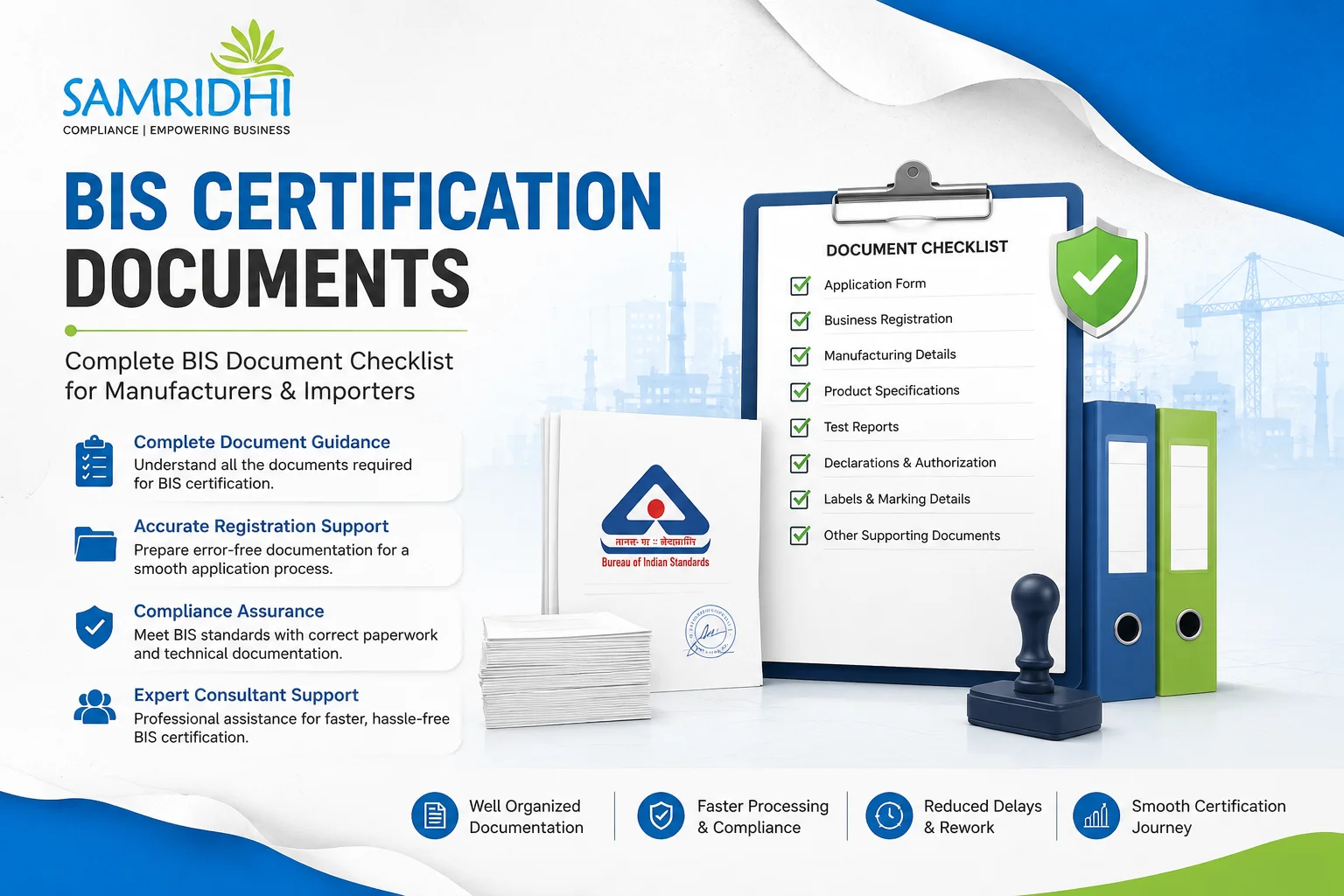
A Practical BIS Documentation Checklist
Before beginning the application, businesses should generally verify that they have prepared:
- Business incorporation or company registration documents.
- Manufacturing facility details and production information.
- Product specifications and technical documentation.
- Quality management and process control records.
- Product testing reports where applicable.
- Product labels, artwork, and marking details.
- Authorized representative documentation (if required).
- Application forms and statutory declarations.
- Any additional documents specified under the applicable certification scheme.
Another common mistake is assuming that the same BIS registration documents apply to every product. In practice, documentation requirements often differ between certification schemes and product categories. For example, electronic products, construction materials, chemicals, steel products, household appliances, and industrial equipment may each require different technical records, testing evidence, or supporting declarations.
Businesses should also remember that obtaining a BIS registration certificate is the result of a broader compliance process rather than document submission alone. Product testing, technical evaluation, factory assessment (where applicable), and regulatory review are often equally important parts of the overall certification journey.
Preparing accurate BIS certification documents before submitting an application not only improves document quality but also helps manufacturers, importers, and compliance teams coordinate more effectively throughout the certification process. Since the documents required for BIS certification are case-specific and depend on the applicable product and certification scheme, businesses should review the latest BIS requirements carefully and ensure that every supporting document aligns with the relevant regulatory framework before applying.
The exact documentation required depends on the applicable BIS certification scheme and product category. Whether you require BIS CRS Registration, BIS ISI Certification for Domestic Manufacturers, BIS ISI Certification for Foreign Manufacturers, or guidance from an experienced BIS Consultant Delhi, preparing the correct documents from the beginning helps build a stronger certification application.
Documents Required for BIS Registration in India: Understanding the BIS Registration Process, Mandatory Paperwork, and Application Requirements
Starting the BIS registration in India process involves much more than completing an application form. Every certification application is supported by a set of technical, legal, and quality-related documents that enable the Bureau of Indian Standards (BIS) to evaluate whether a product and its manufacturing process comply with the applicable Indian Standard. The exact documents required for BIS registration are determined by the product category, certification scheme, manufacturing location, and other regulatory factors. As a result, documentation requirements depend on the product, vary by scope, and remain subject to authority review.
Many businesses begin preparing documentation only after deciding to apply for certification. In practice, it is often more effective to organize the required paperwork during product development or supplier selection. This approach helps manufacturers and importers identify missing information early and reduces the chances of delays caused by incomplete or inconsistent documentation.
The purpose of BIS certification documents is not simply to verify company details. They provide regulators with evidence that the product is manufactured under controlled conditions, supported by appropriate quality systems, and capable of meeting the requirements of the applicable Indian Standard.
Core Categories of Documents Commonly Required
| Document Type |
Why It Is Required |
| Company registration documents |
Verify the legal identity of the applicant or manufacturer. |
| Manufacturing unit information |
Confirm where and how the product is produced. |
| Product specifications |
Describe the technical characteristics, materials, dimensions, and intended application of the product. |
| Manufacturing process details |
Explain production methods, inspection stages, and quality controls. |
| Quality management records |
Demonstrate how product consistency and quality are maintained. |
| Product test reports |
Provide technical evidence that the product complies with the applicable Indian Standard where required. |
| Product labels and marking details |
Verify regulatory marking and identification requirements. |
| Authorization documents |
Required where representatives or authorized Indian entities are involved. |
| Application forms and declarations |
Supply statutory information and applicant declarations required during submission. |
Although these categories are common across many certification schemes, every application should be reviewed individually. Certain products may require additional technical documentation, laboratory reports, factory records, or product-specific information depending on the applicable BIS certification procedure.
For instance, a domestic manufacturer producing electrical appliances and a foreign manufacturer exporting industrial equipment to India may both apply for BIS certification India, but the supporting documentation may differ because they fall under different certification schemes. Likewise, an importer applying for products covered by mandatory regulations may need to coordinate documentation with the overseas manufacturing facility before the application can proceed.
Documents Businesses Should Prepare Before Applying
A practical BIS registration checklist often includes:
- Company incorporation or business registration documents.
- Manufacturing facility details and factory information.
- Product specifications and technical datasheets.
- Manufacturing process flow and quality control procedures.
- Product labels, packaging artwork, and marking information.
- Product testing reports where applicable.
- Authorized representative documents, if required.
- Application forms and statutory declarations.
- Additional technical documents specified for the applicable certification scheme.
One of the most common reasons businesses receive requests for clarification is inconsistency between submitted documents. For example, product specifications may differ from technical drawings, manufacturing information may not match application details, or product labels may not align with the applicable Indian Standard. Even small inconsistencies can require additional explanations before the application progresses.
Another important consideration is that documentation requirements may change over time as regulations evolve. New Quality Control Orders (QCOs), revised Indian Standards, or updated certification procedures may introduce additional documentation requirements for certain product categories. Businesses should therefore rely on the latest regulatory guidance rather than older application checklists or previous certification experiences.
It is also worth noting that documentation is only one component of the overall BIS certification process India. Depending on the product and certification scheme, businesses may also need to complete laboratory testing, factory evaluations, technical reviews, or other compliance activities before a BIS registration certificate can be issued. Preparing documentation early helps ensure these later stages are supported by accurate and complete information.
Ultimately, successful BIS registration in India begins with well-organized paperwork. By preparing complete BIS registration documents, verifying technical information, and ensuring consistency across all supporting records, manufacturers, importers, and compliance teams can build a stronger foundation for the certification process while reducing avoidable documentation-related challenges. Since every application is case-specific and subject to authority review, businesses should always align their documentation with the applicable product requirements and current BIS guidelines.
Accurate documentation is closely linked with product testing and technical compliance. Services such as NABL Testing, LM79 Testing, Lab Setup and Equipment, and support from a BIS Consultant Mumbai can help manufacturers prepare technical records and documentation that align with applicable BIS requirements.
Step-by-Step BIS Certification Procedure: Which Documents Are Needed at Every Stage of the BIS Certification Process India?
Preparing the right documentation is one of the most important aspects of the BIS certification process India. Many businesses focus primarily on product testing or application submission, but documentation supports every stage of the certification journey. From identifying the correct certification scheme to obtaining a BIS registration certificate, each phase requires specific information that enables authorities to assess product compliance, manufacturing capability, and adherence to the applicable Indian Standard.
One important point to understand is that there is no universal document package for every product. The documents required for BIS certification differ depending on the certification scheme, product category, manufacturing location, and regulatory framework. Consequently, the documentation required depends on the product, varies by scope, and remains subject to authority review.
Rather than collecting documents only at the time of application, businesses should prepare them progressively throughout the certification process. This makes it easier to identify missing information and helps maintain consistency between technical records, product specifications, and application details.
Stage-Wise Documentation in the BIS Certification Process
| BIS Certification Stage |
Common Documents Required |
| 1. Product & Scheme Identification |
Product specifications, technical description, applicable Indian Standard (IS), product classification details. |
| 2. Application Preparation |
Company registration documents, manufacturing facility information, authorized representative details (where applicable), statutory declarations, completed application forms. |
| 3. Technical Documentation Review |
Product drawings, technical datasheets, bill of materials (where applicable), manufacturing process information, quality management records. |
| 4. Product Testing |
Product samples, laboratory submission documents, applicable test reports, technical specifications supporting testing requirements. |
| 5. Factory Evaluation (where applicable) |
Manufacturing process records, production capability details, inspection procedures, quality control documentation, calibration records, equipment information. |
| 6. Regulatory Assessment |
Clarifications requested by BIS, additional supporting documents, revised declarations, updated technical information if required. |
| 7. Certification & Ongoing Compliance |
Final approvals, product marking information, compliance records, documentation supporting continued conformity where applicable. |
Although the process follows a logical sequence, businesses often underestimate how closely each stage is connected. A missing technical specification during the application stage can affect product testing later, while inconsistent manufacturing information may result in additional clarification requests during the regulatory review.
For example, consider a company importing industrial equipment into India. During the initial application, the business submits company registration documents and product specifications but overlooks an updated manufacturing process record. When the technical review begins, the reviewing authority may request additional clarification because the submitted information does not fully explain how the product is manufactured. Although the issue may ultimately be resolved, preparing complete documentation from the beginning could have prevented the additional review cycle.
Documentation Checklist by Process Stage
To prepare more effectively, businesses should generally ensure the following documentation is available before progressing to the next stage:
- Product Identification
- Product specifications
- Technical description
- Applicable Indian Standard reference
- Product classification details
- Application Submission
- Company registration documents
- Manufacturing facility details
- Authorized representative documents where applicable
- Completed application forms and declarations
- Technical Evaluation
- Product drawings
- Manufacturing process documentation
- Quality management records
- Technical datasheets
- Testing Stage
- Product samples
- Laboratory documentation
- Applicable test reports
- Supporting technical specifications
- Factory Assessment (where applicable)
- Production records
- Equipment details
- Inspection procedures
- Calibration and quality control records
- Final Review
- Clarification responses
- Updated declarations if requested
- Additional supporting documentation
Another common misconception is that once documents are submitted, they no longer require attention. In reality, authorities may request additional information if technical specifications, testing results, or manufacturing records require further clarification. Responding promptly with accurate documentation helps maintain consistency throughout the review process.
Businesses should also remember that the BIS certification procedure is designed to evaluate both the product and the manufacturing system behind it. This is why documentation extends beyond legal paperwork and includes technical information, quality controls, manufacturing capability, and evidence supporting compliance with applicable Indian Standards.
Whether the applicant is a domestic manufacturer, an overseas manufacturer, or an importer coordinating certification, maintaining organized BIS registration documents throughout the application lifecycle is essential. Well-prepared documentation enables technical teams, manufacturers, laboratories, and compliance professionals to work from the same set of verified information, reducing unnecessary revisions and improving overall application readiness.
Ultimately, the documentation required at each stage of the BIS certification process India forms a continuous compliance record rather than a collection of independent files. By preparing the correct BIS certification documents at every phase, reviewing them for accuracy, and ensuring consistency across all submissions, businesses can build a stronger foundation for certification while minimizing avoidable documentation-related challenges. Since every application is case-specific and subject to authority review, documentation should always be aligned with the applicable certification scheme and current BIS requirements.
Many regulated products require additional approvals alongside BIS certification depending on their category. Businesses should also evaluate services such as BIS Scheme X Certification, WPC ETA Approval, TEC MTCTE Approval, CDSCO Certification, and BEE Star Rating Approval to ensure complete regulatory compliance before product launch.
Common Mistakes in BIS Certification Documents: How to Prepare Accurate BIS Registration Documents and Avoid Application Delays
Preparing accurate BIS certification documents is often one of the most challenging parts of the BIS certification India process. While businesses typically focus on product testing and application submission, documentation quality plays an equally important role in determining how smoothly the certification process progresses. Many applications require additional clarification not because the product fails to meet technical requirements, but because the supporting documents are incomplete, inconsistent, or do not fully align with the applicable certification scheme.
It is important to understand that the Bureau of Indian Standards evaluates the entire application package rather than a single document. Company information, product specifications, manufacturing records, quality management documents, technical drawings, test reports, and statutory declarations should all present a consistent and accurate picture of the product being certified. Since documentation requirements depend on the product, vary by scope, and remain subject to authority review, businesses should carefully review every document before submission.
Below are some of the most common documentation mistakes observed during the BIS certification process India.
| Common Mistake |
Possible Impact |
| Incomplete application forms |
Additional clarification requests or delays in processing. |
| Incorrect product specifications |
Mismatch between technical documents and actual product characteristics. |
| Inconsistent company or manufacturing information |
Verification issues during document review. |
| Missing supporting documents |
Requests for additional documentation before evaluation can continue. |
| Outdated test reports or technical records |
Product compliance may need further verification. |
| Incorrect product labels or marking details |
Additional revisions may be required to satisfy applicable standards. |
| Poor coordination between importer and manufacturer |
Missing manufacturing information or incomplete declarations. |
One of the most frequent issues involves inconsistencies between documents prepared by different departments. For example, the engineering team may update the product specifications, while the compliance team submits an earlier version of the technical datasheet. Even small differences in model numbers, dimensions, material descriptions, or product ratings can result in questions during the document review stage.
Another common mistake is assuming that documents submitted for previous certifications can simply be reused for new applications. Although certain business registration documents may remain valid, product specifications, manufacturing information, testing reports, and technical records should always reflect the product currently being certified. Every BIS registration in India application should be reviewed independently because documentation requirements often change depending on the applicable certification scheme.
Practical Steps to Prepare Accurate Documentation
Businesses can reduce documentation-related issues by following a structured review process before submitting their application.
- Verify that all company and manufacturing information is consistent across every document.
- Ensure product specifications match technical drawings, labels, packaging, and test reports.
- Confirm that the applicable Indian Standard and certification scheme have been correctly identified.
- Review statutory declarations and authorization documents for completeness.
- Organize technical records in a logical sequence that supports the application.
- Check whether laboratory reports and supporting documents correspond to the current product model.
- Coordinate closely with overseas manufacturers where imported products are involved.
- Perform a final internal review before submission to identify missing or inconsistent information.
Consider a practical example. A manufacturer preparing an application for electrical equipment submits product drawings showing one technical specification, while the laboratory test report references a slightly different product configuration. Although the variation may appear minor, it can prompt additional clarification because the reviewing authority must verify that all submitted documents relate to the same product. Identifying this discrepancy during an internal review would be far easier than addressing it after submission.
Businesses should also recognize that documentation quality extends beyond technical accuracy. Documents should be legible, properly organized, correctly signed where required, and supported by relevant evidence. A well-structured application enables reviewers to understand the product more efficiently and reduces the likelihood of repeated clarification requests.
Another effective practice is maintaining a centralized documentation system. Instead of collecting information from multiple departments at the last moment, many experienced manufacturers maintain updated technical files, quality records, and compliance documents throughout product development. This approach simplifies future certification activities and ensures that information remains consistent whenever regulatory requirements need to be addressed.
While many businesses focus on estimating the BIS certification cost in India, the quality of documentation often has a greater influence on the overall certification experience than cost alone. Investing time in preparing complete and accurate BIS registration documents can help reduce avoidable administrative challenges, improve coordination between technical and compliance teams, and support a more organized application process.
Ultimately, successful BIS certification India begins with reliable documentation. By carefully reviewing every document, verifying technical consistency, maintaining accurate records, and preparing a comprehensive BIS registration checklist, manufacturers, importers, and compliance managers can strengthen their applications while minimizing documentation-related delays. Since every application is case-specific and subject to authority review, thorough preparation remains one of the most effective ways to support a smooth certification process.
Well-organized documentation often begins with strong business and quality management systems. Services including ISO Certification, MSME Registration, Startup India Certification, Trademark Registration, and Make in India Certification can help businesses strengthen operational readiness while supporting long-term compliance objectives.
How BIS Certification Consultants Help Prepare BIS Certificate Documents, Registration Checklists, and Compliance Documentation for Successful Applications
Preparing documentation for BIS certification India involves much more than collecting business certificates and completing application forms. Every application requires technical accuracy, document consistency, product-specific information, and alignment with the applicable certification scheme. For many manufacturers and importers, coordinating these requirements across engineering, production, quality assurance, and regulatory teams can become a complex task. This is where experienced BIS certification consultants in India provide valuable support.
It is important to understand that consultants do not approve applications or influence regulatory decisions. Their role is to help businesses understand the applicable BIS certification procedure, organize documentation, identify compliance gaps, coordinate testing requirements, and prepare applications that align with the relevant BIS framework. Since every certification is case-specific, depends on the product, and remains subject to authority review, consultants focus on improving preparedness rather than guaranteeing outcomes.
Instead of reacting to documentation requests after submission, experienced consultants usually encourage businesses to prepare a structured compliance plan before the application begins. This proactive approach often reduces avoidable documentation errors and improves coordination between manufacturers, laboratories, and compliance teams.
How BIS Certification Consultants Typically Support Businesses
| Area of Support |
How It Helps Businesses |
| Product compliance assessment |
Identifies the applicable certification scheme and Indian Standard before documentation begins. |
| Documentation planning |
Helps prepare complete BIS certification documents based on the product category and certification requirements. |
| Registration checklist preparation |
Develops a structured BIS registration checklist to ensure required documents are available before submission. |
| Technical documentation review |
Verifies consistency between product specifications, technical drawings, labels, and manufacturing records. |
| Testing coordination |
Assists with planning laboratory testing requirements where applicable. |
| Application review |
Reviews completed applications to identify missing information before submission. |
| Compliance guidance |
Supports businesses in responding to documentation or clarification requests during the certification process. |
One of the biggest advantages of professional compliance support is early planning. Rather than waiting until every document has been collected, consultants generally begin by understanding the product, manufacturing process, intended market, and applicable regulations. This allows businesses to identify documentation requirements before production schedules or shipment timelines are affected.
For example, consider an importer planning to source consumer electronics from an overseas manufacturer. During the initial review, a compliance consultant identifies that the product falls under a specific BIS certification scheme and notices that several technical documents from the manufacturer do not fully match the latest product specifications. By resolving these inconsistencies before the application is submitted, the importer is able to present a more complete documentation package, reducing the likelihood of additional clarification requests during the review process.
Areas Where Consultants Commonly Assist
Businesses often seek guidance with:
- Preparing documents required for BIS certification.
- Organizing BIS registration documents in the required format.
- Reviewing technical specifications for consistency.
- Coordinating documentation with domestic or overseas manufacturers.
- Preparing product labeling and marking information.
- Developing a complete BIS registration checklist before submission.
- Understanding applicable testing requirements.
- Responding to clarification requests during the certification process.
Another important role of consultants is helping businesses distinguish between mandatory documents and supporting documents. Many first-time applicants either submit unnecessary paperwork or overlook critical technical records. An organized document review helps ensure that the application contains the information required under the applicable certification scheme without creating unnecessary complexity.
Consultants also help improve communication between different stakeholders involved in the certification process. Manufacturers focus on production, quality teams manage technical documentation, laboratories conduct testing, while importers coordinate commercial activities. Without proper coordination, inconsistencies may arise between technical drawings, product specifications, laboratory reports, and application forms. A structured documentation review helps align these records before submission.
Businesses should also remember that compliance is not a one-time exercise. Products may undergo design modifications, manufacturing processes may change, and new Quality Control Orders (QCOs) or revised Indian Standards may affect future certification requirements. Maintaining organized compliance records and updated documentation helps businesses manage ongoing regulatory responsibilities more effectively.
Although many companies compare service providers based on the BIS certification cost in India, the value of professional guidance often lies in reducing avoidable documentation errors rather than simply completing paperwork. Well-prepared documentation, accurate technical records, and organized compliance planning can contribute to a more efficient certification journey while helping businesses avoid unnecessary administrative challenges.
Ultimately, BIS certification consultants in India serve as compliance advisors rather than approval authorities. Their role is to help manufacturers, importers, startups, and compliance managers prepare accurate BIS certificate documents, organize registration checklists, coordinate technical documentation, and understand the applicable BIS certification process India. Since every application is product-specific, varies by scope, and is subject to authority review, experienced guidance can help businesses approach certification with greater clarity, stronger documentation, and better overall preparedness.
Professional compliance guidance becomes more effective when combined with technical expertise and reliable testing support. Working with experienced BIS Consultant Bangalore, BIS Consultant Delhi, ISO Consultant Delhi, NABL Testing Delhi, and NABL Testing Bangalore services can help businesses organize documentation, improve application readiness, and navigate product-specific compliance requirements more confidently.


 Get Certified with Confidence – Your One-Stop Compliance Partner
 Grab Your Certified Now
 +91 8799708673
 WhatsApp