Why Testing Reports Are Important for Product Certification in India
In product certification, approvals are not based on assumptions.
They are based on evidence.
That evidence usually comes in one form — the testing report.
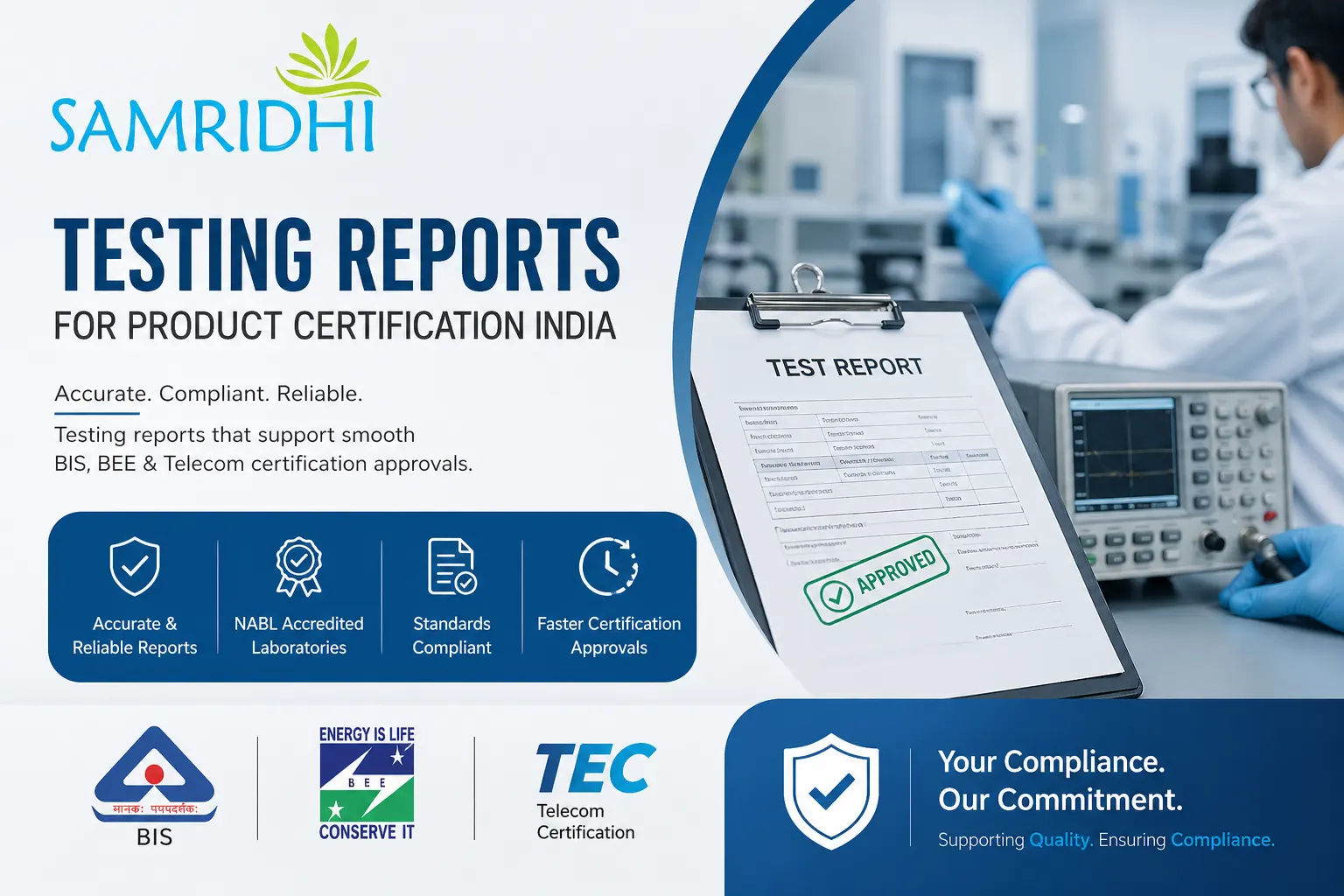
This is why testing reports for product certification India are treated as one of the most important parts of the compliance process.
Because before authorities approve a product, they need proof that it actually meets the required standards.
What a Testing Report Actually Represents
A testing report is more than a document filled with technical data.
It represents:
- Product performance
- Safety evaluation
- Compliance with applicable standards
In simple terms, it shows whether the product behaves within acceptable limits under defined conditions.
This is the core importance of testing reports in product certification.
Why Authorities Depend on Testing Reports
Regulatory bodies like BIS, BEE, and TEC do not physically inspect every product in the market.
Instead, they rely on:
- Accredited laboratory testing
- Technical evaluation
- Verified performance data
Testing reports become the primary reference point for approval decisions.
That’s why why test reports matter for certification approval is directly connected to regulatory trust.
Testing Reports as Proof of Compliance
Every certification has standards behind it.
For example:
- BIS focuses on safety and conformity
- BEE evaluates energy efficiency
- Telecom certification checks RF and network performance
Authorities use reports to confirm that the product complies with these requirements.
This defines the role of test reports in product compliance India.
Without proper reports, certification applications usually cannot proceed.
Why NABL-Based Reports Carry More Weight
Not all reports are accepted equally.
In many cases, authorities expect reports from accredited laboratories.
This is where NABL test reports for product certification India become important.
Because NABL-accredited labs are evaluated for:
- Testing accuracy
- Process reliability
- Technical competence
This increases confidence in the results being submitted.
The Link Between Testing Reports and Approval Timelines
A strong, properly aligned report often helps reduce friction during review.
But if reports contain:
- Incomplete information
- Incorrect standards
- Mismatched specifications
then queries may arise.
This is a common issue in product testing documentation for certification India.
And once clarification starts, timelines extend.
Testing Reports Are Not Just Formalities
Many businesses treat reports as paperwork required at the end.
But in practice, they influence the entire certification flow.
Authorities look at reports to assess:
- Whether testing was done correctly
- Whether standards were followed
- Whether the product aligns with submitted documentation
This is why regulatory compliance test reports India are central to approvals.
The Practical Takeaway
Testing reports are not supporting documents.
They are the foundation of certification decisions.
- They validate product claims
- They demonstrate compliance
- They support regulatory evaluation
And since:
- Requirements depend on product category
- Report formats vary by certification
- Acceptance is subject to authority review
getting the testing report right becomes critical.
Because in product certification…
the application may open the process.
But the testing report is what actually supports it.
NABL Testing supports accurate and credible testing reports required for certification approvals in India.
What Makes a Test Report Valid for BIS, BEE, and Telecom Certification
A test report can look complete and still not be accepted.
That surprises many businesses during certification.
Because in approvals like BIS, BEE, and TEC, it’s not enough to simply have a report.
The report has to meet specific acceptance conditions.
That’s where test report acceptance for BIS BEE TEC certification becomes important.
Validity Is About More Than Test Results
Authorities don’t review reports only for pass/fail outcomes.
They also evaluate:
- Where the testing was conducted
- Whether correct standards were followed
- Whether the report matches the product being certified
This is why testing reports for product certification India are closely linked with documentation accuracy and lab credibility.
Importance of NABL Accreditation
One of the biggest factors in report acceptance is the testing laboratory.
In many certification processes, reports from NABL-accredited labs are preferred or required.
This is because NABL test reports for product certification India are generated under controlled and standardized systems.
Accredited labs are expected to:
- Follow validated testing methods
- Maintain calibrated equipment
- Ensure reliability and consistency of results
Without this credibility, reports may face additional scrutiny or may not be accepted, depending on the certification scope.
Correct Standard Selection Matters
Even a technically accurate report can become unusable if the wrong standard is applied.
For example:
- Testing performed under an outdated version of a standard
- Missing parameters required for certification
- Wrong category or product classification
These are common issues in product certification test report requirements India.
And they often lead to re-testing.
Product and Report Must Match Exactly
A valid report must reflect the actual product being certified.
This includes:
- Model numbers
- Product specifications
- Hardware and software configuration
- Technical parameters
Even small mismatches can trigger queries.
This is one of the biggest reasons reports face issues during review.
Accuracy and Completeness of Information
Authorities expect reports to be:
- Technically accurate
- Complete in scope
- Properly documented
Missing information such as:
- Test conditions
- Product details
- Required annexures
can affect the report’s acceptance.
This is where product testing documentation for certification India becomes critical.
Different Certifications Have Different Expectations
Each certification authority evaluates reports differently.
For example:
- BIS focuses heavily on safety and conformity
- BEE evaluates energy performance and efficiency metrics
- TEC reviews RF, telecom, and network-related parameters
This is why regulatory compliance test reports India are always certification-specific.
A report valid for one approval may not automatically work for another.
The Practical Takeaway
A valid test report is not just about getting tested.
It’s about getting tested correctly.
- Use accredited labs where required
- Follow the correct standards
- Ensure product and report alignment
- Maintain complete and accurate documentation
Because in BIS, BEE, and telecom certifications…
a report is only useful if the authority accepts it.
BIS CRS Registration depends on valid testing reports aligned with applicable Indian Standards.
How Testing Reports Support Product Compliance and Regulatory Approval
A certification application may contain forms, declarations, and technical documents.
But the testing report is usually the part that proves everything else.
Because compliance is not about what a product claims to do.
It’s about what the product can actually demonstrate under testing conditions.
That’s where regulatory compliance test reports India become important.
Testing Reports Turn Claims Into Evidence
Manufacturers often describe products as:
- Safe
- Energy efficient
- Technically compliant
- Suitable for telecom or wireless use
But authorities don’t approve products based on descriptions alone.
They rely on measurable results.
Testing reports provide that measurable evidence by showing how the product performs against applicable standards.
This defines the role of test reports in product compliance India.
How Reports Demonstrate Product Safety
For certifications like BIS, safety is a major focus.
Testing reports may evaluate:
- Electrical safety
- Protection against hazards
- Structural or operational reliability
The report helps show whether the product operates within acceptable safety limits.
Without this validation, approval usually cannot move forward.
Role of Performance Testing in Compliance
In certifications like BEE, performance becomes equally important.
Reports are used to verify:
- Energy consumption
- Efficiency levels
- Product performance under standard conditions
These results directly influence:
- Compliance status
- Labeling requirements
- Star ratings (where applicable)
This is one of the practical reasons why test reports matter for certification approval.
Telecom and RF Compliance Through Reports
For telecom-related products, reports help verify:
- RF parameters
- EMI/EMC performance
- Network compatibility
Authorities use these reports to assess whether the product can operate properly without interfering with telecom systems.
This is especially important in telecom certification workflows.
Reports Help Authorities Make Decisions Efficiently
Regulators cannot independently test every product submitted for approval.
Instead, they depend on:
- Accredited laboratory evaluations
- Standardized testing methods
- Documented technical results
This is why testing reports for product certification India become central to the approval process.
The report acts as the technical basis for review.
Importance of Accuracy and Consistency
A report is only useful if it aligns with:
- Product specifications
- Submitted documents
- Applicable standards
If inconsistencies appear, authorities may:
- Raise clarification requests
- Ask for additional evidence
- Require re-testing
These issues are common in product testing documentation for certification India.
The Practical Takeaway
Testing reports support more than just certification applications.
They support confidence in the product itself.
- They validate safety
- They confirm performance
- They demonstrate conformity with standards
And since:
- Requirements depend on certification type
- Standards vary by product category
- Acceptance is subject to authority review
accurate testing reports become critical.
Because in regulatory approvals…
the report is what connects the product to the standard it claims to meet.
BEE Star Rating Approval uses testing reports to validate appliance energy efficiency and labeling compliance.
Common Mistakes in Product Testing Reports That Cause Certification Delays
Most certification delays don’t happen because the product fails testing.
They happen because the report creates questions.
And once questions begin, the process slows down.
This is one of the biggest realities in product testing documentation for certification India — small reporting mistakes often create larger approval problems later.
Mismatch Between Product and Report
This is probably the most common issue.
For example:
- The tested sample is different from the final product
- Model numbers don’t match application documents
- Product specifications differ across files
Even minor inconsistencies can trigger clarification requests.
Because authorities expect the testing report to represent the exact product being certified.
This directly affects test report acceptance for BIS BEE TEC certification.
Using the Wrong Testing Standard
Another major issue is incorrect standard selection.
This can happen when:
- An outdated standard version is used
- Required test parameters are skipped
- The wrong product category is selected
In such cases, the report may not support certification, even if the product itself performs correctly.
This is a common cause of re-testing.
Incomplete Testing Scope
Sometimes reports are technically correct but incomplete.
For example:
- Required safety tests are missing
- RF parameters are not fully covered
- Performance evaluations are partial
This creates gaps in compliance evidence.
And incomplete reports often delay regulatory compliance test reports India review processes.
Missing or Incorrect Technical Details
Authorities closely review technical consistency.
Common problems include:
- Missing product specifications
- Incorrect ratings or technical values
- Incomplete product descriptions
These may look like small documentation issues, but they raise concerns about report reliability.
Changes Made After Testing
This is a hidden problem many businesses overlook.
A product may be modified after testing due to:
- Component shortages
- Design updates
- Firmware changes
Once this happens, the report may no longer represent the final product accurately.
Depending on the scope of changes, additional testing may be required.
Poor Coordination Between Teams
Testing reports often involve multiple stakeholders:
- Product teams
- Labs
- Compliance teams
- Certification consultants
If communication is weak:
- Wrong information gets submitted
- Documentation becomes inconsistent
- Clarifications take longer
This affects the overall testing reports for product certification India workflow.
Re-Testing Scenarios and Their Impact
When reports are rejected or questioned, re-testing may become necessary.
This usually means:
- Additional time
- Extra coordination
- Revised documentation
In some cases, even small report errors create a full re-testing cycle.
The Practical Takeaway
Most testing report issues are not technical failures.
They are alignment failures.
- Ensure product and report match exactly
- Use the correct standards
- Cover the full testing scope
- Keep technical details accurate
- Avoid product changes after testing
Because in certification…
a report does not need to look impressive.
It needs to be accurate, complete, and acceptable to the reviewing authority.
TEC MTCTE Approval requires accurate telecom testing reports aligned with RF and network standards.
How to Prepare Accurate Testing Reports for Product Certification Applications
A testing report is only useful when it reflects the product correctly.
That sounds obvious, but many certification delays begin because the report, the sample, and the documents are slightly out of sync.
And in certification, “slightly” is often enough to create problems.
That’s why understanding product certification test report requirements India is not just about testing — it’s about preparation and alignment.
Start With the Correct Certification Scope
Before testing begins, the first step is identifying:
- Which certification applies (BIS, BEE, TEC, etc.)
- Which standards are relevant
- What parameters need evaluation
This is where testing reports for product certification India become certification-specific.
Because each approval process expects different technical evidence.
Ensure the Product Version Is Final
One of the most common mistakes is testing a product too early.
For example:
- Prototype version sent to the lab
- Product updated after testing
- Components changed before market launch
When this happens, the report may no longer represent the actual product.
This creates issues during test report acceptance for BIS BEE TEC certification.
The safest approach is to test the final market-ready configuration.
Coordinate Properly With the Testing Laboratory
Testing accuracy depends heavily on lab coordination.
The lab needs clear information about:
- Product functionality
- Applicable standards
- Required test scope
Miscommunication at this stage often leads to:
- Incorrect testing parameters
- Missing evaluations
- Reports that cannot be used for certification
This is why NABL test reports for product certification India are valuable when paired with proper technical coordination.
Keep Documentation Consistent Across All Files
Documentation alignment is critical.
Everything should match:
- Product specifications
- Model numbers
- Technical ratings
- Declared features
Even minor inconsistencies between the report and submitted documents can trigger queries.
This is one of the biggest challenges in product testing documentation for certification India.
Verify Testing Scope Before Report Finalization
Before accepting the final report, businesses should confirm:
- All required parameters were tested
- Correct standards were used
- Product details are accurate
Skipping this review often results in discovering errors only during certification review.
At that stage, corrections become slower and more complicated.
Focus on Accuracy, Not Just Completion
A report being “complete” is not enough.
Authorities evaluate whether the report is:
- Technically accurate
- Properly structured
- Aligned with certification requirements
This is central to regulatory compliance test reports India.
Because approval decisions rely on confidence in the report’s reliability.
The Practical Takeaway
Preparing accurate testing reports is mostly about alignment.
- Test the final product version
- Use the correct standards
- Coordinate clearly with the lab
- Keep documentation consistent
- Review reports before submission
Because in product certification…
most delays don’t happen during testing.
They happen when the report no longer matches the product it was supposed to represent.
ISO Certification helps businesses maintain consistent documentation aligned with certification testing requirements.


 Get Certified with Confidence – Your One-Stop Compliance Partner
 Grab Your Certified Now
 +91 8799708673
 WhatsApp