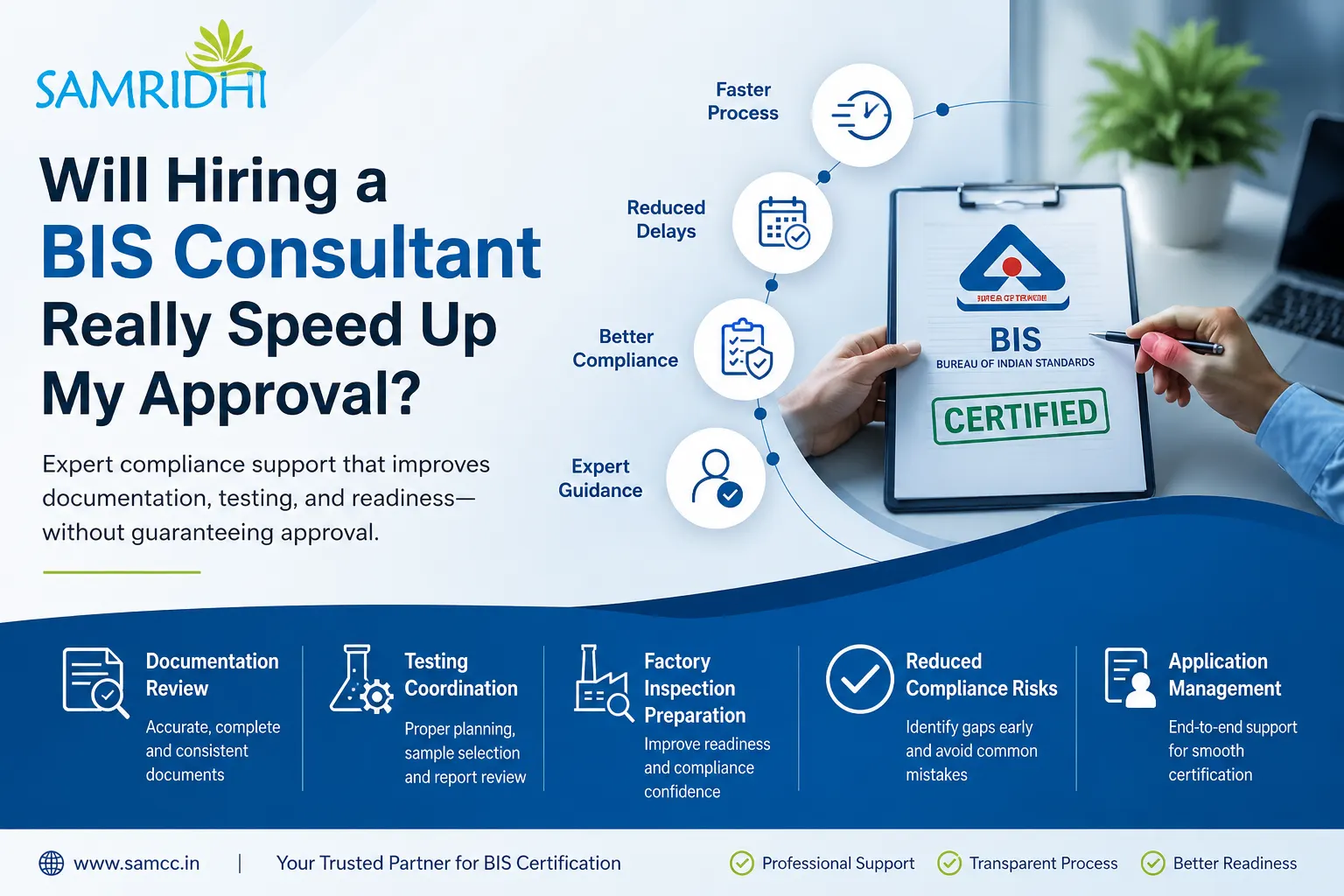
Will Hiring a BIS Consultant Really Speed Up Your Approval? Understanding What Consultants Can and Cannot Do
One of the most common questions manufacturers and importers ask before beginning the BIS certification process is whether hiring a consultant will result in faster approval. It is an understandable concern, especially for businesses planning a product launch, meeting customer commitments, or preparing for market entry. Many organizations hope that professional assistance can shorten the certification timeline and reduce the uncertainty often associated with regulatory compliance.
The short answer is that a BIS consultant cannot guarantee faster approvals or influence regulatory decisions. Final certification timelines always depend on factors such as the applicable certification scheme, product category, testing requirements, factory inspection outcomes where applicable, documentation quality, and the evaluation conducted by the Bureau of Indian Standards (BIS). These elements remain subject to official review and cannot be accelerated simply by appointing a consultant.
However, this does not mean consultants provide little value. Their primary contribution is helping businesses avoid common mistakes that frequently lead to delays, repeated documentation requests, testing issues, or compliance gaps. In many cases, improved preparation results in a smoother certification process, even though the final timeline remains case-specific.
Consultants Do Not Control Approval Decisions
One of the biggest misconceptions surrounding BIS Registration Consultant India services is the belief that consultants can approve applications or influence certification outcomes.
In reality, consultants do not:
- Approve BIS applications
- Issue certification
- Waive testing requirements
- Change regulatory procedures
- Influence inspection findings
- Guarantee approvals
Every certification application is independently evaluated by the relevant authority based on applicable standards and compliance requirements.
The final outcome always remains subject to BIS review.
What Consultants Actually Do
Rather than influencing approvals, consultants primarily help businesses improve their readiness before and during the certification process.
Typical areas of support include:
- Product applicability assessment
- Documentation review
- Testing coordination
- Factory inspection preparation
- Compliance planning
- Application review
- Regulatory guidance
- Response coordination for clarification requests
The goal is reducing preventable errors that might otherwise delay the certification process.
Better Preparation Often Means Fewer Avoidable Delays
One of the most practical Benefits of Hiring a BIS Consultant is improved preparation.
Many certification projects experience delays because of issues such as:
- Missing documentation
- Incorrect product classification
- Testing coordination problems
- Inconsistent technical information
- Factory readiness gaps
These are areas where experienced compliance professionals often provide valuable operational support.
Although consultants cannot shorten official review periods, they may help businesses reduce delays caused by avoidable internal mistakes.
Documentation Quality Plays a Major Role
Documentation remains one of the most common reasons applications require additional clarification.
Professional consultants frequently review:
- Product specifications
- Technical documentation
- Manufacturer information
- Product descriptions
- Supporting records
- Compliance documents
The objective is ensuring that submitted information is complete, accurate, and internally consistent before the application reaches the review stage.
Strong documentation preparation often reduces the likelihood of repeated clarification requests.
Testing Coordination Is Another Important Area
Many businesses assume testing begins after the application is submitted.
In reality, testing often requires careful planning beforehand.
A consultant may assist with:
- Identifying applicable testing requirements
- Coordinating laboratory activities
- Reviewing testing documentation
- Aligning tested products with submitted specifications
This type of coordination helps reduce common BIS Testing Coordination Services issues that can affect certification progress.
Actual testing timelines continue to depend on laboratory scheduling, product complexity, and certification requirements.
Factory Inspection Preparation Can Improve Readiness
For certification schemes involving manufacturing facility evaluations, preparation is often just as important as documentation.
Consultants commonly help businesses review:
- Production records
- Quality control systems
- Testing logs
- Calibration records
- Manufacturing procedures
- Traceability documentation
These activities help manufacturers prepare for inspections but do not influence inspection findings.
Inspection outcomes remain dependent on the facility's actual compliance with applicable BIS requirements.
Consultants Help Businesses Stay Organized
Many organizations underestimate how much coordination is required during certification.
Projects often involve:
- Engineering teams
- Production departments
- Quality managers
- Testing laboratories
- Management teams
- Overseas manufacturers
- Importers
Professional consultants often act as coordinators, helping ensure that documentation, testing activities, and compliance tasks move forward in an organized manner.
This project management role frequently reduces confusion during complex certification projects.
Importers and Foreign Manufacturers Often Benefit From Additional Support
Importers and overseas manufacturers frequently manage certification across multiple organizations.
Common challenges include:
- International document collection
- Product specification verification
- Authorized representative coordination
- Communication with manufacturing facilities
- Technical record management
Professional support can simplify coordination among stakeholders, particularly when documentation must be collected from different countries or production sites.
However, final approval timelines still depend on regulatory evaluation and applicable certification requirements.
Can Consultants Reduce Certification Delays?
A more accurate question is not whether consultants speed up approvals, but whether they help reduce avoidable delays.
In many cases, the answer is yes.
Consultants often help businesses avoid issues such as:
- Documentation errors
- Missing records
- Incorrect applications
- Product classification mistakes
- Testing coordination problems
- Factory inspection readiness gaps
Reducing these issues may contribute to a smoother certification process.
It should not be interpreted as a guarantee of faster approval.
Choosing Experience Over Shortcuts
Businesses should be cautious of claims promising guaranteed approvals, fixed timelines, or special access to regulatory authorities.
Certification decisions are based on technical evaluation and compliance with applicable requirements.
A reputable BIS Compliance Consultant India typically focuses on:
- Compliance planning
- Documentation quality
- Technical coordination
- Operational readiness
- Regulatory guidance
These services improve preparation rather than attempting to bypass established certification procedures.
Preparation Influences the Process More Than Promises
For most manufacturers and importers, the greatest advantage of working with a professional consultant is not faster approval but fewer avoidable mistakes throughout the certification journey. Well-organized documentation, timely testing coordination, accurate technical records, and proper factory preparation often contribute to a more efficient process because fewer issues require correction later.
Businesses researching Does Hiring a BIS Consultant Speed Up Approval, Will a BIS Consultant Speed Up BIS Certification, Can a BIS Consultant Reduce Certification Delays, and BIS Certification Consultant Benefits should understand that consultants support preparation, coordination, and compliance management rather than approval decisions. Every BIS certification project remains influenced by product complexity, applicable standards, testing requirements, factory readiness, documentation quality, and authority review. As a result, certification timelines are always case-specific and subject to BIS evaluation rather than consultant involvement.
While a BIS consultant cannot guarantee approvals or fixed timelines, professional guidance helps businesses prepare accurate documentation, coordinate testing, and understand regulatory requirements. If your product requires certification, you may also want to explore BIS CRS Registration, BIS ISI Domestic Manufacturers, and BIS ISI Foreign Manufacturers services to understand the certification process applicable to your products.
How BIS Consultants Help Reduce Documentation Errors, Testing Delays, and Compliance Risks
For many manufacturers and importers, the most challenging part of the BIS certification process is not understanding that certification is required—it is managing the numerous compliance activities that must come together before an application is ready for review. Technical documentation, product testing, manufacturing records, quality procedures, and regulatory coordination all need to align. When even one of these elements is incomplete or inconsistent, businesses may receive clarification requests, repeat testing, or experience avoidable delays.
This is where professional compliance support often provides practical value. A BIS consultant does not influence approval decisions or guarantee certification. Instead, the consultant helps businesses prepare more effectively by identifying documentation gaps, coordinating testing activities, reviewing compliance requirements, and reducing procedural mistakes that frequently affect certification projects.
Reviewing Documentation Before Submission
Documentation is one of the most common areas where businesses encounter problems during the certification process.
Applications often require multiple technical and administrative records that must remain consistent throughout the submission.
Professional consultants typically review documentation such as:
- Technical specifications
- Product descriptions
- Manufacturing information
- Company records
- Product drawings
- Supporting declarations
The objective is to identify missing information or inconsistencies before the application is submitted, helping businesses reduce unnecessary clarification requests later in the process.
Helping Businesses Understand Applicable Requirements
Every product does not follow the same certification pathway.
Requirements may differ depending on:
- Product category
- Applicable Indian Standard
- Certification scheme
- Manufacturing location
- Intended product use
One of the most common BIS Certification Process Support activities involves helping businesses understand which regulatory requirements apply to their products before testing and documentation begin.
This early planning often reduces the likelihood of incorrect applications.
Reducing Documentation Errors
Many certification delays are linked to relatively small documentation issues rather than major technical problems.
Common examples include:
- Inconsistent model numbers
- Incorrect manufacturer details
- Missing technical records
- Conflicting product specifications
- Incomplete application forms
Professional consultants generally perform structured document reviews to ensure that information remains aligned across all supporting records.
This reduces the risk of avoidable BIS Documentation Support Services issues during regulatory evaluation.
Coordinating Product Testing Activities
Testing is another area where businesses frequently encounter delays.
Manufacturers sometimes arrange testing before confirming applicable standards or submit samples that do not accurately represent the final production model.
Consultants often assist by helping businesses:
- Confirm applicable testing requirements
- Coordinate laboratory activities
- Organize testing documentation
- Review testing reports
- Verify consistency between tested samples and submitted records
Testing timelines still depend on laboratory scheduling and product complexity, but proper coordination often helps reduce procedural mistakes.
Improving Communication Between Departments
Certification projects usually involve multiple teams working simultaneously.
Engineering, production, quality assurance, procurement, and management departments often contribute information throughout the process.
Without effective coordination, businesses may experience:
- Delayed documentation
- Duplicate work
- Conflicting technical information
- Missed compliance requirements
Consultants frequently serve as project coordinators, helping ensure that information moves efficiently between departments and supporting a more organized certification workflow.
Supporting Factory Inspection Preparation
For certification schemes requiring factory assessments, preparation extends beyond documentation.
Manufacturers may need to demonstrate:
- Production controls
- Quality procedures
- Calibration management
- Product traceability
- Inspection records
- Testing practices
Professional BIS Factory Inspection Preparation support typically focuses on reviewing these operational areas before inspection.
The goal is improving readiness rather than influencing inspection outcomes, which always remain subject to the inspector's observations and applicable BIS requirements.
Helping Importers Manage Technical Documentation
Importers often depend on overseas manufacturers for product information.
One common challenge is collecting complete documentation from different countries, production facilities, or suppliers.
Consultants may assist with:
- Technical record coordination
- Product specification reviews
- Manufacturer documentation
- Communication with overseas stakeholders
- Compliance record organization
This support is particularly valuable when several organizations are involved in the certification process.
Assisting Foreign Manufacturers With Regulatory Coordination
Foreign manufacturers frequently face additional administrative responsibilities.
Certification projects may require coordination between:
- Manufacturing facilities
- Authorized Indian Representatives
- Laboratories
- Importers
- Technical teams
Professional compliance support helps organize these activities while ensuring that documentation remains consistent across different stakeholders.
Because every project differs, the level of coordination required depends on the product, manufacturing structure, and applicable certification scheme.
Identifying Compliance Risks Before They Become Problems
One of the greatest advantages of experienced compliance support is early risk identification.
Rather than waiting for authorities to discover issues during review, consultants often help businesses identify concerns such as:
- Missing documentation
- Technical inconsistencies
- Product classification questions
- Testing gaps
- Factory readiness concerns
- Traceability issues
Resolving these matters before submission generally reduces the likelihood of repeated review cycles.
Helping Businesses Respond to Regulatory Queries
Clarification requests are a normal part of many certification projects.
Authorities may seek additional information regarding:
- Product specifications
- Testing reports
- Manufacturing processes
- Technical documentation
- Quality systems
Consultants often help businesses organize responses by ensuring that supporting documentation addresses the requested information clearly and consistently.
The final evaluation remains subject to BIS review, but organized responses can help avoid further misunderstandings.
Compliance Support Is About Preparation, Not Promises
Businesses should distinguish between professional compliance support and unrealistic claims of guaranteed approvals or fixed certification timelines. A reputable consultant cannot accelerate regulatory decision-making or influence technical evaluations. Instead, their role is to strengthen the quality of preparation by improving documentation, coordinating testing, organizing compliance activities, and helping businesses avoid mistakes that commonly lead to delays.
For organizations researching How BIS Consultants Help with Certification, BIS Documentation Support Services, BIS Testing Coordination Services, Professional BIS Consultant for Manufacturers, and Can a BIS Consultant Reduce Certification Delays, the greatest value of professional support lies in reducing avoidable compliance risks rather than promising faster approvals. Since every certification project depends on product complexity, applicable standards, testing requirements, factory readiness, and authority review, outcomes and timelines remain case-specific and subject to BIS evaluation.
Proper documentation and technical testing are among the most important aspects of a successful certification project. Businesses can strengthen their compliance readiness by learning more about NABL Testing, LM79 Testing, and Lab Setup and Equipment, which support testing coordination and quality assurance activities required for regulated products.
 Get Certified with Confidence – Your One-Stop Compliance Partner
From BIS, WPC, TEC, BEE, EPR, LMPC, CDSCO, FSSAI, ISO, MSME to PESO, NABL testing, Startup India, Make in India, and Lab Setup, we handle all your regulatory approvals, certifications, and documentation needs with precision and speed. Partner with Samridhi Compliance Certification and simplify your journey to full compliance—so you can focus on growing your business.
Can a BIS Consultant Help Avoid Certification Delays? Common Reasons Applications Take Longer Than Expected
One of the biggest concerns for manufacturers and importers pursuing BIS certification is the possibility of unexpected delays. Product launches, supply chain commitments, customer contracts, and import schedules often depend on timely certification, making any interruption a significant business concern. When delays occur, many companies immediately assume that the regulatory process itself is the primary reason. While regulatory review is naturally an important part of certification, practical experience shows that a large number of delays actually originate from avoidable compliance issues before or during the application process.
This is where professional compliance support can make a meaningful difference. A BIS consultant cannot promise quicker approvals or influence the authority's decision-making process. However, consultants often help businesses reduce delays caused by incomplete documentation, testing coordination issues, incorrect applications, or factory readiness gaps. Their role focuses on improving preparation rather than accelerating regulatory review.
Many Certification Delays Begin Before the Application Is Submitted
One of the most overlooked facts about BIS certification is that delays often begin long before the application reaches the reviewing authority.
Businesses frequently lose valuable time because they start the process without fully understanding:
- Applicable certification schemes
- Product-specific requirements
- Documentation expectations
- Testing obligations
- Factory inspection requirements
Correcting these issues after submission usually requires additional communication, document revisions, or further technical evaluation.
Professional consultants often help identify these requirements at the planning stage, reducing the likelihood of avoidable procedural mistakes.
Incorrect Product Classification Can Create Significant Delays
A common reason applications take longer than expected is incorrect product classification.
Some businesses assume their product falls under a particular Indian Standard because it appears similar to another product already on the market.
However, small differences in:
- Product functionality
- Technical characteristics
- Intended application
- Product design
may result in different certification requirements.
Consultants typically review product information early in the project to help determine the appropriate certification pathway before testing and documentation activities begin.
Documentation Problems Frequently Trigger Clarification Requests
Documentation remains one of the leading causes of certification delays.
Authorities may request additional information when applications contain:
- Missing technical specifications
- Inconsistent product descriptions
- Incorrect manufacturer information
- Incomplete supporting records
- Conflicting documentation
Every clarification request can add additional review time while businesses gather and submit revised information.
Professional BIS Application Documentation Review helps identify these issues before submission, reducing the likelihood of repeated document revisions.
Product Testing Requires Careful Coordination
Testing is another area where businesses often experience delays.
Many companies schedule laboratory testing without first confirming:
- Applicable standards
- Product configurations
- Required documentation
- Certification scope
If testing is performed incorrectly or additional evaluations become necessary, project timelines may be affected.
Consultants frequently assist by coordinating testing activities so they align with the certification strategy and applicable regulatory requirements.
Laboratory schedules and testing durations, however, continue to depend on laboratory availability and product complexity.
Delays Can Result From Product Changes During Certification
Certification projects sometimes extend over several months.
During this period, manufacturers may:
- Update components
- Modify product designs
- Change suppliers
- Revise technical specifications
While these changes may improve the product, they can also create compliance challenges if they affect the information previously submitted for certification.
Consultants often encourage businesses to evaluate proposed design changes before implementation so that any potential certification impact can be assessed early.
Factory Inspection Readiness Influences Project Progress
For certification schemes involving factory inspections, operational readiness is just as important as application quality.
Common issues identified during preparation include:
- Missing production records
- Incomplete calibration documentation
- Weak traceability systems
- Unclear quality procedures
- Inconsistent testing records
Professional BIS Factory Inspection Preparation focuses on helping manufacturers organize these records before inspections take place.
Inspection findings always depend on the actual condition of the manufacturing facility and remain subject to official evaluation.
Importers Often Experience Documentation Delays
Importers face unique challenges because much of the required information originates from overseas manufacturers.
Common issues include:
- Delayed technical documentation
- Missing product specifications
- Incomplete manufacturing records
- Communication gaps between suppliers
Professional compliance support often helps coordinate communication between importers and manufacturers, ensuring required information is collected before application submission whenever possible.
Foreign Manufacturers Must Coordinate Multiple Stakeholders
Certification projects involving overseas manufacturing facilities generally require collaboration between several parties.
These may include:
- Manufacturing facilities
- Authorized Indian Representatives
- Laboratories
- Importers
- Compliance teams
Without clear coordination, businesses may experience delays caused by inconsistent documentation or incomplete technical records.
Consultants often act as a central point of coordination, helping ensure that information remains organized throughout the project.
Delayed Responses Can Extend Certification Timelines
Many businesses assume that once an application has been submitted, there is little left to do.
In practice, authorities may request:
- Additional documentation
- Technical clarifications
- Supporting evidence
- Manufacturing details
If these requests are not addressed promptly or completely, certification timelines may extend significantly.
Consultants often assist businesses by organizing responses and ensuring supporting information is submitted in a clear and consistent manner.
Consultants Reduce Avoidable Risks Rather Than Regulatory Timelines
It is important to distinguish between reducing compliance risks and reducing regulatory review periods.
Professional consultants cannot:
- Guarantee approvals
- Bypass regulatory procedures
- Influence technical evaluations
- Shorten mandatory testing requirements
Instead, they help businesses reduce avoidable risks by improving:
- Documentation quality
- Testing coordination
- Compliance planning
- Factory readiness
- Application accuracy
This preparation often results in a smoother certification process because fewer preventable issues arise during review.
Better Preparation Usually Leads to Fewer Delays
Although every BIS certification project follows its own timeline, well-prepared applications generally experience fewer interruptions caused by documentation errors, testing issues, or missing compliance records. Organizations that invest time in planning, technical review, document verification, and factory readiness often reduce the number of clarification requests and corrective actions required during the certification journey.
Businesses researching Can a BIS Consultant Reduce Certification Delays, Common Reasons for BIS Certification Delays, Will Hiring a BIS Consultant Really Speed Up My Approval, BIS Certification Timeline Factors, and BIS Registration Process Assistance should understand that consultants improve preparation rather than guarantee faster approvals. Certification timelines ultimately depend on product category, applicable standards, testing outcomes, factory inspection findings where applicable, documentation quality, and BIS evaluation. Every application remains case-specific and subject to authority review and regulatory requirements.
Many certification delays occur because of incomplete documentation, testing gaps, or incorrect product classification rather than the regulatory review itself. Businesses preparing for compliance can also review BIS Scheme X Certification, TEC MTCTE Approval, and WPC ETA Approval to better understand product-specific certification requirements.
DIY BIS Certification vs Hiring a Professional BIS Consultant: Which Approach Is Right for Manufacturers and Importers?
Every business beginning the BIS certification process eventually faces the same question: should the certification be managed internally, or is it better to hire a professional BIS consultant? The answer is rarely the same for every organization. It depends on several factors, including the complexity of the product, the experience of the internal compliance team, available technical resources, and the certification scheme involved.
Some manufacturers successfully manage certification projects using their own engineering and quality teams, particularly when they have previous experience with Indian regulatory requirements. Others prefer professional support because they are entering the Indian market for the first time, launching a new product category, or managing multiple certification activities simultaneously. Neither approach is automatically better. The right choice depends on whether the business has the knowledge, systems, and resources needed to manage the process effectively.
What DIY BIS Certification Actually Means
A DIY approach means the manufacturer or importer manages every stage of the certification process internally without ongoing external compliance support.
Typical responsibilities include:
- Identifying applicable certification schemes
- Understanding Indian Standards
- Preparing technical documentation
- Coordinating product testing
- Managing factory inspection preparation
- Responding to authority queries
- Tracking application progress
For organizations with experienced regulatory teams, this approach may work well. However, businesses new to BIS certification often discover that compliance involves far more coordination than expected.
When DIY Certification Can Be a Practical Option
Managing certification internally may be suitable when a company already has:
- An experienced compliance department
- Previous BIS certification experience
- Well-established quality systems
- Dedicated engineering support
- Strong documentation management processes
- Internal resources for testing coordination
In these situations, businesses often understand the certification workflow and have procedures in place to manage regulatory requirements efficiently.
Even then, occasional external guidance may still be useful for complex or unfamiliar product categories.
Challenges Businesses Often Face With DIY Certification
The most significant challenge in self-managed certification is not completing individual tasks but coordinating them effectively.
Many companies underestimate the amount of communication required between:
- Engineering teams
- Production departments
- Quality assurance personnel
- Procurement teams
- Overseas manufacturers
- Testing laboratories
When information is collected from multiple departments, inconsistencies can appear in technical documentation, product specifications, or application records.
These issues frequently become visible only after the application has been submitted.
Professional Consultants Focus on Preparation
A Professional BIS Consultant for Manufacturers does not replace the manufacturer's technical expertise.
Instead, consultants typically help organize and coordinate the compliance process.
Their responsibilities may include:
- Reviewing documentation
- Confirming certification requirements
- Coordinating testing activities
- Preparing factory inspection documentation
- Monitoring compliance progress
- Supporting responses to clarification requests
The objective is reducing avoidable procedural mistakes rather than managing the product itself.
Documentation Is Often Where Professional Support Adds Value
One of the most common reasons businesses seek professional assistance is documentation management.
Certification projects usually require multiple technical records prepared by different departments.
Professional consultants often review documentation for:
- Accuracy
- Consistency
- Completeness
- Technical alignment
- Administrative compliance
This review process helps identify missing information before the application reaches the evaluation stage.
While no review can eliminate every issue, early identification of documentation gaps often reduces repeated revisions later.
Testing Coordination Can Become More Complex Than Expected
Product testing is frequently viewed as a straightforward laboratory activity.
In practice, successful testing depends on careful preparation.
Businesses must ensure:
- Correct standards are identified
- Appropriate product samples are selected
- Technical documentation matches tested products
- Testing reports support certification requirements
Professional BIS Testing Coordination Services help organize these activities, reducing the likelihood of avoidable testing-related complications.
Testing outcomes and laboratory schedules remain independent of consultant involvement.
Importers Face Different Challenges Than Manufacturers
Importers often depend on overseas manufacturers for nearly all technical documentation.
This creates additional challenges such as:
- Delayed document collection
- Cross-border communication
- Product specification verification
- Coordination with multiple suppliers
Professional BIS Registration Consultant for Importers services often focus on managing communication between stakeholders and organizing documentation before submission.
This coordination is particularly valuable when suppliers operate in different countries or time zones.
Foreign Manufacturers Often Require Additional Coordination
For overseas manufacturers, certification frequently involves several independent organizations working together.
These may include:
- Manufacturing facilities
- Authorized Indian Representatives
- Importers
- Laboratories
- Compliance teams
Professional consultants often help coordinate communication and document management across these parties, reducing confusion throughout the certification process.
The amount of coordination required depends on the product, manufacturing structure, and certification framework.
Consultants Cannot Replace Internal Responsibility
Hiring a consultant does not transfer responsibility for compliance.
Manufacturers and importers remain responsible for:
- Product quality
- Manufacturing processes
- Technical accuracy
- Quality management systems
- Product conformity
Consultants provide guidance and coordination, but they cannot create compliance where operational systems are lacking.
Successful certification always depends on the organization's own manufacturing and quality practices.
Choosing the Right Approach for Your Business
Businesses considering whether to manage certification internally or seek professional support should evaluate several practical questions.
For example:
- Has the organization completed BIS certification before?
- Does the internal team understand applicable Indian Standards?
- Are documentation systems well organized?
- Can testing activities be coordinated efficiently?
- Is factory inspection preparation already established?
- Are sufficient compliance resources available internally?
The answers often provide a clearer indication of which approach is most suitable than focusing only on cost or perceived timelines.
The Best Choice Depends on Experience and Resources
There is no universal answer to whether DIY certification or professional compliance support is the better option. Businesses with experienced regulatory teams and established compliance systems may successfully manage many certification activities internally. Organizations entering the process for the first time, introducing new product categories, or working with multiple stakeholders often benefit from additional coordination and technical guidance.
Companies researching BIS Consultant vs DIY Certification, Benefits of Hiring a BIS Consultant, BIS Registration Process Assistance, BIS Consultant for Product Certification, and How BIS Consultants Help Manufacturers should recognize that consultants improve organization, documentation quality, testing coordination, and compliance readiness rather than guarantee certification outcomes. Every BIS project depends on product complexity, applicable standards, testing requirements, manufacturing controls, documentation quality, and authority review. For this reason, certification timelines and outcomes remain case-specific and subject to BIS evaluation.
Organizations with limited compliance experience often benefit from expert guidance when managing documentation, testing coordination, and certification planning. Businesses seeking local compliance assistance may also explore BIS Consultant Delhi, BIS Consultant Mumbai, and BIS Consultant Bangalore for region-specific advisory support.
Get Certified with Confidence – Your One-Stop Compliance Partner
From BIS, WPC, TEC, BEE, EPR, LMPC, CDSCO, FSSAI, ISO, MSME to PESO, NABL testing, Startup India, Make in India, and Lab Setup, we handle all your regulatory approvals, certifications, and documentation needs with precision and speed. Partner with Samridhi Compliance Certification and simplify your journey to full compliance—so you can focus on growing your business.
Choosing the Right BIS Registration Consultant: How Expert Compliance Support Improves Certification Readiness Without Guaranteeing Approval
Selecting a BIS registration consultant is an important decision for any manufacturer or importer planning to introduce regulated products into the Indian market. While many businesses focus primarily on finding someone who can "speed up approval," experienced organizations usually look beyond timelines. The real value of professional compliance support lies in helping businesses prepare correctly, organize documentation, coordinate testing, and reduce procedural mistakes that often result in unnecessary delays.
It is equally important to understand what a consultant cannot do. No consultant can guarantee BIS approval, bypass regulatory requirements, influence technical evaluations, or promise fixed certification timelines. Every application is assessed independently by the Bureau of Indian Standards based on applicable regulations, testing results, product conformity, factory inspection findings where applicable, and overall compliance with the relevant certification scheme.
The role of a consultant is therefore not to change the outcome of regulatory review but to improve the quality of preparation before that review begins.
Start by Evaluating Industry Experience
Not every compliance project follows the same certification pathway.
Products covered under BIS CRS, ISI certification, FMCS, or Scheme X may involve different documentation requirements, testing procedures, and regulatory obligations.
When selecting a BIS Certification Consultant India, businesses should consider whether the consultant has experience working with:
- Electronics products
- Electrical equipment
- Consumer appliances
- Industrial products
- Imported products
- Foreign manufacturing facilities
Practical exposure to similar certification projects often helps consultants identify potential compliance challenges earlier in the process.
Look for Strong Documentation Management Capabilities
Documentation is one of the most critical parts of any BIS certification project.
Even technically compliant products may experience delays if submitted records contain inconsistencies or missing information.
A professional consultant should be able to assist with:
- Technical documentation reviews
- Product specification verification
- Manufacturer information checks
- Supporting document coordination
- Application consistency reviews
Effective BIS Application Documentation Review helps businesses improve the quality of submissions before they reach the evaluation stage.
Ask How They Handle Testing Coordination
Testing is more than simply sending samples to a laboratory.
Proper planning requires businesses to confirm:
- Applicable Indian Standards
- Product configurations
- Sample selection
- Supporting documentation
- Testing scope
Experienced consultants generally coordinate these activities to ensure testing aligns with certification requirements.
Testing schedules, laboratory availability, and technical evaluations remain independent processes and continue to depend on product complexity and laboratory capacity.
Understand Their Approach to Factory Inspection Preparation
Certain certification schemes require manufacturing facility inspections.
Factory readiness often involves reviewing:
- Production controls
- Quality procedures
- Calibration records
- Inspection reports
- Product traceability
- Internal testing records
Professional BIS Factory Inspection Preparation focuses on helping manufacturers organize these systems before inspection.
Consultants cannot influence inspection findings, but they can assist businesses in identifying documentation or process gaps that may require attention beforehand.
Consider Their Ability to Coordinate Multiple Stakeholders
Many certification projects involve more than one organization.
For example, a single application may require coordination between:
- Manufacturers
- Importers
- Engineering teams
- Laboratories
- Quality departments
- Authorized Indian Representatives
- Overseas suppliers
A good consultant acts as a project coordinator, ensuring information moves efficiently between all stakeholders and reducing communication gaps that frequently delay certification projects.
Evaluate Their Knowledge of Different Certification Schemes
Businesses often assume that every BIS certification follows identical procedures.
In reality, compliance requirements differ depending on:
- Product category
- Applicable Indian Standard
- Certification scheme
- Manufacturing location
- Regulatory scope
An experienced BIS Compliance Consultant India should understand how these differences affect documentation, testing, inspections, and overall certification planning.
This helps businesses develop a certification strategy that reflects the specific requirements of their products.
Transparency Is More Valuable Than Unrealistic Promises
Businesses should approach with caution any consultant who advertises:
- Guaranteed approvals
- Fixed approval timelines
- Special access to authorities
- Assured certification success
Certification decisions are based on regulatory evaluation rather than consultant influence.
A reputable consultant typically explains:
- Expected certification stages
- Documentation responsibilities
- Testing requirements
- Possible challenges
- Factors that may affect timelines
This realistic approach helps businesses establish practical expectations from the beginning.
Support for Importers and Foreign Manufacturers
Importers and overseas manufacturers often require additional coordination because documentation originates from multiple countries and production facilities.
Professional BIS Registration Consultant for Importers services may include:
- Overseas documentation coordination
- Technical record management
- Communication with manufacturers
- Authorized representative support
- Compliance planning
For foreign manufacturers, these activities often reduce administrative complexity while keeping documentation organized throughout the certification process.
Compliance Planning Is More Valuable Than Last-Minute Corrections
One of the biggest advantages of professional support is that consultants become involved before problems occur.
Rather than correcting mistakes after an application has been submitted, experienced consultants often help businesses:
- Identify documentation gaps
- Confirm certification applicability
- Review technical information
- Coordinate testing
- Organize inspection readiness
- Plan certification milestones
Preventive planning generally reduces the number of avoidable issues encountered later in the project.
Choosing a Consultant Is About Expertise, Not Speed
Businesses sometimes select consultants based solely on promises of faster approvals.
A more effective approach is evaluating whether the consultant demonstrates:
- Technical understanding
- Regulatory knowledge
- Industry experience
- Strong project coordination
- Clear communication
- Practical compliance guidance
These qualities often contribute more to successful certification projects than unrealistic claims regarding approval speed.
Expert Guidance Improves Readiness, While Approval Depends on Compliance
The right BIS registration consultant helps businesses become better prepared by improving documentation quality, coordinating testing activities, supporting factory inspection readiness, and organizing certification workflows. These contributions often reduce avoidable mistakes that can delay applications. However, they should never be interpreted as guarantees of certification or faster regulatory approval.
Organizations researching Does Hiring a BIS Consultant Speed Up Approval, Choosing the Right BIS Registration Consultant, BIS Consultant for Faster Certification Process, BIS Certification Consultant Benefits, and How BIS Consultants Help with Certification should understand that professional support strengthens compliance readiness rather than influencing regulatory decisions. Every BIS certification project depends on product characteristics, applicable standards, testing outcomes, documentation accuracy, manufacturing compliance, and authority evaluation. Consequently, certification timelines and approval decisions remain case-specific and subject to BIS review.
Selecting the right consultant involves evaluating technical expertise, documentation support, testing coordination, and overall compliance experience. Businesses looking to strengthen their internal compliance systems may also find value in ISO Certification, which supports quality management and documentation practices that complement regulatory certification projects.


 Grab Your Certified Now
 +91 8799708673
 WhatsApp