What Certifications Are Required for IoT Devices in India
If you’re building or importing an IoT product, one thing becomes clear very quickly — there is no single certification that covers everything.
That’s where most confusion starts.
Because IoT device certification India is not a one-step process. It’s a combination of approvals, each linked to a specific feature of the device.
And unless those features are mapped correctly, compliance gaps start appearing later.
Why IoT Devices Need Multiple Certifications
Unlike traditional products, IoT devices combine multiple functions:
- Electronics hardware
- Wireless communication (Wi-Fi, Bluetooth, RF)
- Sometimes telecom/network connectivity
- Firmware and data interaction
Each of these falls under different regulatory areas.
That’s why certification requirements for IoT devices in India are layered, not centralized.
One device… multiple approvals.
BIS Certification for Safety Compliance
For most IoT devices, the starting point is BIS certification for IoT devices India under the Compulsory Registration Scheme (CRS).
This applies to:
- Electronic components
- Power-related products
- Devices that fall under notified categories
BIS focuses on:
- Electrical safety
- Product reliability
- Conformance to Indian standards
If applicable, BIS certification is usually required before the product can be sold or imported.
But applicability depends on product category — it’s not universal.
WPC ETA Approval for Wireless Functionality
If your IoT device uses wireless communication, another layer comes in.
This is where WPC ETA approval for IoT devices India becomes relevant.
It applies to devices using:
- Wi-Fi
- Bluetooth
- RF modules
WPC ensures that:
- Devices operate within approved frequency bands
- Wireless transmission does not interfere with other systems
This is a key part of wireless device certification India IoT.
And for most IoT products, this requirement is almost unavoidable.
TEC Certification for Telecom-Connected Devices
Some IoT devices go beyond wireless connectivity.
If the device connects directly to telecom networks, TEC certification for IoT devices India may apply.
This includes:
- Devices using SIM-based communication
- Network-dependent hardware
- Certain communication equipment
TEC focuses on telecom compliance and network safety.
But again, applicability depends on how the device communicates.
How These Certifications Work Together
In practice, an IoT device may require:
- BIS for safety
- WPC for wireless
- TEC for telecom functionality
Not always all three — but often more than one.
This is what makes IoT compliance requirements India complex.
Each certification:
- Covers a different risk area
- Is handled by a different authority
- Requires separate documentation and testing
Where Most Businesses Get Confused
The confusion usually comes from:
- Assuming one certification is enough
- Not identifying all device features early
- Overlooking embedded modules (like RF components)
This leads to missed approvals… and delays later.
The Practical Takeaway
There is no fixed checklist for IoT product certification India.
Because it:
- Depends on device functionality
- Varies by scope
- Is always case-specific
What matters is early evaluation.
- Identify all features of the device
- Map them to regulatory requirements
- Plan certifications before development is finalized
Because once the product is ready, discovering missing approvals becomes one of the biggest reasons behind delays.
And in IoT, those delays rarely come from complexity…
They come from incomplete planning.
BIS CRS Registration is required for many electronic components used in IoT devices in India.
How BIS Certification Applies to IoT Devices in India
For most IoT products, the first compliance checkpoint isn’t wireless or telecom.
It’s safety.
That’s where BIS certification for IoT devices India comes in.
And this is also where many businesses get confused — because BIS doesn’t certify “IoT devices” as a category. It certifies specific product types under defined standards.
Why BIS Applies to IoT Devices
IoT devices may look different on the surface — smart plugs, wearables, sensors, gateways — but internally, they share common elements:
- Power supplies and adapters
- Electronic circuits
- Components that interact with electricity
These elements fall under safety regulations.
So if any part of your device matches a notified product category, IoT device certification India will likely include BIS under the Compulsory Registration Scheme (CRS).
Understanding the CRS Framework
Under CRS, BIS requires certain electronic products to be:
- Tested as per Indian Standards
- Registered before sale or import
- Manufactured in compliance with defined specifications
The focus is not on features like connectivity or software.
It’s on safety.
This is a key part of IoT compliance requirements India — separating safety certification from other approvals.
What Triggers BIS Certification in IoT Devices
BIS applicability is not based on the term “IoT.”
It depends on:
- The type of product
- Its electrical function
- Its classification under notified categories
For example:
- A smart plug may fall under electrical equipment
- A smart LED device may fall under lighting products
- A connected adapter may fall under power supply categories
Each of these may require BIS separately.
This is why IoT product certification India depends on how the device is categorized, not just what it does.
Testing Requirements Under BIS
To obtain BIS registration, products must be tested through recognized labs.
Testing typically evaluates:
- Electrical safety
- Performance under defined conditions
- Compliance with applicable standards
A common issue arises when:
- Testing is done on a prototype
- Product design changes later
- Final version does not match the tested sample
This leads to re-testing… and delays.
Documentation and Registration Alignment
Beyond testing, BIS requires:
- Manufacturer details
- Product specifications
- Test reports aligned with final configuration
All of these must match exactly.
Even small inconsistencies can trigger queries during review.
And once queries begin, timelines extend.
Where Businesses Face Challenges
Most delays related to BIS certification for IoT devices India come from:
- Incorrect product classification
- Late identification of applicability
- Misalignment between product and test reports
These are not major errors individually, but they create friction in the process.
The Practical Takeaway
BIS certification is not optional where applicable.
It’s a foundational step in smart device certification India.
- It ensures electrical safety
- It validates product reliability
- It enables legal sale or import in many cases
But its applicability:
- Depends on product category
- Varies by scope
- Is always case-specific
Understanding this early helps avoid one of the most common compliance issues — realizing too late that safety certification was required from the beginning.
BIS CRS Registration ensures electrical safety compliance for IoT devices before market entry.
When WPC ETA and Wireless Certifications Are Required for IoT Devices
In IoT, connectivity is the core feature.
And that’s exactly what brings in one of the most overlooked compliance requirements — wireless approval.
Many startups assume once safety certification is handled, they’re covered.
But the moment a device uses Wi-Fi, Bluetooth, or any RF module, another layer gets added.
That’s where WPC ETA approval for IoT devices India becomes relevant.
Why Wireless Certification Is Required
IoT devices don’t just operate independently.
They communicate.
And in India, wireless communication is regulated to ensure:
- Devices operate within approved frequency bands
- Signals don’t interfere with other networks
- Spectrum usage remains controlled
This is why wireless device certification India IoT exists — not for safety, but for spectrum management.
What Triggers WPC ETA Approval
The requirement is simple in principle.
If your device uses wireless communication, it may need WPC approval.
This includes:
- Wi-Fi-enabled devices
- Bluetooth-based products
- RF-enabled smart devices
- IoT products with embedded communication modules
Even if wireless is not the primary function, the presence of an RF module can trigger applicability.
That’s where many businesses miss it.
Role of RF Modules in Compliance
Most IoT devices use pre-certified RF modules.
This creates a common assumption:
“If the module is certified, the product doesn’t need approval.”
But in practice, applicability depends on:
- Whether the module certification is valid in India
- Whether the module is integrated without modification
- How the final product uses the module
In some cases, module-level approval may be sufficient.
In others, product-level evaluation may still be required.
This is why IoT compliance requirements India remain case-specific.
What WPC ETA Approval Covers
WPC ETA (Equipment Type Approval) focuses on:
- Frequency range used by the device
- Power output levels
- Compliance with Indian spectrum regulations
It does not evaluate:
- Electrical safety
- Product performance
Those are handled separately (like BIS).
This separation is important in IoT device certification India — each authority handles a different aspect.
Documentation and Testing Considerations
For WPC approval, typical requirements include:
- RF test reports
- Technical specifications
- Details of the wireless module
The key is alignment.
If the RF parameters in documentation don’t match the actual device:
- Queries may be raised
- Additional clarification may be required
And that slows down the process.
Where Businesses Usually Face Delays
Common challenges include:
- Not identifying wireless functionality early
- Assuming module certification is enough
- Using modules not aligned with Indian standards
These issues often lead to IoT testing and certification India delays, especially when discovered late.
The Practical Takeaway
Wireless certification is not optional for connected devices.
- If your device communicates wirelessly, WPC likely applies
- Applicability depends on how the module is used
- Requirements vary by product and configuration
That’s why planning WPC ETA approval for IoT devices India early is critical.
Because once the product is ready, fixing wireless compliance gaps is not just technical…
It becomes a timing issue that affects the entire launch.
WPC ETA Approval is mandatory for IoT devices using Wi-Fi, Bluetooth, or RF modules in India.
Do IoT Devices Need TEC Certification in India
Not every IoT device needs telecom approval.
But some absolutely do.
The confusion usually comes from one question:
“Does my device count as telecom equipment?”
That’s where TEC certification for IoT devices India becomes relevant — and also where many businesses misjudge applicability.
What TEC Actually Covers
TEC (Telecommunication Engineering Centre) regulates equipment that connects to telecom networks.
This includes devices that:
- Use SIM-based communication (2G/3G/4G/5G)
- Transmit data over licensed telecom networks
- Interact directly with telecom infrastructure
So while many IoT devices use Wi-Fi or Bluetooth, not all fall under TEC.
But once a device connects to a telecom network, the compliance scope changes.
When TEC Certification Becomes Applicable
Applicability depends on how the device communicates.
For example:
- A Wi-Fi-based smart home device → typically does not require TEC
- A GPS tracker with SIM connectivity → may require TEC
- An industrial IoT device using cellular communication → likely falls under TEC
This is why IoT device certification India is not uniform.
The same type of product can have different requirements based on connectivity.
How TEC Fits Into IoT Compliance
TEC certification is part of a broader compliance structure.
An IoT device may require:
- BIS for safety
- WPC for wireless
- TEC for telecom connectivity
Each authority evaluates a different aspect.
This is what makes IoT compliance requirements India multi-layered.
And missing one layer can delay the entire approval process.
What TEC Certification Evaluates
TEC focuses on:
- Network compatibility
- Telecom interface standards
- Performance within telecom environments
The goal is to ensure that devices:
- Do not disrupt telecom networks
- Operate within defined parameters
- Meet regulatory requirements for connectivity
This is different from safety or RF approvals.
Documentation and Testing Considerations
For TEC approval, typical requirements include:
- Technical specifications of the device
- Network interface details
- Test reports aligned with telecom standards
As with other certifications, consistency is critical.
If documentation does not match actual device behavior:
- Queries may be raised
- Additional testing may be required
And timelines can extend.
Where Businesses Get It Wrong
Most challenges come from:
- Assuming Wi-Fi devices need TEC (they often don’t)
- Overlooking cellular connectivity in product design
- Not evaluating telecom applicability early
These gaps lead to delays in IoT testing and certification India, especially when discovered late.
The Practical Takeaway
TEC certification is not required for all IoT devices.
But when it applies, it becomes a critical requirement.
- Applicability depends on connectivity type
- Requirements vary by product scope
- Evaluation is always case-specific
Understanding this early helps avoid one of the most common mistakes — realizing after development that telecom compliance was required.
Because once the product is ready, adding telecom certification into the process is rarely quick.
TEC MTCTE Approval is required for IoT devices that connect directly to telecom networks.
Step-by-Step IoT Device Certification Process in India
If you look at IoT compliance from a distance, it feels complicated.
Multiple approvals, different authorities, overlapping requirements…
But in practice, the process becomes manageable when it’s broken into steps.
The problem is not the process itself.
It’s when steps are missed or done in the wrong order.
That’s where most IoT device certification India challenges begin.
Step 1: Understand the Device and Its Features
Everything starts with the product.
Before thinking about certifications, you need clarity on:
- What the device does
- How it communicates (Wi-Fi, Bluetooth, cellular)
- Its electrical and functional components
This is what defines certification requirements for IoT devices in India.
Since requirements depend on features, this step sets the direction for everything that follows.
Step 2: Map Applicable Certifications
Once features are clear, the next step is identifying approvals.
This may include:
- BIS for safety
- WPC for wireless communication
- TEC for telecom connectivity
Not every device needs all three.
But most IoT products need more than one.
This is why IoT compliance requirements India are layered and case-specific.
Step 3: Plan Testing Based on Final Product Configuration
Testing is where compliance becomes real.
But timing matters.
Common issues arise when:
- Testing is done on early prototypes
- Product design changes after testing
- Final version does not match tested sample
To avoid this, testing should be aligned with:
- Final product configuration
- Actual operating conditions
This is a critical part of IoT testing and certification India.
Step 4: Prepare Documentation with Precision
Documentation is not just paperwork.
It’s how your product is represented during evaluation.
Key elements include:
- Technical specifications
- Test reports
- Product details and configurations
Everything must match.
Even small inconsistencies can lead to queries.
And once queries start, timelines extend.
Step 5: Submit Applications to Relevant Authorities
After testing and documentation are aligned, applications are submitted.
Each authority handles a specific area:
- BIS for safety
- WPC for wireless
- TEC for telecom
They review:
- Technical details
- Test results
- Compliance with applicable standards
Since approvals are subject to authority review, timelines vary based on product scope and documentation clarity.
Step 6: Handle Queries and Clarifications
In most cases, authorities may raise questions.
This is a normal part of the process.
Common reasons include:
- Missing details
- Documentation mismatch
- Technical clarification requirements
How quickly these are resolved often depends on preparation.
Step 7: Align Compliance Before Launch or Import
Once approvals are in place:
- Documentation should be aligned with final product
- Certifications should match shipment or market version
This helps avoid issues during:
- Product launch
- Import clearance
- Market entry
This step connects compliance with real-world execution.
The Practical Takeaway
The certification process is not about doing more steps.
It’s about doing them in the right sequence.
- Understand the product
- Map certifications early
- Align testing with final design
- Keep documentation consistent
- Coordinate across authorities
Because most delays in IoT product certification India don’t come from the process itself…
They come from gaps between these steps.
NABL Testing ensures IoT devices meet required standards before certification approvals.


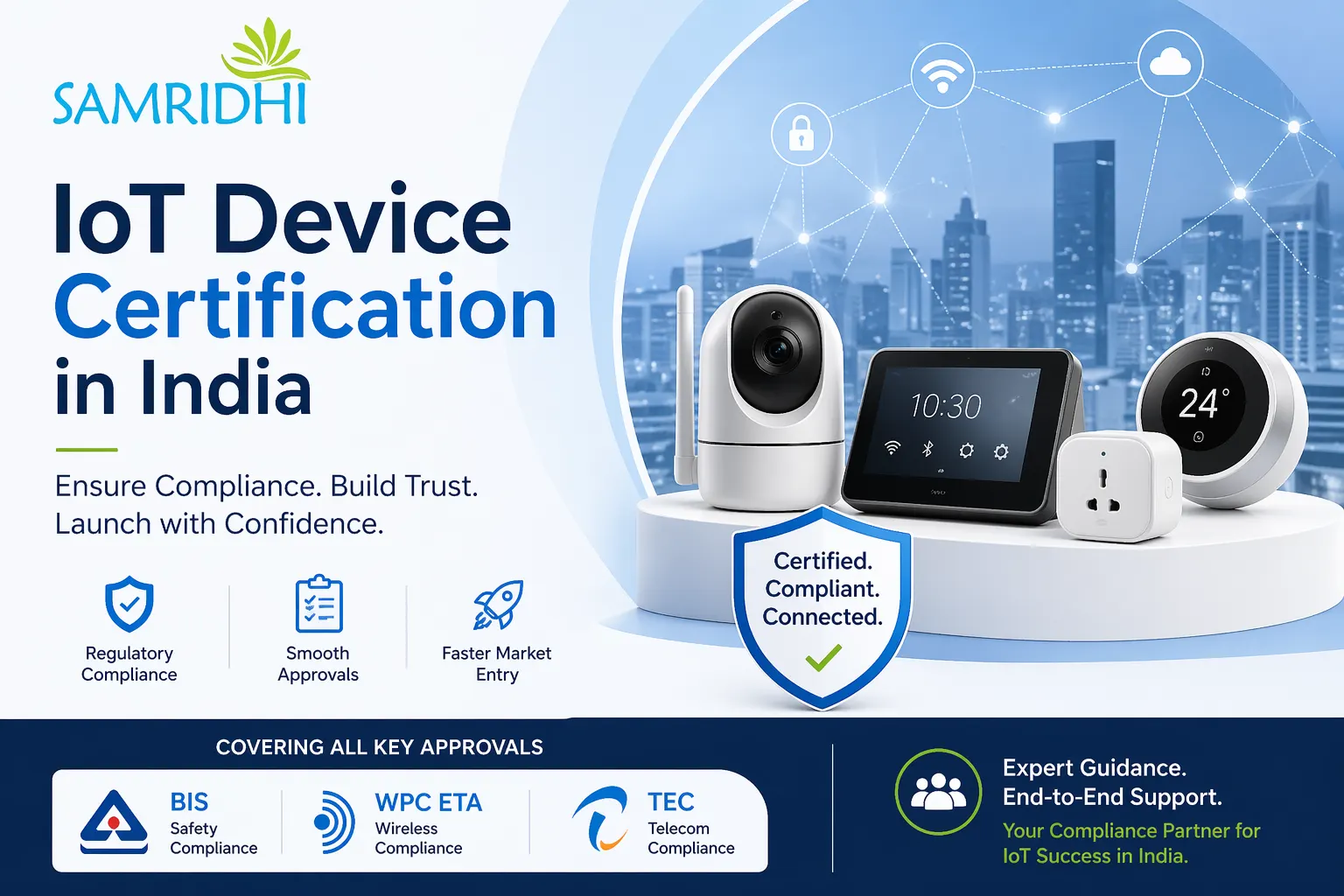
 Get Certified with Confidence – Your One-Stop Compliance Partner
 Grab Your Certified Now
 +91 8799708673
 WhatsApp