 Get Certified with Confidence – Your One-Stop Compliance Partner
From BIS, WPC, TEC, BEE, EPR, LMPC, CDSCO, FSSAI, ISO, MSME to PESO, NABL testing, Startup India, Make in India, and Lab Setup, we handle all your regulatory approvals, certifications, and documentation needs with precision and speed. Partner with Samridhi Compliance Certification and simplify your journey to full compliance—so you can focus on growing your business.
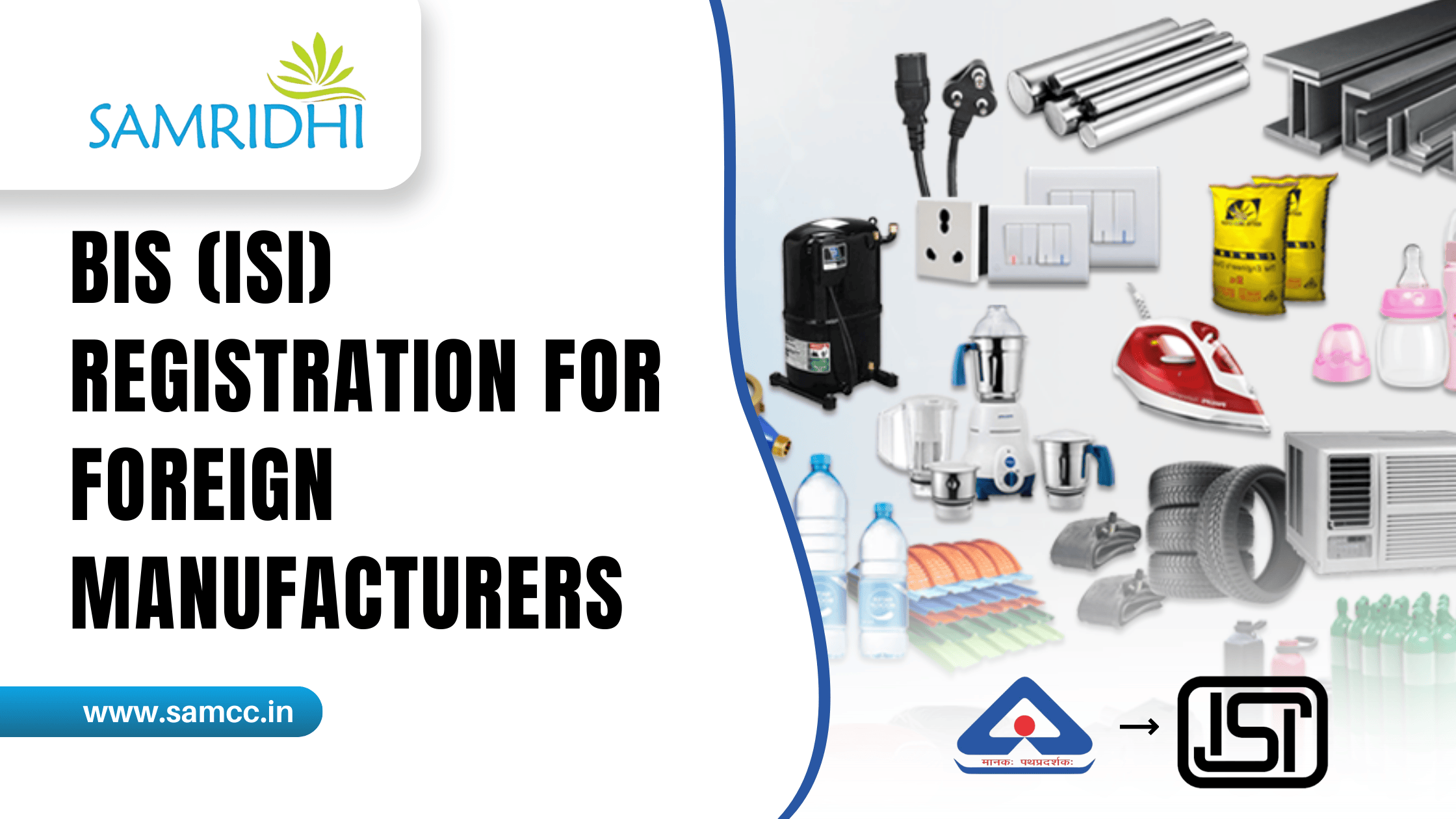
BIS ISI Registration for Foreign Manufacturers – Why Market Entry Into India Now Carries Real Risk
For foreign manufacturers, India often looks ready long before compliance is. Products are tested internationally. Packaging is approved. Distributors are lined up. Shipments are planned.
And then everything stops—at customs, during a market audit, or just before a commercial launch.
That pause usually traces back to BIS isi registration for foreign manufacturers not being in place under FMCS / Scheme-X.
The fear here is practical, not theoretical. Import holds that stretch without clarity. Legal penalties that appear after goods have already landed. Distributors who quietly step back once they realise certification isn’t confirmed. Under India’s bis registration framework, foreign manufacturers are no longer evaluated only at the border—they’re reviewed through documentation, factory audits, and post-market surveillance.
Regulatory tightening has changed the landscape.
Over the last few years, BIS has strengthened enforcement for overseas manufacturers supplying the Indian market. Certifications issued under FMCS BIS certification India are now closely tied to factory-level accountability, Indian Authorized Representative obligations, and consistency across shipments. Audits are no longer rare. Reviews are no longer passive. And approvals are no longer assumed to be permanent without continued compliance.
This is why certification is unavoidable today.
Many exporters still believe how foreign manufacturers can get BIS certification is a paperwork-driven process handled after sales begin. In reality, Scheme X BIS foreign manufacturer registration operates as a gatekeeper. Without it, ISI-marked products cannot legally be imported, sold, or distributed in India—regardless of approvals held in other countries.
Early trust matters more than speed here.
Foreign manufacturers who approach BIS ISI registration process with clarity—understanding where BIS focuses scrutiny, how factory audits are evaluated, and how Indian authorities interpret overseas documentation—face fewer disruptions. Those who treat it as a formality often encounter silent delays that escalate quickly.
This is where experience becomes visible. Knowing when factory inspection requirements apply. Knowing how Indian standards differ from international ones. Knowing where ISI mark registration india intersects with parallel approvals like WPC ETA Certification, TEC / MTCTE Certification, or BEE Star Rating Certification depending on product type.
At Samridhi Compliance Certification, early discussions usually focus on risk, not promises. Which products genuinely fall under ISI marking? What parts of the BIS FMCS process for exporters to India are likely to raise queries? Where does responsibility sit between the overseas factory and the Indian representative? These answers shape realistic planning.
There are no guaranteed approvals. Timelines always depend on audit readiness and documentation quality. Outcomes vary by product and manufacturing setup. But when foreign manufacturers treat BIS ISI compliance as market-entry infrastructure—not an afterthought—the fear of delays and penalties reduces sharply.
India remains a high-opportunity market.
But entry today demands proof, not intention.
Understanding Why BIS ISI Registration Becomes a Major Barrier for Foreign Manufacturers
Most foreign manufacturers don’t struggle with BIS isi registration for foreign manufacturers because they lack technical capability. They struggle because India’s compliance logic doesn’t mirror international certification systems. What looks complete abroad often appears incomplete once evaluated under Indian regulatory expectations.
This mismatch is where friction begins.
Under FMCS BIS certification India, compliance is not assessed only at the product level. It extends to factory controls, test report alignment with Indian Standards, and the role of the Indian Authorized Representative. Many exporters underestimate how interconnected these elements are—and how quickly small errors can halt progress.
Common Mistakes That Disrupt the Process
The same patterns repeat across product categories, regardless of country of origin.
-
Wrong product category selection
Products are often classified based on global standards or competitor listings. Under Scheme X BIS foreign manufacturer registration, applicability depends strictly on notified Indian Standards. Misclassification invalidates testing and restarts the process.
-
Incomplete or misaligned test reports
International test reports may exist, but they don’t always map cleanly to Indian requirements. Missing clauses, outdated standards, or scope gaps trigger re-testing under the BIS ISI registration process.
-
Wrong laboratory selection
Not all labs recognized internationally are accepted by BIS. Testing must be done at BIS-recognized laboratories, or reports are rejected outright.
-
Timeline misjudgment
Exporters often plan shipments assuming approvals will align with commercial timelines. In reality, timelines are indicative and depend on factory audit readiness, test outcomes, and clarification cycles.
Each of these issues alone seems manageable. Together, they create serious disruption.
The Practical Impact Exporters Feel Too Late
When certification gaps surface after export planning, consequences escalate quickly:
-
Shipments held at Indian ports due to missing ISI mark registration
-
Financial penalties under bis registration enforcement
-
Costly relaunches due to relabeling or re-testing
-
Loss of distributor confidence when supply commitments fail
In one recent case, a foreign manufacturer had products cleared technically but blocked at customs because the FMCS approval was still under review. The delay wasn’t dramatic—but it was long enough for distributors to walk away.
This is the reality many exporters encounter only once.
Understanding how foreign manufacturers can get BIS certification requires accepting that approval is not a single event. It’s a compliance system. One that demands coordination between overseas factories, Indian representatives, laboratories, and BIS authorities.
The process isn’t unfair.
It’s just stricter than most expect.
Get Certified with Confidence – Your One-Stop Compliance Partner
From BIS, WPC, TEC, BEE, EPR, LMPC, CDSCO, FSSAI, ISO, MSME to PESO, NABL testing, Startup India, Make in India, and Lab Setup, we handle all your regulatory approvals, certifications, and documentation needs with precision and speed. Partner with Samridhi Compliance Certification and simplify your journey to full compliance—so you can focus on growing your business.
Industry Reality Behind BIS ISI Registration for Foreign Manufacturers Entering India
India’s compliance environment has changed in tone—and in consequence. BIS isi registration for foreign manufacturers now sits inside a system that actively tests credibility, not just paperwork. What once felt procedural is now enforced through inspections, cross-authority checks, and post-import scrutiny.
This shift catches many exporters off guard.
Under FMCS BIS certification India, approval is no longer treated as a one-time gate. Authorities expect ongoing alignment between factory practices, test reports, and what actually enters the Indian market. Audits are more frequent. Surveillance extends beyond ports into warehouses and distribution channels. And when inconsistencies surface, enforcement moves faster than most exporters anticipate.
Rules also don’t stay still.
Regulatory Updates Are Frequent and Interconnected
BIS standards are revised. Product scopes expand. Testing parameters evolve. At the same time, related authorities—WPC and TEC—continue tightening their own frameworks. A product cleared earlier under Scheme X BIS foreign manufacturer registration may now face additional scrutiny because of component changes or updated interpretations.
What complicates matters is overlap. A product requiring ISI mark registration may simultaneously trigger WPC ETA Certification or TEC / MTCTE Certification, depending on wireless or telecom functionality. Treating these approvals separately often leads to contradictions during review.
Earlier assumptions age quickly here.
How Most Consultants Actually Operate
This is where industry practice quietly fails exporters.
Many bis consultants still rely on:
-
Checklist-based execution – collect documents, submit, wait
-
Authority-specific silos – BIS handled independently of WPC or TEC
This approach prioritizes speed over coherence. It assumes eligibility. It assumes testing will pass. It assumes the first submission will be accepted. When those assumptions break, responsibility fragments—and delays multiply.
Exporters often aren’t told where risk actually sits.
What Foreign Manufacturers Are Rarely Told Upfront
There are a few truths that usually emerge only after resistance appears:
-
Not all products qualify for ISI marking, even if similar goods are already sold in India
-
Testing failures are common, especially when international standards don’t map cleanly to Indian requirements
-
Approvals are iterative, not linear—queries, clarifications, and follow-up audits are normal
Even timelines remain indicative. Outcomes depend on factory audit readiness, lab alignment, and how well the Indian Authorized Representative manages communication with BIS.
This isn’t a hostile system.
It’s a precise one.
Foreign manufacturers who accept this reality plan compliance as part of market-entry infrastructure. Those who don’t often find themselves correcting assumptions after shipments are already committed.
In today’s Indian market, intent is not enough.
Consistency is what gets reviewed.
Practical Solutions and Use Cases That Actually Work for BIS ISI Registration Under FMCS / Scheme-X
When foreign manufacturers face resistance with BIS isi registration for foreign manufacturers, the issue is rarely effort. It’s direction. Most delays happen because actions are taken in the wrong order or based on assumptions that don’t hold under Indian regulatory review. Practical solutions focus on correcting that sequence—quietly, deliberately, and early enough to matter.
There is no single “best” method. What works is situational clarity.
Practical Certification Approaches That Reduce FMCS Friction
The most reliable outcomes under FMCS BIS certification India follow a few grounded approaches.
-
Product-first analysis
Before applications or lab bookings, the product itself is examined against notified Indian Standards. This determines whether ISI mark registration is applicable at all and under which scope. Many FMCS delays trace back to skipping this step.
-
Correct standard identification
Selecting the exact Indian Standard under Scheme X BIS foreign manufacturer registration is not interchangeable. Close matches don’t pass. Correct mapping stabilizes testing, audit focus, and documentation expectations from the start.
-
Testing and documentation alignment
International test reports often exist—but alignment matters more than presence. Test parameters, sample configurations, and declared specifications must tell one consistent story during the BIS ISI registration process.
-
Authority coordination
Products entering India frequently intersect with WPC ETA Certification, TEC / MTCTE Certification, or BEE Star Rating Certification. Coordinating these approvals prevents contradictions that surface during FMCS review.
None of these approaches promise faster approvals. They reduce reversals.
Who Each Approach Works Best For
Different exporters face different exposure levels.
For Indian manufacturers, these steps are familiar—but often underestimated when overseas plants are involved. Importers benefit most from early clarity on factory authorization and Indian representative responsibilities. OEMs exporting multiple variants need disciplined variant mapping to avoid duplicate testing.
Startups entering India for the first time often struggle with overconfidence—assuming global approvals translate locally. Established brands face a different challenge: legacy processes that no longer align with updated BIS expectations. Both require restraint, not acceleration.
Real-World Use Cases That Reflect FMCS Reality
In one case, a foreign manufacturer faced repeated queries because the product was classified under the wrong Indian Standard. Testing wasn’t invalid—it was misdirected. A careful reclassification reset the path without requiring a redesign. Cost increased slightly. Market entry stayed intact.
In another situation, an exporter’s shipment was scheduled while FMCS approval was still under review. Early intervention corrected documentation gaps related to the Indian Authorized Representative. The issue was resolved before customs inspection, avoiding a shipment hold and distributor fallout. BIS FMCS process for exporters to India shifted slightly, but penalties were avoided.
These aren’t dramatic rescues.
They’re controlled corrections.
That’s what effective bis registration solutions look like for foreign manufacturers—less noise, fewer assumptions, and decisions made early enough to protect market entry.
BIS ISI Registration Process for Foreign Manufacturers Under FMCS / Scheme-X
This part exists because uncertainty hurts more than effort.
Foreign manufacturers usually don’t fear compliance work—they fear hidden checkpoints, unclear authority expectations, and delays that surface after shipments are planned. Understanding how the BIS isi registration for foreign manufacturers process actually unfolds removes most of that anxiety.
The process under FMCS BIS certification India is structured, but it is not linear. Each stage introduces decision points where outcomes depend on technical accuracy, factory readiness, and how well overseas documentation aligns with Indian regulatory logic.
Product Applicability Assessment Sets the Direction
The first checkpoint is not filing. It’s eligibility.
Not every exported product requires ISI marking. Applicability depends on whether the product falls under a notified Indian Standard. Many exporters assume coverage based on similar products already selling in India. That assumption often collapses during review.
This step determines whether ISI mark registration india is required at all—and under which standard. Getting this wrong invalidates testing, audits, and timelines downstream.
Correct Standard Identification Is Non-Negotiable
Once applicability is confirmed, the exact Indian Standard must be identified under Scheme X BIS foreign manufacturer registration. Close matches are not accepted. Indian standards often differ subtly—but critically—from IEC or other international equivalents.
This decision defines:
-
Testing parameters
-
Factory audit focus
-
Documentation depth
Incorrect standard selection is one of the most common causes of FMCS rejection cycles.
Testing and Lab Coordination Acts as a Technical Gate
Testing must be conducted through BIS-recognized laboratories. International reports may exist, but they are rarely sufficient on their own.
Samples must reflect actual manufacturing conditions. Test outcomes feed directly into factory audit expectations. This is why BIS FMCS process for exporters to India often slows here—because lab alignment and factory reality must match precisely.
Testing outcomes also influence cost and movement. BIS ISI registration process timelines remain indicative and vary by product and audit readiness.
Documentation Preparation Is Where Delays Usually Begin
Documentation under FMCS is broader than many exporters expect.
It includes:
Any inconsistency triggers clarification. This stage quietly determines how smooth authority interaction will be later.
Authority Submission, Review, and Clarifications
After submission, BIS reviews coherence, not speed. Queries are normal. Clarifications are expected. They are part of validation, not rejection.
Responses must be precise and evidence-backed. Rushed replies often extend cycles instead of closing them.
Approval, when granted, reflects cumulative alignment across product scope, testing, factory audit, and documentation—not urgency.
There are no guaranteed timelines.
No promised approvals.
But when foreign manufacturers treat FMCS as a sequence of decisions rather than a checklist, uncertainty reduces—and market entry becomes manageable.
Cost of BIS ISI Registration for Foreign Manufacturers Under FMCS / Scheme-X
Cost is where most foreign manufacturers hesitate—not because BIS isi registration for foreign manufacturers is unaffordable, but because pricing feels uncertain until the process is already underway. That uncertainty blocks decisions, delays market entry, and often leads exporters to underestimate the real effort involved.
Transparency helps. Not by fixing numbers—but by explaining what actually shapes them.
There is no flat or guaranteed price for FMCS BIS certification India. All costs are indicative, and they depend on product category, applicable Indian Standards, factory readiness, and how smoothly testing and audits progress. Any quote given without reviewing the product and factory context is incomplete by default.
Indicative Cost Structure for FMCS / Scheme-X Registration
| Cost Component |
Approximate Range |
| Testing Fees |
Depends on product & standard |
| Government Fees |
As per authority |
| Documentation & Processing |
Varies by scope |
| Total Estimated Cost |
Case-specific |
This structure reflects how bis registration works for foreign manufacturers. Government fees are defined by BIS, but most variability sits around testing depth, audit effort, and documentation alignment.
What Actually Influences FMCS Certification Cost
The first driver is product category. Products covered under ISI mark registration india differ widely in complexity. A simple regulated product and a technically layered device may both require FMCS approval, but the testing and audit expectations are not comparable. This directly affects overall cost.
Second is testing complexity. Many exporters already have international test reports, but under the BIS ISI registration process, additional testing is often required to align with Indian Standards. BIS-recognized laboratory selection, sample configuration, and parameter coverage all influence expense.
Third, re-testing is the most underestimated variable. If initial test results don’t align with declared specifications, or if factory audit observations require corrective action, re-testing becomes necessary. This doesn’t signal failure—it reflects correction—but it does increase cost and shift timelines. Outcomes here always vary by product and manufacturing consistency.
Documentation scope also matters. Under Scheme X BIS foreign manufacturer registration, requirements extend beyond product data to factory systems and Indian Authorized Representative alignment. Gaps here increase processing effort and cost indirectly through clarification cycles.
Costs may also intersect with parallel approvals. Products that additionally require WPC ETA Certification, TEC / MTCTE Certification, or BEE Star Rating Certification can see costs rise or streamline depending on how well certifications are coordinated.
There’s no honest way to lock pricing upfront.
But understanding what shapes cost allows foreign manufacturers to plan realistically—before commitments become expensive to reverse.
Products Covered Under BIS ISI Registration for Foreign Manufacturers
This part answers the most immediate question exporters ask before committing resources:
“Does my product actually require BIS isi registration for foreign manufacturers to enter the Indian market?”
If the answer is no, the FMCS route stops right here.
If the answer is yes, bis registration becomes mandatory before import, sale, or distribution can legally proceed.
What creates confusion is familiarity. Products approved in other countries—or already sold in India by competitors—are often assumed to be covered or exempt. Under FMCS BIS certification India, that assumption rarely holds. Applicability is determined strictly by notified Indian Standards, not by market presence or international approvals.
Below is a practical, relevance-first grouping to help foreign manufacturers quickly assess scope.
Common Product Categories Covered Under FMCS / Scheme-X
| Product Group |
Typical Examples |
| IT & Electronic Products |
Electronic equipment, control units, IT hardware |
| LED Lighting Products |
LED lamps, luminaires, LED drivers |
| Power Adapters & Chargers |
Power supplies, external adapters |
| Wireless & RF Devices |
Equipment with integrated RF or communication modules |
These categories commonly fall under ISI mark registration india for foreign manufacturers exporting to India. However, coverage is never blanket.
Within each group, eligibility depends on:
-
Applicable Indian Standard
-
Voltage, power, and safety parameters
-
Internal design and construction
-
Intended end use in the Indian market
This is where many exporters misjudge early decisions.
For example, two chargers with identical output ratings may differ in FMCS applicability due to insulation design or component layout. A wireless-enabled product may require ISI mark registration and also trigger WPC ETA Certification because of frequency usage. In some cases, TEC / MTCTE Certification or BEE Star Rating Certification may also apply, depending on functionality.
Another overlooked factor is variant handling. Under the BIS ISI registration process, not all model variants qualify under a single approval. Some require separate evaluation, testing, or even independent certification.
A critical reminder that prevents costly assumptions:
Not all variants qualify. Applicability depends on technical parameters, notified standards, and current BIS interpretations—not on what similar products appear to be doing in the market.
This is why experienced exporters confirm scope before discussing timelines, cost, or shipment schedules under the BIS FMCS process for exporters to India. Because none of those decisions make sense until product eligibility is verified with precision.
For foreign manufacturers, this relevance check is not optional.
It’s the first compliance decision that protects market entry from silent disruption.
Benefits and Honest Risks of BIS ISI Registration for Foreign Manufacturers
This is where expectations need to be grounded. BIS isi registration for foreign manufacturers delivers clear advantages—but only when it’s approached with realism. Overconfidence creates delays. Ignoring risk creates cost. The balance sits in understanding both sides before committing shipments or distributor timelines.
When handled correctly, FMCS BIS certification India becomes a market-stability mechanism, not just a regulatory hurdle.
Benefits That Matter for Exporters Entering India
-
Faster approvals
Not because authorities accelerate reviews, but because accurate classification, aligned testing, and clean documentation reduce clarification loops. Correct execution shortens friction.
-
Reduced rejection cycles
Proper standard identification and lab alignment lower the chances of re-testing and resubmission under the BIS ISI registration process.
-
Compliance confidence
Once ISI mark registration india is secured under FMCS, exporters operate with clarity—shipments move with less anxiety, distributors engage with more confidence.
-
Market access stability
Certified products face fewer customs interruptions, marketplace takedowns, or post-import enforcement actions. Oversight continues—but unpredictability reduces.
These benefits don’t come from approval alone.
They come from predictability.
Risks and Limitations Foreign Manufacturers Must Accept
Even with strong preparation, certain variables remain outside direct control.
-
Timeline dependency on laboratories
Testing capacity, retesting requirements, and report revisions directly influence progress. This is why timelines always depend on lab readiness and product complexity.
-
Authority clarifications
Queries during FMCS review are normal. They are part of validation—not rejection. But incomplete or rushed responses often extend cycles unnecessarily.
-
Product redesign requirements
Occasionally, testing or audit findings reveal gaps that require design or process changes. This is uncomfortable, but far safer than post-market penalties.
Earlier, many exporters could navigate India with minimal scrutiny. Today, tolerance is lower and expectations are higher.
How Professionals Quietly Reduce These Risks
Experienced teams don’t eliminate risk. They manage exposure.
-
Pre-testing checks
Early technical reviews identify gaps before samples reach BIS-recognized labs, reducing re-testing probability.
-
Authority-specific documentation planning
BIS reviews foreign manufacturers through a factory-accountability lens. Aligning documents with audit expectations reduces clarification cycles.
-
Parallel processing where allowed
While testing progresses, documentation and Indian Authorized Representative alignment can move in parallel—depending on product scope and preparedness.
None of this guarantees approval.
No fixed timelines are promised.
Outcomes always vary by product and factory maturity.
But this approach shifts bis registration under FMCS from reactive correction to controlled execution—and that difference is what protects foreign manufacturers from costly market-entry disruptions.
How BIS ISI Registration Under FMCS Actually Solves the Market-Entry Problem for Foreign Manufacturers
When foreign manufacturers search for BIS isi registration for foreign manufacturers, they’re not looking for definitions. They’re trying to answer a deeper question: How do we enter India without shipments getting stuck, distributors backing out, or compliance turning into a recurring firefight?
The FMCS framework doesn’t remove complexity. What it does—when executed correctly—is replace uncertainty with control.
A Step-by-Step Flow That Makes the Process Predictable
The BIS ISI registration process under FMCS works best when each step is treated as a decision checkpoint, not a mechanical task.
-
Product applicability confirmation
The first filter establishes whether the product genuinely falls under mandatory ISI marking. This avoids wasted effort on non-notified products and prevents misclassification that leads to rejection later.
-
Standard identification and scope finalisation
Selecting the exact Indian Standard defines testing depth, factory audit expectations, and documentation scope. This anchors ISI mark registration india to regulatory reality rather than international assumptions.
-
Testing and lab coordination
Samples are tested at BIS-recognised laboratories against Indian Standards. Outcomes here often trigger adjustments or confirmations, which is why timelines always depend on technical readiness.
-
Documentation preparation and internal alignment
Factory quality systems, process controls, test reports, Indian representative authorisations, and marking formats must all align. This stage quietly determines how smooth authority review will be.
-
Authority submission, review, and clarification
BIS review is iterative. Queries are normal. Clarifications are expected. Precision—not speed—decides how quickly cycles close.
This flow applies across FMCS BIS certification India, but execution details vary by product and factory maturity.
Documentation Checkpoints That Prevent Backtracking
Most FMCS delays originate here.
Critical checkpoints include:
-
Consistency between test reports and actual manufacturing practices
-
Clear linkage between factory controls and declared specifications
-
Accurate Indian Authorised Representative documentation
-
Correct ISI marking and labelling formats
Missing alignment doesn’t always trigger rejection—but it almost always triggers delay.
Where Authority Interaction Really Happens
Many exporters expect one submission and one response. Reality is layered.
Authority interaction occurs:
-
During initial scrutiny of the FMCS application
-
When technical or documentation clarifications are raised
-
During or after factory audit reviews
Each interaction tests coherence. Clear, evidence-based responses shorten cycles. Vague or rushed replies extend them. This is why timelines remain indicative and depend on how interactions are handled—not how quickly files are uploaded.
Why Accuracy Beats Speed Every Time
Rushing early steps feels efficient. It isn’t.
A fast but misaligned FMCS submission often leads to re-testing, repeated clarifications, or corrective actions after shipments are planned. Slower, accurate execution reduces downstream risk, protects distributor confidence, and stabilises market access.
Over time, this becomes obvious to experienced exporters.
Speed creates movement.
Accuracy creates entry.
And that’s what foreign manufacturers are really seeking when they ask how to navigate BIS isi registration for foreign manufacturers—even if the question sounds simpler on the surface.
Why BIS ISI Registration Under FMCS Matters for Foreign Manufacturers Operating Through Delhi
For compliance, location doesn’t change the law.
It changes exposure.
For foreign manufacturers entering India, Delhi—and business zones like Laxmi Nagar—operate as a high-visibility gateway. Decisions made here shape how smoothly products move through ports, distributors, marketplaces, and audits. That’s why BIS isi registration for foreign manufacturers carries more weight in this region than many exporters initially expect.
Why Demand Is Concentrated in This Region
Delhi functions as:
-
A coordination hub for importers and Indian Authorized Representatives
-
A decision center for brands distributing across multiple Indian states
-
A dense startup and SME ecosystem sourcing products from overseas manufacturers
Because of this concentration, importers and distributors based here increasingly require FMCS BIS certification India before onboarding products. Under the BIS FMCS process for exporters to India, missing approvals are flagged earlier—often before shipments even leave origin ports.
Earlier, informal entry survived. Recently, it doesn’t.
Common Compliance Gaps Seen Locally
Despite awareness, the same issues repeat among Delhi-based import operations:
-
Products sourced before confirming applicability under Scheme X BIS foreign manufacturer registration
-
Factory audits underestimated because documentation was prepared only for international regulators
-
Indian Authorized Representative roles treated as symbolic instead of operational
-
Parallel approvals like WPC ETA Certification or TEC / MTCTE Certification planned too late
These gaps rarely surface during initial discussions. They appear during customs review, distributor audits, or BIS clarification cycles—when correction costs more and timelines tighten.
Why Delhi Increases the Risk Profile
Delhi’s proximity to BIS offices, testing laboratories, and enforcement teams increases scrutiny. Importers operating from this region are often reviewed as reference points for national distribution. Expectations around documentation accuracy, factory accountability, and response quality are higher.
This directly affects planning. Even when ISI mark registration india is achievable, timelines remain indicative and depend on how well overseas factories and Indian representatives coordinate under review.
For startups importing into India, one compliance slip can stall market entry. For established exporters, it can disrupt national supply chains.
Location Also Shapes Interlinked Compliance
Products routed through Delhi rarely stay local. They move into multiple states, government procurement channels, and online marketplaces. That’s why bis registration planning here often intersects with broader, state-level compliance strategies and additional certifications.
Location doesn’t change BIS rules.
It changes how quickly gaps are noticed—and how little tolerance exists once they are.
For foreign manufacturers working through Delhi and Laxmi Nagar, accurate execution of how foreign manufacturers can get BIS certification is not just regulatory hygiene. It’s market-entry risk control.
Real Experiences Around BIS ISI Registration Under FMCS That Reflect Export Reality
Foreign manufacturers rarely talk about FMCS compliance when things go smoothly. They talk when something almost derailed—and didn’t.
That’s where real experiences around BIS isi registration for foreign manufacturers tend to surface. Not as success stories. As near-misses that stayed contained.
One exporter described a familiar situation.
The product was ready. International certifications were complete. Distributors in India were aligned. Then FMCS approval stalled—not because testing failed, but because the product was mapped to the wrong Indian Standard. The issue wasn’t obvious at first. A careful reclassification corrected the path before factory audit scheduling. The launch slipped slightly. Penalties were avoided.
Another case involved an overseas manufacturer shipping samples while approval was still under review. During a routine document check, gaps appeared in Indian Authorized Representative authorization. Fixing that early clarified responsibility under FMCS BIS certification India and prevented a customs hold that would have delayed market entry by weeks.
Short reflections like these come up repeatedly:
-
“Once the Indian standard was confirmed, the BIS ISI registration process became clearer.”
-
“Understanding how factory audits are evaluated reduced back-and-forth.”
-
“Clarifying documentation early helped us avoid re-testing costs.”
There are also quieter trust moments that matter more than marketing claims.
In one instance, testing revealed a minor deviation. It wasn’t reframed as a win. The product needed adjustment. That pause increased effort, and costs varied by product, but it prevented a post-import enforcement notice that would have been far more disruptive.
These experiences don’t promise speed.
They demonstrate control.
Reduced delay.
Clearer process.
Avoided penalties.
No exaggeration. No guarantees.
Just the reality of navigating bis registration under FMCS with enough accuracy that problems are addressed before they become public—and expensive.
Where FMCS / Scheme-X Leaves Foreign Manufacturers and What Comes Next
For foreign manufacturers, BIS isi registration for foreign manufacturers is no longer a procedural checkpoint—it’s a market-entry filter. When product eligibility is confirmed early, the correct Indian Standard is identified, testing aligns with factory reality, and FMCS documentation is prepared with audit expectations in mind, uncertainty reduces sharply. The BIS ISI registration process becomes navigable, even though outcomes always depend on product category, factory readiness, and authority review depth.
What consistently works is execution accuracy, not urgency. Clean classification lowers re-testing risk. Aligned documentation shortens clarification cycles. Clear coordination with the Indian Authorized Representative stabilizes reviews. While costs and timelines remain indicative and vary by product, informed planning prevents shipment holds, penalties, and distributor hesitation. This clarity becomes even more important when ISI requirements intersect with WPC ETA Certification, TEC / MTCTE Certification, or BEE Star Rating Certification, depending on product functionality.
If you’re deciding next steps, begin with scope verification. Confirm whether your product truly requires ISI marking under FMCS, understand how foreign manufacturers can get BIS certification in a way that fits your factory systems, and plan testing and documentation together. That shift—early and deliberate—removes most downstream friction under bis registration.
For exporters seeking structured guidance without overpromising outcomes, Samridhi Compliance Certification supports product-first analysis, FMCS-aligned documentation, Indian Authorized Representative coordination, and audit-ready preparation. To discuss your product scope or factory readiness, call +91 8799708673 or email info.samcc@gmail.com. Results will always depend on technical and regulatory realities—but clarity can start immediately.
Get Certified with Confidence – Your One-Stop Compliance Partner
From BIS, WPC, TEC, BEE, EPR, LMPC, CDSCO, FSSAI, ISO, MSME to PESO, NABL testing, Startup India, Make in India, and Lab Setup, we handle all your regulatory approvals, certifications, and documentation needs with precision and speed. Partner with Samridhi Compliance Certification and simplify your journey to full compliance—so you can focus on growing your business.


 Grab Your Certified Now
 +91 8799708673
 WhatsApp