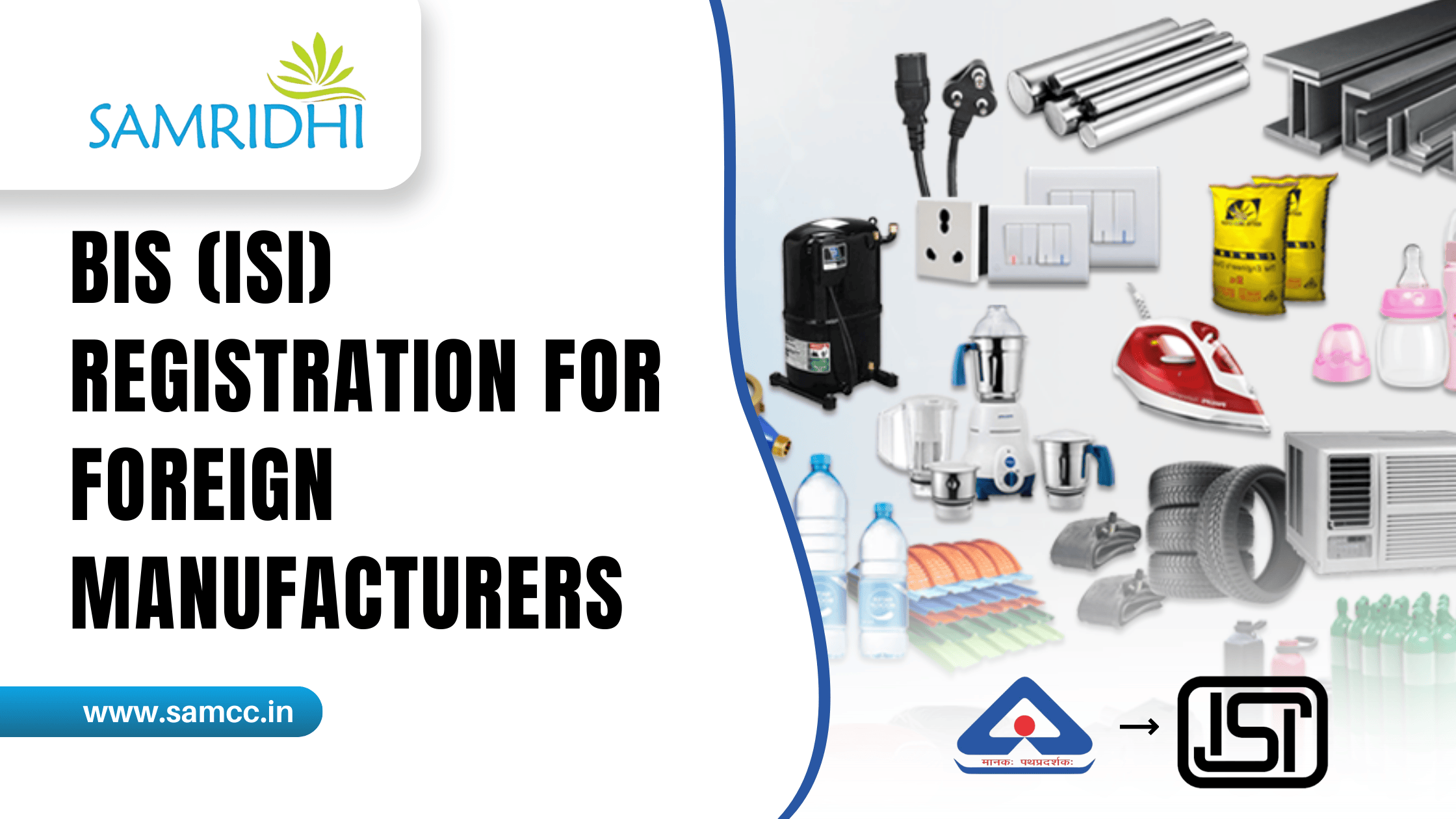
BIS ISI Certification for Foreign Manufacturers - Mandatory compliance for imports
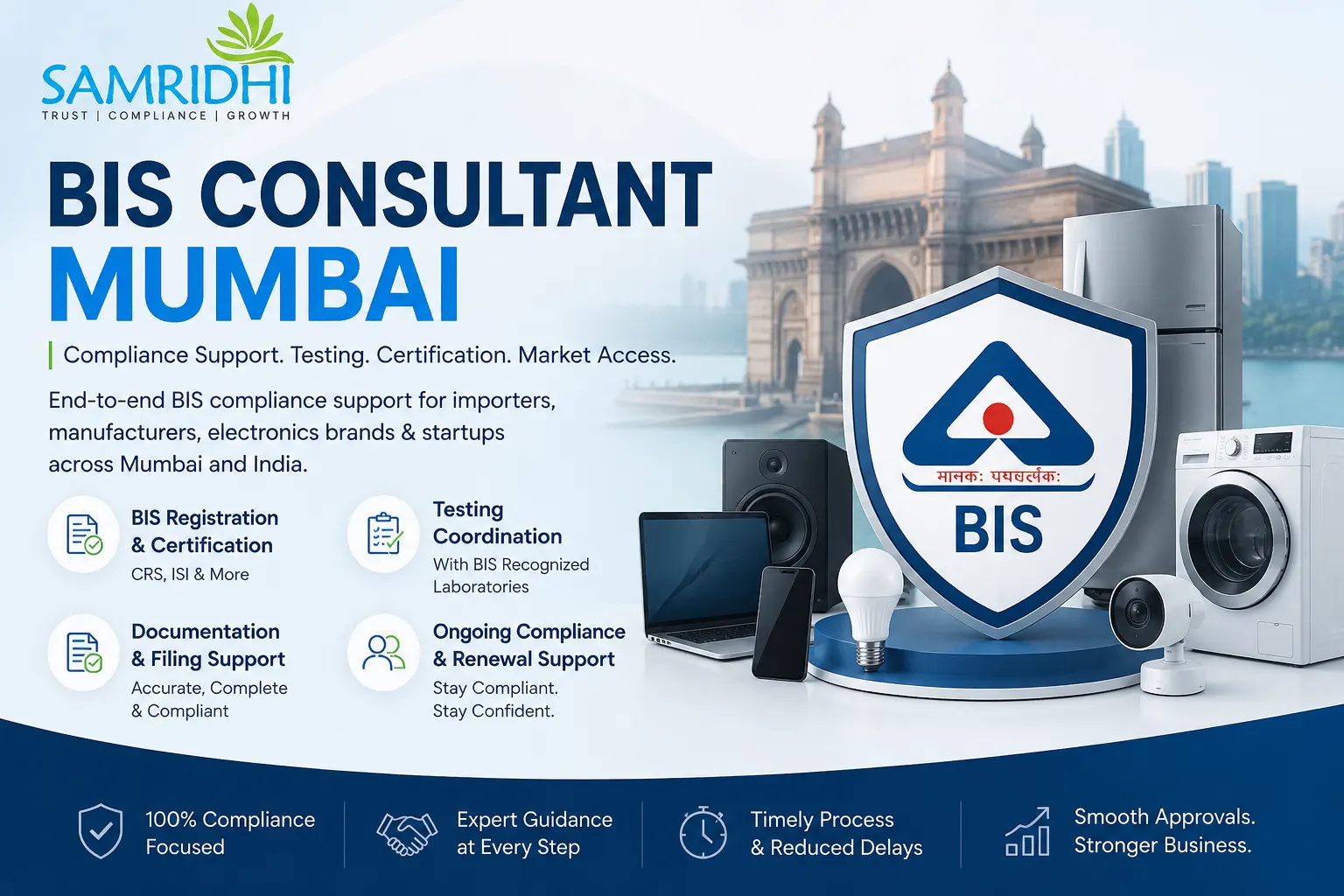
BIS ISI Certification for Foreign Manufacturers is a mandatory compliance requirement for overseas companies exporting regulated products to India under the FMCS scheme. It ensures that products manufactured outside India meet Indian quality, safety, and performance standards before import, helping businesses operate legally, clear customs smoothly, and avoid penalties, shipment detention, or product bans. With expanding regulatory coverage and stricter enforcement, timely BIS FMCS compliance enables foreign manufacturers and Indian importers to build trust, scale operations confidently, and maintain uninterrupted market access. For expert guidance and end-to-end support, contact +91 8799708673.
 Get Certified with Confidence – Your One-Stop Compliance Partner
From BIS, WPC, TEC, BEE, EPR, LMPC, CDSCO, FSSAI, ISO, MSME to PESO, NABL testing, Startup India, Make in India, and Lab Setup, we handle all your regulatory approvals, certifications, and documentation needs with precision and speed. Partner with Samridhi Compliance Certification and simplify your journey to full compliance—so you can focus on growing your business.
BIS ISI Certification for Foreign Manufacturers
BIS ISI Certification for Foreign Manufacturers is a mandatory regulatory requirement that allows overseas manufacturers to legally export, distribute, and sell regulated products in the Indian market. Under India’s quality and safety framework, foreign manufacturers must comply with the standards set by the Bureau of Indian Standards (BIS) through the Foreign Manufacturers Certification Scheme (FMCS). This certification ensures that imported products meet Indian safety, performance, and quality benchmarks, protecting consumers and supporting fair trade.
This certification is essential for foreign manufacturers, brand owners, exporters, and Indian importers dealing in regulated products. Without BIS ISI certification for foreign manufacturers, products may face customs clearance issues, seizures, penalties, or outright bans from the Indian market.
India as a Regulated Business & Manufacturing Market ⚖️🏭
India is one of the world’s fastest-growing consumer and manufacturing markets, but it is also highly regulated. The Indian government has strengthened its compliance ecosystem to ensure product safety, quality control, and consumer protection.
For manufacturing, compliance ensures that products conform to Indian standards before they reach consumers. For imports, BIS certification for import is critical to clear customs smoothly and avoid delays. From a market access perspective, BIS approval is often the first legal step to sell products in India.
Non-compliance can result in penalties, product seizures, blacklisting, and long-term business disruption. Alongside BIS, authorities such as WPC (for wireless products), TEC (for telecom equipment), and CPCB (for environmental compliance) collectively shape India’s regulatory framework. This makes BIS certification for foreign manufacturers a foundational requirement for entering the Indian market.
Industry, Product, and Technology Context 📡
BIS ISI certification applies across multiple industries, depending on the product category:
Electronics & IT Products
Foreign manufacturers of IT hardware, electronics, and IoT devices must comply with BIS standards to ensure electrical safety, performance, and durability. For many products, BIS FMCS approval works alongside CRS requirements.
Mobile Phones, CCTV, Batteries
Product-specific compliance is critical for safety-sensitive categories. BIS certification for import items like mobile phones and CCTV cameras ensures adherence to Indian safety and quality norms, reducing risks associated with electrical faults or misuse.
Wireless & RF Devices
When products include Bluetooth, Wi-Fi, or RF modules, WPC approval may be required in addition to BIS. Understanding how BIS FMCS and WPC interact is crucial for foreign manufacturers.
In all these cases, certification is critical because India follows a mandatory compliance model. Selling uncertified products is not permitted, regardless of whether they are manufactured domestically or overseas.
Process Overview: BIS ISI Certification for Foreign Manufacturers 📄✅
The BIS ISI certification process for foreign manufacturers follows a structured approach under FMCS:
Step 1: Product Identification
Determine whether the product falls under the list of import items required BIS certification. This step confirms whether BIS certification is required for import.
Step 2: Application Preparation
Foreign manufacturers must appoint an Authorized Indian Representative (AIR). Documentation related to manufacturing processes, quality control, and factory details is prepared at this stage.
Step 3: Product Testing
Samples are tested in BIS-recognized laboratories in India. Testing verifies compliance with applicable Indian Standards.
Step 4: Factory Inspection
BIS officials may conduct an on-site inspection of the foreign manufacturing facility to assess production capability and quality systems.
Step 5: Grant of License
Once testing and inspection are successfully completed, BIS issues the license under FMCS, allowing the use of the ISI mark.
Timelines vary depending on product type, factory readiness, and documentation accuracy. Common challenges include incomplete documentation, delays in testing, and coordination across borders.
Cost, Validity & Key Compliance Factors 💰📑
The cost of BIS certification for foreign manufacturers includes multiple components:
The BIS FMCS license is typically valid for a defined period and must be renewed periodically. Any changes in product design, manufacturing location, or quality processes may require modification or fresh approval.
Penalties for non-compliance are strict. Importing products without BIS certification for Indian importers can lead to confiscation, financial penalties, and suspension of import rights.
Role of Professional Certification Consultants 🧭
Foreign manufacturers often underestimate the complexity of Indian compliance. Working with experienced compliance consultants helps businesses navigate regulatory requirements efficiently.
Consultants vs Agents
Consultants provide advisory, compliance interpretation, and end-to-end coordination. Agents often focus only on filing paperwork, without addressing compliance risks.
DIY vs Expert-Managed Compliance
DIY approaches frequently result in delays, rejections, or costly rework. Expert-managed compliance ensures accurate documentation, smooth testing coordination, and proper communication with BIS authorities.
Professional guidance is especially valuable for managing BIS certification for import items, understanding the bis requirement for import items, and ensuring long-term compliance.
Recent & Trending Compliance Updates 📈⚠️
India’s regulatory landscape is evolving rapidly. Recent trends include:
-
Expansion of the list of import items required BIS certification
-
Increased enforcement on imports at ports and customs
-
Updates to FMCS and CRS procedures
-
Greater reliance on digital portals and online application systems
These changes make it even more important for foreign manufacturers to stay updated and compliant. BIS certification for foreign manufacturers is no longer a one-time task but an ongoing compliance responsibility.
Why BIS ISI Certification Matters for Foreign Manufacturers 🌍
BIS ISI certification for foreign manufacturers enables lawful market entry, protects brand reputation, and builds trust with Indian consumers and regulators. It ensures that products meet Indian safety standards, supports smooth customs clearance, and reduces business risk.
For Indian importers, working with BIS-compliant foreign manufacturers simplifies sourcing and reduces regulatory exposure. As enforcement tightens and product categories expand, BIS certification for import will remain a non-negotiable requirement.
BIS ISI Certification for Foreign Manufacturers is a critical compliance requirement for accessing the Indian market. From electronics and IT products to safety-sensitive equipment, certification under FMCS ensures quality, safety, and regulatory alignment. By understanding the process, cost factors, and compliance responsibilities, foreign manufacturers can avoid penalties, delays, and reputational damage.
Samridhi Compliance Certification (SAMCC) supports foreign manufacturers with expert-driven guidance to manage BIS FMCS compliance accurately and efficiently, helping businesses enter and grow in India with confidence.
Get Certified with Confidence – Your One-Stop Compliance Partner
From BIS, WPC, TEC, BEE, EPR, LMPC, CDSCO, FSSAI, ISO, MSME to PESO, NABL testing, Startup India, Make in India, and Lab Setup, we handle all your regulatory approvals, certifications, and documentation needs with precision and speed. Partner with Samridhi Compliance Certification and simplify your journey to full compliance—so you can focus on growing your business.
BIS ISI Certification for Foreign Manufacturers - Business & Industry Landscape in India 🏭📄
India is one of the fastest-growing consumer and manufacturing markets in the world, attracting global brands across electronics, engineering goods, consumer appliances, and industrial products. However, this growth is supported by a strict regulatory framework that prioritizes quality, safety, and standardization. BIS ISI Certification for Foreign Manufacturers plays a central role in this framework by ensuring that products manufactured outside India meet Indian standards before entering the market.
Several categories of businesses are directly affected by this requirement:
-
Foreign manufacturing units supplying finished goods to India must comply with BIS standards under the Foreign Manufacturers Certification Scheme (FMCS).
-
Importers & exporters rely on BIS certification for import to ensure smooth customs clearance and uninterrupted supply chains.
-
Electronics & IT companies dealing in regulated products such as power supplies, electronic assemblies, and safety-critical components must follow BIS FMCS norms.
-
Startups & MSMEs importing branded or white-label products into India need BIS approval to avoid legal and financial risks.
-
Foreign manufacturers supplying to India must obtain certification even if products are already approved in other countries.
In all these cases, BIS certification for foreign manufacturers is mandatory because Indian law requires compliance before products are sold, distributed, or even stored for commercial use.
Key Business & Industrial Locations Driving Compliance Demand ⚙️📦
Compliance demand is especially high around India’s major commercial and industrial hubs. Ports, SEZs, and logistics corridors see strict enforcement because imports are monitored at entry points. Manufacturing clusters and electronics hubs also drive higher regulatory scrutiny due to the volume of regulated goods.
Foreign manufacturers exporting to India often deal with importers based near ports and industrial zones, where customs authorities verify whether products fall under the list of import items required BIS certification. Any mismatch or missing approval can result in shipment detention. This makes BIS certification for Indian importers and their overseas suppliers a shared compliance responsibility.
Rather than geography alone, the key factor is business relevance—high-value imports, safety-sensitive products, and electronics face closer checks, increasing the importance of BIS FMCS compliance.
Future Growth Potential & Regulatory Expansion 📈⚠️
India’s regulatory environment is becoming more structured and enforcement-driven. The future scope of BIS ISI certification for foreign manufacturers is expanding due to:
-
Increasing enforcement of mandatory certifications at customs and in the domestic market
-
Expansion of regulated product categories, with frequent updates to the BIS compulsory list
-
Government focus on quality, safety, and standardization to protect consumers and support “Make in India” and quality imports
As the bis requirement for import items grows, early compliance becomes a strategic advantage. Businesses that obtain BIS certification for import in advance can scale faster, reduce supply chain risks, and avoid last-minute disruptions. Delayed compliance, on the other hand, increases legal exposure and costs.
How Professional Compliance Services Support Business Growth 🧭
Navigating BIS FMCS requirements is complex, especially for overseas manufacturers unfamiliar with Indian regulations. Professional compliance services play a critical role in turning regulatory obligations into a smooth business process.
Certification consultants help businesses by:
-
Reducing approval delays through correct application structuring
-
Avoiding rejection caused by documentation gaps or testing errors
-
Managing testing, licensing, and renewals under FMCS
-
Ensuring ongoing compliance when standards, product designs, or factories change
For foreign manufacturers, managing BIS certification for foreign manufacturers internally often leads to misinterpretation of rules. Expert guidance ensures that BIS certification for import items aligns with the latest regulatory expectations and customs practices.
Digital & Online Compliance Ecosystem in India 💻📄
India has moved rapidly toward digital compliance systems. Online portals have transformed how applications are filed, tracked, and approved. BIS, WPC, CPCB, and TEC now rely heavily on digital workflows.
While these systems improve transparency, they also require precision. Incorrect data entry, wrong standard selection, or incomplete uploads can stall applications. This is where consultants add value by navigating portals efficiently, coordinating between authorities, and ensuring accuracy across submissions.
For foreign manufacturers, digital compliance does not eliminate complexity—it shifts the responsibility toward technical correctness and procedural clarity, especially under bis fmcs requirements.
Why BIS ISI Certification for Foreign Manufacturers Is Business-Critical ✅
BIS ISI certification for foreign manufacturers is not just a legal formality; it is a market access requirement. It ensures that imported products meet Indian standards, supports consumer trust, and protects businesses from enforcement action.
Key business benefits include:
-
Smooth customs clearance where BIS certificate required for import is enforced
-
Reduced risk of shipment detention or product recalls
-
Stronger credibility with Indian partners and distributors
-
Long-term scalability as regulations expand
For Indian importers, sourcing from compliant overseas suppliers simplifies operations and lowers regulatory risk. As enforcement tightens, bis required for import will increasingly determine which products can enter and remain in the market.
Looking Ahead: Compliance as a Growth Enabler 🌍
With India expanding its regulatory coverage, BIS ISI certification for foreign manufacturers will continue to gain importance. Businesses that treat compliance as an early-stage investment rather than a last-minute requirement are better positioned to grow sustainably.
Understanding the bis requirement for import items, keeping track of the list of import items required BIS certification, and maintaining active FMCS licenses will become standard practice for global suppliers to India.
BIS ISI Certification for Foreign Manufacturers is essential for any overseas business planning to supply regulated products to India. It safeguards market access, ensures legal compliance, and builds trust with regulators and consumers. As India strengthens quality and safety enforcement, BIS FMCS compliance is no longer optional—it is foundational to doing business in India.
Samridhi Compliance Certification (SAMCC) supports foreign manufacturers and Indian importers with structured, expert-driven compliance services, helping businesses navigate BIS FMCS requirements confidently and prepare for future regulatory expansion.
BIS ISI Certification for Foreign Manufacturers - Advantages and Disadvantages
Foreign manufacturers planning to export regulated products to India must comply with strict quality and safety regulations. BIS ISI Certification for Foreign Manufacturers is a mandatory requirement under Indian law for several product categories. This certification ensures that products manufactured outside India meet Indian Standards before they are imported, sold, or distributed in the Indian market. Understanding the advantages of compliance—and the risks of non-compliance—is critical for sustainable business growth in India.
Advantages of BIS ISI Certification for Foreign Manufacturers ⚖️📄
Obtaining BIS ISI certification for foreign manufacturers offers practical and long-term benefits across the entire supply chain. It is not just a regulatory formality; it is a business enabler.
1. Legal Market Entry in India
-
BIS certification for foreign manufacturers allows businesses to operate legally in India.
-
Products listed under the list of import items required BIS certification cannot be imported without approval.
-
Certification ensures compliance with the bis requirement for import items, reducing legal uncertainty.
2. Smooth Import & Customs Clearance
-
BIS certificate required for import is closely checked by Indian customs authorities.
-
Proper fmcs BIS approval prevents shipment detention and demurrage charges.
-
BIS certification for import enables faster customs clearance and predictable delivery timelines.
3. Trust & Credibility with Authorities and Buyers
-
BIS FMCS approval signals product safety and quality to regulators.
-
Indian distributors and buyers prefer sourcing from BIS-certified foreign manufacturers.
-
Certification strengthens confidence among Indian importers relying on compliant suppliers.
4. Business Benefits for Different Stakeholders 🏭📡
For Foreign Manufacturers
-
Direct access to the Indian market without regulatory interruptions
-
Reduced risk of product bans or forced recalls
-
Long-term scalability as regulations expand
For Indian Importers
-
Assurance that BIS certificate required for import is already in place
-
Lower risk of customs rejection and penalties
-
Simplified compliance for high-volume imports
For Startups & MSMEs
For New Foreign Entrants
Disadvantages of NOT Using BIS ISI Certification ⚠️🏭
Ignoring BIS ISI certification for foreign manufacturers exposes businesses to serious legal and operational risks. These risks are increasing as enforcement becomes stricter.
1. Legal Penalties and Regulatory Notices
-
Importing products without bis required for import approvals can attract fines.
-
Authorities may issue stop-sale or recall orders.
-
Non-compliance under BIS FMCS can lead to long-term restrictions.
2. Import Clearance Failures
-
BIS certificate required for import item list is checked at ports.
-
Shipments may be held, returned, or destroyed if certification is missing.
-
Delays disrupt supply chains and damage importer relationships.
3. Product Seizure or Market Ban
4. Business Reputation & Financial Loss
-
Indian partners may terminate contracts with non-compliant suppliers.
-
Loss of trust impacts future orders and brand image.
-
Storage, re-export, and testing costs significantly increase expenses.
Compliance vs Non-Compliance: A Clear Comparison 📊
| Benefits of Compliance / Certification |
Drawbacks of Non-Compliance |
| Legal entry into the Indian market |
Import rejection at customs |
| Smooth BIS certification for import |
Shipment detention and delays |
| Trust with regulators and buyers |
Loss of distributor confidence |
| Reduced risk of penalties |
Fines and legal notices |
| Long-term business scalability |
Product bans and recalls |
This comparison highlights why BIS certification for foreign manufacturers is a strategic requirement, not an optional step.
Why BIS FMCS Compliance Matters More Today 📈
India is steadily expanding the scope of mandatory certifications. More products are being added to the bis certificate required for import item list, and enforcement at ports is becoming stricter. BIS FMCS authorities now rely on digital systems to cross-check compliance data, making it easier to identify violations.
Foreign manufacturers supplying to India must treat bis for foreign manufacturer compliance as part of their core export strategy. Early adoption of FMCS certification reduces long-term risk and ensures uninterrupted access to one of the world’s largest consumer markets.
Role of Professional Certification Support ✅
While online systems exist, BIS FMCS compliance involves complex documentation, testing coordination, and regulatory interpretation. Professional support helps businesses:
-
Understand changing bis requirement for import items
-
Manage testing at BIS-recognized labs
-
Handle renewals and modifications efficiently
-
Avoid procedural errors that delay approvals
Samridhi Compliance Certification (SAMCC) provides structured advisory support to foreign manufacturers and Indian importers, helping them meet BIS FMCS requirements accurately and on time.
BIS ISI Certification for Foreign Manufacturers is essential for legal, smooth, and scalable business operations in India. It protects businesses from penalties, ensures uninterrupted imports, and builds trust with regulators and buyers. In contrast, non-compliance leads to delays, losses, and reputational damage. As India tightens enforcement and expands regulated product lists, BIS FMCS compliance is no longer optional—it is the foundation for sustainable market entry and growth.
BIS ISI Certification for Foreign Manufacturers Importans
Entering the Indian market offers massive growth potential for global brands, but it also comes with strict regulatory responsibilities. BIS ISI Certification for Foreign Manufacturers is one of the most critical compliance requirements for overseas companies exporting regulated products to India. This certification ensures that products manufactured outside India meet Indian quality, safety, and performance standards before they are imported, sold, or distributed in the country.
Why BIS ISI Certification for Foreign Manufacturers Is Important ⚖️📄
For any foreign business, legal market entry is the first step toward long-term success. BIS certification for foreign manufacturers helps businesses operate legally in India by complying with mandatory standards notified by Indian authorities.
This certification enables businesses to:
-
Operate legally in India without facing regulatory objections
-
Meet Indian quality and safety standards, which are often different from international norms
-
Avoid penalties, seizures, and operational delays at ports and warehouses
-
Build long-term trust with Indian customers, regulators, and distribution partners
Many products fall under the bis certificate required for import item list, making certification non-negotiable. Without it, even well-known global brands can face shipment rejection or product bans.
India’s Growing Regulatory & Compliance Landscape 🏭📈
India’s manufacturing and import ecosystem has expanded rapidly over the last decade. With this growth, the government has increased its focus on product quality, consumer safety, and standardization. As a result, enforcement of bis required for import regulations has become stricter.
Key regulatory trends include:
-
Expansion of the list of import items required BIS certification
-
Increased scrutiny at customs for BIS FMCS approvals
-
Digital tracking of compliance data across departments
The bis requirement for import items is no longer limited to a few categories. Electronics, industrial goods, consumer products, and safety-critical components are increasingly covered. Non-compliance risks are rising because authorities now have better systems to identify uncertified imports in real time.
Business Impact Across Industries 📡🏭
Electronics & IT Manufacturers
Electronics and IT products often fall under mandatory BIS standards. Foreign manufacturers supplying power adaptors, electronic assemblies, or IT hardware must obtain fmcs BIS approval. BIS certification for foreign manufacturers enables uninterrupted entry into India’s fast-growing electronics market while ensuring alignment with safety standards.
Mobile Phones & Wireless Devices
Mobile phones and wireless-enabled devices require compliance with BIS and other related approvals. For foreign brands, bis certification for import is essential to sell devices legally and partner with Indian distributors. Certification supports credibility and faster market penetration.
Importers & Foreign Manufacturers (FMCS)
Under fmcs certification, foreign manufacturers are directly responsible for compliance, not just Indian importers. BIS FMCS approval ensures that products manufactured abroad are tested, licensed, and monitored as per Indian standards. This reduces dependency risks for Indian partners.
Startups & MSMEs
Indian startups and MSMEs importing products from overseas suppliers rely heavily on compliant manufacturers. BIS certification for Indian importers becomes easier when foreign suppliers already hold valid FMCS licenses. This allows smaller businesses to scale without regulatory hurdles.
Why BIS FMCS Compliance Enables Market Access ✅
BIS ISI certification for foreign manufacturers acts as a gateway to the Indian market. It confirms that products are safe, standardized, and suitable for Indian conditions. Certification also:
-
Improves acceptance by Indian distributors and retailers
-
Reduces inspection frequency once compliance history is established
-
Enables scalability as new models or variants are introduced
Without BIS FMCS approval, even high-quality products may be blocked because bis certificate required for import rules apply regardless of brand reputation.
Role of Professional Compliance Consultants 🧭
Despite the availability of online portals, BIS FMCS compliance remains complex. Documentation requirements, testing coordination, and interpretation of standards often create challenges for foreign manufacturers unfamiliar with Indian regulations.
Professional consultants help businesses by:
-
Preparing accurate documentation for bis for foreign manufacturer applications
-
Coordinating product testing with approved laboratories
-
Managing approvals, renewals, and modifications under FMCS
-
Monitoring regulatory updates affecting the bis requirement for import items
Consultants act as risk reducers by ensuring that applications meet regulatory expectations the first time, minimizing delays and rejections.
Why Compliance Is Non-Negotiable in Today’s Market ⚠️
India is moving toward stricter enforcement rather than voluntary compliance. Customs authorities actively verify whether products fall under the list of import items required BIS certification. Any mismatch can result in:
For foreign manufacturers, ignoring BIS ISI certification is no longer a calculated risk—it is a direct threat to business continuity.
Long-Term Business Benefits of Early Compliance 📄📈
Businesses that invest early in bis certification for foreign manufacturers gain a strategic advantage. Early compliance allows:
-
Faster entry when demand rises
-
Easier expansion into additional product categories
-
Stronger brand positioning as a compliant and reliable supplier
As India continues to expand mandatory certification coverage, FMCS-compliant manufacturers will be better positioned to adapt without disruption.
BIS ISI Certification for Foreign Manufacturers is essential for any overseas business planning to operate in or enter the Indian market. It ensures legal compliance, protects against penalties, and builds long-term trust with regulators and customers. With India tightening enforcement and expanding the scope of regulated products, BIS FMCS compliance is no longer optional—it is the foundation for sustainable growth.
Samridhi Compliance Certification (SAMCC) supports foreign manufacturers and Indian importers with expert-driven guidance, helping businesses navigate FMCS requirements confidently and stay prepared for evolving regulatory expectations.
Get Certified with Confidence – Your One-Stop Compliance Partner
From BIS, WPC, TEC, BEE, EPR, LMPC, CDSCO, FSSAI, ISO, MSME to PESO, NABL testing, Startup India, Make in India, and Lab Setup, we handle all your regulatory approvals, certifications, and documentation needs with precision and speed. Partner with Samridhi Compliance Certification and simplify your journey to full compliance—so you can focus on growing your business.
Frequently Asked Questions
Yes, BIS certification for foreign manufacturers is mandatory for products notified under Indian regulations. If a product appears in the bis certificate required for import item list, it cannot be imported or sold without approval. Under fmcs BIS, foreign manufacturers must obtain certification before shipping goods to India, regardless of approvals held in other countries.
Under fmcs certification, the responsibility lies with the foreign manufacturer, not the Indian importer. BIS for foreign manufacturer approval ensures that products meet Indian standards at the source. Indian importers benefit because bis required for import compliance is already in place, reducing customs and regulatory risks.
Products listed under the list of import items required BIS certification include electronics, electrical goods, industrial products, and safety-related items. BIS certification for import is enforced at customs, and authorities verify whether the product falls under the bis requirement for import items before allowing clearance.
The bis fmcs process involves application filing, product testing, factory evaluation, and license approval. Timelines vary based on product type and documentation readiness. On average, fmcs BIS certification may take a few months. Delays usually occur due to incomplete documents or test failures, making proper preparation essential.
Ignoring bis certification for foreign manufacturers can result in shipment detention, penalties, or product seizure. If a product requires BIS certification for Indian importers and compliance is missing, customs may reject or re-export shipments. Repeated violations can damage brand reputation and restrict future imports into India.


 Grab Your Certified Now
 +91 8799708673
 WhatsApp