BIS Certification for CCTV Cameras in India - Process, cost, and compliance requirements
BIS Certification for CCTV Cameras is a mandatory compliance requirement in India that ensures surveillance products meet prescribed quality, safety, and performance standards before they are manufactured, imported, or sold in the Indian market. This service helps manufacturers, importers, startups, MSMEs, and foreign brands identify whether their CCTV products fall under BIS mandatory products, complete product testing, prepare accurate documentation, and obtain BIS product certification without delays or rejection. Proper BIS certification protects businesses from penalties, import seizures, product bans, and reputational risks while building trust with regulators and customers. Samridhi Compliance Certification (SAMCC) provides expert, end-to-end guidance to simplify this process and ensure smooth approvals. For professional assistance, contact +91 8799708673.
 Get Certified with Confidence – Your One-Stop Compliance Partner
From BIS, WPC, TEC, BEE, EPR, LMPC, CDSCO, FSSAI, ISO, MSME to PESO, NABL testing, Startup India, Make in India, and Lab Setup, we handle all your regulatory approvals, certifications, and documentation needs with precision and speed. Partner with Samridhi Compliance Certification and simplify your journey to full compliance—so you can focus on growing your business.
BIS Certification for CCTV Cameras 📄⚖️📡
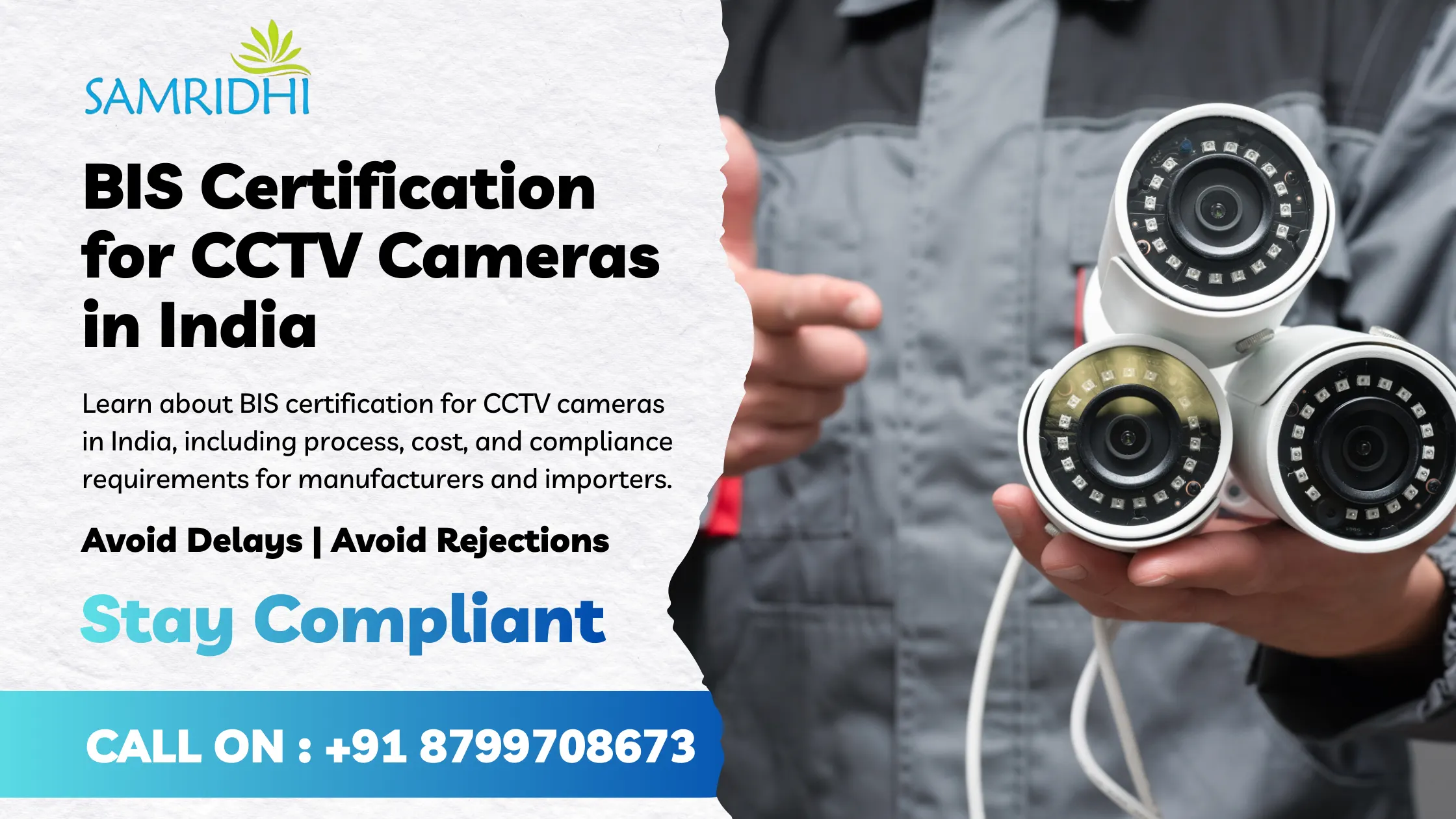
BIS certification for CCTV cameras is a mandatory compliance requirement in India for surveillance and security products that fall under notified electronic categories. Issued by the Bureau of Indian Standards, this certification ensures that CCTV cameras meet prescribed Indian quality, safety, and performance standards before they are manufactured, imported, or sold in the Indian market. With increasing concerns around security, data protection, and product reliability, BIS certification has become a critical regulatory checkpoint for CCTV manufacturers, importers, and brand owners.
What Is BIS Certification for CCTV Cameras and Why Is It Important? ✅
BIS certification for CCTV cameras is part of India’s broader product conformity framework designed to protect consumers and ensure reliable electronic products. Under this system, CCTV cameras must comply with applicable Indian Standards and be registered before market entry.
Who Needs BIS Certification for CCTV Cameras?
-
Indian manufacturers producing CCTV cameras
-
Importers bringing CCTV cameras into India
-
Foreign manufacturers supplying CCTV products to India
-
Brand owners selling CCTV cameras under their own label
For all these stakeholders, bis product certification is essential to operate legally and avoid enforcement action.
India as a Regulated Business & Manufacturing Market 🏭📈
India is one of the most tightly regulated markets for electronics and security equipment. The government actively monitors compliance to ensure product safety, cybersecurity readiness, and standardization.
Why Compliance Matters
-
Manufacturing: Factories must meet BIS norms to produce bis certified products legally.
-
Imports: Customs authorities verify BIS compliance at ports, making bis registration consultant support critical for importers.
-
Market Access: E-commerce platforms, distributors, and institutional buyers require proof of bis certification.
-
Risk Avoidance: Non-compliance can result in penalties, seizures, and bans under the bis certification mandatory products framework.
Authorities such as BIS, WPC (for wireless modules), TEC (for telecom interfaces), and CPCB (for environmental aspects) collectively enforce compliance, making India a highly regulated market for CCTV products.
Industry & Technology Context: CCTV Cameras 📡🎥
CCTV cameras fall under sensitive electronic and security equipment categories due to their role in surveillance, data capture, and connectivity.
Product-Specific Compliance Needs
-
CCTV cameras must meet safety and performance standards under BIS.
-
Devices with Wi-Fi, RF, or wireless transmission may also require wireless product certification in India from WPC.
-
Power adapters, storage components, and embedded electronics must align with BIS norms.
Because CCTV cameras are often installed in public spaces, offices, and residential areas, certification is critical to ensure reliability, electrical safety, and consumer protection. Only bis certified products are legally allowed for sale in India.
BIS Certification Process for CCTV Cameras 🧾🔍
The bis certification process for CCTV cameras follows a structured compliance pathway.
Step-by-Step Process Overview
-
Product Identification: Confirm whether the CCTV camera model falls under bis certification mandatory products.
-
Standard Mapping: Identify applicable Indian Standards for CCTV cameras.
-
Testing: Product samples are tested at BIS-recognized laboratories.
-
Documentation: Preparation of technical documents, test reports, and declarations.
-
Application Submission: Filing the application through the BIS system.
-
Approval & Registration: Grant of BIS certification upon successful evaluation.
Indicative Timelines
Timelines vary depending on product readiness, testing outcomes, and documentation accuracy. Delays often occur due to incomplete files or incorrect standard selection.
Common Challenges
-
Misclassification of product category
-
Incomplete technical documentation
-
Delays in lab testing
-
Overlooking wireless compliance where applicable
Engaging experienced bis certification consultants helps businesses manage these challenges efficiently.
Cost, Validity & Key Compliance Factors 💰📄
Indicative Cost Components
-
Government application and registration fees
-
Laboratory testing charges
-
Documentation and compliance management
-
Professional consultancy support
The bis certification cost for CCTV cameras depends on model complexity, testing scope, and whether wireless features are included.
Validity & Maintenance
-
BIS certification remains valid as long as compliance is maintained.
-
Any design change, component change, or model update may require amendment or fresh approval.
Penalties for Non-Compliance
Selling or importing CCTV cameras without valid bis certification can lead to:
This makes compliance a high-trust, non-negotiable requirement.
Role of Professional Certification Consultants 🧭📑
The regulatory landscape for CCTV cameras is technical and evolving, making professional guidance essential.
Consultants vs Agents
-
Consultants provide end-to-end compliance strategy, documentation accuracy, and regulatory interpretation.
-
Agents often focus only on submission, increasing the risk of rejection or delays.
Why Expert Support Matters
-
Accurate classification under bis certification mandatory products
-
Proper coordination of testing and documentation
-
Managing overlaps between BIS and wireless product certification in India
-
Faster resolution of queries raised by authorities
Working with experienced bis registration consultant teams reduces risk and ensures smooth approvals.
In this context, Samridhi Compliance Certification supports manufacturers and importers with structured guidance across testing, documentation, application filing, and post-approval compliance—helping businesses stay focused on growth while remaining compliant.
Recent & Trending Compliance Updates for CCTV Cameras 📊📡
-
Expansion of Mandatory Product Lists: More electronic and surveillance products are being added under compulsory BIS certification.
-
Stricter Import Enforcement: Increased checks on imported CCTV cameras for valid bis product certification.
-
Wireless Compliance Integration: Greater scrutiny of Wi-Fi and RF-enabled cameras under wireless product certification in India.
-
Digital Filing & Monitoring: Online portals enable faster tracking but also increase transparency and enforcement.
Staying updated with these trends is essential to avoid sudden compliance disruptions.
Why BIS Certification Is Critical for CCTV Businesses ✅
For CCTV camera manufacturers and importers, bis certification for CCTV cameras is not just a legal formality—it is a strategic business requirement. Certified products gain:
Businesses that plan compliance early and work with reliable bis certification consultants are better positioned to scale operations and compete in India’s security technology market.
BIS certification for CCTV cameras is a cornerstone of India’s electronics and security compliance framework. It ensures product safety, quality, and regulatory acceptance while protecting consumers and businesses alike. As enforcement becomes stricter and more products fall under bis certification mandatory products, timely and accurate compliance is essential.
By understanding the bis certification process, managing bis certification cost effectively, and ensuring complete bis product certification, manufacturers and importers can turn compliance into a long-term competitive advantage—supporting sustainable growth in India’s rapidly expanding surveillance and security market.
Get Certified with Confidence – Your One-Stop Compliance Partner
From BIS, WPC, TEC, BEE, EPR, LMPC, CDSCO, FSSAI, ISO, MSME to PESO, NABL testing, Startup India, Make in India, and Lab Setup, we handle all your regulatory approvals, certifications, and documentation needs with precision and speed. Partner with Samridhi Compliance Certification and simplify your journey to full compliance—so you can focus on growing your business.
BIS Certification for CCTV Cameras for Business & Industry Landscape in India
BIS certification for CCTV cameras is a mandatory regulatory requirement in India for surveillance and security products that fall under notified electronic categories. As the use of CCTV cameras increases across residential, commercial, industrial, and public infrastructure projects, the Indian government has strengthened quality and safety regulations to ensure reliable and secure products enter the market. BIS certification ensures that CCTV cameras meet prescribed Indian Standards before they are manufactured, imported, or sold in India.
Business & Industry Landscape in India 📈
The requirement for bis certification for CCTV cameras impacts multiple business segments across India’s growing electronics and security ecosystem.
Manufacturing Units
Domestic manufacturers producing CCTV cameras must comply with BIS norms to legally manufacture and distribute their products. Without bis product certification, manufacturers risk factory-level enforcement, product recalls, and sales restrictions. Certification helps manufacturers align production quality with national safety standards.
Importers & Exporters
Importers bringing CCTV cameras into India must ensure that the products are part of bis certification mandatory products and carry valid approval. Customs authorities frequently verify BIS compliance at ports, making bis registration consultant support critical to avoid shipment delays or rejection.
Electronics & IT Companies
Electronics and IT companies involved in surveillance systems, smart security solutions, and integrated monitoring platforms rely on bis certified products to meet regulatory and buyer expectations. BIS certification supports smooth integration of CCTV cameras into larger IT and security solutions.
Startups & MSMEs
For startups and MSMEs, early compliance with bis certification prevents costly redesigns and re-testing. BIS approval enables smaller businesses to participate in organized supply chains, government tenders, and enterprise security projects.
Foreign Manufacturers Supplying to India
Foreign manufacturers exporting CCTV cameras to India must also comply with BIS requirements. Global certifications alone are not sufficient—Indian market entry requires bis certification for CCTV cameras to ensure local regulatory acceptance.
Key Business & Industrial Locations Driving Compliance 🏗️🚢
The demand for bis certification for CCTV cameras is higher in regions with concentrated electronics manufacturing and import activity.
Manufacturing Clusters
Electronics manufacturing clusters face frequent inspections and quality checks. Businesses operating here must maintain valid bis product certification to ensure uninterrupted production and distribution.
Electronics & Technology Hubs
Technology-focused regions generate consistent demand for bis certified products, especially CCTV cameras used in smart cities, offices, data centers, and public surveillance projects.
Ports, SEZs, and Logistics Zones
Ports and SEZs are key enforcement points where BIS compliance is verified for imported CCTV cameras. Import-heavy zones experience higher scrutiny under the bis certification process, making compliance essential for predictable logistics.
These locations highlight how regulatory demand is driven by business volume and risk exposure rather than geography alone.
Future Growth Potential & Regulatory Expansion 📊✅
The future scope of bis certification for CCTV cameras in India is expanding due to evolving security and compliance priorities.
Increasing Enforcement
Authorities are strengthening checks on electronics and surveillance products. Non-compliance with bis certification mandatory products is more likely to result in penalties, seizures, and sales bans.
Expansion of Regulated Product Categories
As surveillance technology evolves, more devices and components may be brought under compulsory BIS certification. Businesses that plan bis certification early can adapt faster to regulatory changes.
Focus on Quality, Safety, and Standardization
India’s regulatory direction emphasizes consistent quality, electrical safety, and performance reliability. Bis certified products are increasingly preferred by institutional buyers, government bodies, and large enterprises.
Early compliance helps businesses scale operations, enter new markets, and avoid legal risks that slow growth.
How Professional Compliance Services Support Business Growth 🧭📑
Managing bis certification for CCTV cameras requires technical understanding, documentation accuracy, and coordination with multiple regulatory bodies.
Reducing Approval Delays
Experienced bis certification consultants help businesses identify applicable standards, prepare complete documentation, and manage the bis certification process efficiently, reducing avoidable delays.
Avoiding Rejection Due to Errors
Incorrect product classification or incomplete files are common reasons for rejection. A qualified bis registration consultant ensures accuracy across test reports, declarations, and application submissions.
Managing Testing, Licensing, and Renewals
From coordinating laboratory testing to handling approvals and amendments, professional consultants manage the full lifecycle of bis product certification, including updates when product designs change.
Staying Compliant with Changing Regulations
Regulatory requirements evolve with technology and policy updates. Expert guidance ensures businesses remain compliant with new notifications, expanded bis certification mandatory products, and enforcement trends.
In this context, Samridhi Compliance Certification supports manufacturers and importers with structured, end-to-end compliance services—covering testing coordination, documentation, application filing, and post-approval compliance—allowing businesses to focus on growth with confidence.
Digital & Online Compliance Ecosystem in India 💻📡
India has modernized the compliance framework for electronics, including the bis certification process.
Online Filing and Tracking
Digital portals enable faster application submission, tracking, and communication with authorities, improving transparency across the bis certification lifecycle.
Centralized Regulatory Oversight
Integration across regulatory systems increases traceability and enforcement. Accurate records and valid bis product certification are essential during audits and inspections.
Why Expert Guidance Still Matters
While digital systems simplify submissions, they do not replace regulatory interpretation. Correct standard selection, testing scope, and documentation still require experienced oversight from bis certification consultants.
Why BIS Certification Is a Strategic Advantage for CCTV Businesses 📈
For businesses dealing in surveillance products, bis certification for CCTV cameras is not just a legal requirement—it is a growth enabler. Certified products benefit from:
-
Legal market access
-
Faster acceptance by distributors and buyers
-
Reduced regulatory and operational risk
-
Stronger brand credibility and trust
Companies that invest early in bis certification, understand bis certification cost implications, and follow a structured bis certification process are better positioned to compete in India’s expanding security and surveillance market.
BIS certification for CCTV cameras plays a vital role in India’s electronics and security compliance framework. It ensures product safety, quality, and regulatory acceptance while protecting consumers and businesses alike. As enforcement tightens and more devices fall under bis certification mandatory products, timely and accurate compliance is essential.
By understanding the bis certification process, planning for bis certification cost, and maintaining valid bis product certification, manufacturers and importers can turn compliance into a long-term competitive advantage—supporting sustainable growth in India’s rapidly evolving surveillance and security industry.
BIS Certification for CCTV Cameras - Advantages and Disadvantages
BIS certification for CCTV cameras is a mandatory regulatory requirement in India for surveillance and security products that fall under notified electronic categories. As CCTV cameras are widely used in homes, offices, factories, public places, and government projects, the Indian government has made strict compliance essential to ensure safety, quality, and performance. Following the correct bis certification process helps businesses operate legally, avoid enforcement issues, and build long-term trust in the Indian market.
Advantages of BIS Certification for CCTV Cameras ✅
Obtaining bis certification for CCTV cameras offers clear and practical benefits for businesses involved in manufacturing, importing, or selling surveillance products.
Operate Legally in India
-
CCTV cameras listed under bis certification mandatory products cannot be sold without approval.
-
BIS certification ensures lawful manufacturing, import, and sale across India.
-
Businesses dealing in bis certified products face fewer regulatory objections.
Avoid Penalties, Seizures, and Delays
-
Products without valid bis product certification may be seized or banned from sale.
-
Importers without BIS approval often face customs clearance delays.
-
Completing the bis certification process on time reduces compliance risks.
Build Trust with Customers and Authorities
-
BIS marking signals safety, reliability, and regulatory compliance.
-
Buyers, enterprises, and institutions prefer bis certified products.
-
Authorities treat compliant businesses as lower-risk entities.
Enable Smooth Imports, Manufacturing, and Sales
-
Manufacturers can plan production confidently once certification is granted.
-
Importers experience faster clearance with proper documentation.
-
Distributors and marketplaces readily onboard BIS-approved CCTV cameras.
Benefits by Business Type
Manufacturers
-
Legal production of CCTV cameras under bis certification
-
Reduced inspection-related disruptions
-
Stronger acceptance in organized supply chains
Importers
-
Faster customs clearance with valid bis product certification
-
Lower risk of shipment rejection
-
Predictable logistics and delivery timelines
Startups & MSMEs
-
Early compliance avoids redesign and re-testing costs
-
Easier entry into government and enterprise projects
-
Better investor and partner confidence
Foreign Companies Entering India
-
Smooth market entry with bis certification for CCTV cameras
-
Compliance even when global certifications exist
-
Reduced regulatory and legal exposure
Disadvantages of NOT Using BIS Certification for CCTV Cameras ⚠️
Failing to comply with bis certification for CCTV cameras can seriously impact business operations.
Legal Penalties and Notices
Import Clearance Issues
Product Seizures or Sales Bans
Business Reputation Damage
-
Loss of trust among buyers, partners, and distributors.
-
Negative impact on brand credibility in a competitive market.
Financial and Operational Losses
-
Costs related to re-testing, re-application, and unsold inventory.
-
Missed sales opportunities and delayed market entry.
These risks often outweigh the bis certification cost, making compliance the safer business choice.
Compliance vs Non-Compliance: Quick Comparison 📊
| Benefits of Compliance / Certification |
Drawbacks of Non-Compliance |
| Legal sale of CCTV cameras in India |
Penalties and legal notices |
| Faster imports with bis product certification |
Customs delays or rejection |
| Strong trust with buyers and authorities |
Reputation damage |
| Smooth manufacturing and sales |
Product seizures or bans |
| Long-term business stability |
Financial and operational losses |
This comparison clearly highlights why following the bis certification process is essential for CCTV businesses.
Why Professional Support Matters 🧭📑
The compliance framework for CCTV cameras involves technical standards, testing, and detailed documentation. Even small errors can delay or block approval.
Role of BIS Certification Consultants
-
bis certification consultants help identify applicable standards and documentation needs.
-
A skilled bis registration consultant ensures error-free application submission.
-
Experts manage testing coordination and respond to regulatory queries efficiently.
Professional support reduces approval timelines, avoids rejections, and ensures smooth handling of amendments or renewals under the bis certification process.
In this context, Samridhi Compliance Certification assists manufacturers and importers with structured guidance across testing, documentation, application filing, and post-approval compliance—helping businesses remain compliant while focusing on growth.
BIS certification for CCTV cameras is a critical requirement for businesses operating in India’s security and surveillance market. It ensures legal operations, protects against penalties and seizures, and builds trust with customers and regulators. While non-compliance can lead to serious financial and reputational damage, timely certification provides stability, credibility, and long-term growth opportunities.
By understanding the bis certification process, managing bis certification cost effectively, and working with experienced bis certification consultants, businesses can turn regulatory compliance into a strategic advantage and confidently expand in India’s rapidly growing CCTV and security sector.
Why BIS Certification for CCTV Cameras Is Important for Businesses ⚖️📄📈
BIS certification for CCTV cameras has become a critical compliance requirement for businesses operating in or entering the Indian security and surveillance market. With the rapid adoption of CCTV cameras across homes, offices, factories, public infrastructure, and smart city projects, the Indian government has strengthened regulations to ensure safety, quality, and standardization. BIS certification is no longer just a regulatory formality—it is a key factor that determines whether a business can legally operate, scale, and build trust in India.
Importance of BIS Certification for CCTV Cameras for Businesses ✅
Operate Legally in India
CCTV cameras fall under bis certification mandatory products notified by the government. This means manufacturers, importers, and brand owners cannot legally manufacture, import, or sell CCTV cameras without valid bis certification. Businesses that comply with the bis certification process gain lawful market access and avoid regulatory interruptions that can halt operations.
Meet Indian Quality, Safety, and Regulatory Standards
The primary goal of bis product certification is to ensure that CCTV cameras meet Indian standards for electrical safety, performance, and reliability. Bis certified products are tested and evaluated against defined benchmarks, helping businesses demonstrate compliance with national quality requirements. This is especially important for surveillance products that operate continuously and are installed in sensitive locations.
Avoid Penalties, Seizures, and Operational Delays
Non-compliance with bis certification for CCTV cameras can result in customs detention, product seizures, monetary penalties, and sales bans. Importers often face shipment delays if BIS approval is missing or incomplete. By following the correct bis certification process, businesses can avoid costly disruptions and ensure predictable supply chains.
Build Long-Term Brand Trust
In a competitive security market, trust is a major differentiator. Customers, distributors, and institutional buyers prefer bis certified products because certification signals safety, reliability, and regulatory compliance. Over time, BIS certification helps businesses build credibility with regulators, partners, and end users—supporting long-term brand growth.
India’s Growing Regulatory & Compliance Landscape 📈🇮🇳
India’s manufacturing and import ecosystem is expanding rapidly, particularly in electronics and security equipment. Alongside this growth, the government has increased its focus on:
-
Product quality to protect consumers
-
Consumer safety in electronic and surveillance devices
-
Standardization and traceability across supply chains
As enforcement becomes stricter, the risks of non-compliance are rising. Authorities now rely on digital systems, port-level checks, and market surveillance to verify bis certification mandatory products. Businesses that delay bis certification for CCTV cameras face a higher likelihood of penalties, seizures, and reputational damage. Early compliance is becoming a strategic necessity rather than a reactive measure.
Business Impact Across Industries 🏭📡
Electronics & IT Manufacturers (CRS, BIS)
Electronics and IT manufacturers producing surveillance equipment must align with multiple regulatory frameworks. While some products fall under CRS, CCTV cameras often require bis certification to ensure safety and performance. Proper bis product certification enables manufacturers to plan production, testing, and launches without regulatory uncertainty.
Mobile Phones and Wireless Devices (BIS + WPC)
Although mobile phones follow CRS and WPC requirements, many CCTV cameras include wireless modules. Compliance with bis certification for CCTV cameras ensures that the core device meets safety standards, while supporting certifications address connectivity. Together, these approvals enable seamless market entry and integration.
Importers and Foreign Manufacturers (FMCS)
Foreign manufacturers exporting CCTV cameras to India must meet local regulations regardless of global certifications. Importers rely on valid bis certified products to clear customs smoothly. BIS compliance enables foreign brands to establish credibility and scale operations in the Indian market.
Startups & MSMEs Entering Regulated Sectors
For startups and MSMEs, early compliance with the bis certification process can be a growth enabler. Certification allows smaller businesses to participate in government tenders, enterprise security projects, and organized retail channels—opening doors that are otherwise inaccessible without BIS approval.
Across these industries, BIS certification directly supports market access, scalability, and credibility.
Role of Professional Compliance Consultants 🧭📑
Despite the availability of online portals, obtaining bis certification for CCTV cameras remains a technical and documentation-heavy process.
Why Expert Guidance Is Crucial
-
Online systems do not interpret standards or product scope.
-
Incorrect classification can delay or block approval.
-
Errors in documentation increase rejection risk and cost.
How Consultants Support Businesses
-
Correct documentation: Preparing accurate technical files and declarations
-
Testing coordination: Managing lab testing and compliance evidence
-
Timely approvals: Reducing delays during the bis certification process
-
Ongoing compliance: Handling amendments, renewals, and surveillance
Experienced bis certification consultants and a qualified bis registration consultant act as risk reducers, helping businesses avoid mistakes that lead to delays or penalties. Their role extends beyond application filing to long-term compliance management.
In this context, Samridhi Compliance Certification supports manufacturers and importers with structured, end-to-end guidance—covering testing coordination, documentation accuracy, application filing, and post-approval compliance—so businesses can focus on growth while remaining compliant.
Why BIS Certification Is Non-Negotiable for CCTV Businesses ⚠️➡️✅
As surveillance technology becomes more widespread, regulatory scrutiny is increasing. Bis certification for CCTV cameras ensures that products entering the Indian market are safe, reliable, and traceable. Businesses that invest early in compliance benefit from:
-
Legal certainty and uninterrupted operations
-
Faster acceptance by buyers and distributors
-
Reduced regulatory and financial risk
-
Stronger long-term brand trust
While bis certification cost is often viewed as an expense, non-compliance can result in far greater financial and reputational losses.
BIS certification for CCTV cameras is a critical requirement for businesses operating in India’s rapidly growing security and surveillance sector. It enables legal operations, ensures compliance with Indian quality and safety standards, and protects businesses from penalties, seizures, and delays. As enforcement tightens and more products fall under bis certification mandatory products, timely and accurate compliance is essential.
By understanding the bis certification process, managing bis certification cost effectively, and ensuring complete bis product certification, businesses can turn compliance into a strategic advantage—building trust, supporting scalability, and achieving sustainable growth in the Indian market.
Get Certified with Confidence – Your One-Stop Compliance Partner
From BIS, WPC, TEC, BEE, EPR, LMPC, CDSCO, FSSAI, ISO, MSME to PESO, NABL testing, Startup India, Make in India, and Lab Setup, we handle all your regulatory approvals, certifications, and documentation needs with precision and speed. Partner with Samridhi Compliance Certification and simplify your journey to full compliance—so you can focus on growing your business.
Frequently Asked Questions
Yes, BIS certification for CCTV cameras is mandatory in India as these products are included under BIS certification mandatory products. Manufacturers, importers, and foreign brands must ensure their CCTV cameras meet Indian safety and quality standards before sale. Without bis certification, products can face import restrictions, penalties, or market withdrawal, making compliance essential for legal operations.
Both manufacturers and importers require bis certification for CCTV cameras. Indian manufacturers must obtain approval before production and sale, while importers and foreign manufacturers must ensure their products are registered as bis certified products. A qualified bis registration consultant can help identify the correct certification route and manage documentation to avoid delays or rejection.
The bis certification process for CCTV cameras involves product testing at a BIS-recognized lab, preparation of technical documents, online application submission, and approval by authorities. Once granted, bis product certification allows legal sale and import. Working with experienced bis certification consultants helps streamline testing coordination, documentation accuracy, and approval timelines.
The bis certification cost for CCTV cameras depends on several factors, including product type, testing requirements, government fees, and consultancy support. Costs may vary for manufacturers and importers. Although certification involves an upfront investment, obtaining bis certification helps avoid penalties, shipment delays, and losses caused by non-compliance in the long run.
Selling CCTV cameras without bis certification for CCTV cameras can lead to serious consequences, including customs seizures, fines, product bans, and reputational damage. Non-compliant products are often removed during market surveillance. Ensuring timely bis product certification protects businesses from legal risks and supports sustainable growth in India’s regulated electronics market.


 Grab Your Certified Now
 +91 8799708673
 WhatsApp