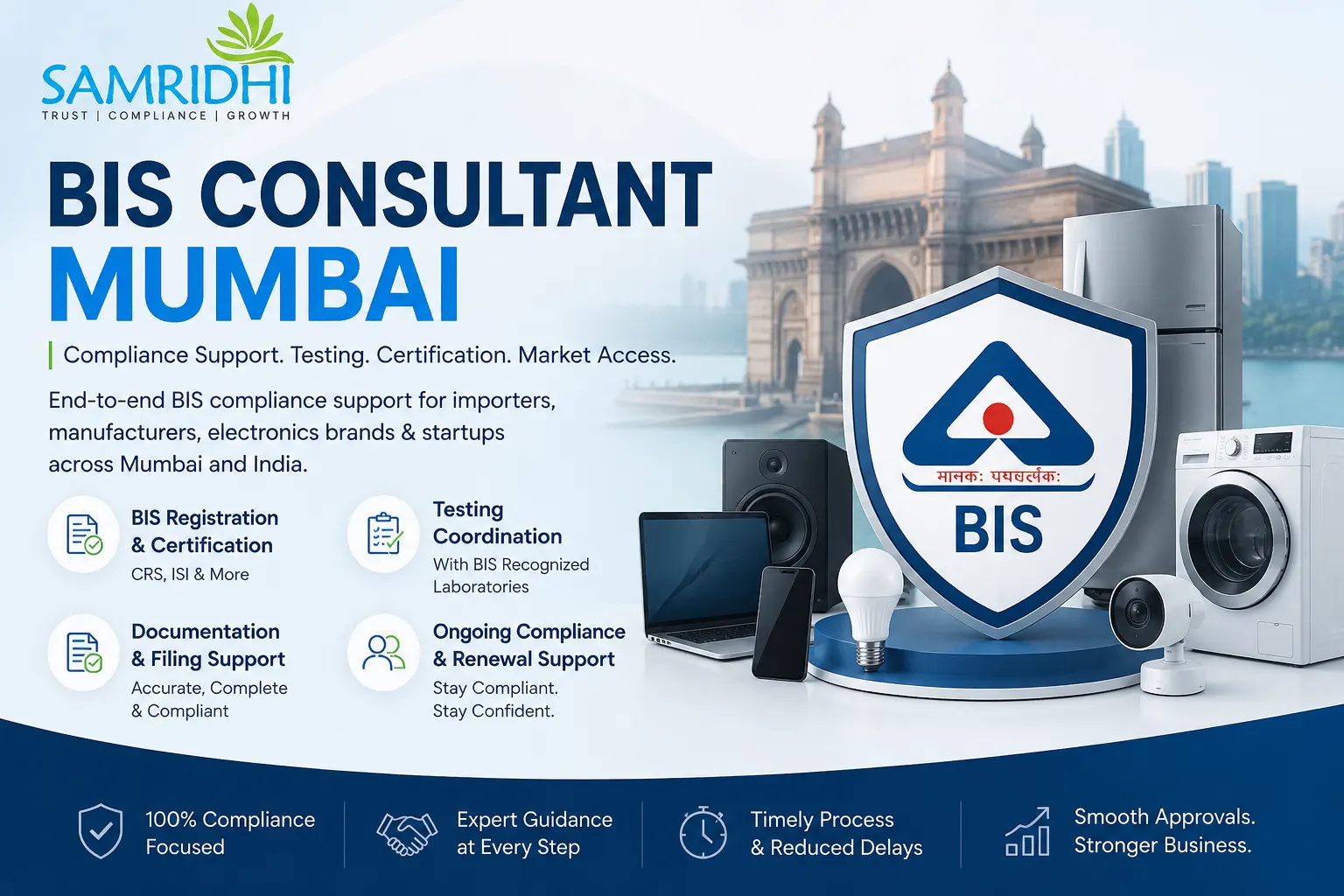
 Get Certified with Confidence – Your One-Stop Compliance Partner
From BIS, WPC, TEC, BEE, EPR, LMPC, CDSCO, FSSAI, ISO, MSME to PESO, NABL testing, Startup India, Make in India, and Lab Setup, we handle all your regulatory approvals, certifications, and documentation needs with precision and speed. Partner with Samridhi Compliance Certification and simplify your journey to full compliance—so you can focus on growing your business.
BIS Scheme X Certification in India – Why Compliance Delays Are Becoming Costly
Products today don’t fail in India because they lack demand. They fail because they get stuck—at customs, during audits, or just before launch—due to missing or misunderstood compliance. This is where BIS Scheme X certification enters the conversation, usually later than it should.
The fear businesses carry is very real. Launch dates slip without clear explanations. Shipments remain on hold despite paperwork “looking complete.” Legal exposure quietly increases while teams wait for clarity. Under India’s evolving bis registration framework, these risks aren’t edge cases anymore—they’re becoming routine for businesses that rely on assumptions.
Regulatory tightening has changed the ground rules.
Over the past few years, BIS has moved away from passive approvals toward active enforcement. Audits are more frequent. Post-market surveillance has expanded. Certifications are no longer viewed as static permissions but as living compliance obligations. In this environment, what is BIS Scheme X and who needs it is no longer a theoretical question—it directly affects whether products can legally enter or remain in the market.
Many companies first encounter BIS alternative compliance Scheme X when their existing approval path stops working. Products that don’t neatly fit traditional schemes, or businesses operating in newer or transitional categories, often find themselves redirected toward Scheme X with little warning. Without early understanding, this redirection feels abrupt and disruptive.
This is where early trust matters.
Clarity around Scheme X BIS requirements India, how authorities interpret scope, and where documentation or testing expectations differ from legacy routes changes everything. Businesses that understand these decision points plan differently. They stop rushing submissions. They start sequencing compliance alongside product readiness.
At Samridhi Compliance Certification, early discussions around Scheme X usually focus on context, not shortcuts. Which products are better suited for Scheme X? Where does it differ from FMCS? How does it interact with approvals like BEE Star Rating Certification, WPC ETA Certification, or TEC / MTCTE Certification depending on product functionality? These questions shape realistic planning, not marketing promises.
There are no guaranteed approvals. Timelines always depend on product scope, authority interpretation, and documentation quality. Outcomes vary by product and compliance maturity. But when businesses treat BIS Scheme X certification as a strategic compliance route—rather than a last-minute alternative—the fear of delays, penalties, and import holds reduces sharply.
In today’s India market, readiness isn’t enough.
Regulatory fit is what decides whether a product moves forward or stops cold.
Why Businesses Struggle With BIS Scheme X Certification Despite Being Market-Ready
Most manufacturers and importers don’t struggle with BIS Scheme X certification because they ignore compliance. They struggle because the compliance path itself isn’t obvious—especially when products don’t fit neatly into traditional BIS routes. Scheme X often appears mid-journey, not at the planning stage, which is where the real problem begins.
From the outside, bis registration still looks linear: identify the scheme, test the product, submit documents, get approval. Inside the system, it rarely works that way. Scheme X sits in the grey zone—used when standard schemes don’t fully apply, or when product scope, usage, or technology doesn’t align cleanly with existing categories. That ambiguity is what trips businesses up.
The Mistakes That Quietly Trigger Delays
These errors aren’t dramatic. They’re subtle—and expensive.
-
Wrong product category selection
Many applicants assume Scheme X is a fallback option. It isn’t. Misunderstanding what is BIS Scheme X and who needs it leads to filing under the wrong scope, which triggers objections later rather than outright rejection.
-
Incomplete or misaligned test reports
Test reports may exist, but they often don’t reflect the exact parameters expected under Scheme X BIS requirements India. Missing clauses, outdated standards, or reports prepared for a different scheme stall review cycles.
-
Wrong laboratory selection
Not all labs are accepted for all evaluation paths. Using a lab aligned with another BIS scheme—or international standards—creates re-testing requirements that applicants didn’t plan for.
-
Timeline misjudgment
Businesses often plan launches assuming approval will align with commercial schedules. Under BIS alternative compliance Scheme X, timelines are indicative and depend on authority interpretation, documentation quality, and clarification rounds.
Each mistake feels manageable in isolation. Together, they create cascading delays.
The Practical Impact Businesses Feel Too Late
When Scheme X issues surface late, the impact spreads beyond compliance teams:
-
Shipments held or delayed because approval status is unclear
-
Financial penalties or demurrage under tightening bis registration enforcement
-
Forced relaunches due to re-labeling or documentation corrections
-
Lost distributor trust when promised timelines quietly collapse
One common pattern appears again and again. A product is technically ready. Demand exists. But certification clarity is missing. Distributors hesitate. Importers pause. The cost isn’t just money—it’s credibility.
This is why confusion around Scheme X application steps and documents causes more damage than rejection itself. Rejection is visible. Uncertainty isn’t—and it lingers.
Scheme X isn’t broken.
It’s misunderstood.
And until businesses treat BIS Scheme X certification as a decision-driven compliance route—rather than a backup option—the same problems repeat, launch after launch.
Get Certified with Confidence – Your One-Stop Compliance Partner
From BIS, WPC, TEC, BEE, EPR, LMPC, CDSCO, FSSAI, ISO, MSME to PESO, NABL testing, Startup India, Make in India, and Lab Setup, we handle all your regulatory approvals, certifications, and documentation needs with precision and speed. Partner with Samridhi Compliance Certification and simplify your journey to full compliance—so you can focus on growing your business.
Industry Reality Behind BIS Scheme X Certification in Today’s Compliance Landscape
The compliance environment in India has shifted—subtly, but decisively. BIS Scheme X certification exists precisely because the market no longer fits neatly into legacy approval boxes. New product categories, evolving technologies, and mixed-use applications have forced regulators to tighten interpretation rather than loosen standards.
What many businesses feel today isn’t confusion. It’s friction from increased precision.
Under the broader bis registration framework, authorities are enforcing scope more strictly. Audits are more frequent. Documentation is cross-checked across schemes. Products are evaluated not just on what they are, but on how and where they’re used. This is why Scheme X is appearing more often—not as an exception, but as a necessary route when traditional schemes fall short.
And the rules don’t stay still.
Regulatory Updates Are Constant and Interconnected
BIS standards are revised regularly. Product coverage expands. Interpretations evolve. At the same time, authorities like WPC and TEC continue updating their own requirements. A product assessed one way last year may now trigger different expectations under Scheme X BIS requirements India.
This is where overlap becomes visible. A product that doesn’t cleanly qualify under FMCS may still require Scheme X evaluation, while also touching WPC ETA Certification or TEC / MTCTE Certification depending on wireless or telecom functionality. Treating each authority in isolation often leads to contradictions during review.
Earlier approaches don’t always survive current scrutiny.
How Most Consultants Actually Operate
This is where industry practice quietly creates problems.
Many bis consultants still operate on:
-
Checklist-based execution – collect documents, submit, wait
-
Authority-specific silos – BIS handled separately, WPC separately, TEC separately
This model assumes certainty where none exists. It assumes eligibility before scope is confirmed. It assumes testing will pass before parameters are validated. It assumes approval is linear.
Under BIS alternative compliance Scheme X, those assumptions break quickly.
What Clients Are Rarely Told Upfront
There are a few truths businesses usually encounter only after resistance appears:
-
Not all products qualify for Scheme X, even if they don’t fit other schemes
-
Testing failures are common, especially when products sit between categories
-
Approvals are iterative, not linear—queries, clarifications, and reinterpretations are normal
Scheme X is not a shortcut. It’s a controlled evaluation path for products that require closer scrutiny. Timelines remain indicative. Outcomes depend on authority interpretation, testing alignment, and how well documentation reflects actual use cases.
The system isn’t unpredictable.
It’s selective.
Businesses that accept this reality plan compliance as part of product strategy. Those who don’t often discover—too late—that approval isn’t about submitting faster, but about aligning better.
That’s the industry reality behind BIS Scheme X certification today.
Practical Solutions and Use Cases That Actually Work Under BIS Scheme X Certification
Most problems with BIS Scheme X certification don’t come from lack of intent. They come from choosing the wrong compliance path too early—or worse, choosing one without understanding why it applies. Scheme X works best when it’s treated as a deliberate evaluation route, not a fallback when other options fail.
Before breaking this into methods, one reality needs to be clear: Scheme X rewards clarity. Not speed. Not volume. Just alignment between product reality and regulatory expectation.
Practical Certification Approaches That Reduce Scheme X Friction
The following approaches consistently reduce uncertainty under BIS alternative compliance Scheme X, not because they guarantee outcomes, but because they remove avoidable missteps.
-
Product-first analysis
Everything starts with how the product is actually used—not how it’s marketed. Functional scope, operating environment, user exposure, and component behavior are assessed before assuming eligibility. This is often where confusion around what is BIS Scheme X and who needs it finally gets resolved.
-
Correct standard identification
Scheme X does not mean “no standard.” It means closer interpretation. Identifying the right benchmark—sometimes by exclusion rather than inclusion—prevents repeated objections under Scheme X BIS requirements India.
-
Testing and documentation alignment
Test reports, declarations, and technical files must describe the same product in the same language. Misalignment here is the most common reason Scheme X application steps and documents enter clarification loops.
-
Authority coordination
Products evaluated under Scheme X often overlap with WPC ETA Certification, TEC / MTCTE Certification, or BEE Star Rating Certification. Coordinating authority expectations avoids contradictory submissions that slow reviews.
None of these approaches promise faster approvals. They reduce reversals—and that’s more valuable.
Who Each Approach Works Best For
Different businesses experience Scheme X very differently.
Indian manufacturers benefit from early scope clarity, especially when products sit between traditional categories. Importers gain control by confirming whether Scheme X applies before shipment planning under broader bis registration requirements. OEMs exporting variants need disciplined mapping to avoid duplicative testing.
Startups often struggle because they build first and interpret later. Scheme X penalizes that sequence. Established brands face a different issue—legacy assumptions that no longer align with current interpretations. Both need restraint more than acceleration.
Real-World Use Cases That Reflect Scheme X Reality
In one case, a product stalled because it was pushed toward a traditional scheme that didn’t truly fit. Testing wasn’t wrong—classification was. A careful reclassification under BIS Scheme X certification realigned expectations. The process restarted, not fast—but clean. Relaunch costs stayed contained.
In another situation, an importer faced a potential customs block due to unclear certification status. Early clarification that Scheme X applied—and adjusting documentation accordingly—resolved the issue before inspection. Costs shifted slightly. Delays were avoided. Distributor confidence stayed intact.
These aren’t dramatic recoveries.
They’re controlled corrections.
And that’s what effective execution under BIS Scheme X certification usually looks like—quiet decisions made early enough to prevent visible problems later.
BIS Scheme X Certification Process in India – How the Evaluation Actually Works
This part matters because BIS Scheme X certification is often perceived as unpredictable. Businesses worry about unclear steps, shifting requirements, and delays that appear without warning. That anxiety usually comes from not knowing where decisions are made and why progress slows.
Scheme X is not chaotic. It’s selective.
Unlike traditional routes, BIS alternative compliance Scheme X works as an evaluation-driven process. Each stage introduces checkpoints where outcomes depend on how clearly the product fits regulatory intent, not how fast documents are submitted.
Product Applicability Assessment Is the First Decision Gate
Before applications or labs, authorities look at one core question:
Does the product genuinely require Scheme X?
This assessment examines product function, usage environment, exposure risk, and why standard schemes may not apply. Many delays happen because businesses assume Scheme X is a default option, without first confirming what is BIS Scheme X and who needs it.
If applicability isn’t justified clearly, the process stalls early.
Standard Identification Sets the Evaluation Lens
Scheme X does not mean “no standard.” It means interpretation.
At this stage, BIS determines which Indian Standard—or reference framework—best evaluates the product. Sometimes this is based on exclusion rather than direct inclusion. Choosing the wrong benchmark leads to repeated clarifications under Scheme X BIS requirements India.
This step shapes:
Getting this right reduces friction later.
Testing and Laboratory Coordination Becomes a Control Point
Testing under Scheme X is purpose-driven. Labs must be appropriate for the evaluation scope, not just technically capable.
Test samples must reflect real-use conditions. Reports must answer the regulatory question being asked—not just list parameters. This is why Scheme X application steps and documents often slow here: alignment matters more than speed.
Testing outcomes influence next steps, not finality. Adjustments are common.
Documentation Preparation Is Where Most Uncertainty Builds
This stage connects everything.
Technical files, test reports, declarations, usage explanations, and risk justifications must be internally consistent. Any contradiction triggers clarification cycles. Documentation here is not administrative—it’s interpretive.
This is also where overlap with bis registration under other schemes may surface, requiring alignment to avoid conflicting positions.
Authority Submission, Review, and Clarifications
After submission, BIS reviews coherence, not urgency.
Clarifications are normal. Follow-up questions are expected. Responses must be precise and evidence-based. Vague explanations extend cycles; clear justification closes them.
Approval, when issued, reflects cumulative alignment across applicability, testing, and documentation—not submission speed.
There are no promised timelines.
There are no guaranteed outcomes.
But when businesses treat BIS Scheme X certification as a sequence of informed decisions—rather than a procedural shortcut—uncertainty reduces, and control replaces guesswork.
Cost of BIS Scheme X Certification in India – What Businesses Should Expect Realistically
Cost is often the point where interest quietly turns into hesitation. Not because BIS Scheme X certification is prohibitively expensive, but because pricing feels uncertain until the process is already in motion. That uncertainty blocks decisions, delays launches, and creates unnecessary back-and-forth.
Transparency helps—but only when it’s honest.
There is no fixed or universal fee for BIS Scheme X certification. All costs are indicative and depend on the product category, evaluation scope, testing depth, and how smoothly documentation and reviews progress. Any number quoted without understanding the product first is incomplete by default.
Indicative Cost Structure for BIS Scheme X Certification
| Cost Component |
Approximate Range |
| Testing Fees |
Depends on product & standard |
| Government Fees |
As per authority |
| Documentation & Processing |
Varies by scope |
| Total Estimated Cost |
Case-specific |
This structure reflects how bis registration under Scheme X actually works. Government fees are defined by BIS, but the real variability sits around testing, interpretation effort, and clarification cycles.
What Actually Influences the Overall Cost
The first major factor is product category. Scheme X is typically used where products don’t align cleanly with traditional schemes. That alone increases evaluation effort. A relatively simple product assessed under Scheme X will cost very differently from a complex or hybrid-use product. Costs vary by product, not by business size.
The second factor is testing complexity. Testing under Scheme X is not always standardised. Parameters are often selected based on risk, usage conditions, and regulatory intent. This means testing scope can expand during review, especially if initial reports don’t fully address authority concerns.
Third, re-testing is the most underestimated variable. If test results don’t align with declared use cases, or if documentation raises new technical questions, additional testing may be required. This doesn’t signal failure—it reflects refinement—but it does increase expenses and extend effort.
Documentation depth also shapes cost. Under Scheme X BIS requirements India, explanatory justifications, usage narratives, and technical clarifications require more time than checklist-based schemes. Gaps here don’t just slow reviews; they increase processing effort indirectly.
Costs may also intersect with parallel approvals. Products that later require BEE Star Rating Certification, WPC ETA Certification, or TEC / MTCTE Certification can see costs rise or streamline depending on how well compliance planning is coordinated.
There’s no honest way to promise a fixed figure upfront.
But understanding what drives cost allows businesses to plan with clarity—before uncertainty becomes expensive.
Products Covered Under BIS Scheme X Certification in India
This is usually the first practical question businesses ask—sometimes silently, sometimes urgently:
“Does my product actually fall under BIS Scheme X certification?”
It’s a high-intent checkpoint. If the product doesn’t qualify, pursuing Scheme X wastes time and money. If it does, delaying the decision increases exposure to launch blocks, audit objections, or import disruption under bis registration.
What makes this tricky is that Scheme X is not a product list–driven scheme. It exists for products that don’t align cleanly with traditional BIS schemes, either because of mixed functionality, emerging use cases, or gaps in existing standards. That’s why relevance must be assessed carefully, not assumed.
Product Categories Commonly Evaluated Under Scheme X
| Product Group |
Typical Examples |
| IT & Electronic Products |
Specialized electronic systems, control units, hybrid-use equipment |
| LED Lighting Products |
Non-standard LED configurations, integrated lighting systems |
| Power Adapters & Chargers |
Custom power supplies, adapters with mixed safety profiles |
| Wireless & RF Devices |
Devices with embedded RF modules or atypical usage scenarios |
These categories are often assessed under BIS alternative compliance Scheme X when they don’t fully satisfy eligibility conditions of other schemes, or when product behavior falls between defined regulatory boundaries.
This is where many businesses misjudge early decisions.
For example, two electronic products may look identical in function, yet only one qualifies for Scheme X because of differences in operating environment, user exposure, or integration with other systems. A wireless-enabled product may require Scheme X evaluation while also intersecting with WPC ETA Certification, depending on frequency usage and deployment context.
Variant handling adds another layer. Under Scheme X BIS requirements India, not all variants are automatically covered under a single evaluation. Changes in configuration, power ratings, or application environment may trigger separate assessment—even if the core product remains the same.
A critical note that prevents costly assumptions:
Not all variants qualify. Applicability depends on technical parameters, real-world use conditions, and current regulatory interpretation—not on visual similarity or competitor behavior.
This is why experienced teams confirm scope before discussing Scheme X application steps and documents, cost planning, or launch timelines. Because under BIS Scheme X certification, eligibility is not implied—it’s justified.
For businesses operating in evolving or non-standard product categories, this relevance check isn’t optional.
It’s the decision point that determines whether compliance moves forward—or stalls later when it hurts more.
Benefits and Honest Risks of BIS Scheme X Certification
This is where expectations need to be calibrated properly. BIS Scheme X certification offers real advantages for businesses operating in complex or non-standard product categories—but it also carries limitations that shouldn’t be glossed over. Treating Scheme X as either a shortcut or a risk-free alternative usually leads to disappointment. Treating it as a controlled evaluation path is where it starts to work.
When approached with the right intent, Scheme X becomes a stabilising compliance route rather than a recurring obstacle.
Benefits That Matter in Practice
-
Faster approvals
Not because authorities rush decisions, but because correctly scoped applications face fewer back-and-forth cycles. When the product is genuinely suited for Scheme X and documentation is aligned from the start, reviews move with less friction.
-
Reduced rejection cycles
Clear justification under Scheme X BIS requirements India lowers the chance of being redirected mid-process. Businesses avoid the costly reset that happens when products are pushed between schemes.
-
Compliance confidence
Once clarity is established under BIS Scheme X certification, teams stop second-guessing whether they chose the wrong route. This confidence matters during audits, distributor onboarding, and regulatory queries.
-
Market access stability
Products evaluated correctly under Scheme X face fewer surprise interruptions—whether at customs, during surveillance, or when expanding into new channels. Oversight continues, but uncertainty reduces.
These benefits don’t come from approval alone.
They come from predictability—and predictability is what most businesses actually want.
Risks and Limitations That Cannot Be Ignored
Even with strong preparation, Scheme X carries inherent constraints.
-
Timeline dependency on laboratories
Testing availability, scope adjustments, and report revisions directly affect movement. Timelines always depend on how well testing aligns with evaluation intent.
-
Authority clarifications
Scheme X involves interpretation. Clarifications are normal, not exceptional. Each query pauses momentum until resolved—and vague responses often invite more questions.
-
Product redesign requirements
In some cases, evaluation reveals gaps between declared use and actual design. Minor redesigns or specification changes may be required. This is uncomfortable—but far safer than post-market enforcement.
Earlier, many businesses avoided these realities by fitting products into familiar schemes. Today, that avoidance no longer works.
How Professionals Reduce These Risks Quietly
Experienced teams don’t try to eliminate risk. They reduce exposure.
-
Pre-testing checks
Early technical reviews identify gaps before samples reach labs, lowering the probability of re-testing.
-
Authority-specific documentation planning
Scheme X reviews focus on justification, not checklists. Aligning documentation with how BIS evaluates intent reduces clarification loops.
-
Parallel processing where allowed
While testing progresses, explanatory documentation and supporting compliance work can move alongside—depending on product scope and readiness.
None of this guarantees approval.
No timelines are fixed.
Outcomes always vary by product and regulatory interpretation.
But this approach shifts bis registration under Scheme X from reactive correction to controlled execution—and that shift is what protects businesses from delays that surface when it’s already too late.
How BIS Scheme X Certification Solves the Real Compliance Problem Businesses Face
When businesses search for BIS Scheme X certification, they’re rarely looking for theory. They’re trying to solve a practical problem: How do we move forward without our product getting stuck in regulatory uncertainty? Scheme X exists precisely to address that gap—where traditional routes don’t fit cleanly, but compliance is still mandatory.
What Scheme X offers, when handled correctly, is not speed. It offers direction.
A Step-by-Step Flow That Replaces Guesswork
The BIS alternative compliance Scheme X works best when treated as a sequence of decisions, not a checklist.
-
Product applicability confirmation
The first checkpoint determines whether Scheme X genuinely applies. This involves understanding product function, usage environment, and why standard schemes are unsuitable. Getting this wrong wastes time and increases rejection risk later.
-
Standard or reference framework identification
Even under Scheme X, evaluation needs a benchmark. BIS identifies the most appropriate Indian Standard or reference criteria. This step defines testing depth and documentation expectations under Scheme X BIS requirements India.
-
Testing and lab coordination
Testing is aligned to evaluation intent, not generic parameters. Labs must be suitable for the scope defined. Outcomes here often shape follow-up questions, which is why timelines always depend on technical alignment rather than submission speed.
-
Documentation preparation and internal consistency
Technical files, test reports, usage explanations, and declarations must describe the same product reality. This is where most delays originate—not from missing documents, but from conflicting ones.
-
Authority submission, review, and clarification
BIS review under Scheme X is interpretive. Clarifications are expected. Responses must be precise and evidence-backed. Rushed answers usually extend cycles instead of closing them.
This flow doesn’t eliminate uncertainty—but it contains it.
Documentation Checkpoints That Prevent Backtracking
Certain checkpoints quietly decide whether the process moves forward or stalls:
-
Alignment between declared use cases and test parameters
-
Clear justification for Scheme X applicability
-
Consistency across technical drawings, reports, and declarations
-
Supporting explanations that reflect real-world usage
Missing alignment here doesn’t always trigger rejection. It almost always triggers delay.
Where Authority Interaction Actually Happens
Authority engagement under Scheme X is layered. It occurs:
-
During initial scope review
-
When testing outcomes are evaluated
-
Through clarification rounds that interpret intent rather than format
Each interaction tests coherence. Clear explanations shorten cycles. Ambiguity extends them. That’s why bis registration under Scheme X rewards clarity over volume.
Why Accuracy Matters More Than Speed
Speed feels productive early. Accuracy proves valuable later.
A fast but misaligned Scheme X submission often leads to repeated clarifications, additional testing, or even product adjustments. Slower, accurate execution reduces downstream disruption, protects launch plans, and preserves distributor confidence.
In practice, this is what businesses are really asking when they explore what is BIS Scheme X and who needs it. They’re not seeking a shortcut. They’re seeking a path that holds up under scrutiny.
Scheme X doesn’t simplify compliance.
It makes it navigable—when handled with intent.
Why BIS Scheme X Certification Matters for Businesses Operating in Delhi and Laxmi Nagar
Location doesn’t change BIS rules.
It changes how quickly gaps are noticed—and how little tolerance exists once they are.
For businesses operating from Delhi, especially commercial and compliance-heavy zones like Laxmi Nagar, BIS Scheme X certification carries practical weight. This region isn’t just a marketplace; it’s a coordination hub for manufacturers, importers, compliance teams, and regulatory-facing decision makers. Products routed through Delhi are scrutinised earlier and more frequently under bis registration frameworks.
Why Demand Is Higher in This Region
Delhi functions simultaneously as:
-
A manufacturing coordination base for North India
-
A major import–export decision zone
-
A dense startup ecosystem launching new and hybrid products
Because of this mix, businesses here often deal with products that don’t fit neatly into traditional BIS schemes. That’s exactly where BIS alternative compliance Scheme X becomes relevant. Manufacturers and importers in this region encounter Scheme X earlier in their journey—not because they seek it, but because authorities flag ambiguity faster.
Distributors and institutional buyers based in Delhi also demand clarity upfront. If certification scope isn’t settled, onboarding stalls quietly.
Common Local Compliance Gaps Seen in Practice
Despite high awareness, certain patterns repeat among Delhi-based businesses:
-
Products finalised before confirming what is BIS Scheme X and who needs it
-
Testing initiated under assumed standards that later prove misaligned
-
Documentation prepared generically, not tailored to Scheme X evaluation logic
-
Parallel approvals like WPC ETA Certification or TEC / MTCTE Certification planned too late
These gaps don’t always appear during filing. They surface during audits, distributor due diligence, or clarification rounds—when timelines tighten and costs increase.
Why Delhi Increases the Exposure Factor
Proximity matters.
Delhi’s closeness to BIS offices, recognised laboratories, and enforcement teams means Scheme X evaluations here are rarely superficial. Documentation quality, justification depth, and response clarity are scrutinised more closely.
For startups, one unclear compliance position can delay market entry entirely. For established brands, misalignment can disrupt multi-state distribution plans. In both cases, outcomes depend on how well Scheme X applicability is justified early.
Location Also Shapes Interlinked Compliance Planning
Businesses operating from Delhi rarely stay local. Products move into other states, online marketplaces, and government procurement channels. That’s why Scheme X planning here often intersects with broader state- or city-level compliance strategies and additional certifications.
This is where structured interlinking between related compliance pages becomes operationally relevant—not informational fluff.
Location doesn’t change the standard.
It changes the margin for error.
For businesses in Delhi and Laxmi Nagar, accurate execution of BIS Scheme X certification isn’t just regulatory hygiene. It’s how launch plans stay intact when scrutiny arrives early.
Real Experiences Around BIS Scheme X Certification That Reflect Ground Reality
Most businesses don’t talk about BIS Scheme X certification when everything goes smoothly. They talk about it when something almost went wrong—and didn’t. That’s where real experience lives. Not in approvals, but in avoided damage.
One manufacturer described it plainly:
“The product was ready, distributors were waiting, but approval stalled without a clear reason.”
The issue wasn’t testing failure. It was scope. The product had been pushed toward a familiar BIS route when it actually required BIS alternative compliance Scheme X. Reclassifying early didn’t speed things up—but it stopped the confusion. The delay reduced. The process finally made sense.
Another case involved an importer preparing to land goods while compliance was still being “figured out.” On paper, documents existed. In reality, they weren’t aligned to Scheme X BIS requirements India. A short pause to correct documentation and testing scope clarified authority expectations and avoided a customs hold. No penalty. No relabeling. Just a quieter outcome.
You hear similar reflections repeatedly:
-
“Once we understood what is BIS Scheme X and who needs it, the pressure dropped.”
-
“Clarity mattered more than speed—we stopped chasing timelines.”
-
“We avoided re-testing only because the right questions were asked early.”
There are also trust moments that don’t look impressive on slides—but matter operationally.
In one situation, testing flagged a mismatch between declared use and actual configuration. The product needed a minor adjustment. It wasn’t hidden or reframed. The change increased effort, costs varied by product, but it prevented a post-market notice that would have disrupted distribution entirely.
That’s the pattern experienced teams recognise.
Reduced delay.
Clearer authority communication.
Avoided penalties.
No exaggeration. No guaranteed outcomes.
Just realistic execution under bis registration, where BIS Scheme X certification is treated as an evaluation path—not a shortcut—and problems are handled early, before they become visible, expensive failures.
Where BIS Scheme X Certification Leaves You and What to Do Next
For businesses navigating non-standard or evolving products, BIS Scheme X certification is not an exception—it’s a signal that regulatory expectations have become more precise. When scope is verified early, the evaluation route is justified correctly, testing aligns with real-world use, and documentation explains intent clearly, uncertainty drops. The process remains iterative, and outcomes always depend on authority interpretation, testing alignment, and documentation quality—but it becomes controllable.
What consistently works is accuracy over urgency. Correct classification reduces rework. Aligned testing prevents repeated clarifications. Clear explanations shorten review cycles. While costs and timelines remain indicative and vary by product, informed planning protects launch schedules, distributor confidence, and long-term market access. This matters even more when Scheme X intersects with WPC ETA Certification, TEC / MTCTE Certification, or BEE Star Rating Certification, depending on functionality.
If you’re deciding next steps, begin with relevance. Confirm whether Scheme X genuinely applies to your product, understand Scheme X BIS requirements India, and plan testing and documentation together—before timelines are committed. That early pause often saves months later under bis registration.
For businesses seeking structured guidance without overpromising outcomes, Samridhi Compliance Certification supports product-first assessment, Scheme X–aligned documentation, authority coordination, and review-ready preparation. To discuss your product scope or compliance direction, call +91 8799708673 or write to info.samcc@gmail.com. Results will always depend on technical and regulatory realities—but clarity can begin now.
Get Certified with Confidence – Your One-Stop Compliance Partner
From BIS, WPC, TEC, BEE, EPR, LMPC, CDSCO, FSSAI, ISO, MSME to PESO, NABL testing, Startup India, Make in India, and Lab Setup, we handle all your regulatory approvals, certifications, and documentation needs with precision and speed. Partner with Samridhi Compliance Certification and simplify your journey to full compliance—so you can focus on growing your business.


 Grab Your Certified Now
 +91 8799708673
 WhatsApp