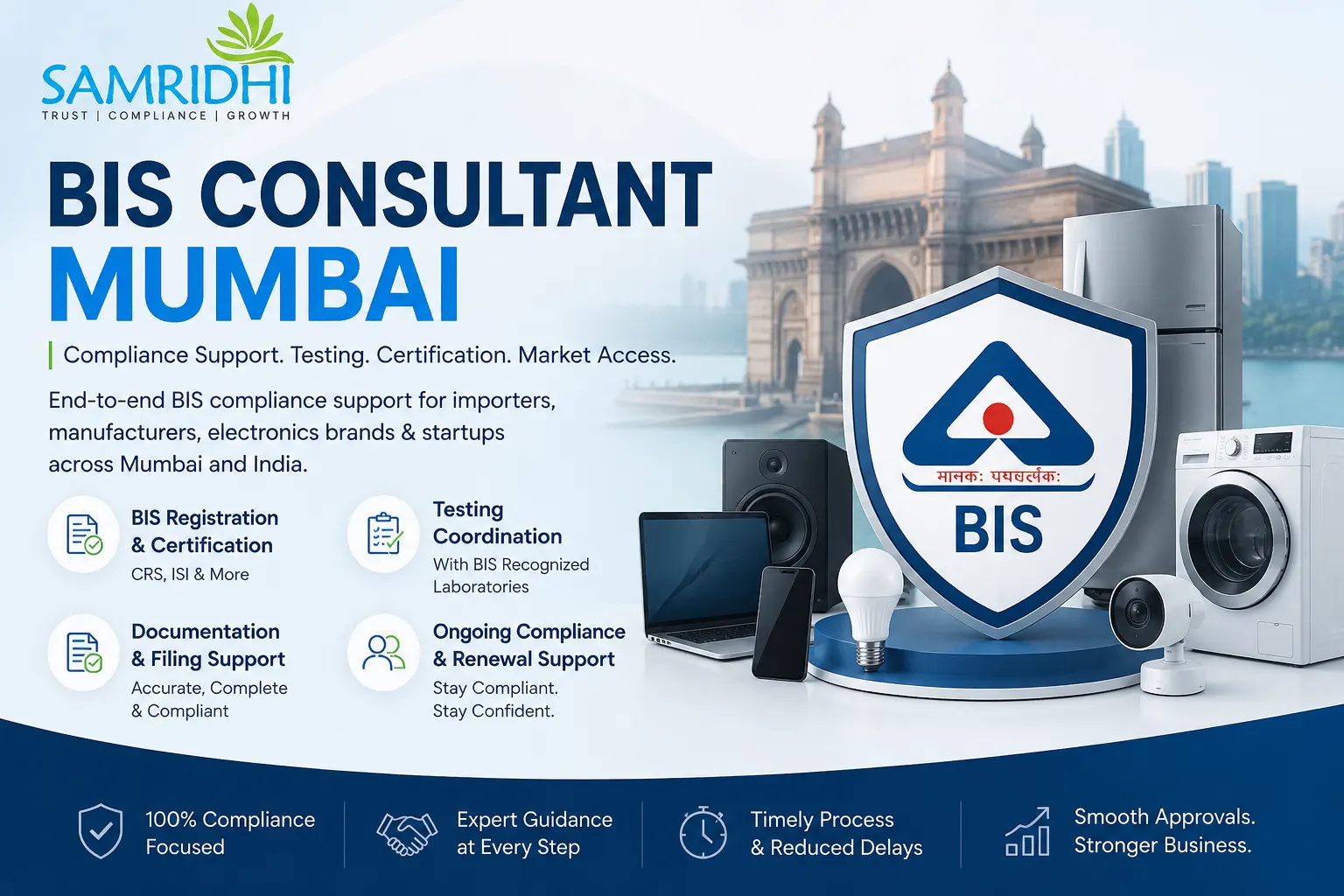
BIS Certification for Battery Import in India - Ensure legal imports, safety compliance, and smooth market entry.
BIS certification for battery import is a mandatory regulatory process that ensures batteries, power banks, and lithium-ion products meet Indian safety and quality standards before entering the market. It applies to manufacturers, importers, MSMEs, and foreign suppliers, helping businesses avoid penalties, ensure smooth customs clearance, and build market trust. With expert-managed compliance, companies can reduce approval delays, manage testing efficiently, and stay aligned with evolving Indian regulations. For professional assistance and end-to-end compliance support, contact +91 8799708673.
 Get Certified with Confidence – Your One-Stop Compliance Partner
From BIS, WPC, TEC, BEE, EPR, LMPC, CDSCO, FSSAI, ISO, MSME to PESO, NABL testing, Startup India, Make in India, and Lab Setup, we handle all your regulatory approvals, certifications, and documentation needs with precision and speed. Partner with Samridhi Compliance Certification and simplify your journey to full compliance—so you can focus on growing your business.
BIS Certification for Batteries 📄⚖️
BIS Certification for Batteries is a mandatory regulatory requirement in India that ensures batteries sold, manufactured, or imported into the country meet defined safety, quality, and performance standards. Batteries are widely used in everyday products such as mobile phones, laptops, power banks, electric vehicles, medical equipment, and industrial systems. Because batteries involve chemical reactions and electrical energy, they carry inherent safety risks if not manufactured or tested properly. To control these risks and protect consumers, the Indian government has placed batteries under strict regulatory oversight.
In simple terms, battery BIS certification confirms that a battery product complies with the standards notified by the Bureau of Indian Standards (BIS). Without this approval, batteries cannot be legally manufactured, imported, or sold in the Indian market.
Why BIS Certification for Batteries Is Mandatory in India 🏭
India follows a precautionary regulatory approach for products that impact consumer safety, energy usage, and the environment. Batteries fall into this category due to risks such as overheating, leakage, fire hazards, and short circuits. As a result, battery BIS certification has been made compulsory for specific battery types, including lithium-ion batteries and power banks.
The requirement is not only about safety. It also ensures consistency in product quality, proper labeling, traceability, and accountability of manufacturers and importers. Products that meet these standards are recognized as BIS certified battery products, giving regulators and consumers confidence in their reliability.
For imported batteries, bis certification for battery import is especially important. Indian customs authorities verify BIS compliance at ports, and shipments without valid registration are often detained or rejected.
Who Needs BIS Certification for Batteries?
BIS Certification for Batteries applies to a wide range of businesses involved in the battery supply chain. Compliance is mandatory regardless of company size or origin.
Manufacturers
Domestic manufacturers producing batteries in India must obtain battery BIS certification before starting commercial production or sales. This includes manufacturers of lithium-ion cells, battery packs, and integrated batteries used in electronics.
Importers and Exporters
Businesses involved in bis certification for battery import must ensure that the products they bring into India comply with applicable Indian Standards. Importers are legally responsible for compliance, even if the battery is manufactured overseas.
MSMEs and Startups
Startups and MSMEs working in electronics, renewable energy, or electric mobility often rely on batteries as core components. BIS registration helps these businesses avoid regulatory issues and scale their operations smoothly.
Foreign Manufacturers
Overseas manufacturers supplying batteries to India must obtain approval under the BIS framework before exporting. This is critical for companies producing bis certified lithium ion battery products for the Indian market.
India as a Highly Regulated Manufacturing and Import Market ⚖️
India has one of the most structured product compliance systems among emerging economies. The government has strengthened regulatory enforcement to ensure product safety, consumer protection, and standardization across industries.
Why India Maintains Strict Regulations
-
Rapid growth in electronics and energy storage sectors
-
Increased imports of batteries and power banks
-
Rising safety incidents linked to non-compliant products
-
Focus on quality manufacturing under “Make in India”
Authorities such as BIS play a central role in setting and enforcing standards. In related product categories, regulators like WPC (for wireless components), MeitY (electronics policy), DoT (telecom-related devices), TEC (technical evaluation), and CPCB (environmental compliance) may also be involved, depending on the product configuration.
For businesses, bis registration in india is not optional. It is a legal requirement that directly affects market access, customs clearance, and sales approval.
Importance of Compliance for Manufacturing and Imports 🏭📄
Compliance with BIS standards is essential at multiple stages of business operations.
Manufacturing Approvals
Manufacturers must demonstrate that their production process, testing methods, and quality controls align with Indian Standards. This ensures consistent output and reduces product failure risks.
Import Clearance
For bis certification for battery import, customs authorities verify registration details before allowing entry. Non-compliant shipments may face delays, fines, or rejection.
Market Access and Sales
Retailers, distributors, and e-commerce platforms increasingly demand proof of compliance. Products labeled as bis certified battery gain faster acceptance and consumer trust.
Risk Reduction
Regulatory compliance minimizes the risk of product recalls, penalties, and legal disputes that can damage business reputation.
Batteries, Power Banks, and Lithium-Ion Products 🔋
The battery ecosystem in India includes several regulated product categories.
Power Banks
Power banks are among the most closely monitored battery products. BIS certification for power bank products is mandatory because they combine batteries with electronic circuits and are widely used by consumers.
Lithium-Ion Batteries
Lithium-ion batteries are used in mobile phones, laptops, EVs, and energy storage systems. A bis certified lithium ion battery ensures safety against thermal runaway and electrical faults.
Integrated Battery Products
Many electronics contain built-in batteries, making battery BIS certification relevant even when batteries are not sold separately.
Role of BIS Certification Consultants 📄⚖️
The certification process involves technical documentation, laboratory testing, and regulatory interpretation. This is where professional bis certification consultants add value.
Why Expert Guidance Matters
-
Correct identification of applicable Indian Standards
-
Coordination with BIS-recognized testing laboratories
-
Accurate documentation and application filing
-
Faster approvals and fewer objections
A qualified bis registration consultant helps businesses avoid common errors that cause delays or rejections. Compared to agents who only submit applications, consultants provide advisory support and long-term compliance planning.
Many businesses, especially international suppliers, rely on experienced bis consultants in india to manage local regulatory requirements efficiently.
BIS Certification and Long-Term Business Growth 📈
Compliance is not just about meeting legal obligations. It directly supports business expansion and sustainability.
-
Enables entry into India’s fast-growing electronics and EV markets
-
Builds credibility with regulators, distributors, and customers
-
Reduces operational risks and compliance costs over time
-
Supports partnerships with established brands and platforms
As India continues to tighten enforcement and expand the list of regulated battery products, early compliance gives businesses a clear competitive advantage.
BIS Certification for Batteries is a critical requirement for any business involved in battery manufacturing or imports in India. Whether it is bis certification for battery import, approval for power banks, or compliance for lithium-ion batteries, meeting BIS standards ensures safety, quality, and legal market access. India’s highly regulated environment makes bis registration in india essential for avoiding disruptions and building long-term success.
With increasing scrutiny on battery safety and performance, working with experienced bis certification consultants and reliable bis consultants in india helps businesses navigate regulations confidently and operate without compliance risks.
Get Certified with Confidence – Your One-Stop Compliance Partner
From BIS, WPC, TEC, BEE, EPR, LMPC, CDSCO, FSSAI, ISO, MSME to PESO, NABL testing, Startup India, Make in India, and Lab Setup, we handle all your regulatory approvals, certifications, and documentation needs with precision and speed. Partner with Samridhi Compliance Certification and simplify your journey to full compliance—so you can focus on growing your business.
BIS Certification for Batteries: Business Impact & India’s Industrial Ecosystem 🏭📦
BIS Certification for Batteries plays a decisive role in how businesses manufacture, import, distribute, and scale battery-related products in India. Batteries are not standalone products anymore; they are core components of electronics, mobility solutions, energy storage systems, and consumer devices. Because of this deep integration across industries, bis certification for battery import and domestic compliance have become unavoidable for businesses that want stable market access and long-term growth in India.
India’s regulatory framework links product compliance directly with industrial expansion, import clearance, and consumer safety. As battery usage grows across sectors, battery BIS certification has shifted from being a regulatory formality to a strategic business requirement.
Impact on Manufacturing Units 🏭
Manufacturing units producing batteries or battery-integrated products are among the most affected stakeholders. Whether manufacturing lithium-ion cells, battery packs, or finished products like power banks, BIS compliance is mandatory before commercial production.
Without battery BIS certification, manufacturers cannot legally place products in the Indian market. This impacts production planning, vendor approvals, and supply chain timelines. A BIS certified battery gives manufacturers credibility and allows smoother onboarding with OEMs, distributors, and large retailers.
Manufacturers producing advanced products such as EV batteries or storage systems must also ensure their bis certified lithium ion battery models meet Indian safety and performance standards. As India promotes domestic manufacturing under policy initiatives, regulatory scrutiny on factories has increased, making bis registration in india essential from the early design stage.
Impact on Importers and Exporters 📦
Importers face the most immediate regulatory consequences if compliance is ignored. Bis certification for battery import is checked at customs, and shipments without valid registration are often held, leading to financial losses and delivery delays.
For exporters sourcing batteries from overseas manufacturers, ensuring that the products qualify as BIS certified battery items is critical before shipment. Importers are legally accountable for compliance, even if manufacturing happens outside India.
Products like power banks attract special attention due to consumer safety risks. This makes bis certification for power bank products a high-priority requirement. Importers that fail to plan compliance timelines properly often face detention costs, demurrage, and loss of buyer confidence.
Impact on Electronics & IT Companies 📡
Electronics and IT companies depend heavily on batteries for devices such as smartphones, laptops, wearables, networking equipment, and IoT products. Even when batteries are embedded within devices, battery regulations still apply.
For such companies, battery BIS certification directly affects product launch schedules. If the battery component is not compliant, the entire product may be blocked from sale. Using a bis certified lithium ion battery ensures uninterrupted approvals for finished electronics.
As compliance expands across product categories, electronics companies increasingly work with bis certification consultants to align battery compliance with broader regulatory needs, including other approvals where applicable.
Impact on Startups & MSMEs 🚀
Startups and MSMEs often underestimate the regulatory impact of batteries in their products. Many innovation-driven businesses work on power banks, energy storage solutions, or battery-powered devices without realizing that bis registration in india is mandatory before commercialization.
For these businesses, compliance delays can disrupt funding cycles, pilot deployments, and customer onboarding. Early adoption of battery BIS certification helps startups scale without regulatory interruptions.
Working with a professional bis registration consultant allows MSMEs to understand applicable standards, manage testing requirements, and avoid rejections that could otherwise strain limited resources.
Impact on Foreign Manufacturers Entering India 🌍
Foreign manufacturers supplying batteries or battery-powered products to India must comply with Indian standards before market entry. Bis certification for battery import is mandatory regardless of the country of origin or existing international certifications.
Overseas manufacturers producing bis certified lithium ion battery products gain faster access to Indian distributors and importers. Without certification, shipments may never reach the market.
Given the complexity of Indian regulations, foreign companies often rely on experienced bis consultants in india to manage documentation, testing coordination, and regulatory communication on their behalf.
Why Certification Is Unavoidable in India ⚖️
India’s regulatory approach emphasizes preventive safety and standardization. Batteries are categorized as high-risk products due to fire hazards, chemical exposure, and electrical risks. As a result, battery BIS certification is strictly enforced.
Key reasons certification is unavoidable include:
-
Mandatory customs verification for imports
-
Increased surveillance of online and offline sales
-
Product liability risks for non-compliance
-
Expansion of regulated battery categories
Authorities actively monitor whether products sold are BIS certified battery items, making compliance a non-negotiable requirement for sustainable business operations.
Industrial Hubs and Compliance Demand 🏭📡
Certain industrial and commercial zones face higher compliance demand due to concentrated manufacturing and import activity.
Manufacturing Clusters
Battery and electronics manufacturing clusters experience frequent regulatory audits. High production volumes and safety risks make battery BIS certification critical in these zones.
Electronics Hubs
Electronics-focused regions handle large-scale assembly of battery-powered products. Compliance failures in these hubs can disrupt entire supply chains, increasing reliance on bis certification consultants.
Ports and SEZs 📦
Ports and Special Economic Zones see intense scrutiny for bis certification for battery import. Customs authorities at these locations strictly verify documentation, making pre-clearance compliance essential.
The concentration of imports, exports, and manufacturing activity in these areas explains why businesses operating there must prioritize bis registration in india early in their planning.
Role of Professional Support in the Ecosystem 📄
Navigating India’s compliance ecosystem requires more than form submission. Regulations evolve, standards are updated, and enforcement intensity changes regularly.
This is why businesses increasingly engage:
-
Bis certification consultants for advisory and compliance planning
-
A trusted bis registration consultant for documentation accuracy
-
Experienced bis consultants in india for local regulatory coordination
Professional support reduces delays, ensures correct interpretation of standards, and aligns certification timelines with business goals.
Long-Term Business Implications 📈
BIS Certification for Batteries is not a one-time regulatory task. It influences product design, sourcing decisions, supplier selection, and market strategy. Companies that proactively comply gain smoother operations, stronger partnerships, and better risk management.
As battery usage grows across consumer electronics, EVs, and energy storage, battery BIS certification will remain a core requirement. Businesses that integrate compliance into their strategy are better positioned to grow in India’s regulated but opportunity-rich market.
BIS Certification for Battery Import: Process, Cost, Validity & Digital Compliance 📄💻⚙️
BIS certification for battery import is a structured regulatory process designed to ensure that batteries entering the Indian market meet defined safety, quality, and performance standards. With batteries being classified as high-risk products due to fire, chemical, and electrical hazards, battery BIS certification is closely monitored through standardized procedures and digital compliance systems. Understanding the process, cost structure, validity, and online portals involved helps businesses plan imports without disruption.
Step-by-Step Compliance Process for Battery Imports ⚙️
The bis certification for battery import process follows a defined sequence. While the exact documentation may vary by battery type, the overall framework remains consistent.
Step 1: Applicability Assessment 📄
The first step is identifying whether the product falls under mandatory BIS standards. Batteries used in power banks, consumer electronics, EVs, or energy storage systems are commonly covered. Importers must confirm if their product must be registered as a BIS certified battery before shipment.
This stage is critical because importing a non-applicable product unnecessarily increases cost, while missing applicability can lead to customs detention.
Step 2: Product & Manufacturer Evaluation
Once applicability is confirmed, details of the battery model, chemistry, capacity, and manufacturer are reviewed. For lithium-based products, confirming compliance as a bis certified lithium ion battery is especially important due to stricter safety norms.
Foreign manufacturers supplying batteries to India must align product specifications with Indian standards, even if they already comply with international norms.
Step 3: Testing at BIS-Recognized Labs 🧪
Battery samples are sent to BIS-recognized laboratories for testing. This step validates safety parameters such as electrical stability, thermal performance, and durability.
Testing is mandatory for:
-
Standalone batteries
-
Batteries used in consumer devices
-
Products like power banks, where bis certification for power bank products is closely monitored
Testing timelines can vary depending on lab workload and product complexity.
Step 4: Documentation & Application Filing 💻
After successful testing, the applicant prepares technical documents, test reports, factory details, and authorization letters. These are submitted through the official BIS digital system as part of bis registration in india.
Accuracy is crucial at this stage. Errors in documents are a common reason for delays, which is why many businesses work with a bis registration consultant to manage filings correctly.
Step 5: Review, Queries & Approval ✅
BIS reviews the application and may raise technical or procedural queries. Once clarifications are accepted, registration is granted, allowing the product to be imported and sold legally as a BIS certified battery.
Indicative Timelines (Non-Guaranteed) ⏳
Timelines for bis certification for battery import depend on multiple factors:
On average:
Engaging experienced bis consultants in india can help reduce avoidable delays but cannot eliminate statutory timelines.
Common Challenges Faced by Applicants ⚠️
Despite a defined process, businesses often face challenges such as:
-
Incorrect identification of applicable standards
-
Delays in lab testing
-
Documentation mismatches between manufacturer and importer
-
Misunderstanding of labeling and marking rules
For products like power banks and lithium-based batteries, additional scrutiny increases the risk of rejection. Professional bis certification consultants help anticipate these issues and manage them proactively.
Cost Components of BIS Certification 💰
The total cost of battery BIS certification is not a single fixed amount. It consists of multiple components:
1. Testing Charges
Laboratory testing forms a significant portion of the cost. Advanced batteries, especially bis certified lithium ion battery models, may involve higher testing fees due to extensive safety checks.
2. Government Fees
BIS charges official registration and processing fees, which are mandatory for bis registration in india.
3. Documentation & Coordination Costs
Preparing technical files, coordinating with labs, and responding to regulatory queries requires time and expertise. Businesses often include professional support costs when working with bis certification consultants or a bis registration consultant.
4. Ongoing Compliance Costs
Post-approval, businesses must maintain compliance through renewals or modifications, which also carry associated costs.
Validity, Renewal & Modification Requirements 📄
Once granted, bis certification for battery import is valid for a defined period, subject to compliance with BIS conditions. During validity:
-
Product design must remain unchanged
-
Manufacturing location must be consistent
-
Marking and labeling rules must be followed
If there are changes in battery specifications, factory location, or branding, modification approvals are required. Renewal applications must be filed before expiry to avoid lapses that could block imports.
Digital Compliance Ecosystem in India 💻
India has moved most regulatory processes online, increasing transparency but also procedural complexity.
BIS Digital Portal
The BIS portal is the primary platform for application filing, tracking, and approvals related to battery BIS certification.
Other Portals (Contextual Use)
Depending on the product, additional portals may be relevant:
-
WPC for wireless-enabled battery products
-
CPCB for environmental or waste-related compliance
-
TEC for telecom-related equipment
Even though systems are digital, interpretation of requirements still demands expertise. This is where bis consultants in india play a key role in navigating multiple platforms smoothly.
Why Professional Support Matters 📌
While online systems enable self-filing, the regulatory environment remains complex. Differences between international standards and Indian requirements often cause confusion.
Working with experienced bis certification consultants ensures:
-
Correct applicability assessment
-
Error-free documentation
-
Faster response to regulatory queries
-
Better alignment of certification timelines with import schedules
For businesses unfamiliar with bis registration in india, expert guidance reduces compliance risk significantly.
Final Perspective 📈
The process of bis certification for battery import is detailed, multi-stage, and closely monitored. From testing and documentation to digital filings and renewals, every step impacts business continuity. Companies that understand cost components, plan timelines realistically, and integrate compliance into their import strategy are better positioned to operate smoothly in India’s regulated market.
With batteries becoming central to electronics, mobility, and energy storage, battery BIS certification is no longer optional—it is a foundational requirement for sustainable growth and market access.
Advantages vs Risks & Future Potential of BIS Certification for Battery Import ⚖️📈⚠️
As batteries become a core component of electronics, mobility, and energy storage, bis certification for battery import has emerged as a critical compliance requirement in India. This certification is not just a regulatory formality; it directly affects business continuity, market access, and long-term scalability. Understanding the advantages of compliance, the risks of non-compliance, and the future scope of regulation helps businesses make informed, forward-looking decisions.
Advantages of BIS Certification for Battery Import ✅
1. Legal Market Entry & Business Continuity
The most immediate benefit of bis certification for battery import is the ability to legally import and sell batteries in India. Certified products clear customs smoothly, reducing shipment delays and avoiding unexpected disruptions. For importers and distributors, this ensures predictable supply chains and stable operations.
2. Improved Product Credibility & Trust
A BIS certified battery signals that the product meets Indian safety and quality standards. This builds confidence among customers, distributors, government buyers, and institutional clients. For lithium-based products, being recognized as a bis certified lithium ion battery is particularly important due to safety concerns around overheating and fire risks.
3. Easier Access to Large Buyers & Tenders
Many corporate buyers, public sector units, and e-commerce platforms require proof of battery BIS certification before onboarding suppliers. Compliance opens doors to large-volume contracts that are otherwise inaccessible to non-certified brands.
4. Reduced Regulatory & Legal Risk
Complying with bis registration in india significantly lowers the risk of legal notices, penalties, or product seizures. Businesses that plan certification early avoid last-minute compliance issues that can disrupt imports or halt sales.
5. Long-Term Cost Efficiency
Although there are upfront costs, compliance often reduces long-term expenses by preventing re-testing, re-labeling, or shipment rejections. With proper planning and support from bis certification consultants, businesses can optimize timelines and budgets.
Benefits Across Different Business Categories 🏭📦
Manufacturers
For domestic and overseas manufacturers, battery BIS certification ensures products are accepted in the Indian market without repeated regulatory hurdles. It also supports brand positioning as a compliant and quality-focused supplier.
Importers & Distributors
Importers benefit from faster customs clearance and lower risk exposure. Products like power banks, where bis certification for power bank rules are strictly enforced, require proactive compliance to avoid port-level issues.
MSMEs & Startups
For smaller businesses, certification creates a level playing field. A compliant product gains credibility similar to established brands, helping MSMEs scale faster with the support of a bis registration consultant.
Foreign Companies
Foreign manufacturers entering India must align with Indian standards even if their products meet global norms. Bis certification for battery import acts as a gateway to one of the world’s largest consumer markets.
Risks & Disadvantages of Non-Compliance ⚠️
1. Import Detention & Product Seizure
Non-compliant batteries are often detained at ports. If products are found outside the list of applicable standards, authorities may seize or order re-export, leading to heavy financial losses.
2. Legal Penalties & Notices
Importing without required approval can result in penalties, show-cause notices, or prosecution under Indian regulations. Repeated violations may attract stricter scrutiny on future shipments.
3. Business Reputation Damage
Selling non-compliant products can damage brand reputation among distributors and customers. Once a product is flagged, rebuilding trust becomes difficult, even after later compliance.
4. Loss of Market Opportunities
Many platforms and buyers reject non-certified products outright. Without battery BIS certification, businesses may lose access to organized retail, online marketplaces, and institutional buyers.
5. Higher Long-Term Costs
Attempting to fix compliance issues after imports arrive often costs more than planned certification. Emergency testing, storage charges, and consultant fees can escalate quickly.
Compliance vs Non-Compliance: Quick Comparison ⚖️
| Compliance Benefits |
Non-Compliance Risks |
| Legal import and sale in India |
Shipment detention at ports |
| Faster customs clearance |
Product seizure or re-export |
| Higher customer and buyer trust |
Legal penalties and notices |
| Access to large buyers and tenders |
Loss of sales opportunities |
| Predictable long-term operations |
Reputation and financial damage |
Role of Professional Support 📄
Navigating standards, documentation, and timelines is complex. This is why many businesses rely on bis consultants in india or experienced bis certification consultants. Professional guidance helps ensure correct applicability assessment, reduces documentation errors, and manages regulatory communication efficiently.
A skilled bis registration consultant also helps businesses align certification timelines with import schedules, minimizing operational disruption.
Future Growth Potential & Regulatory Trends 📈
1. Expansion of Mandatory Product Coverage
India is gradually expanding the scope of mandatory certification. More battery categories, chemistries, and applications are expected to come under regulation, increasing the importance of bis certification for battery import.
2. Stricter Enforcement at Ports
Customs and regulatory authorities are increasingly using digital data and risk profiling. This means non-compliant shipments are more likely to be flagged early, making proactive bis registration in india essential.
3. Focus on Safety & Sustainability
With rising battery usage in EVs, renewable energy, and consumer electronics, regulators are emphasizing safety, lifecycle management, and environmental responsibility. Products like bis certified lithium ion battery models will face higher scrutiny.
4. Digital-First Compliance Ecosystem
Online portals and centralized systems are becoming the norm. While this improves transparency, it also demands accurate digital filings. Businesses without regulatory expertise may find it challenging to keep pace without support from bis certification consultants.
5. Competitive Advantage Through Early Compliance
Companies that treat compliance as a strategic investment rather than a last-minute obligation gain a competitive edge. Early certification allows faster market entry, smoother scaling, and better alignment with future regulations.
Bis certification for battery import is no longer just a regulatory requirement—it is a business enabler. Compliance protects against legal and operational risks, enhances credibility, and prepares businesses for future regulatory expansion. On the other hand, non-compliance carries tangible financial, reputational, and operational consequences.
As India strengthens its regulatory framework for batteries, businesses that invest early in battery BIS certification and structured compliance strategies will be best positioned for sustainable growth in a rapidly evolving market.
Role of Professional Compliance Consultants in BIS Certification for Battery Import ✅📄🏭
Managing bis certification for battery import involves far more than submitting an online application. Indian compliance frameworks are technical, document-heavy, and strictly enforced, especially for batteries and power storage products. This is where professional compliance consultants play a critical role in reducing risk and ensuring smooth approvals.
Consultants vs Agents
Compliance consultants work with in-depth regulatory knowledge. They assess product applicability, align testing with Indian Standards, and interpret BIS guidelines correctly. Agents, on the other hand, usually focus only on form submission, without taking responsibility for technical accuracy or long-term compliance. For sensitive products like batteries, this difference can directly impact approval success.
DIY vs Expert-Managed Compliance
While BIS portals are digital, DIY applications often face rejection due to minor documentation errors, incorrect standards selection, or testing gaps. Expert-managed compliance ensures end-to-end handling—from applicability checks to test coordination—saving time, cost, and repeated filings. Businesses importing regulated batteries benefit significantly when supported by experienced bis certification consultants rather than handling compliance internally.
Professional consultants also help businesses plan future imports, renewals, and scope extensions, making bis registration in india a structured and scalable process. One such trusted compliance partner in this domain is Samridhi Compliance Certification (SAMCC), known for handling complex battery and electronics certifications with a compliance-first approach.
Get Certified with Confidence – Your One-Stop Compliance Partner
From BIS, WPC, TEC, BEE, EPR, LMPC, CDSCO, FSSAI, ISO, MSME to PESO, NABL testing, Startup India, Make in India, and Lab Setup, we handle all your regulatory approvals, certifications, and documentation needs with precision and speed. Partner with Samridhi Compliance Certification and simplify your journey to full compliance—so you can focus on growing your business.
Frequently Asked Questions
Yes, bis certification for battery import is mandatory for batteries covered under notified Indian Standards. Products like lithium-ion batteries and power banks fall under regulated categories. Importing without battery BIS certification can lead to customs detention, penalties, or re-export orders, making compliance essential before shipment.
Absolutely. Bis certification for power bank and bis certified lithium ion battery products is mandatory when they fall under BIS-notified standards. These products are closely regulated due to safety risks such as overheating and fire hazards, making certification crucial for legal sale in India.
In most cases, the manufacturer applies, even for imports. However, Indian importers remain responsible for ensuring that a bis certified battery is supplied. Foreign manufacturers often appoint an Authorized Indian Representative, while importers work closely with a bis registration consultant to ensure compliance.
Common challenges include selecting the correct Indian Standard, coordinating product testing, and managing technical documentation. Many businesses face delays due to incomplete submissions. This is why companies rely on bis consultants in india to avoid repeated objections and ensure timely approvals.
Timelines vary based on product type, testing requirements, and documentation readiness. On average, bis certification for battery import may take several weeks to a few months. Working with experienced bis certification consultants helps streamline the process and avoid unnecessary delays.


 Grab Your Certified Now
 +91 8799708673
 WhatsApp