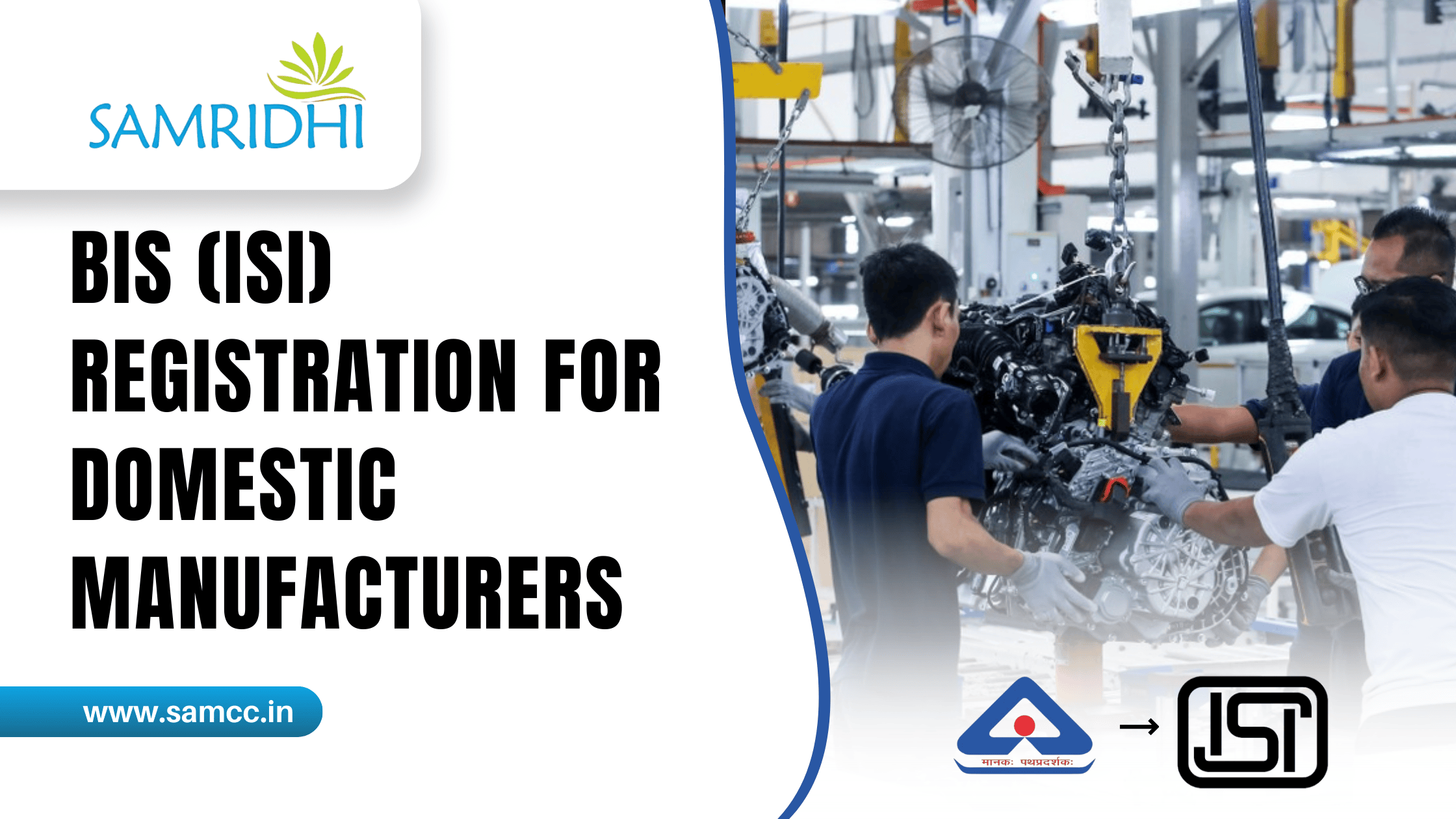
BIS ISI Certification for Domestic Manufacturers – Learn eligibility, process, cost, validity, and compliance rules
BIS ISI Certification for Domestic Manufacturers is a mandatory requirement for Indian manufacturing units producing products covered under the ISI marking scheme, ensuring they meet Indian quality, safety, and performance standards. This service helps manufacturers understand whether their products require ISI certification, complete BIS registration, prepare accurate documentation, manage product testing and factory inspections, and obtain a valid BIS licence and license certificate without delays or rejection. Proper BIS ISI certification allows businesses to operate legally, avoid penalties, product seizures, and sales bans, and build long-term trust with regulators, buyers, and customers. Samridhi Compliance Certification (SAMCC) provides structured, end-to-end guidance to simplify this compliance process and support sustainable manufacturing growth. For expert assistance, call +91 8799708673.
 Get Certified with Confidence – Your One-Stop Compliance Partner
From BIS, WPC, TEC, BEE, EPR, LMPC, CDSCO, FSSAI, ISO, MSME to PESO, NABL testing, Startup India, Make in India, and Lab Setup, we handle all your regulatory approvals, certifications, and documentation needs with precision and speed. Partner with Samridhi Compliance Certification and simplify your journey to full compliance—so you can focus on growing your business.
BIS ISI Certification for Domestic Manufacturers 📄⚖️🏭
BIS ISI Certification for Domestic Manufacturers is a mandatory regulatory requirement for Indian manufacturers producing notified products that fall under the ISI marking scheme. Issued by the Bureau of Indian Standards, the ISI mark confirms that a product complies with Indian quality, safety, and performance standards. For domestic manufacturers, obtaining a valid BIS licence is not only a legal obligation but also a critical step toward building trust, ensuring market access, and achieving long-term business sustainability in India’s highly regulated environment.
What Is BIS ISI Certification and Why Is It Important? ✅
BIS ISI certification is a conformity assessment scheme applicable to products that must carry the ISI mark before being sold in the Indian market. Under this framework, manufacturers are required to obtain a BIS license certificate after their manufacturing unit, product quality, and testing processes are evaluated and approved.
This certification is mandatory for a wide range of products, including construction materials, electrical appliances, industrial goods, and consumer products. Without a valid bureau of indian standards license, domestic manufacturers cannot legally manufacture, store, distribute, or sell these products in India.
Who Needs BIS ISI Certification?
-
Indian manufacturing units producing notified ISI products
-
Brand owners manufacturing through domestic facilities
-
MSMEs and startups entering regulated product categories
-
Manufacturers expanding into new ISI-covered product lines
For these businesses, bis product certification under the ISI scheme is a non-negotiable compliance requirement.
India as a Regulated Manufacturing Market 🏭📈
India has one of the most comprehensive regulatory frameworks for product quality and consumer safety. The government actively enforces compliance to protect consumers, improve product reliability, and align domestic manufacturing with global standards.
Why Compliance Matters in India
-
Manufacturing: Factories must operate under approved standards to retain their bis licence.
-
Market Access: Retailers, distributors, and government buyers often require a valid BIS license certificate before onboarding products.
-
Risk Avoidance: Non-compliance can lead to penalties, factory shutdowns, seizures, and cancellation of bis registration.
Authorities such as BIS, WPC, TEC, and CPCB work together to enforce compliance across sectors. For domestic manufacturers, meeting BIS ISI certification requirements is essential to remain operational and competitive.
Industry & Product Context for BIS ISI Certification 🏗️🔌
The ISI scheme covers a broad range of industries where product safety and quality directly impact public welfare.
Electrical & Industrial Products
Products like switches, cables, transformers, and industrial equipment require bis isi certification to ensure safety and performance. A valid bis license certificate confirms that these products meet Indian Standards.
Construction & Infrastructure Materials
Cement, steel products, pipes, and building materials must comply with ISI standards. BIS product certification is critical for participation in infrastructure projects and institutional supply chains.
Consumer Goods & Appliances
Household items, pressure cookers, gas appliances, and similar products fall under mandatory ISI marking. Domestic manufacturers must maintain ongoing compliance to retain their bureau of indian standards license.
In all these sectors, certification is critical to protect end users and maintain trust in Indian-made products.
BIS ISI Certification Process for Domestic Manufacturers 📋🔍
The BIS ISI Certification for Domestic Manufacturers follows a structured, step-by-step process designed to evaluate both the product and the manufacturing facility.
Step-by-Step Process Overview
-
Product Identification: Confirm whether the product falls under mandatory ISI certification.
-
Application & BIS Registration: Submit application along with factory and product details through the BIS system.
-
Factory Inspection: BIS officials conduct an on-site inspection to verify manufacturing processes, quality controls, and testing facilities.
-
Product Testing: Samples are tested at BIS-recognized laboratories.
-
Grant of Licence: Upon successful evaluation, a bis licence and BIS license certificate are issued.
Timelines & Common Challenges
-
Timelines vary depending on product type and factory readiness.
-
Common challenges include incomplete documentation, inadequate in-house testing facilities, and non-alignment with Indian Standards.
Proper planning and documentation are key to avoiding delays in bis registration and approval.
Cost, Validity & Key Compliance Factors 💰📄
Indicative Cost Components
-
Application and government fees
-
Product testing charges
-
Factory inspection expenses
-
Professional consultancy support
The bis product certification cost depends on product category, testing requirements, and factory complexity.
Validity & Renewal
-
A bis licence is typically granted for a defined validity period and must be renewed periodically.
-
Manufacturers must maintain continuous compliance, surveillance audits, and periodic testing.
Penalties for Non-Compliance
Operating without a valid bureau of indian standards license can result in fines, cancellation of licence, product recalls, and legal action—making compliance a high-trust requirement.
Role of Professional BIS Certification Consultants 🧭📑
Navigating BIS ISI certification involves technical standards, factory audits, and regulatory interpretation.
Consultants vs Agents
-
Consultants provide strategic guidance, documentation accuracy, and long-term compliance planning.
-
Agents often focus only on submission, without addressing underlying compliance risks.
Why Expert Support Matters
-
Accurate preparation of documents for bis registration
-
Readiness for factory inspection and testing
-
Faster resolution of queries raised by BIS
-
Ongoing compliance management post-certification
Working with experienced bis consultants reduces approval risks and ensures smoother certification.
In this context, Samridhi Compliance Certification supports domestic manufacturers with end-to-end guidance—from application and inspection readiness to licence grant and renewals—ensuring a structured and compliant certification journey.
Recent & Trending Updates in BIS ISI Compliance 📡📊
-
Expansion of Mandatory Product Lists: More products are being added under ISI requirements.
-
Stricter Enforcement: Increased factory inspections and market surveillance.
-
Digital Filing Systems: Online applications and tracking have become standard, increasing transparency and scrutiny.
-
Alignment with Quality Initiatives: Greater emphasis on standardization and “Make in India” quality benchmarks.
Manufacturers who stay updated and compliant gain a competitive edge in an evolving regulatory landscape.
BIS ISI Certification for Domestic Manufacturers is a cornerstone of India’s quality and safety framework. It impacts manufacturers across industries, from infrastructure and industrial goods to consumer products. Obtaining and maintaining a valid bis licence, bis registration, and BIS license certificate is essential for legal operations, market access, and long-term credibility.
By understanding regulatory requirements, planning certification early, and ensuring ongoing compliance, domestic manufacturers can turn bis isi certification into a strategic advantage—supporting growth, trust, and sustainability in the Indian market.
Get Certified with Confidence – Your One-Stop Compliance Partner
From BIS, WPC, TEC, BEE, EPR, LMPC, CDSCO, FSSAI, ISO, MSME to PESO, NABL testing, Startup India, Make in India, and Lab Setup, we handle all your regulatory approvals, certifications, and documentation needs with precision and speed. Partner with Samridhi Compliance Certification and simplify your journey to full compliance—so you can focus on growing your business.
BIS ISI Business & Industry Certification for Domestic Manufacturers
BIS ISI Certification for Domestic Manufacturers is a mandatory compliance requirement for Indian manufacturing units producing products notified under the ISI marking scheme. Issued by the Bureau of Indian Standards, this certification confirms that a product consistently meets Indian quality, safety, and performance standards. In today’s compliance-driven business environment, holding a valid bis licence is not only a legal necessity but also a foundation for sustainable manufacturing growth in India.
Business & Industry Landscape in India 📈
India’s manufacturing ecosystem spans multiple sectors, and the need for bis isi certification varies across business types depending on the product category and end-use.
Manufacturing Units
Domestic manufacturers producing ISI-notified products must obtain a bis license certificate before commercial production or sale. Without a valid bureau of indian standards license, manufacturing activities can be suspended, leading to regulatory action and financial losses.
Importers & Exporters
While ISI certification primarily applies to domestic manufacturing, importers working with Indian factories must ensure that products carry valid bis product certification. Export-oriented units supplying the domestic market are also required to meet ISI standards.
Electronics & IT Companies
Certain electronics, electrical, and industrial components fall under ISI requirements. These companies must complete bis registration and factory approval to ensure their manufacturing processes meet notified standards.
Startups & MSMEs
For startups and MSMEs, early understanding of BIS ISI Certification for Domestic Manufacturers prevents costly rework and redesign. Timely compliance allows smaller businesses to scale operations and participate in organized supply chains.
Foreign Manufacturers Supplying to India
Foreign brands manufacturing through Indian facilities must also ensure that local production units hold a valid bis licence. Compliance under ISI is mandatory regardless of international certifications.
Across these segments, bis certification consultants play a critical role in guiding businesses through technical and procedural requirements.
Key Business & Industrial Locations Driving ISI Compliance 🏗️🚢
Demand for bis isi certification is higher in regions with concentrated manufacturing and regulatory oversight.
Manufacturing Clusters
Industrial belts with heavy production activity face frequent inspections. Manufacturers in these clusters rely on accurate bis registration and a valid bis license certificate to maintain uninterrupted operations.
Electronics & Engineering Hubs
Electronics, electrical, and engineering-focused regions generate consistent demand for bis product certification, as safety and performance standards are closely monitored.
Ports, SEZs, and Logistics Zones
Although ISI certification applies to manufacturing, supply chains connected to ports and SEZs face strict scrutiny. Products manufactured without a proper bureau of indian standards license risk rejection and recall.
In these locations, compliance is driven by business volume, inspection frequency, and regulatory exposure rather than geography alone.
Future Growth Potential & Regulatory Expansion 📊✅
The scope of BIS ISI Certification for Domestic Manufacturers is expanding as India strengthens its quality and standardization framework.
Increasing Enforcement
Authorities are conducting more factory audits and market surveillance. Operating without a valid bis licence is becoming increasingly risky.
Expansion of Mandatory Product Categories
More products are being added under ISI requirements. Manufacturers that plan bis isi certification early can avoid last-minute compliance pressure.
Focus on Quality, Safety, and Standardization
Government initiatives emphasize consistent quality across Indian-made products. The bureau of indian standards license is central to aligning manufacturers with national and global benchmarks.
Early compliance helps businesses scale faster, attract institutional buyers, and reduce long-term legal risks.
How Professional Compliance Services Support Business Growth 🧭📄
Managing BIS ISI Certification for Domestic Manufacturers involves technical standards, factory readiness, and continuous compliance.
Reducing Approval Delays
Experienced bis consultants help manufacturers prepare documentation correctly and align factory processes with ISI standards, reducing delays during inspection and approval.
Avoiding Rejection Due to Documentation Errors
Incorrect or incomplete filings are a common reason for rejection. A qualified bis registration consultant ensures accuracy across applications, test reports, and declarations.
Managing Testing, Licensing, and Renewals
From coordinating product testing to managing licence renewals and surveillance audits, bis certification consultants provide long-term compliance support.
Staying Updated with Regulatory Changes
ISI standards evolve over time. Professional consultants help manufacturers stay aligned with new notifications, revised standards, and enforcement trends.
In this context, Samridhi Compliance Certification supports domestic manufacturers with structured guidance across application filing, factory inspection readiness, licence grant, and ongoing compliance—allowing businesses to focus on production and growth while remaining fully compliant.
Digital & Online Compliance Ecosystem in India 💻📡
India has significantly modernized its compliance systems, including processes related to bis registration and licence management.
Shift to Online Filing
Applications, renewals, and communications for bis isi certification are now largely digital, improving transparency and traceability.
Centralized Compliance Oversight
Integration with other regulatory systems increases scrutiny. Accurate records and a valid bis license certificate are essential during audits and inspections.
Why Expert Guidance Still Matters
While digital portals simplify submissions, they do not replace regulatory interpretation. Understanding standards, inspection requirements, and ongoing obligations still requires expert involvement from bis consultants.
Why BIS ISI Certification Is a Strategic Advantage 📈
For domestic manufacturers, BIS ISI Certification for Domestic Manufacturers is not just about legal compliance—it is a competitive advantage. Businesses with a valid bis licence gain:
-
Legal certainty and operational continuity
-
Better acceptance by distributors and institutional buyers
-
Reduced regulatory risk
-
Stronger brand credibility
By maintaining proper bis product certification and working with experienced bis certification consultants, manufacturers can transform compliance into a growth enabler.
BIS ISI Certification for Domestic Manufacturers is a cornerstone of India’s manufacturing compliance framework. It affects manufacturers across industries and regions, requiring strict adherence to notified standards. With expanding enforcement, digital oversight, and a growing list of regulated products, timely compliance is essential.
By understanding certification requirements, planning early, and maintaining a valid bureau of indian standards license, domestic manufacturers can protect their operations, scale confidently, and build long-term trust in the Indian market.
BIS ISI Certification for Domestic Manufacturers - Advantages and Disadvantages
BIS ISI Certification for Domestic Manufacturers is a mandatory compliance requirement for Indian manufacturing units producing products notified under the ISI marking scheme. Issued by the Bureau of Indian Standards, this certification confirms that products meet prescribed Indian quality, safety, and performance standards. For domestic manufacturers, holding a valid bis licence is essential to operate legally, avoid regulatory action, and build long-term credibility in the Indian market.
Advantages of BIS ISI Certification for Businesses ✅
Obtaining bis isi certification delivers clear, practical advantages for businesses operating in regulated product categories.
Operate Legally in India
-
A valid bureau of indian standards license allows manufacturers to legally produce and sell ISI-marked products.
-
Compliance through BIS ISI Certification for Domestic Manufacturers prevents legal notices and factory-level enforcement.
-
Proper bis registration ensures uninterrupted business operations.
Avoid Penalties, Seizures, and Delays
-
Products manufactured without a valid bis license certificate may be seized or banned from sale.
-
Timely bis product certification reduces the risk of inspections leading to stoppages.
-
Accurate documentation prepared during bis registration avoids approval delays.
Build Trust with Customers and Authorities
-
ISI marking signals quality and safety to consumers and institutional buyers.
-
Regulators view compliant manufacturers as lower-risk entities.
-
Consistent bis isi certification strengthens brand reputation and market acceptance.
Enable Smooth Manufacturing and Sales
-
Manufacturers can plan production confidently once the bis licence is granted.
-
Distributors and retailers often require a valid bis license certificate before onboarding products.
-
Certified products face fewer barriers in organized supply chains.
Benefits by Business Type
Manufacturers
-
Legal certainty with a valid bureau of indian standards license
-
Stable production cycles supported by bis product certification
-
Reduced inspection-related disruptions
Importers
-
Assurance that domestically sourced products meet ISI norms
-
Lower risk of downstream compliance issues
-
Stronger supplier credibility through bis isi certification
Startups & MSMEs
-
Early compliance avoids costly rework and redesign
-
Faster entry into regulated markets with proper bis registration
-
Improved trust with investors and partners
Foreign Companies Manufacturing in India
-
Local compliance through Indian facilities holding a bis licence
-
Reduced regulatory risk despite global certifications
-
Easier participation in Indian supply chains
Disadvantages of NOT Using BIS ISI Certification ⚠️
Failing to obtain BIS ISI Certification for Domestic Manufacturers exposes businesses to significant risks.
Legal Penalties and Notices
Product Seizures or Sales Bans
Import and Supply Chain Issues
Reputation and Financial Losses
-
Loss of customer trust due to non-ISI-marked products.
-
Higher costs from corrective actions, re-testing, and halted production.
These risks often exceed the effort and cost required to complete bis isi certification correctly.
Compliance vs Non-Compliance: Quick Comparison 📊
| Benefits of Compliance / Certification |
Drawbacks of Non-Compliance |
| Legal operations with valid bis licence |
Legal notices and penalties |
| Market acceptance via bis license certificate |
Product seizures or bans |
| Stable production with bis product certification |
Factory shutdown risks |
| Trust from buyers and regulators |
Reputation damage |
| Long-term scalability |
Financial and operational losses |
This comparison clearly shows why BIS ISI Certification for Domestic Manufacturers is a business necessity rather than a formality.
Why Professional Support Matters 🧭📑
The ISI certification process involves factory inspections, product testing, and strict documentation standards. Even minor errors can delay or block approval.
Role of BIS Consultants
-
bis consultants help manufacturers understand applicable standards and inspection requirements.
-
A qualified bis registration consultant ensures accurate filings and inspection readiness.
-
Experienced bis certification consultants support renewals, surveillance audits, and ongoing compliance.
Working with professionals reduces approval risks and ensures that the bis licence remains valid throughout the product lifecycle.
In this context, Samridhi Compliance Certification supports domestic manufacturers with structured guidance across documentation preparation, factory audit readiness, licence grant, and post-certification compliance—helping businesses stay compliant while focusing on growth.
BIS ISI Certification for Domestic Manufacturers is a critical requirement for legally manufacturing and selling ISI-marked products in India. It helps businesses avoid penalties, build trust, and ensure smooth manufacturing and sales operations. While non-compliance carries serious legal and financial risks, proper certification provides stability, credibility, and long-term growth opportunities.
By securing a valid bis licence, maintaining accurate bis registration, and ensuring ongoing bis product certification, domestic manufacturers can turn regulatory compliance into a strategic advantage in India’s increasingly quality-driven market.
Why BIS ISI Certification for Domestic Manufacturers Is Important ⚖️📄🏭
India’s manufacturing sector is expanding rapidly, supported by strong government initiatives, rising domestic demand, and global supply chain shifts. In this environment, BIS ISI Certification for Domestic Manufacturers has become a critical compliance requirement for businesses that manufacture products covered under mandatory Indian Standards. More than a regulatory formality, bis isi certification is a foundation for legal operations, product credibility, and long-term business growth in the Indian market.
Importance of BIS ISI Certification for Businesses ✅
Operate Legally in India
For many product categories, operating without a valid bis licence is not permitted under Indian law. Domestic manufacturers must obtain a bureau of indian standards license before manufacturing or selling ISI-notified products. The presence of a valid bis license certificate ensures that business operations remain lawful and uninterrupted, reducing the risk of notices, factory shutdowns, or enforcement action.
Meet Indian Quality, Safety, and Regulatory Standards
The primary objective of bis product certification is to ensure that products meet defined Indian quality and safety benchmarks. Through BIS ISI Certification for Domestic Manufacturers, businesses demonstrate compliance with nationally recognized standards, which is essential for consumer safety, product reliability, and regulatory acceptance. This compliance also improves acceptance by distributors, institutional buyers, and government procurement bodies.
Avoid Penalties, Seizures, and Operational Delays
Non-compliance with ISI requirements can result in penalties, product seizures, or sales bans. Manufacturers without a valid bis registration or bis licence face higher scrutiny during inspections. Completing bis isi certification on time helps businesses avoid costly disruptions, production halts, and reputational damage.
Build Long-Term Brand Trust
Products bearing the ISI mark are widely recognized as safe and reliable. Holding a valid bureau of indian standards license builds long-term trust with customers, regulators, and business partners. Over time, this trust supports repeat business, stronger distribution relationships, and brand credibility in competitive markets.
India’s Growing Regulatory & Compliance Landscape 📈🇮🇳
India’s regulatory ecosystem is evolving alongside its manufacturing ambitions. As production volumes rise, the government has increased its focus on:
-
Product quality to raise industry benchmarks
-
Consumer safety across essential and industrial goods
-
Standardization and traceability for accountability
With stricter inspections and digital monitoring, non-compliance risks are rising. Operating without BIS ISI Certification for Domestic Manufacturers is increasingly unsustainable. Authorities now rely on centralized systems to verify bis registration, licence validity, and compliance history. Early adoption of bis isi certification helps businesses stay ahead of enforcement trends rather than reacting to them.
Business Impact Across Industries 🏭📡
Electronics & IT Manufacturers (CRS, BIS)
Manufacturers of electrical and electronic components often operate under multiple compliance frameworks. While CRS applies to specific products, many industrial and electrical items require bis product certification under the ISI scheme. Holding a valid bis licence enables these manufacturers to supply both consumer and institutional markets without regulatory barriers.
Mobile Phones and Wireless Devices (BIS + WPC)
Although mobile phones largely fall under CRS and WPC frameworks, supporting components and related products manufactured domestically may require ISI marking. BIS ISI Certification for Domestic Manufacturers ensures that such products meet safety and performance standards, enabling smooth integration into regulated supply chains.
Importers and Foreign Manufacturers (FMCS)
Foreign brands manufacturing in India through local facilities must ensure that those units hold a valid bureau of indian standards license. Even if a product is certified internationally, domestic production requires bis isi certification to legally sell in India. This compliance enables seamless collaboration between Indian manufacturers and global brands.
Startups & MSMEs Entering Regulated Sectors
For startups and MSMEs, compliance can be a growth enabler. Early bis registration helps smaller businesses enter regulated markets confidently, avoid redesign costs, and meet buyer requirements. A valid bis license certificate also improves investor confidence and partnership opportunities.
Across industries, certification directly supports market access, scalability, and credibility.
Role of Professional Compliance Consultants 🧭📑
Despite the availability of online portals, the ISI certification process remains complex and technical.
Why Expert Guidance Is Crucial
-
Online systems do not interpret standards or assess factory readiness.
-
Errors in documentation can delay or derail bis registration.
-
Inspection preparedness is critical to securing a bis licence.
How Consultants Support Businesses
-
Correct documentation: Preparing applications aligned with ISI standards
-
Testing coordination: Managing sample testing and compliance evidence
-
Timely approvals: Reducing delays during audits and reviews
-
Ongoing compliance: Supporting renewals, surveillance audits, and changes
Experienced bis consultants act as risk reducers, while qualified bis certification consultants and a reliable bis registration consultant help businesses manage compliance as a continuous process rather than a one-time event.
In this context, Samridhi Compliance Certification supports domestic manufacturers with structured guidance across documentation, factory inspection readiness, licence issuance, and ongoing compliance—helping businesses remain focused on growth while meeting regulatory obligations.
Why BIS ISI Certification Is Non-Negotiable 📊✅
As India strengthens its manufacturing and quality framework, BIS ISI Certification for Domestic Manufacturers is no longer optional. It is a strategic requirement that:
-
Protects businesses from legal and financial risk
-
Enhances product credibility and market acceptance
-
Supports long-term scalability in regulated industries
Manufacturers that invest early in bis isi certification, maintain a valid bis licence, and work closely with experienced bis consultants are better positioned to compete, expand, and sustain operations in India’s increasingly regulated market.
BIS ISI Certification for Domestic Manufacturers is essential for businesses that want to operate legally, safely, and competitively in India. It ensures compliance with national quality standards, reduces enforcement risks, and builds trust with customers and regulators. As regulatory oversight intensifies and more products fall under mandatory standards, timely certification has become a business necessity.
By securing a valid bureau of indian standards license, maintaining accurate bis registration, and ensuring continuous bis product certification, manufacturers can transform compliance into a long-term strategic advantage in the Indian market.
Get Certified with Confidence – Your One-Stop Compliance Partner
From BIS, WPC, TEC, BEE, EPR, LMPC, CDSCO, FSSAI, ISO, MSME to PESO, NABL testing, Startup India, Make in India, and Lab Setup, we handle all your regulatory approvals, certifications, and documentation needs with precision and speed. Partner with Samridhi Compliance Certification and simplify your journey to full compliance—so you can focus on growing your business.
Frequently Asked Questions
BIS ISI Certification for Domestic Manufacturers is mandatory only for products notified under the ISI scheme by the Bureau of Indian Standards. If a product falls under this list, the manufacturer must obtain a valid bis licence and bis license certificate before manufacturing or selling in India. Non-compliance can lead to penalties, seizures, and business restrictions.
Any Indian manufacturing unit producing ISI-notified products must complete bis isi certification. This includes large manufacturers, MSMEs, startups, and foreign brands manufacturing through Indian factories. To operate legally, such units must secure a bureau of indian standards license and complete bis registration before commercial production begins.
The process involves product identification, bis registration, factory inspection, product testing at BIS-recognized labs, and final approval. Once compliant, BIS issues a bis license certificate allowing ISI marking. Working with experienced bis consultants helps ensure documentation accuracy and inspection readiness, reducing approval delays.
A bis licence is issued for a defined validity period and must be renewed periodically. Costs depend on product type, testing requirements, inspection scope, and documentation complexity. bis product certification costs are lower when factories are prepared in advance and supported by professional bis certification consultants.
Manufacturing without BIS ISI Certification for Domestic Manufacturers can result in legal notices, product seizures, licence cancellation, and sales bans. Operating without a valid bureau of indian standards license also damages credibility with buyers and regulators. A qualified bis registration consultant helps businesses avoid these risks through timely compliance.



 Grab Your Certified Now
 +91 8799708673
 WhatsApp