 Get Certified with Confidence – Your One-Stop Compliance Partner
From BIS, WPC, TEC, BEE, EPR, LMPC, CDSCO, FSSAI, ISO, MSME to PESO, NABL testing, Startup India, Make in India, and Lab Setup, we handle all your regulatory approvals, certifications, and documentation needs with precision and speed. Partner with Samridhi Compliance Certification and simplify your journey to full compliance—so you can focus on growing your business.
BEE Star Rating Approval in India – Why Appliance Launches Get Delayed Before They Begin
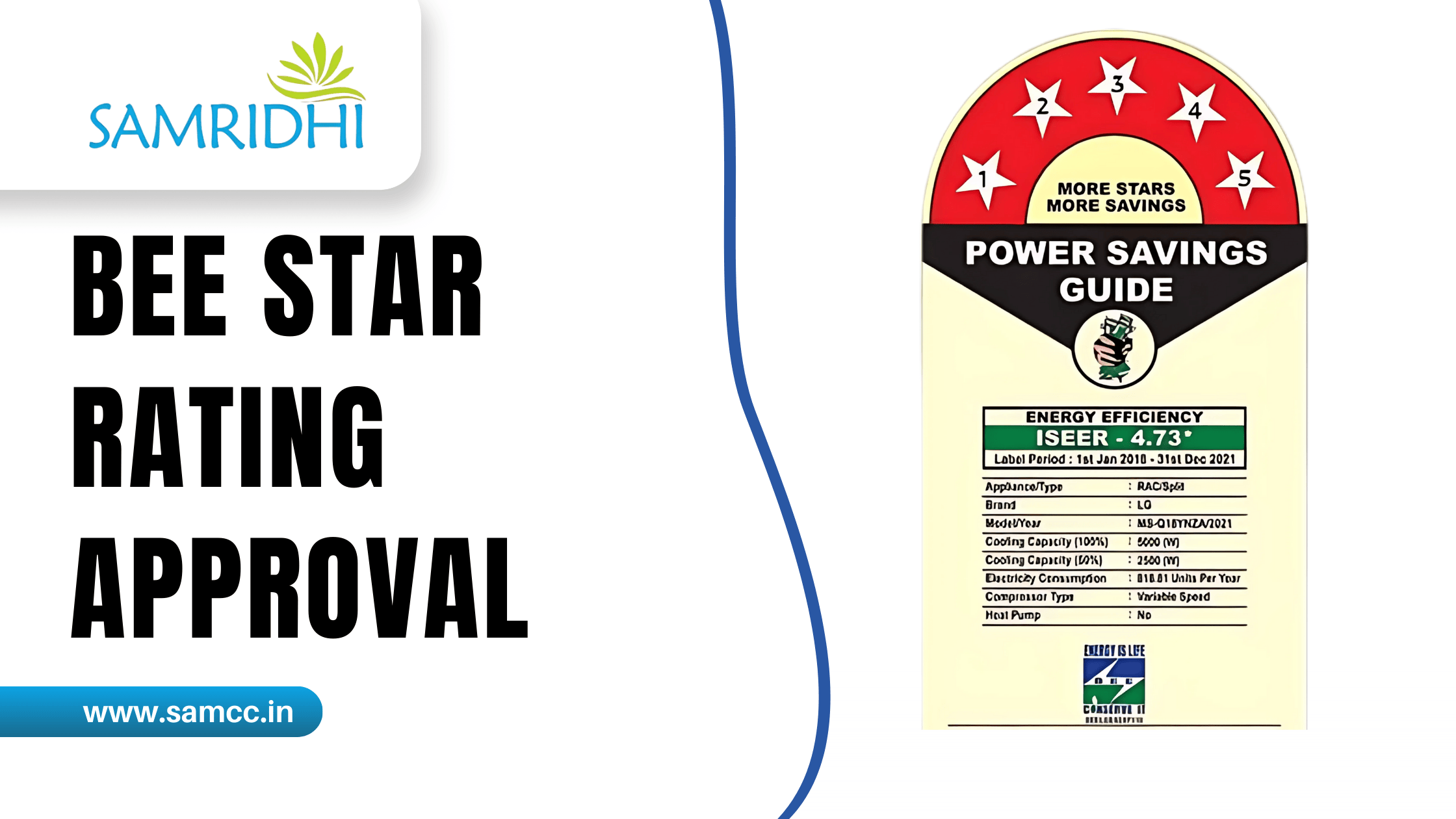
Energy efficiency used to be a marketing advantage. Today, it is a regulatory checkpoint. Many appliance launches pause quietly because the required BEE Star Rating Approval was not planned early enough.
For manufacturers and importers, the fear is practical. Inventory ready but not sellable. Distributors waiting but unable to onboard. Marketing campaigns paused while compliance catches up. Under India’s expanding BEE appliance star rating India framework, many electrical appliances cannot be sold without proper labelling and registration.
The regulatory environment has changed.
Earlier, efficiency labels were often treated as a late-stage requirement. Now, audits, marketplace policies, and procurement rules expect BEE star labelling to be in place before products reach the market. Large retailers and e-commerce platforms increasingly ask for proof of BEE Star Rating certification before listing appliances. Government procurement already treats it as mandatory in many categories.
This shift has made energy efficiency star rating BEE unavoidable.
Many businesses assume that product performance alone is enough. It isn’t. Even high-efficiency appliances require formal BEE star rating certification to legally display star labels and enter the market. Without it, launches slow down, listings get rejected, and distribution becomes uncertain.
Early clarity matters more than speed.
Understanding how to apply for BEE star rating for appliances, which product categories fall under mandatory labelling, and how the process connects with BIS safety certification or other regulatory approvals changes the way companies plan launches. Compliance becomes part of product readiness instead of a last-minute hurdle.
At Samridhi Compliance Certification, early discussions usually begin with eligibility and planning rather than promises. Does the appliance fall under mandatory labelling? What testing is required to meet BEE 5 star rating criteria? How does the certification timeline align with production schedules? These answers help prevent surprises later.
There are no guaranteed approvals. Timelines always depend on testing readiness and documentation accuracy. Outcomes vary by product and efficiency performance. But when businesses treat BEE Star Rating Approval as part of launch planning rather than post-production paperwork, the risk of delays and penalties reduces significantly.
In today’s appliance market, energy efficiency builds trust.
Regulation decides when that trust can reach customers.
Why Manufacturers and Importers Struggle With BEE Star Rating Certification
Most companies don’t struggle with BEE Star Rating Approval because they ignore compliance. They struggle because the process looks simple from the outside and becomes technical the moment testing begins. The gap between assumption and regulatory expectation is where delays quietly start.
Appliances today compete heavily on efficiency. Air conditioners, refrigerators, fans, water heaters, lighting products—almost every major category falls under BEE appliance star rating India requirements. Because efficiency claims are already part of product marketing, many businesses assume certification will be quick. In reality, BEE star labelling is a structured testing and registration process with strict documentation and performance verification.
That difference creates friction.
Common Mistakes That Trigger Delays
The same issues repeat across appliance manufacturers and importers.
-
Wrong product category selection
Many applicants misidentify whether their appliance falls under mandatory or voluntary labelling. Choosing the wrong category delays BEE star rating certification and sometimes requires restarting the process.
-
Incomplete or misaligned test reports
Testing may be completed, but reports often don’t match the exact model configuration submitted. Missing parameters or outdated formats trigger clarification cycles.
-
Wrong laboratory selection
Not every lab is authorised for energy efficiency star rating BEE testing. Using the wrong facility leads to re-testing, increasing cost and delaying approval.
-
Timeline misjudgment
Production and launch plans are often finalised before certification begins. Timelines are indicative and depend on testing readiness and documentation accuracy.
Each mistake appears manageable on its own. Together, they create real disruption.
The Practical Impact Businesses Experience Too Late
When BEE appliance star rating India requirements are discovered late, consequences spread quickly:
-
Shipments held or delayed due to missing BEE star labelling
-
Financial penalties and compliance notices
-
Relaunch costs due to re-testing or packaging changes
-
Lost distributor trust when supply timelines fail
A familiar pattern appears repeatedly. The product is technically ready. Market demand exists. But compliance clarity is missing. Retailers hesitate. Importers pause. Momentum fades.
This is the reality behind BEE Star Rating Approval delays.
The process is not complicated—it is misunderstood.
Until businesses treat how to apply for BEE star rating for appliances as part of product planning instead of post-production paperwork, the same problems continue to repeat across launches.
Get Certified with Confidence – Your One-Stop Compliance Partner
From BIS, WPC, TEC, BEE, EPR, LMPC, CDSCO, FSSAI, ISO, MSME to PESO, NABL testing, Startup India, Make in India, and Lab Setup, we handle all your regulatory approvals, certifications, and documentation needs with precision and speed. Partner with Samridhi Compliance Certification and simplify your journey to full compliance—so you can focus on growing your business.
Industry Reality Behind BEE Star Rating Certification in India
Energy efficiency regulation in India has become noticeably stricter. What once felt like a label for marketing now functions as a gatekeeper for market entry. Under the current BEE Star Rating Approval framework, appliances must prove efficiency through testing and formal registration before they can display star labels.
The shift happened gradually, which is why many manufacturers still underestimate how seriously BEE appliance star rating India is now treated.
Regulatory Expectations Are Increasing Across Authorities
The Bureau of Energy Efficiency continues expanding appliance categories under mandatory labelling. At the same time, BIS safety certification and other regulatory approvals keep evolving. Many products now require multiple approvals—safety certification, energy efficiency labelling, and sometimes wireless or telecom approvals depending on functionality.
This overlap creates complexity.
A single appliance may require BIS certification for safety and BEE star labelling for energy efficiency. Treating these approvals separately often leads to misaligned timelines and delayed launches.
How Most Consultants Still Operate
Many bis consultants and compliance providers continue using outdated methods:
-
Checklist-based execution – gather documents, submit, wait
-
Authority-specific silos – BEE handled separately from BIS or other approvals
This model assumes certainty where none exists. It assumes product eligibility without verifying efficiency performance. It assumes testing reports will be accepted without alignment checks. Under the energy efficiency star rating BEE framework, these assumptions frequently fail.
What Businesses Are Rarely Told Early
Several realities usually appear only after delays begin:
-
Not all products qualify for higher star ratings or even mandatory labelling categories
-
Testing failures and re-testing are common, especially when efficiency performance varies from expectations
-
Approvals are iterative, not linear—queries and clarification rounds are normal
Timelines remain indicative and depend on testing readiness, documentation clarity, and product performance.
The system is not unpredictable.
It is precise.
Businesses that accept this integrate BEE Star Rating certification into product planning. Those who don’t discover the gap when production is already complete.
That is the real market reality behind BEE Star Rating Approval today.
Practical Solutions and Use Cases That Work for BEE Star Rating Certification
Most delays around BEE Star Rating Approval do not happen because energy efficiency regulations are complicated. They happen because the process begins too late or follows the wrong order. Energy labelling works best when planning starts before packaging, printing, or distributor commitments are finalised.
There is no shortcut. There is only the right sequence.
Practical Certification Approaches That Reduce BEE Delays
The following approaches consistently reduce friction under BEE star labelling, not by guaranteeing approvals, but by preventing avoidable mistakes.
-
Product-first analysis
The process begins with understanding appliance performance, power consumption, and usage category. This determines eligibility under BEE appliance star rating India and identifies applicable testing standards.
-
Correct standard identification
Selecting the correct testing protocol early stabilises the BEE star rating certification journey and prevents re-testing later.
-
Testing and documentation alignment
Test reports, model specifications, and declarations must describe the same appliance configuration. Misalignment often triggers clarification cycles.
-
Authority coordination
Appliances frequently require BIS safety certification alongside energy efficiency star rating BEE approval. Coordinating both approvals avoids conflicting timelines.
These steps do not promise speed. They reduce reversals.
Who Each Approach Works Best For
Different businesses experience BEE Star Rating certification differently.
-
Indian manufacturers benefit from integrating testing during product development.
-
Importers reduce shipment risk by confirming eligibility before scheduling imports.
-
OEMs managing multiple variants need structured documentation to avoid duplicate testing.
-
Startups often rush launches; established brands often rely on outdated assumptions. Both benefit from early verification.
Real-World Use Cases That Reflect BEE Reality
In one case, an appliance was initially submitted under the wrong category. Reclassification corrected the path before packaging and labelling began. Launch timelines shifted slightly, but re-testing costs were avoided.
In another situation, an importer scheduled shipments before certification clarity. Early correction of testing scope aligned the how to apply for BEE star rating for appliances process before customs checks. The shipment moved without interruption.
These outcomes were not dramatic.
They were controlled corrections.
That is how effective execution under BEE Star Rating Approval usually looks—decisions made early enough to prevent visible delays later.
Practical Solutions and Use Cases That Work for BEE Star Rating Certification
Most delays around BEE Star Rating Approval do not happen because energy efficiency regulations are complicated. They happen because the process begins too late or follows the wrong order. Energy labelling works best when planning starts before packaging, printing, or distributor commitments are finalised.
There is no shortcut. There is only the right sequence.
Practical Certification Approaches That Reduce BEE Delays
The following approaches consistently reduce friction under BEE star labelling, not by guaranteeing approvals, but by preventing avoidable mistakes.
-
Product-first analysis
The process begins with understanding appliance performance, power consumption, and usage category. This determines eligibility under BEE appliance star rating India and identifies applicable testing standards.
-
Correct standard identification
Selecting the correct testing protocol early stabilises the BEE star rating certification journey and prevents re-testing later.
-
Testing and documentation alignment
Test reports, model specifications, and declarations must describe the same appliance configuration. Misalignment often triggers clarification cycles.
-
Authority coordination
Appliances frequently require BIS safety certification alongside energy efficiency star rating BEE approval. Coordinating both approvals avoids conflicting timelines.
These steps do not promise speed. They reduce reversals.
Who Each Approach Works Best For
Different businesses experience BEE Star Rating certification differently.
-
Indian manufacturers benefit from integrating testing during product development.
-
Importers reduce shipment risk by confirming eligibility before scheduling imports.
-
OEMs managing multiple variants need structured documentation to avoid duplicate testing.
-
Startups often rush launches; established brands often rely on outdated assumptions. Both benefit from early verification.
Real-World Use Cases That Reflect BEE Reality
In one case, an appliance was initially submitted under the wrong category. Reclassification corrected the path before packaging and labelling began. Launch timelines shifted slightly, but re-testing costs were avoided.
In another situation, an importer scheduled shipments before certification clarity. Early correction of testing scope aligned the how to apply for BEE star rating for appliances process before customs checks. The shipment moved without interruption.
These outcomes were not dramatic.
They were controlled corrections.
That is how effective execution under BEE Star Rating Approval usually looks—decisions made early enough to prevent visible delays later.
Cost of BEE Star Rating Certification in India – What Businesses Should Expect
Cost uncertainty often delays decisions around BEE Star Rating Approval. Not because the process is unaffordable, but because the final investment becomes clear only after testing scope and product eligibility are confirmed. Transparent expectations help businesses plan compliance alongside production and launch timelines.
There is no single fixed fee for BEE star rating certification. All costs are indicative and depend on appliance category, testing requirements, and documentation readiness. Any fixed number quoted without understanding the appliance first is incomplete.
Indicative Cost Structure for BEE Star Rating Certification
| Cost Component |
Approximate Range |
| Testing Fees |
Depends on product & standard |
| Government Fees |
As per authority |
| Documentation & Processing |
Varies by scope |
| Total Estimated Cost |
Case-specific |
This structure reflects how BEE appliance star rating India works in practice. Government charges are defined, but most variation comes from testing scope and product performance requirements.
What Influences the Overall Cost
The first factor is product category. A ceiling fan, refrigerator, or air conditioner may all require BEE star labelling, but the depth of testing and performance evaluation differs significantly. Costs always vary by product and efficiency parameters.
The second factor is testing complexity. Appliances with advanced features or multiple variants often require broader testing to confirm compliance with energy efficiency star rating BEE standards. Testing depth directly impacts the total cost.
The third factor is re-testing, which businesses often underestimate. If test results do not match the final product configuration or fail to meet BEE 5 star rating criteria, additional testing may be required. This does not indicate failure—it reflects correction—but it increases expenses.
Documentation scope also affects cost. Clear and consistent files reduce clarification cycles. Incomplete or inconsistent documentation increases processing effort and extends timelines.
Appliances often require BIS safety certification alongside BEE Star Rating Approval. Costs may increase or streamline depending on how approvals are coordinated together.
There is no honest way to promise a fixed figure upfront.
But understanding cost drivers helps businesses plan realistically before production and packaging timelines become inflexible.
Products Covered Under BEE Star Rating Certification in India
One of the first questions manufacturers ask is direct:
“Does my appliance actually need BEE Star Rating Approval?”
If the answer is yes, BEE star labelling becomes mandatory before the product can be sold, listed online, or distributed through major retailers. If the answer is no, the process stops here. The difficulty is that many electrical appliances fall into mandatory categories, and this is often realised late—after production or packaging has already begun.
The BEE appliance star rating India framework focuses on products with measurable energy consumption that directly impacts household and commercial electricity use.
Common Product Categories Requiring BEE Star Rating
| Product Group |
Typical Examples |
| Cooling Appliances |
Air conditioners, refrigerators |
| Water Heating Appliances |
Storage water heaters, heat pumps |
| Lighting Products |
LED lamps and lighting systems |
| Small Electrical Appliances |
Ceiling fans, televisions |
These categories typically require BEE star rating certification because they have significant energy consumption patterns that must meet defined efficiency benchmarks.
However, eligibility is never automatic.
Within each group, applicability depends on:
-
Appliance capacity and power consumption
-
Usage patterns and operating conditions
-
Model configuration and variants
-
Applicable testing standards
This is where many businesses misjudge early decisions.
For example, two appliances may appear similar in function, yet only one falls under mandatory energy efficiency star rating BEE requirements based on capacity or configuration. Similarly, new models or variants may require fresh evaluation even when earlier versions were certified.
A critical reminder that prevents costly assumptions:
Not all variants qualify. Applicability depends on technical parameters and product configuration, not appearance or competitor behaviour.
Appliances often require BIS safety certification alongside BEE Star Rating Approval. Treating approvals separately frequently leads to delays later.
Confirming scope early is the first decision that protects production timelines, packaging design, and product launch planning.
Benefits and Honest Risks of BEE Star Rating Certification in India
A completed BEE Star Rating Approval brings clarity to appliance launches—but expectations must remain realistic. Some businesses expect quick approvals. Others assume the process is unpredictable. The reality sits between those extremes. BEE star rating certification offers clear advantages, yet it also carries limitations that should be understood early.
When approached correctly, BEE star labelling becomes a stability tool rather than a recurring obstacle.
Benefits That Matter in Real Market Conditions
-
Faster approvals
Not because authorities accelerate reviews, but because correct category selection and aligned testing reduce clarification cycles. Fewer corrections mean fewer delays.
-
Reduced rejection cycles
Accurate testing and documentation alignment lower the need for re-testing during energy efficiency star rating BEE review.
-
Compliance confidence
Once BEE appliance star rating India registration is complete, product listings and distributor onboarding become smoother.
-
Market access stability
Certified appliances face fewer listing rejections and compliance issues across marketplaces and retail channels.
These advantages come from predictability, not promises.
Risks and Limitations That Cannot Be Ignored
Even with strong preparation, some variables remain outside direct control.
-
Timeline dependency on laboratories
Testing availability and report revisions directly affect progress. Timelines always depend on testing readiness and product complexity.
-
Authority clarifications
Queries during BEE star rating certification review are normal. Incomplete responses can extend processing cycles.
-
Product redesign requirements
Testing sometimes reveals gaps between expected and actual efficiency performance. Adjustments may be required before approval.
Earlier, energy labels were treated as optional marketing tools. Today, enforcement is stricter and expectations are higher.
How Professionals Reduce These Risks Quietly
Experienced teams focus on reducing exposure rather than promising speed.
-
Pre-testing checks
Early performance analysis identifies gaps before formal testing begins, reducing re-testing risk.
-
Authority-specific documentation planning
Aligning documents with BEE expectations reduces clarification loops.
-
Parallel processing where allowed
Documentation and testing preparation can move simultaneously—depending on product readiness.
No guarantees exist.
Timelines are indicative.
Outcomes always vary by product and efficiency performance.
But treating BEE Star Rating Approval as part of product planning shifts the process from reactive correction to controlled execution.
How BEE Star Rating Certification Solves the Real Launch Problem for Appliances
When businesses search for BEE Star Rating Approval, they are usually trying to solve one practical concern: How do we launch appliances without listing rejections, distributor hesitation, or compliance notices later? The BEE star labelling framework does not remove complexity, but it replaces uncertainty with a structured path.
A Step-by-Step Flow That Removes Guesswork
The process works best when treated as a sequence of decision checkpoints rather than a documentation task.
-
Product applicability confirmation
The first step confirms whether the appliance falls under BEE appliance star rating India requirements and whether the category is mandatory or voluntary.
-
Testing standard identification
Correct testing protocols are selected according to appliance category and performance benchmarks under energy efficiency star rating BEE guidelines.
-
Testing and lab coordination
Testing is conducted in recognised laboratories using the exact model configuration intended for sale.
-
Documentation preparation and alignment
Test reports, product specifications, and declarations must describe the same appliance configuration and energy performance.
-
Authority submission and review
Applications are reviewed by BEE authorities, and clarification rounds are expected before approval.
This process reduces uncertainty, but progress always depends on testing readiness and documentation accuracy.
Documentation Checkpoints That Prevent Delays
Most delays originate from inconsistencies rather than missing files. Key checkpoints include:
-
Alignment between test reports and final product specifications
-
Accurate product model details and efficiency claims
-
Consistent label design and declaration documents
-
Clear manufacturer and importer information
Misalignment often triggers clarification cycles and slows BEE star rating certification review.
Where Authority Interaction Happens
Authority engagement occurs during:
-
Application scrutiny
-
Clarification rounds
-
Final approval review
Each interaction tests consistency. Clear responses shorten review cycles; vague responses extend them.
Why Accuracy Matters More Than Speed
Rushing early steps often leads to re-testing, packaging changes, or listing delays. Accurate preparation reduces downstream disruption and protects launch timelines.
In practice, this is what businesses are really asking when they explore how to apply for BEE star rating for appliances. They are not seeking shortcuts—they want a process that holds up under scrutiny.
Accuracy creates predictability. Predictability keeps appliance launches on track.
Why BEE Star Rating Certification Matters for Businesses in Delhi and Laxmi Nagar
Location does not change energy efficiency rules.
It changes how quickly compliance gaps become visible.
For businesses operating in Delhi, especially commercial areas like Laxmi Nagar, demand for BEE Star Rating Approval has grown steadily. The region connects appliance importers, distributors, e-commerce sellers, and manufacturers supplying products across North India. Appliances entering this ecosystem face compliance checks earlier than many expect.
Why Demand Is Increasing in This Region
Delhi functions as:
-
A major distribution hub for electrical appliances
-
A strong e-commerce and retail marketplace base
-
A startup ecosystem launching new appliance brands
Because of this, distributors and marketplaces increasingly request proof of BEE appliance star rating India registration before onboarding new products. Many sellers discover this requirement only when product listings are rejected or delayed.
Earlier, energy labels were often addressed after product launch. Today, they are expected before sales begin.
Common Local Compliance Gaps
Several patterns repeat among businesses operating in the Delhi–NCR region:
-
Appliances produced or imported before confirming BEE star labelling requirements
-
Packaging and label printing completed before certification begins
-
Global energy efficiency reports assumed to be sufficient for BEE star rating certification
-
Overlap with BIS safety certification discovered late in the process
These gaps often surface during marketplace onboarding or distributor reviews, when corrections become expensive and timelines tighten.
Why This Region Increases the Exposure Factor
Proximity to major retailers, e-commerce platforms, and procurement teams means scrutiny appears earlier. Products routed through Delhi often supply multiple states and marketplaces, increasing expectations around compliance readiness.
For startups, missing BEE Star Rating Approval can delay launch entirely. For established brands, it can disrupt large-scale distribution plans. Outcomes always depend on how early compliance planning begins.
Location Also Shapes Interlinked Compliance Planning
Appliances rarely require only one approval. Businesses in this region often coordinate BEE star rating certification alongside BIS safety certification depending on product category.
Location does not change the rules.
It reduces the margin for error.
For companies in Delhi and Laxmi Nagar, early planning for energy efficiency star rating BEE is not just regulatory hygiene—it is how appliance launches stay predictable.
Real Experiences Around BEE Star Rating Certification That Reflect Launch Reality
Most companies don’t talk about BEE Star Rating Approval when everything goes smoothly. They talk about it when something almost delayed the launch—and didn’t. That is where the real value of BEE star labelling becomes visible.
One importer shared a familiar situation:
“The product was ready, distributors were waiting, but approval stalled just before listing.”
The appliance had completed testing, but the submitted model details didn’t perfectly match the final packaging configuration. Aligning documentation early helped the BEE star rating certification move forward without re-testing or relabeling penalties.
Another scenario involved a manufacturer preparing for a seasonal product launch. Testing had been scheduled late, assuming approval would align with production timelines. Early correction of testing scope clarified the how to apply for BEE star rating for appliances process and reduced the delay before market entry.
Short reflections like these appear often:
-
“Once we understood BEE appliance star rating India, the process became clearer.”
-
“We stopped rushing and focused on documentation accuracy.”
-
“Early clarification helped us avoid listing delays.”
There are also quieter trust moments that rarely appear in marketing material.
In one case, testing revealed that the appliance did not meet expected BEE 5 star rating criteria. Adjustments were required. Costs varied by product, and timelines shifted slightly, but the correction prevented compliance notices and marketplace rejection after launch.
That pattern repeats across appliance categories.
Reduced delay.
Clearer authority communication.
Avoided penalties.
No guarantees. No exaggerated claims.
Just realistic execution under energy efficiency star rating BEE, where BEE Star Rating Approval becomes part of launch planning rather than last-minute paperwork—and problems are handled early, before they become expensive.
Where BEE Star Rating Certification Leaves You and What to Do Next
For appliance manufacturers and importers, BEE Star Rating Approval is no longer an optional step—it is part of launch readiness. When testing aligns with the final product configuration, documentation clearly reflects appliance performance, and labelling is planned early, the BEE star labelling process becomes manageable. Outcomes always depend on testing scope, documentation quality, and efficiency performance, but uncertainty reduces significantly when planning begins early.
What consistently works is accuracy over urgency. Correct testing prevents rework. Clear documentation reduces clarification cycles. Early planning protects packaging timelines, distributor relationships, and marketplace listings. Costs and timelines remain indicative and vary by product, but treating BEE star rating certification as part of product planning helps avoid the delays and penalties that appear when approval is left too late.
If you are preparing to launch appliances in India, begin with eligibility confirmation. Understand whether your product falls under BEE appliance star rating India requirements, align testing with the correct standards, and prepare documentation alongside production planning. That early step often prevents months of disruption later under energy efficiency star rating BEE requirements.
For structured guidance without overpromising outcomes, Samridhi Compliance Certification supports eligibility assessment, testing coordination, documentation alignment, and authority-ready application preparation. You can discuss your product or compliance requirements at +91 8799708673 or email info.samcc@gmail.com. Results will always depend on technical and regulatory realities—but clarity can begin now.
Get Certified with Confidence – Your One-Stop Compliance Partner
From BIS, WPC, TEC, BEE, EPR, LMPC, CDSCO, FSSAI, ISO, MSME to PESO, NABL testing, Startup India, Make in India, and Lab Setup, we handle all your regulatory approvals, certifications, and documentation needs with precision and speed. Partner with Samridhi Compliance Certification and simplify your journey to full compliance—so you can focus on growing your business.


 Grab Your Certified Now
 +91 8799708673
 WhatsApp