BIS CRS Registration for LED Lights in India - Mandatory compliance, process, cost, and expert support
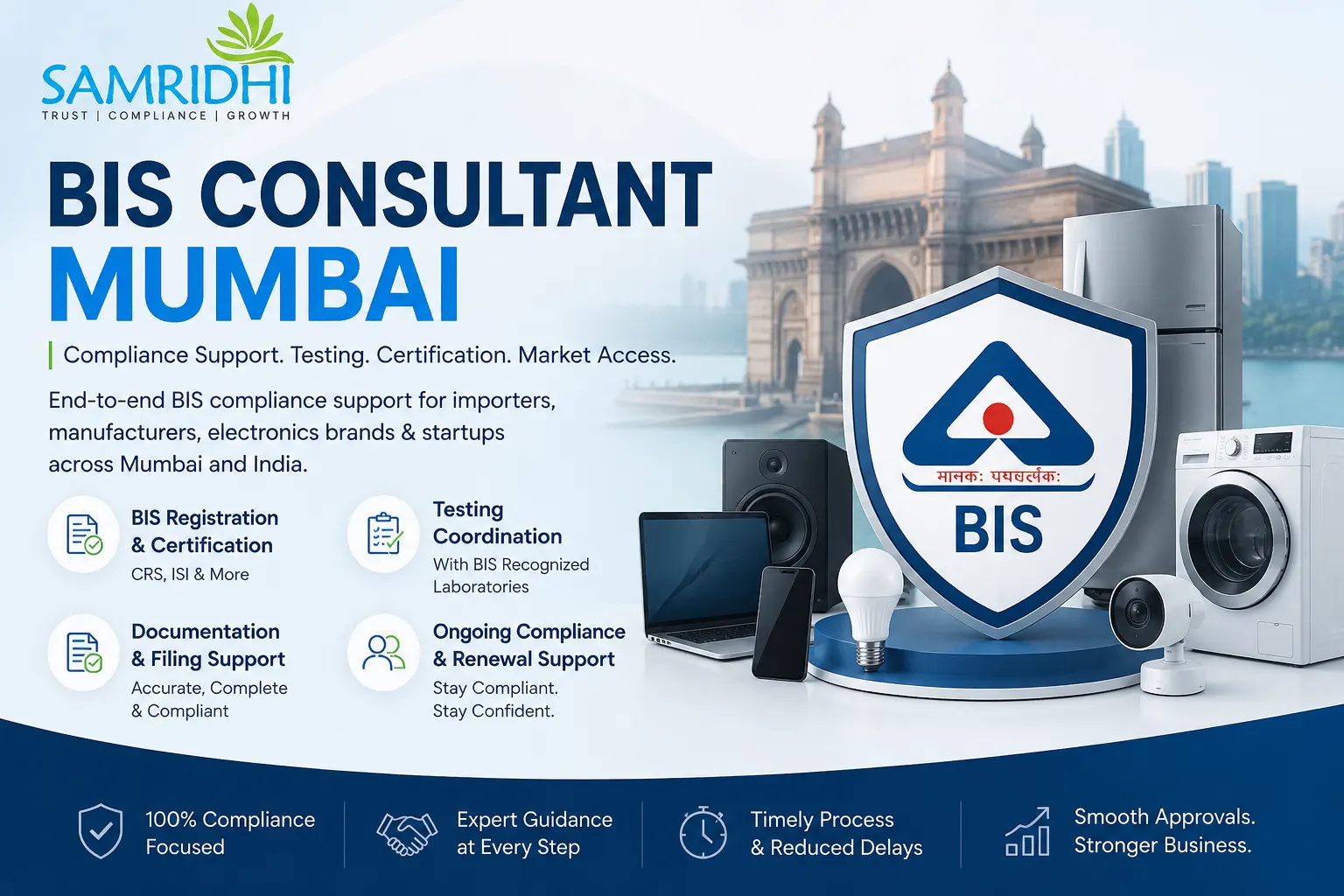
BIS CRS Registration for LED Lights ensures that LED products meet India’s mandatory safety and quality standards before entering the market. The process includes product testing at BIS-recognized labs, online application filing, regulatory scrutiny, and approval under CRS. Proper compliance protects businesses from penalties, enables legal sales, and builds market trust. For end-to-end assistance with testing, documentation, and approvals, call +91 8799708673 to get expert guidance.
 Get Certified with Confidence – Your One-Stop Compliance Partner
From BIS, WPC, TEC, BEE, EPR, LMPC, CDSCO, FSSAI, ISO, MSME to PESO, NABL testing, Startup India, Make in India, and Lab Setup, we handle all your regulatory approvals, certifications, and documentation needs with precision and speed. Partner with Samridhi Compliance Certification and simplify your journey to full compliance—so you can focus on growing your business.
BIS CRS Registration for LED Lights: Regulatory Landscape & Compliance Essentials in India
Introduction to BIS CRS Registration for LED Lights 📄⚖️
BIS CRS Registration for LED Lights is a mandatory conformity assessment requirement introduced by the Government of India to ensure that LED lighting products sold or imported into the country meet defined quality, safety, and performance standards. CRS stands for Compulsory Registration Scheme, which is administered by the Bureau of Indian Standards (BIS) under the Ministry of Electronics and Information Technology (MeitY).
Under this scheme, LED lights must be tested in BIS-recognized laboratories and registered before they can be manufactured, imported, distributed, or sold in the Indian market. The BIS registration for LED lights confirms that the product complies with relevant Indian Standards (IS), helping protect consumers from unsafe or substandard electronic products.
In simple terms, if a business wants to legally place LED bulbs, LED luminaires, or similar lighting products in India, BIS CRS registration for LED lights is not optional—it is a legal requirement.
Why BIS CRS Registration for LED Lights Is Mandatory in India 🏭
India has one of the largest and fastest-growing electronics and lighting markets in the world. With rising demand for energy-efficient LED products, the government has strengthened regulatory controls to ensure safety, quality, and energy performance.
BIS registration for LED lights is mandatory because LED products are classified as electronic products under the CRS framework. These products directly impact consumer safety due to risks such as overheating, electrical failure, fire hazards, and poor durability if not manufactured properly.
Key reasons why compliance is mandatory include:
-
Protection of consumers from unsafe or low-quality electronic products
-
Standardization of LED products across domestic and imported supply chains
-
Reduction of substandard imports affecting Indian manufacturers
-
Alignment with national quality and safety objectives
Without BIS CRS registration, LED lights cannot be legally sold, imported, or distributed in India, regardless of whether they are manufactured locally or overseas.
Who Needs BIS CRS Registration for LED Lights?
BIS CRS registration for LED lights applies to a wide range of businesses involved in the electronics and lighting ecosystem.
Manufacturers
Indian manufacturers producing LED bulbs, LED lamps, or luminaires must obtain BIS registration before commercial production and sale. BIS registration for electronic products ensures that manufacturing units follow approved standards and quality benchmarks.
Importers & Exporters
Importers bringing LED lighting products into India must ensure that the products are registered with BIS. Customs authorities often verify BIS registration during import clearance, making compliance critical for uninterrupted trade.
MSMEs & Startups
Startups and MSMEs entering the LED lighting market must also comply with BIS CRS registration for LED lights. Early compliance helps new businesses avoid launch delays, penalties, and market access restrictions.
Foreign Manufacturers
Overseas manufacturers supplying LED lights to India must register under the CRS scheme through an authorized Indian representative. BIS registration for electronic products is equally mandatory for foreign brands targeting Indian consumers.
India as a Highly Regulated Manufacturing & Import Market ⚖️
India follows a structured and tightly regulated framework for electronics, electricals, and consumer products. Regulatory bodies such as BIS, MeitY, WPC, TEC, CPCB, and DoT collectively ensure that products entering the Indian market meet safety, quality, environmental, and technical requirements.
For LED lighting products, BIS plays the central role under CRS. MeitY provides policy oversight for electronics regulation, while CPCB may become relevant if environmental or waste management aspects apply. This multi-authority ecosystem reflects India’s focus on consumer safety and sustainable manufacturing.
Because of this regulatory environment, businesses must plan compliance well in advance. BIS registration for LED lights is often one of the first approvals required before manufacturing approvals, imports, or large-scale distribution can begin.
Importance of Compliance for Manufacturing Approvals & Market Access 🏭
Obtaining BIS CRS registration for LED lights is not just a regulatory formality—it is a critical business enabler.
Manufacturing Approvals
Manufacturers require BIS registration before starting mass production. Without it, production batches may be halted, rejected, or declared non-compliant during inspections.
Import Clearance
Customs authorities regularly check BIS registration details for electronic products. Lack of registration can result in shipment detention, re-export orders, or financial penalties.
Legal Market Access
Only BIS-registered LED lights can be legally sold on e-commerce platforms, supplied to government projects, or distributed through retail channels in India.
Brand Trust & Credibility
Products bearing the BIS mark for electronics signal quality, safety, and regulatory compliance. This builds trust among distributors, institutional buyers, and end consumers.
Understanding BIS CRS Registration for LED Lights in Simple Terms
The CRS process involves product testing, documentation, and online registration through BIS systems. LED lights are tested against specific Indian Standards to verify electrical safety, performance, and reliability.
While the BIS certification cost for electronic products may vary depending on product type and testing requirements, the long-term benefits of compliance far outweigh the initial investment. Non-compliance, on the other hand, can lead to product bans, legal notices, and significant business losses.
Role of BIS Registration in India’s Electronics Ecosystem 📄
BIS registration in India acts as a gatekeeper for quality in the electronics sector. By enforcing compulsory registration for LED lights, the government ensures that both domestic and imported products compete on equal quality standards.
The BIS registration for electronic products also supports India’s broader goals of standardization, energy efficiency, and consumer protection. As LED lighting continues to replace traditional lighting systems, regulatory oversight becomes even more critical.
Why Businesses Work With Compliance Experts
The CRS framework involves technical standards, lab coordination, and precise documentation. Many businesses choose to work with BIS certification consultants or a BIS registration consultant to navigate the process efficiently. A reliable BIS certificate agent helps interpret standards, coordinate testing, and ensure correct submissions, reducing the risk of rejection or delays.
BIS CRS registration for LED lights is a mandatory regulatory requirement for any business looking to manufacture, import, or sell LED lighting products in India. It ensures compliance with Indian safety and quality standards, enables smooth market access, and protects businesses from legal and operational risks.
In a highly regulated market like India, BIS registration for LED lights is not just about meeting legal obligations—it is about building a compliant, credible, and sustainable business in the electronics sector.
Get Certified with Confidence – Your One-Stop Compliance Partner
From BIS, WPC, TEC, BEE, EPR, LMPC, CDSCO, FSSAI, ISO, MSME to PESO, NABL testing, Startup India, Make in India, and Lab Setup, we handle all your regulatory approvals, certifications, and documentation needs with precision and speed. Partner with Samridhi Compliance Certification and simplify your journey to full compliance—so you can focus on growing your business.
Business Impact & Industrial Ecosystem of BIS CRS Registration for LED Lights in India 🏭📡
Understanding the Business Relevance of BIS CRS Registration for LED Lights
BIS CRS Registration for LED Lights plays a critical role in shaping how lighting products are manufactured, imported, and sold across India. LED lights fall under the Compulsory Registration Scheme (CRS) because they are classified as electronic products that directly affect consumer safety, energy efficiency, and electrical reliability. As India rapidly shifts toward energy-efficient lighting, regulatory scrutiny around LED products has increased significantly.
From a business perspective, BIS registration for LED lights is not just a compliance requirement—it is a gatekeeping mechanism that determines whether a product can legally access the Indian market. This impacts multiple stakeholders across industries, supply chains, and business models.
Impact on Manufacturing Units 🏭
For domestic manufacturing units, BIS registration for LED lights is a foundational requirement before mass production or commercial sales can begin. Manufacturing facilities producing LED bulbs, luminaires, panels, or drivers must align their production processes with Indian Standards notified under CRS.
Without BIS registration for electronic products, manufacturers face restrictions on selling their output, even if demand exists. Compliance ensures that production lines are standardized, quality checks are enforced, and products are tested against safety benchmarks. This also helps manufacturers avoid post-production risks such as recalls, rejections, or regulatory inspections that could halt operations.
Manufacturing clusters producing electronics and lighting equipment experience higher compliance demand because regulatory audits and third-party checks are more frequent in these zones. As a result, BIS registration becomes an operational necessity rather than a one-time approval.
Impact on Importers & Exporters 📦
Importers bringing LED lighting products into India are directly affected by BIS CRS registration for LED lights. Customs authorities often verify BIS registration numbers during clearance, and shipments lacking valid registration are commonly held or rejected.
For importers, bis registration for led lights determines supply chain continuity. Delays at ports can lead to demurrage costs, missed delivery timelines, and strained distributor relationships. Export-oriented businesses sourcing LED products from overseas suppliers must also ensure that their vendors comply with BIS standards before shipping.
Exporters operating from India benefit indirectly, as BIS registration improves product credibility in global markets by demonstrating adherence to structured quality systems.
Impact on Electronics & IT Companies 📡
Electronics and IT companies that diversify into LED lighting products—such as smart lighting, IoT-enabled LEDs, or integrated electrical systems—must comply with BIS CRS norms. LED lights are often bundled with other electronic solutions, making bis certification for electronic products a cross-functional compliance requirement.
For these companies, the BIS mark for electronics signals regulatory readiness and reduces friction when entering institutional, government, or B2B procurement channels. Non-compliance can block participation in tenders or large infrastructure projects where certified products are mandatory.
Impact on Startups & MSMEs 🚀
Startups and MSMEs entering the LED lighting sector often underestimate the regulatory landscape. BIS CRS registration for LED lights is unavoidable, regardless of business size or production scale. Early-stage companies that delay compliance may face launch postponements, inventory blockage, or forced redesigns.
On the positive side, obtaining BIS registration helps startups build trust with distributors, investors, and channel partners. While the bis certification cost for electronic products may seem like an initial burden, it enables long-term scalability and smoother expansion across states and sales platforms.
MSMEs operating from industrial estates or shared manufacturing zones also face stricter monitoring, making regulatory approval a prerequisite for sustained operations.
Impact on Foreign Manufacturers Entering India 🌍
Foreign manufacturers supplying LED lights to India must register their products under CRS through an authorized Indian representative. BIS registration for LED lights is mandatory even if products are already certified in other countries.
For foreign brands, compliance determines market entry speed and acceptance. Products without BIS registration cannot be legally imported, sold online, or distributed through Indian retail networks. As India tightens enforcement on electronic imports, foreign manufacturers increasingly rely on bis certification consultants or a bis registration consultant to navigate documentation, testing, and liaison requirements.
Why BIS CRS Registration Is Unavoidable ⚖️
India’s electronics market is governed by a strong regulatory framework designed to protect consumers and ensure product standardization. BIS registration is legally enforced, not optional. Authorities such as BIS and MeitY actively monitor compliance, while customs, state regulators, and market surveillance agencies support enforcement.
For LED lights, certification is unavoidable because:
-
LED products pose electrical and fire safety risks if poorly designed
-
Energy efficiency and performance standards must be uniform
-
Substandard imports can disrupt domestic manufacturing
-
Consumer safety laws mandate preventive regulation
Ignoring BIS registration exposes businesses to penalties, seizures, and long-term reputational damage.
Industrial Hubs & Compliance Demand 🏭📦
Compliance demand is naturally higher in regions with dense manufacturing and import activity. Electronics manufacturing clusters, integrated industrial parks, ports, and SEZ-linked supply chains handle large volumes of LED and electronic products.
Ports and logistics zones face strict customs checks, making BIS registration verification routine. Industrial corridors with electronics production units also experience frequent audits and sampling. In these environments, bis registration becomes a basic operational requirement rather than a strategic choice.
Because LED lights are part of the broader electronics ecosystem, compliance expectations align closely with those for other regulated electronic products.
Role of Compliance Support in the Ecosystem 📄
Given the technical standards, testing protocols, and online filing involved, many businesses engage bis consultants or work with a bis certificate agent to manage registration efficiently. Professional guidance helps businesses interpret standards correctly, coordinate with labs, and ensure accurate submissions.
As regulations evolve and product categories expand, the role of BIS registration consultants becomes more strategic—helping businesses stay compliant while focusing on growth.
BIS CRS Registration for LED Lights has a far-reaching impact on manufacturing units, importers, electronics companies, startups, and foreign manufacturers operating in India. It directly influences market access, supply chain stability, and business credibility.
In a regulated industrial ecosystem where electronics compliance is tightly enforced, bis registration for led lights is unavoidable. Businesses that integrate compliance into their operational strategy gain a clear advantage—ensuring legal continuity, customer trust, and long-term scalability in India’s fast-growing LED lighting market.
Process, Cost, Validity & Digital Compliance for BIS CRS Registration for LED Lights 📄💻⚙️
BIS CRS Registration for LED Lights is a structured compliance process designed to ensure that LED lighting products sold in India meet prescribed safety, performance, and quality standards. Since LED lights fall under the Compulsory Registration Scheme (CRS), manufacturers and importers must complete this process before launching or importing products into the Indian market. Understanding the process, costs, validity, and digital systems involved helps businesses plan compliance smoothly and avoid operational delays.
Step-by-Step Compliance Process for BIS CRS Registration for LED Lights ⚖️
The bis registration for led lights follows a defined sequence, from determining applicability to receiving approval. Each stage requires accuracy, as errors can lead to rejection or prolonged timelines.
1️⃣ Applicability Assessment
The first step is confirming whether the product falls under CRS. Most LED lighting products such as LED bulbs, LED luminaires, LED modules, and drivers are notified under CRS. At this stage, businesses identify the applicable Indian Standard and product category under bis registration for electronic products.
This step is critical because incorrect classification can result in applying under the wrong standard, leading to rejection later.
2️⃣ Product Testing at BIS-Recognized Laboratories
Once applicability is confirmed, product samples must be tested at a BIS-recognized laboratory in India. Testing verifies compliance with safety, electrical, and performance parameters defined under the relevant Indian Standard.
For LED lights, test reports are mandatory and form the backbone of the application. This stage directly impacts the bis certification cost for electronic products, as laboratory fees depend on product type, test scope, and number of models.
3️⃣ Documentation Preparation
After testing, businesses prepare the application dossier. This typically includes:
-
Test reports from BIS-recognized labs
-
Manufacturing details
-
Factory and quality control documents
-
Authorization letters (for importers or foreign manufacturers)
Accurate documentation ensures smooth processing. Many businesses rely on bis certification consultants or a bis registration consultant at this stage to reduce the risk of document-related objections.
4️⃣ Online Application Submission
The application for bis registration for led lights is submitted through the official BIS CRS online portal. This digital system allows applicants to upload documents, track application status, and respond to queries.
During submission, applicants must ensure consistency between test reports, product labels, and application data. Any mismatch can delay approval.
5️⃣ Scrutiny & Clarifications
After submission, BIS officials review the application. They may raise queries or request clarifications related to product specifications, test results, or documentation.
Responding promptly and accurately is essential to keep the process moving. Delayed or incorrect responses often extend timelines unnecessarily.
6️⃣ Grant of BIS CRS Registration
Once the application is approved, BIS grants CRS registration, allowing the manufacturer or importer to use the bis mark for electronics on LED light products. Only after this approval can products be legally manufactured, imported, or sold in India.
Indicative Timelines for BIS CRS Registration ⏳
Timelines for bis registration for led lights vary depending on preparedness and response speed. While timelines are not guaranteed, a general indication is:
-
Product testing: 2–4 weeks
-
Documentation & application filing: 1–2 weeks
-
BIS scrutiny & approval: 3–6 weeks
Overall, the process may take 6–10 weeks, provided there are no major objections. Delays are common when documentation is incomplete or test results require revision.
Cost Components Involved 💰
The bis certification cost for electronic products is not a single fixed amount. It consists of multiple components that businesses should budget for:
🔹 Laboratory Testing Fees
This is usually the largest cost component. Fees depend on:
🔹 Government Fees
BIS charges application and registration fees as part of the CRS process. These are standardized but may change based on regulatory updates.
🔹 Professional & Coordination Costs
Many businesses engage bis consultants or a bis certificate agent to manage testing coordination, documentation, and online filing. While optional, professional support often reduces delays and rework.
🔹 Additional Costs
These may include:
Understanding these components helps businesses estimate realistic compliance budgets.
Validity, Renewal & Modifications 🔄
Once granted, BIS CRS registration for LED lights is generally valid for two years. To continue selling products legally, registration must be renewed before expiry.
🔹 Renewal
Renewal requires:
Timely renewal ensures uninterrupted use of the BIS registration.
🔹 Modifications
If there are changes in:
-
Product design
-
Manufacturing location
-
Brand name or labeling
A modification or fresh application may be required. Businesses must assess changes carefully, as unreported modifications can invalidate the registration.
Common Challenges Faced by Applicants ⚠️
Despite a defined process, businesses often face challenges such as:
-
Selecting the wrong product standard
-
Test failures due to design issues
-
Documentation mismatches
-
Delays in laboratory slots
-
Slow response to BIS queries
These challenges highlight why many applicants work with bis registration consultant services to streamline compliance.
Role of Digital Compliance Portals 💻
India’s compliance ecosystem has become increasingly digital. For BIS CRS registration, the BIS online portal plays a central role in application filing and tracking.
Other portals may become relevant depending on the product ecosystem:
-
WPC: For LED products with wireless or RF components
-
CPCB: For environmental compliance, if applicable
-
TEC: For telecom-linked devices
While bis registration is the primary requirement for LED lights, integrated digital systems mean businesses must ensure consistency across portals if multiple approvals are required.
Importance of Structured Compliance 📈
BIS CRS Registration for LED Lights is not just a regulatory formality—it is a structured compliance system that ensures product safety, consumer trust, and market discipline. Businesses that approach the process methodically benefit from faster approvals, fewer disruptions, and stronger market credibility.
With growing enforcement and expanding CRS coverage, understanding the process, costs, and digital systems behind bis registration for led lights is essential for manufacturers and importers aiming for long-term success in India’s electronics and lighting market.
Role of Professional Consultants for BIS CRS Registration for LED Lights ✅📄🏭
Navigating BIS CRS Registration for LED Lights requires more than just filling an online form. Indian compliance frameworks are document-intensive, process-driven, and strictly monitored. This is where professional consultants add real value—not as middlemen, but as compliance managers who understand regulations, standards, and evolving enforcement practices.
Consultants vs Agents
A consultant focuses on regulatory interpretation, documentation accuracy, testing coordination, and long-term compliance strategy. In contrast, an agent usually acts as a filing intermediary with limited accountability beyond submission. For businesses dealing with bis registration for led lights, consultants help reduce rejection risks, avoid misclassification, and ensure the correct Indian Standard is applied from the start.
DIY vs Expert-Managed Compliance
While BIS portals are digital, DIY compliance often leads to delays due to testing errors, incorrect declarations, or incomplete documentation. Expert-managed compliance ensures smoother approvals, predictable timelines, and proper use of the bis mark for electronics after registration. This approach is especially valuable for importers, startups, and foreign manufacturers unfamiliar with Indian regulatory workflows.
Businesses that work with experienced bis certification consultants gain clarity, compliance confidence, and long-term regulatory stability. Samridhi Compliance Certification (SAMCC) supports businesses with structured compliance planning and execution across product categories.
Get Certified with Confidence – Your One-Stop Compliance Partner
From BIS, WPC, TEC, BEE, EPR, LMPC, CDSCO, FSSAI, ISO, MSME to PESO, NABL testing, Startup India, Make in India, and Lab Setup, we handle all your regulatory approvals, certifications, and documentation needs with precision and speed. Partner with Samridhi Compliance Certification and simplify your journey to full compliance—so you can focus on growing your business.
Frequently Asked Questions
Yes. BIS CRS registration for LED lights is mandatory under the Compulsory Registration Scheme. Without bis registration for led lights, manufacturers and importers cannot legally sell or distribute LED products in India. Non-compliance can result in import clearance issues, product seizures, and market bans, regardless of whether products are locally made or imported.
Applications can be filed by manufacturers, importers, and foreign manufacturers. Importers often require authorization from the overseas factory. The process follows bis registration for electronic products guidelines and must be completed before commercial sales. Many businesses rely on a bis registration consultant to manage documentation and testing coordination.
The bis certification cost for electronic products depends on laboratory testing fees, BIS government charges, and professional coordination costs. Testing costs vary based on product type and number of models. There is no single fixed fee, which is why early cost planning with bis consultants helps avoid unexpected expenses.
Timelines typically range from 6 to 10 weeks, depending on testing duration and BIS scrutiny. Delays often occur due to documentation errors or test failures. Working with experienced bis certification consultants helps streamline approvals and reduces back-and-forth with authorities.
Yes. Changes in product design, manufacturing location, or labeling may require modification or fresh registration. Maintaining updated bis registration is critical to retain the validity of the bis mark for electronics. A bis certificate agent or consultant can help assess whether changes trigger re-approval requirements.


 Grab Your Certified Now
 +91 8799708673
 WhatsApp