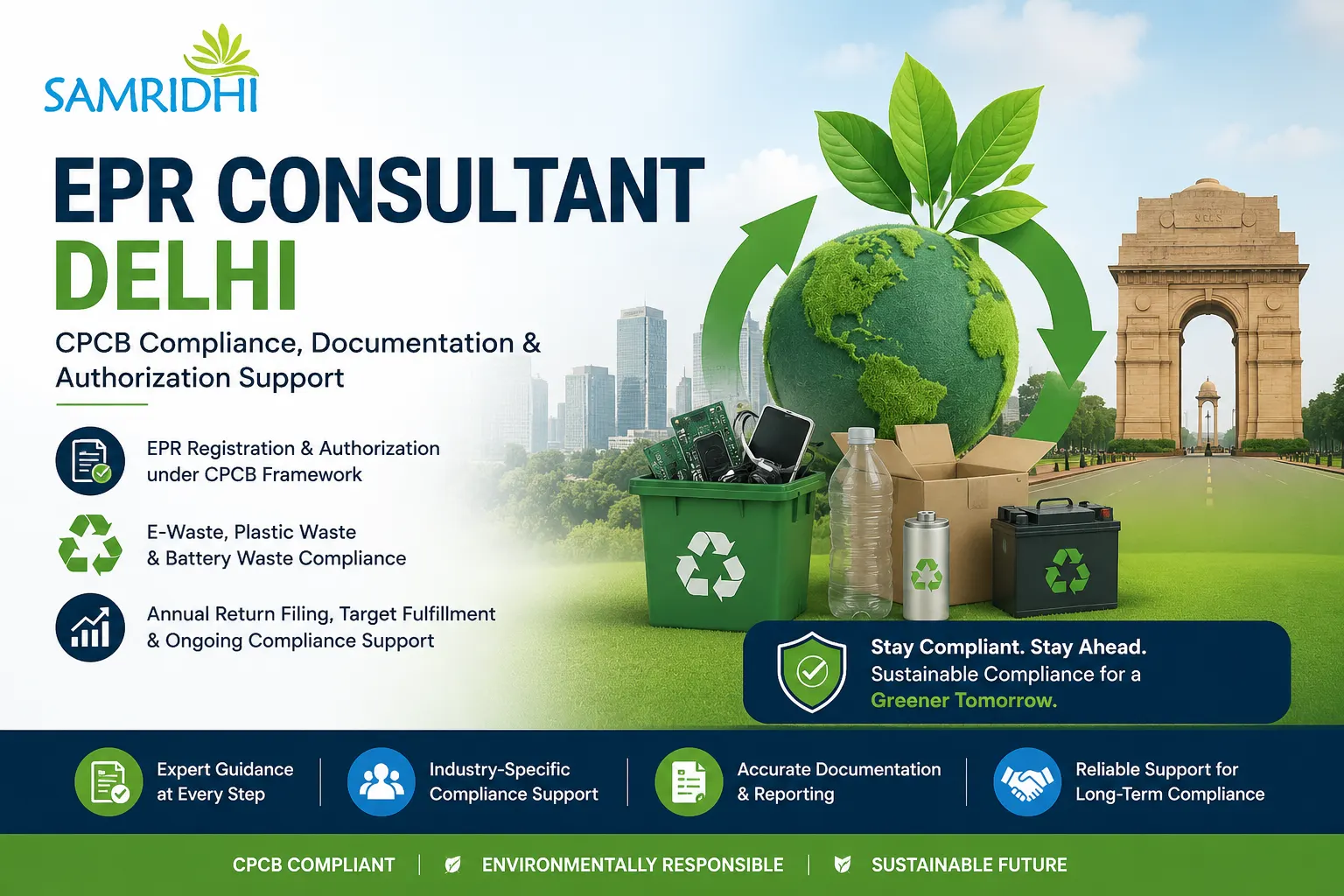
EPR Consultant Delhi – CPCB Compliance, Documentation & Authorization Support
EPR compliance support services in Delhi help importers, manufacturers, electronics brands, packaging companies, battery businesses, startups, and consumer-product companies manage CPCB registration, environmental documentation, recycler coordination, annual return filing, and long-term compliance responsibilities under E-waste, plastic waste, and battery waste regulations. The service supports businesses with applicability assessment, compliance planning, reporting workflows, target fulfillment coordination, and environmental documentation management. The main outcome is improved compliance readiness, better operational coordination, and smoother long-term environmental compliance management across India.
 Get Certified with Confidence – Your One-Stop Compliance Partner
From BIS, WPC, TEC, BEE, EPR, LMPC, CDSCO, FSSAI, ISO, MSME to PESO, NABL testing, Startup India, Make in India, and Lab Setup, we handle all your regulatory approvals, certifications, and documentation needs with precision and speed. Partner with Samridhi Compliance Certification and simplify your journey to full compliance—so you can focus on growing your business.
EPR Consultant Delhi – CPCB Compliance, Documentation & Authorization Support
Managing EPR compliance in Delhi has become increasingly important for manufacturers, importers, brand owners, producers, e-commerce sellers, and businesses handling regulated waste categories across India. As environmental compliance regulations continue evolving under CPCB frameworks, many businesses are discovering that EPR obligations now extend far beyond basic registration filing. In practice, companies often require structured support involving documentation management, recycler coordination, target fulfillment planning, annual return filing, waste-tracking systems, and long-term compliance continuity.
For businesses operating in Delhi NCR, EPR compliance challenges are especially common because the region has a large ecosystem of:
- importers
- electronics distributors
- packaging businesses
- plastic-product traders
- battery suppliers
- e-commerce brands
- consumer-goods companies
- startup-led product businesses
Many of these businesses fall under environmental compliance obligations involving:
- E-waste
- plastic waste
- battery waste
- packaging materials
- electronic products
- imported consumer goods
depending on product scope and regulatory applicability.
This is why companies increasingly look for experienced EPR Consultant Delhi support to understand how CPCB compliance requirements apply to their operational structure before imports, manufacturing expansion, or commercial distribution activities begin.
A professional EPR Registration Consultant Delhi generally helps businesses coordinate:
- EPR registration planning
- documentation alignment
- waste-category applicability assessment
- recycler and PRO coordination
- annual return support
- target-fulfillment planning
- CPCB documentation management
- long-term compliance tracking
because environmental compliance increasingly functions as an ongoing operational responsibility rather than a one-time approval process.
For electronics businesses, importers, and consumer-product brands, EPR compliance often becomes operationally complex due to supply-chain fragmentation and evolving waste-management obligations. Companies working with smart devices, consumer electronics, packaging products, batteries, or imported goods frequently require support from an experienced EPR Compliance Consultant Delhi to manage documentation consistency and regulatory coordination more effectively.
Businesses searching for E-Waste EPR Consultant Delhi services are often dealing with:
- electronics-product compliance
- recycler agreements
- CPCB portal management
- target-fulfillment obligations
- documentation synchronization
- environmental reporting requirements
while companies requiring Plastic Waste EPR Consultant Delhi support commonly face operational challenges involving packaging declarations, waste-category classification, and fulfillment coordination.
Battery importers and product manufacturers are also increasingly seeking guidance from a Battery Waste EPR Consultant Delhi because battery-related environmental regulations are becoming more structured and documentation-driven under evolving compliance frameworks.
Delhi’s importer and trading ecosystem also creates additional operational complexity because many businesses manage:
- multi-vendor sourcing
- cross-border imports
- warehouse distribution
- relabeling operations
- marketplace sales
- packaging variation management
simultaneously.
Without structured EPR planning, businesses may later face:
- documentation inconsistencies
- annual filing delays
- target-fulfillment uncertainty
- recycler coordination gaps
- compliance-tracking difficulties
- CPCB clarification requirements
especially when operating across multiple waste categories or product ecosystems.
Many companies therefore work with a structured CPCB EPR Consultant Delhi to improve operational visibility into:
- applicability obligations
- waste-management responsibilities
- reporting requirements
- annual return preparation
- authorization continuity
- compliance-document alignment
before environmental compliance issues begin affecting broader business operations.
For startups and growing consumer-product businesses in Delhi NCR, EPR compliance is also becoming increasingly relevant because environmental regulations now affect:
- product launches
- packaging strategy
- electronics distribution
- marketplace readiness
- long-term operational scalability
depending on product type and waste-generation responsibilities.
Businesses looking for EPR Authorization Consultant Delhi support are usually not only searching for registration assistance. Operationally, they often require guidance that helps reduce uncertainty involving:
- CPCB processes
- documentation preparation
- recycler coordination
- target obligations
- reporting workflows
- ongoing compliance management
because environmental compliance expectations continue evolving across regulated industries in India.
For businesses searching for the Best EPR Consultant in Delhi, the real priority is often practical operational support capable of helping companies manage environmental compliance responsibilities more systematically while maintaining documentation consistency and long-term regulatory readiness.
And since:
- EPR applicability depends on product category and waste type
- documentation requirements vary by operational scope
- fulfillment obligations may differ across waste categories
- reporting expectations evolve over time
- final approvals remain subject to authority review and CPCB evaluation
businesses operating in Delhi NCR increasingly benefit from structured environmental compliance planning instead of reactive filing-based approaches alone.
Understanding EPR Compliance Requirements in Delhi
Understanding EPR compliance requirements in Delhi has become increasingly important for manufacturers, importers, brand owners, electronics businesses, packaging companies, battery suppliers, e-commerce sellers, and consumer-product businesses operating across regulated industries in India. As CPCB environmental compliance frameworks continue evolving, many businesses are realizing that EPR obligations now involve much more than basic registration filing. In practice, companies often need structured planning involving documentation management, recycler coordination, target fulfillment tracking, annual return filing, waste-category assessment, and ongoing compliance continuity.
For businesses operating in Delhi NCR, EPR compliance becomes especially relevant because the region has a large concentration of:
- importers
- electronics distributors
- packaging suppliers
- plastic-product traders
- battery businesses
- startup-led brands
- D2C companies
- e-commerce sellers
Many of these businesses may fall under environmental compliance obligations involving:
- E-waste
- plastic waste
- battery waste
- packaging materials
- consumer electronics
- imported products
depending on operational scope, product category, and waste-generation responsibility.
This is one reason companies increasingly work with experienced EPR Consultant Delhi support before scaling imports, launching products, or expanding distribution operations in India.
A common challenge businesses face is understanding whether EPR regulations actually apply to their operational structure. Many companies initially assume environmental compliance affects only manufacturers. Operationally, EPR obligations may also affect:
- importers
- producers
- brand owners
- online sellers
- packaging entities
- electronics distributors
- battery suppliers
depending on how products enter the Indian market and how waste responsibility is classified under CPCB-related frameworks.
A professional EPR Registration Consultant Delhi generally helps businesses assess:
- applicability obligations
- waste-category classification
- registration requirements
- documentation expectations
- recycler coordination responsibilities
- annual filing obligations
- compliance lifecycle planning
before operational gaps begin creating regulatory complications later.
For electronics businesses and importers, working with an experienced E-Waste EPR Consultant Delhi is becoming increasingly important because E-waste compliance now involves multiple operational layers including:
- recycler agreements
- EPR target fulfillment
- CPCB portal coordination
- annual reporting
- documentation management
- waste-channel verification
Many businesses operating in Delhi’s electronics ecosystem face practical challenges because product sourcing, packaging, warehousing, marketplace sales, and interstate distribution often happen simultaneously across different operational partners.
Businesses searching for Plastic Waste EPR Consultant Delhi support also commonly deal with compliance questions involving:
- packaging declarations
- plastic-category classification
- recycling obligations
- packaging-material tracking
- annual reporting coordination
- target-management requirements
especially where multiple packaging layers or outsourced manufacturing structures are involved.
Battery-related environmental compliance is another growing area. Companies importing batteries, selling battery-operated products, or distributing energy-storage systems increasingly require support from a Battery Waste EPR Consultant Delhi because battery waste regulations are becoming more documentation-driven and operationally structured.
Many businesses in Delhi also underestimate the importance of long-term compliance management. EPR compliance generally continues after registration because companies may later require:
- annual return filing
- updated documentation
- target-fulfillment coordination
- recycler verification
- authorization renewal
- compliance reporting support
- operational waste tracking
This is why businesses increasingly work with a structured EPR Compliance Consultant Delhi capable of supporting both registration and ongoing environmental compliance coordination.
Delhi’s importer and trading ecosystem creates additional operational complexity because many businesses manage:
- multiple suppliers
- imported inventory
- warehouse operations
- relabeling activities
- packaging variation
- e-commerce distribution
- interstate logistics
at the same time.
Without structured compliance systems, companies may later face:
- documentation mismatches
- recycler coordination delays
- annual filing complications
- CPCB clarification requests
- target-fulfillment uncertainty
- environmental reporting gaps
especially when operating across multiple waste streams simultaneously.
Many companies therefore seek guidance from a CPCB EPR Consultant Delhi to improve visibility into:
- environmental applicability obligations
- documentation workflows
- compliance reporting expectations
- waste-management coordination
- long-term operational responsibilities
before environmental compliance issues begin affecting business continuity or market operations.
For startups and rapidly growing brands in Delhi NCR, EPR compliance is also becoming operationally important because:
- online marketplaces
- distributors
- procurement systems
- corporate buyers
- large retail ecosystems
increasingly expect businesses to maintain stronger environmental compliance readiness depending on the product category involved.
Businesses looking for the Best EPR Consultant in Delhi are therefore often not searching only for registration support. Operationally, they usually need practical guidance capable of helping them manage:
- compliance planning
- documentation alignment
- CPCB coordination
- recycler engagement
- reporting workflows
- long-term environmental responsibilities
more systematically across evolving regulatory frameworks in India.
And because:
- EPR applicability varies by waste category
- documentation expectations differ by operational structure
- target obligations depend on product volume and classification
- reporting requirements evolve periodically
- approvals remain subject to authority review and CPCB evaluation
businesses operating in Delhi increasingly benefit from structured EPR planning instead of reactive compliance management after operational challenges have already started emerging.
EPR registration services help businesses manage E-waste, plastic waste, and battery waste compliance obligations under evolving CPCB environmental frameworks.
Get Certified with Confidence – Your One-Stop Compliance Partner
From BIS, WPC, TEC, BEE, EPR, LMPC, CDSCO, FSSAI, ISO, MSME to PESO, NABL testing, Startup India, Make in India, and Lab Setup, we handle all your regulatory approvals, certifications, and documentation needs with precision and speed. Partner with Samridhi Compliance Certification and simplify your journey to full compliance—so you can focus on growing your business.
Why Businesses in Delhi Need EPR Compliance Support
Delhi NCR has become one of India’s largest importer, trading, distribution, and startup ecosystems, which is one reason environmental compliance obligations are becoming increasingly important for businesses operating in the region. Unlike smaller regional markets, companies in Delhi often manage complex supply chains involving imports, packaging operations, electronics distribution, warehouse coordination, e-commerce fulfillment, and multi-state product movement simultaneously. Because of this, EPR compliance in Delhi is rarely a simple registration activity. Operationally, it usually involves long-term coordination between producers, importers, recyclers, packaging systems, logistics operations, and reporting workflows.
This is why businesses increasingly seek experienced EPR Consultant Delhi support before compliance gaps begin affecting broader business operations.
Delhi has a particularly strong importer and trader ecosystem. Many companies operating in the region import:
- electronics products
- plastic-packaged goods
- batteries
- consumer appliances
- IT equipment
- smart devices
- FMCG products
- industrial goods
that may later trigger EPR obligations depending on the waste category and operational structure involved.
For importers, one of the biggest challenges is maintaining documentation consistency between:
- overseas suppliers
- product packaging
- inventory records
- waste declarations
- recycler coordination
- compliance reporting
Without structured systems, businesses may later face:
- documentation mismatches
- target-fulfillment uncertainty
- annual filing complications
- recycler coordination gaps
- CPCB clarification requests
especially when product sourcing and distribution activities scale quickly.
This is one reason many businesses work with experienced EPR Registration Consultant Delhi support to improve operational visibility before environmental compliance issues become more difficult to manage later.
Delhi’s startup ecosystem has also contributed significantly to growing EPR compliance demand. Many D2C brands, e-commerce sellers, electronics startups, and fast-growing product businesses initially focus heavily on:
- sourcing
- packaging
- marketplace growth
- distribution
- inventory expansion
but environmental compliance planning often receives attention much later.
Operationally, this creates risk because:
- packaging obligations
- electronics waste responsibilities
- battery compliance requirements
- annual reporting obligations
may continue increasing alongside business growth.
Startups dealing with consumer electronics and smart devices frequently require guidance from an experienced E-Waste EPR Consultant Delhi because electronic-product ecosystems often involve multiple compliance responsibilities connected to:
- product lifecycle management
- recycler coordination
- waste tracking
- target fulfillment
- CPCB reporting
Delhi’s industrial and packaging ecosystem also plays a major role. Manufacturers, private-label brands, packaging suppliers, FMCG businesses, and consumer-goods companies operating across Delhi NCR often require structured environmental compliance planning because plastic packaging obligations are becoming more documentation-driven and operationally monitored.
Businesses working with:
- packaging materials
- flexible plastics
- multilayer packaging
- consumer-product packaging
- plastic containers
frequently seek support from a Plastic Waste EPR Consultant Delhi to manage:
- packaging declarations
- waste-category classification
- target obligations
- recycler coordination
- annual reporting workflows
more systematically.
Battery-related compliance is another growing operational concern in Delhi because many importers and electronics businesses now distribute:
- portable batteries
- lithium systems
- backup power units
- battery-operated devices
- energy-storage products
across expanding commercial networks.
These businesses increasingly require support from a Battery Waste EPR Consultant Delhi because battery waste regulations now involve more structured documentation, reporting, and environmental accountability requirements.
Another reason businesses in Delhi need EPR support is the region’s highly interconnected logistics and distribution ecosystem. Many companies simultaneously manage:
- warehouse operations
- interstate supply chains
- third-party packaging
- relabeling activities
- marketplace fulfillment
- distributor coordination
- multi-vendor sourcing
This operational complexity often creates compliance gaps where:
- packaging records differ from reporting declarations
- supplier data becomes inconsistent
- waste volumes are not tracked properly
- recycler agreements remain incomplete
- annual filing information becomes fragmented
These issues are especially common among rapidly growing businesses that scale distribution faster than internal compliance systems.
Companies working with a professional EPR Compliance Consultant Delhi often improve coordination between:
- compliance teams
- operations departments
- recyclers
- packaging vendors
- import teams
- product suppliers
- reporting systems
which helps reduce long-term operational uncertainty.
Delhi’s large e-commerce and marketplace ecosystem also contributes to rising EPR awareness. Online sellers and D2C brands increasingly discover that environmental compliance obligations may affect:
- marketplace continuity
- procurement eligibility
- corporate partnerships
- distributor onboarding
- product expansion strategies
depending on the waste category involved.
Businesses searching for the Best EPR Consultant in Delhi are therefore often not looking only for filing support. Operationally, they usually require practical guidance capable of helping them manage:
- compliance applicability
- documentation workflows
- recycler engagement
- reporting obligations
- target management
- authorization continuity
- environmental risk planning
across rapidly evolving business ecosystems.
And because:
- EPR obligations vary by product category
- waste applicability depends on operational structure
- reporting requirements differ across waste streams
- target responsibilities evolve over time
- CPCB evaluation remains case-specific and subject to authority review
businesses operating in Delhi increasingly benefit from structured environmental compliance planning that reflects real operational realities instead of generic filing-focused approaches alone.
EPR compliance reporting and annual return filing support help businesses maintain environmental documentation consistency and long-term CPCB compliance readiness.
Step-by-Step EPR Registration Process in Delhi
For many businesses in Delhi NCR, EPR registration initially appears to be a straightforward compliance formality. Operationally, however, the process often involves multiple stages connected to waste-category applicability, documentation preparation, recycler coordination, CPCB portal requirements, target planning, and long-term environmental compliance management. The exact process may vary depending on:
- product category
- waste stream
- operational structure
- import activities
- packaging involvement
- producer responsibility scope
This is one reason businesses increasingly work with experienced EPR Consultant Delhi support before beginning registration or environmental reporting activities.
1. Identifying EPR Applicability
The first stage generally involves assessing whether the business falls under applicable EPR obligations. Depending on operational activities, EPR applicability may affect:
- importers
- producers
- brand owners
- manufacturers
- packaging businesses
- electronics companies
- battery suppliers
- online sellers
- consumer-product brands
Businesses commonly require guidance identifying whether obligations apply under:
- E-waste
- plastic waste
- battery waste
- packaging compliance
- CPCB environmental frameworks
because applicability depends on product category, waste generation, operational role, and market activity.
A structured EPR Registration Consultant Delhi generally helps businesses evaluate:
- operational scope
- applicable waste categories
- reporting responsibilities
- registration requirements
- environmental obligations
before formal compliance activities begin.
2. Documentation Preparation & Business Information Review
Once applicability is identified, the next stage usually involves preparing operational and compliance-related documentation. Depending on the waste category and business structure, this may include:
- company incorporation records
- GST details
- IEC records for importers
- PAN information
- product details
- packaging declarations
- brand authorization records
- waste-category information
- sales data
- operational details
- recycler agreements
Many businesses in Delhi face delays at this stage because supplier records, packaging declarations, or operational information often remain fragmented across multiple departments or vendors.
3. Waste Category Assessment & Quantity Evaluation
An important operational stage involves evaluating:
- waste type
- material category
- annual product volume
- packaging quantity
- electronic-product movement
- battery distribution scale
because EPR obligations frequently depend on how products and packaging enter the market.
Businesses working with an experienced EPR Compliance Consultant Delhi often improve accuracy during this stage by organizing:
- operational data
- inventory information
- product classifications
- packaging-material declarations
- waste-volume calculations
before compliance filings proceed further.
4. Recycler & PRO Coordination
Many EPR frameworks require businesses to coordinate with:
- authorized recyclers
- waste-management partners
- PRO organizations
- collection agencies
depending on the waste category involved.
For electronics businesses and importers, this stage can become operationally complex because recycler availability, target fulfillment structures, and documentation requirements may vary depending on product type and waste stream.
Companies seeking support from an experienced E-Waste EPR Consultant Delhi or Plastic Waste EPR Consultant Delhi often require assistance understanding:
- recycler documentation
- target-fulfillment expectations
- environmental reporting workflows
- operational coordination requirements
before long-term compliance systems are finalized.
5. CPCB Portal Registration & Application Submission
After documentation and operational planning are organized, the formal registration process generally moves toward:
- portal coordination
- application preparation
- compliance-document submission
- declaration management
- waste-category filing
- authorization-related records
This stage requires careful consistency between:
- operational details
- business declarations
- product classifications
- packaging information
- recycler coordination records
- supporting compliance documentation
because mismatches may later create clarification requests or filing delays.
A structured CPCB EPR Consultant Delhi generally helps businesses maintain better synchronization during application stages.
6. Regulatory Review & Clarification Handling
After submission, authorities may review:
- business information
- waste-category applicability
- supporting documents
- recycler coordination details
- operational declarations
- compliance records
Depending on the operational structure involved, businesses may later receive:
- clarification requests
- additional-document requirements
- reporting-related observations
- data verification questions
This is especially common for businesses operating across:
- multiple product categories
- imported goods
- packaging variations
- interstate distribution networks
- electronics ecosystems
where environmental reporting structures become more operationally layered.
7. Authorization, Registration & Compliance Continuity
If the application satisfies applicable environmental compliance expectations, EPR registration or authorization may proceed further subject to regulatory review.
However, operationally, EPR compliance usually continues after registration because businesses may later require:
- annual return filing
- target fulfillment tracking
- updated documentation
- recycler coordination
- waste-volume reporting
- authorization renewal
- compliance continuity management
This is why many companies work with a professional EPR Authorization Consultant Delhi not only for initial filing support, but also for long-term environmental compliance coordination.
Why Process Planning Matters in Delhi
Delhi’s importer, electronics, packaging, and distribution ecosystem creates additional operational complexity because many businesses simultaneously manage:
- multi-vendor sourcing
- packaging operations
- e-commerce sales
- warehouse coordination
- product imports
- interstate logistics
- consumer distribution
Without structured EPR planning, companies may later face:
- reporting inconsistencies
- target-management confusion
- recycler-document gaps
- annual filing delays
- compliance-tracking problems
- operational uncertainty
especially as environmental regulations continue becoming more documentation-driven.
Businesses searching for the Best EPR Consultant in Delhi are therefore often looking for practical operational guidance that helps organize:
- applicability assessment
- documentation workflows
- recycler coordination
- compliance reporting
- target tracking
- long-term environmental planning
more systematically.
And because:
- EPR applicability varies by waste category
- reporting obligations differ by operational structure
- target responsibilities depend on product movement
- documentation expectations evolve periodically
- final approvals remain subject to CPCB review and regulatory evaluation
businesses operating in Delhi NCR increasingly benefit from structured environmental compliance planning instead of reactive filing-only approaches after operational complications have already started emerging.
EPR Target Fulfillment Support helps businesses coordinate recycler engagement, environmental targets, and operational compliance tracking more effectively.
EPR Compliance Support for Importers in Delhi
Delhi NCR has become one of India’s largest import and distribution ecosystems, which is why EPR compliance support is increasingly important for importers handling regulated products and packaging materials entering the Indian market. Many businesses operating through Delhi manage large-scale imports involving:
- electronics products
- packaged consumer goods
- batteries
- plastic-packaged materials
- IT equipment
- smart devices
- industrial products
- e-commerce inventory
As environmental compliance frameworks continue evolving under CPCB regulations, importers are increasingly discovering that EPR obligations may apply long before products reach final consumers.
This is one reason businesses frequently work with experienced EPR Consultant Delhi support before scaling imports or expanding product distribution activities across India.
For importers, one of the biggest operational challenges is understanding how environmental responsibility applies to imported products. Many companies initially assume EPR obligations only affect domestic manufacturers. In practice, importers, brand owners, online sellers, and packaging entities may also fall under:
- E-waste compliance
- plastic waste obligations
- battery waste management requirements
- environmental reporting responsibilities
depending on the operational structure and product category involved.
Businesses working with a professional EPR Registration Consultant Delhi generally seek support understanding:
- waste-category applicability
- importer obligations
- packaging declarations
- recycler coordination
- target fulfillment expectations
- CPCB registration requirements
- environmental reporting workflows
before operational compliance gaps begin affecting broader business continuity.
Importers handling electronics and connected devices often require support from an experienced E-Waste EPR Consultant Delhi because imported electronics products frequently involve:
- lifecycle waste responsibility
- recycler coordination
- CPCB reporting
- environmental target tracking
- product-category classification
- annual return obligations
This becomes especially important for businesses importing:
- smart devices
- consumer electronics
- computer accessories
- networking equipment
- LED products
- electronic appliances
where environmental compliance responsibilities continue after product distribution begins.
Delhi’s importer ecosystem also creates operational complexity because many businesses simultaneously manage:
- overseas suppliers
- customs coordination
- warehouse operations
- relabeling activities
- online marketplace sales
- interstate logistics
- distributor networks
Without structured environmental compliance systems, companies may later face:
- packaging-record inconsistencies
- waste-volume reporting gaps
- recycler-document mismatches
- target-management uncertainty
- annual filing delays
- CPCB clarification requests
particularly when imports expand rapidly across multiple product categories.
Businesses importing packaged goods and consumer products frequently require support from a Plastic Waste EPR Consultant Delhi because packaging compliance obligations are becoming increasingly documentation-driven. Many importers face operational challenges involving:
- multilayer packaging declarations
- packaging-material classification
- imported packaging data
- waste-tracking systems
- recycler coordination
- environmental reporting consistency
especially when packaging formats vary across suppliers or imported product lines.
Battery importers are also increasingly seeking support from a Battery Waste EPR Consultant Delhi because battery-related environmental regulations now involve more structured compliance responsibilities connected to:
- collection targets
- recycler engagement
- documentation management
- annual reporting
- environmental accountability systems
For importers dealing with multiple vendors or overseas manufacturing networks, maintaining accurate environmental compliance data often becomes difficult because:
- supplier records differ
- packaging declarations vary
- product specifications change
- shipment structures evolve
- inventory systems remain fragmented
These operational inconsistencies may later affect:
- compliance reporting accuracy
- target calculations
- recycler coordination
- annual filing preparation
- CPCB review stages
This is why many businesses increasingly rely on a structured EPR Compliance Consultant Delhi capable of coordinating environmental compliance across import, packaging, logistics, and reporting operations simultaneously.
Another practical challenge importers in Delhi frequently face is integrating EPR compliance into fast-moving commercial operations. Businesses scaling rapidly through:
- e-commerce platforms
- distributor networks
- B2B supply chains
- marketplace sales
- consumer retail systems
often prioritize inventory movement and commercial expansion first, while environmental compliance systems remain underdeveloped internally.
Operationally, this creates long-term risk because environmental obligations may continue increasing alongside product volumes and market expansion.
Many importers therefore work with an experienced CPCB EPR Consultant Delhi to improve:
- operational visibility
- documentation consistency
- reporting readiness
- recycler coordination
- waste-tracking systems
- long-term compliance continuity
before environmental management issues become operationally disruptive later.
Businesses searching for the Best EPR Consultant in Delhi are therefore often looking for more than registration assistance alone. Importers usually require practical operational guidance that helps align:
- imports
- packaging records
- environmental declarations
- recycler engagement
- annual filing workflows
- compliance tracking
- authorization continuity
within increasingly regulated environmental compliance ecosystems.
And because:
- importer obligations vary by waste category
- packaging applicability depends on product structure
- reporting requirements evolve periodically
- target responsibilities differ across operational models
- approvals remain subject to CPCB evaluation and authority review
importers operating in Delhi increasingly benefit from structured EPR planning before scaling product distribution or commercial import activities across India.
EPR compliance support for imported electronics, batteries, and packaged goods helps businesses manage long-term environmental obligations across India.
Testing & Documentation Support for EPR Compliance in Delhi
For many businesses in Delhi NCR, one of the most difficult parts of EPR compliance is not the registration itself — it is maintaining accurate documentation, operational records, waste tracking, and compliance coordination over time. As environmental compliance frameworks continue becoming more structured under CPCB regulations, businesses increasingly require systematic support managing:
- operational declarations
- packaging data
- recycler documentation
- waste-volume records
- annual reporting
- compliance continuity
This is especially true for importers, electronics brands, packaging businesses, battery suppliers, startups, and consumer-product companies operating across Delhi’s large commercial ecosystem.
Businesses therefore increasingly work with experienced EPR Consultant Delhi support to organize compliance documentation before reporting gaps or operational inconsistencies begin creating regulatory complications later.
One of the biggest operational challenges companies face is documentation alignment across different business functions. In practice:
- procurement teams
- packaging vendors
- warehouse operations
- import departments
- recyclers
- distributors
- compliance teams
do not always maintain synchronized environmental records.
As a result, businesses frequently encounter issues involving:
- inconsistent packaging declarations
- incorrect waste-category classification
- missing recycler agreements
- fragmented inventory records
- inaccurate reporting data
- annual filing mismatches
These operational gaps become especially common when businesses scale quickly across multiple products or distribution channels.
A professional EPR Registration Consultant Delhi generally helps businesses improve:
- documentation structure
- reporting workflows
- waste-data organization
- operational record management
- recycler-document consistency
- compliance tracking systems
before formal reporting or CPCB submissions begin.
For electronics importers and smart-device businesses, documentation support becomes even more important because E-waste compliance often requires coordination between:
- product sales records
- importer declarations
- recycler engagement
- collection targets
- environmental reporting systems
- product lifecycle data
Businesses working with an experienced E-Waste EPR Consultant Delhi frequently require support organizing:
- E-waste records
- CPCB documentation
- recycler agreements
- operational declarations
- annual compliance reports
- target-management workflows
especially when multiple suppliers, warehouses, or product categories are involved simultaneously.
Plastic waste compliance also creates major documentation challenges for businesses operating in Delhi’s packaging and consumer-products ecosystem. Companies dealing with:
- multilayer packaging
- plastic containers
- imported packaging
- FMCG packaging
- branded consumer goods
often struggle maintaining consistency between:
- packaging procurement records
- operational declarations
- packaging-volume calculations
- waste reporting data
- recycler coordination documents
This is one reason many businesses seek support from a Plastic Waste EPR Consultant Delhi capable of organizing compliance documentation more systematically.
Battery-related environmental compliance introduces another operational layer because battery waste regulations increasingly require businesses to maintain:
- product movement records
- battery-volume declarations
- recycler coordination documents
- waste tracking data
- reporting documentation
- annual compliance information
Businesses working with a Battery Waste EPR Consultant Delhi often require guidance maintaining long-term documentation continuity as operational volumes grow over time.
Delhi’s importer and distribution ecosystem also creates practical compliance complications because many companies simultaneously manage:
- imported inventory
- warehouse transfers
- relabeling activities
- e-commerce distribution
- multi-state logistics
- supplier coordination
- packaging variation management
Without structured documentation systems, businesses may later face:
- reporting inconsistencies
- recycler-verification gaps
- annual filing delays
- CPCB clarification requests
- target-fulfillment uncertainty
- environmental audit concerns
particularly when waste streams expand across multiple product categories.
Many businesses therefore work with an experienced EPR Compliance Consultant Delhi to improve coordination between:
- compliance teams
- packaging departments
- operations teams
- recyclers
- import managers
- environmental reporting systems
because environmental compliance increasingly affects broader operational management beyond registration activities alone.
Another important area businesses often overlook is long-term compliance continuity. EPR compliance generally continues after registration because companies may later need support involving:
- annual return filing
- updated operational declarations
- revised packaging data
- recycler-document updates
- target-fulfillment reporting
- authorization renewal coordination
As businesses scale, maintaining consistency across these records becomes operationally more difficult without structured documentation processes.
This is why many companies work with a professional CPCB EPR Consultant Delhi not only for registration filing, but also for ongoing environmental compliance coordination and reporting support.
For startups and rapidly growing product businesses in Delhi NCR, documentation support is becoming particularly important because:
- product portfolios evolve quickly
- suppliers change frequently
- packaging formats vary
- sales volumes increase rapidly
- operational systems remain decentralized during growth phases
Without organized compliance systems, businesses may later struggle preparing accurate environmental reports or maintaining long-term CPCB compliance continuity.
Businesses searching for the Best EPR Consultant in Delhi are therefore often looking for practical operational support capable of helping them organize:
- environmental documentation
- waste-data tracking
- recycler coordination
- reporting workflows
- compliance records
- annual filing preparation
- operational consistency
more efficiently within increasingly regulated environmental frameworks.
And because:
- documentation requirements vary by waste category
- reporting expectations differ across operational models
- waste declarations depend on product movement
- annual filing obligations evolve periodically
- CPCB review remains subject to authority evaluation
businesses operating in Delhi increasingly benefit from structured documentation and compliance-management systems instead of reactive filing approaches after operational gaps have already started affecting reporting accuracy or regulatory readiness.
EPR Compliance Reporting & Documentation services support structured environmental reporting, operational data management, and long-term compliance continuity.
EPR Renewal & Ongoing Compliance Support in Delhi
For many businesses in Delhi NCR, EPR compliance does not end after registration or authorization approval. Operationally, environmental compliance is becoming a continuous responsibility that requires ongoing documentation management, annual reporting, recycler coordination, target fulfillment tracking, and long-term compliance continuity. As CPCB frameworks continue evolving across E-waste, plastic waste, and battery waste categories, businesses increasingly require structured support to maintain environmental compliance readiness over time.
This is one reason companies now work with experienced EPR Consultant Delhi support not only for initial registration, but also for ongoing operational compliance management.
A common misconception among businesses is that EPR registration is a one-time process.
In reality, companies may later require support involving:
- annual return filing
- authorization renewal
- target fulfillment management
- recycler-document updates
- revised packaging declarations
- waste-volume reporting
- compliance-record maintenance
- operational data synchronization
depending on the waste category and operational structure involved.
For importers and electronics businesses operating in Delhi, ongoing compliance management becomes especially important because product volumes, packaging structures, supplier ecosystems, and distribution networks often evolve rapidly after initial registration.
Businesses working with an experienced EPR Registration Consultant Delhi frequently seek support maintaining:
- compliance continuity
- reporting consistency
- documentation alignment
- recycler coordination
- operational record accuracy
as commercial operations expand over time.
For electronics companies and smart-device importers, ongoing environmental compliance can become operationally complex because E-waste obligations often continue across:
- product lifecycle tracking
- recycler engagement
- target management
- CPCB reporting
- annual filing preparation
- operational waste coordination
Businesses requiring support from an E-Waste EPR Consultant Delhi often need long-term assistance organizing:
- sales-related environmental data
- recycler records
- waste-channel verification
- annual return workflows
- target fulfillment documentation
particularly when operating across multiple product categories or distribution regions simultaneously.
Plastic waste compliance also creates long-term operational responsibilities for businesses managing:
- consumer-product packaging
- multilayer plastics
- imported packaging
- FMCG distribution
- branded packaging systems
Over time, packaging structures, product lines, and procurement systems frequently change. Without structured compliance management, businesses may later face:
- packaging-data inconsistencies
- reporting mismatches
- recycler-document gaps
- target-fulfillment confusion
- annual filing delays
This is why many companies rely on an experienced Plastic Waste EPR Consultant Delhi to maintain documentation continuity and environmental reporting accuracy across changing operational conditions.
Battery waste compliance is another growing area where ongoing management has become increasingly important. Businesses importing or distributing:
- portable batteries
- lithium products
- battery-operated devices
- energy-storage systems
often require continuous support from a Battery Waste EPR Consultant Delhi because battery waste regulations increasingly involve:
- collection targets
- recycler coordination
- annual environmental reporting
- operational tracking systems
- documentation continuity
over extended compliance cycles.
Delhi’s importer and trading ecosystem adds additional complexity because businesses frequently manage:
- multi-vendor sourcing
- warehouse transfers
- e-commerce operations
- interstate logistics
- relabeling activities
- packaging variation
- changing supplier structures
simultaneously.
Without organized compliance systems, companies may later struggle with:
- annual return preparation
- recycler coordination delays
- environmental reporting gaps
- target-management uncertainty
- authorization continuity
- CPCB clarification requests
especially when operational growth outpaces internal compliance management systems.
Businesses working with a professional EPR Compliance Consultant Delhi often improve coordination between:
- compliance teams
- operations departments
- packaging vendors
- recyclers
- distributors
- import managers
- environmental reporting systems
which helps maintain better long-term compliance visibility.
Another important operational challenge businesses face is adapting compliance systems as regulations evolve. CPCB environmental frameworks continue changing across:
- reporting formats
- waste classifications
- target structures
- recycler expectations
- documentation standards
As a result, businesses increasingly require ongoing guidance from a structured CPCB EPR Consultant Delhi to monitor evolving compliance expectations and reduce operational uncertainty.
For startups and growing brands in Delhi NCR, long-term environmental compliance becomes especially important because:
- sales volumes increase
- product portfolios expand
- packaging systems evolve
- marketplace distribution grows
- operational complexity increases
Without proper lifecycle compliance planning, businesses may later face operational disruption during annual reporting or environmental audits.
This is why many businesses now work with an EPR Authorization Consultant Delhi for:
- renewal coordination
- annual filing support
- documentation updates
- recycler verification
- compliance continuity planning
- environmental reporting management
instead of treating EPR compliance as a standalone registration event.
Businesses searching for the Best EPR Consultant in Delhi are therefore often looking for operational guidance capable of helping them maintain:
- long-term compliance continuity
- reporting readiness
- environmental documentation consistency
- recycler coordination
- target tracking
- authorization management
within increasingly regulated environmental ecosystems.
And because:
- renewal obligations vary by waste category
- target responsibilities evolve over time
- reporting requirements may change periodically
- documentation expectations depend on operational scale
- final compliance status remains subject to CPCB review and authority evaluation
businesses operating in Delhi increasingly benefit from structured lifecycle-based environmental compliance planning rather than reactive reporting management after operational gaps have already emerged.
EPR Authorization Renewal and Annual Return Filing services help businesses maintain long-term environmental compliance continuity and reporting readiness.
Documents Required for EPR Registration in Delhi
One of the most common reasons businesses face delays during EPR registration or environmental compliance filing is incomplete or inconsistent documentation. For manufacturers, importers, electronics brands, packaging companies, startups, and consumer-product businesses operating in Delhi NCR, documentation management has become one of the most operationally sensitive parts of the EPR compliance process. Even when businesses are aware of their environmental obligations, missing records, inaccurate declarations, fragmented packaging data, or inconsistent recycler documentation can create complications during CPCB review, annual reporting, or authorization stages.
This is one reason companies increasingly work with experienced EPR Consultant Delhi support before initiating registration or environmental reporting activities.
The exact documentation requirements generally depend on:
- waste category
- operational structure
- product type
- importer status
- packaging involvement
- sales model
- CPCB applicability scope
Because environmental obligations vary across different business models, companies often require structured guidance from professional EPR Registration Consultant Delhi support to ensure documentation remains properly aligned throughout the compliance lifecycle.
Below are some of the commonly required documents businesses may need during EPR registration and environmental compliance management in Delhi.
Business Registration & Organizational Documents
Most EPR registration processes require basic organizational and business-related records such as:
- company incorporation certificate
- GST registration
- PAN details
- authorized signatory documents
- office address proof
- IEC certificate for importers
- CIN details
- business authorization records
For importers and overseas-product businesses, additional operational records may also become relevant depending on product category and waste applicability.
Product & Operational Information
Businesses usually need to provide operational details connected to:
- products sold
- imported inventory
- packaging structure
- product categories
- material composition
- operational scope
- distribution channels
Many companies face operational challenges at this stage because product information is often scattered across suppliers, warehouses, procurement systems, and packaging vendors.
A structured EPR Compliance Consultant Delhi generally helps businesses organize operational records more systematically before filing stages begin.
Packaging & Waste Category Documents
For plastic waste compliance and packaging-related obligations, businesses may require:
- packaging declarations
- plastic-material details
- packaging breakup information
- multilayer packaging data
- packaging-weight calculations
- supplier packaging records
- waste-category classification details
Businesses seeking support from a Plastic Waste EPR Consultant Delhi often require additional guidance because packaging structures may vary significantly across product lines and imported inventory.
E-Waste & Electronics Compliance Records
Electronics businesses and importers commonly require:
- product-category details
- electronic-product declarations
- sales-volume information
- inventory movement records
- product-specification references
- environmental responsibility declarations
Companies working with an experienced E-Waste EPR Consultant Delhi frequently need help coordinating documentation between:
- electronics suppliers
- import teams
- warehouse systems
- recycler partners
- environmental reporting workflows
because E-waste compliance generally involves ongoing lifecycle responsibility management.
Battery Waste Compliance Documents
Battery-related EPR obligations may require businesses to maintain:
- battery-product declarations
- importer records
- battery-type classifications
- quantity details
- operational sales information
- environmental accountability records
Businesses seeking support from a Battery Waste EPR Consultant Delhi often require structured documentation planning because battery waste regulations increasingly involve more detailed reporting and operational tracking requirements.
Recycler & PRO Coordination Documents
Many EPR frameworks also require businesses to maintain:
- recycler agreements
- waste-management partner records
- PRO coordination documents
- environmental processing declarations
- collection-related records
- target fulfillment documentation
Without proper recycler-document management, businesses may later face:
- reporting inconsistencies
- target-tracking gaps
- CPCB clarification requests
- annual filing complications
especially when operating across multiple waste categories simultaneously.
Importer & Distribution-Related Documents
Delhi’s importer ecosystem creates additional documentation requirements because many companies manage:
- imported inventory
- multi-vendor sourcing
- e-commerce fulfillment
- interstate distribution
- packaging variations
- relabeling operations
As a result, importers frequently need:
- IEC documentation
- supplier declarations
- product-volume records
- inventory movement information
- operational sales data
- imported packaging details
Businesses working with a professional CPCB EPR Consultant Delhi often improve documentation consistency across these operational areas before annual reporting or compliance filings begin.
Why Documentation Accuracy Matters in Delhi
Delhi NCR has a highly interconnected importer, packaging, electronics, and distribution ecosystem. Many businesses simultaneously coordinate:
- warehouses
- suppliers
- marketplace operations
- packaging vendors
- logistics partners
- recyclers
- distributors
Without organized documentation systems, companies may later struggle with:
- inaccurate waste declarations
- annual filing delays
- target-fulfillment mismatches
- environmental reporting inconsistencies
- recycler-document gaps
- CPCB scrutiny
particularly when operational growth expands faster than internal compliance management systems.
This is why many businesses increasingly rely on experienced EPR Authorization Consultant Delhi support for:
- document preparation
- operational-data organization
- reporting consistency
- compliance-record maintenance
- annual filing readiness
- long-term documentation continuity
instead of handling environmental compliance reactively.
Another important operational challenge businesses often underestimate is ongoing documentation maintenance. Environmental compliance usually continues after registration because:
- product portfolios evolve
- packaging structures change
- suppliers vary
- operational volumes increase
- waste obligations expand
Over time, businesses may require updated:
- declarations
- reporting records
- packaging information
- recycler agreements
- operational data
- target-management documents
to maintain compliance continuity.
Businesses searching for the Best EPR Consultant in Delhi are therefore often looking for practical operational guidance capable of helping them maintain:
- documentation accuracy
- reporting readiness
- recycler coordination
- environmental data consistency
- long-term compliance continuity
within increasingly regulated environmental ecosystems.
And because:
Get Certified with Confidence – Your One-Stop Compliance Partner
From BIS, WPC, TEC, BEE, EPR, LMPC, CDSCO, FSSAI, ISO, MSME to PESO, NABL testing, Startup India, Make in India, and Lab Setup, we handle all your regulatory approvals, certifications, and documentation needs with precision and speed. Partner with Samridhi Compliance Certification and simplify your journey to full compliance—so you can focus on growing your business.


 Grab Your Certified Now
 +91 8799708673
 WhatsApp