 Get Certified with Confidence – Your One-Stop Compliance Partner
From BIS, WPC, TEC, BEE, EPR, LMPC, CDSCO, FSSAI, ISO, MSME to PESO, NABL testing, Startup India, Make in India, and Lab Setup, we handle all your regulatory approvals, certifications, and documentation needs with precision and speed. Partner with Samridhi Compliance Certification and simplify your journey to full compliance—so you can focus on growing your business.
BIS Certification for Importers in India 📄⚖️🏭
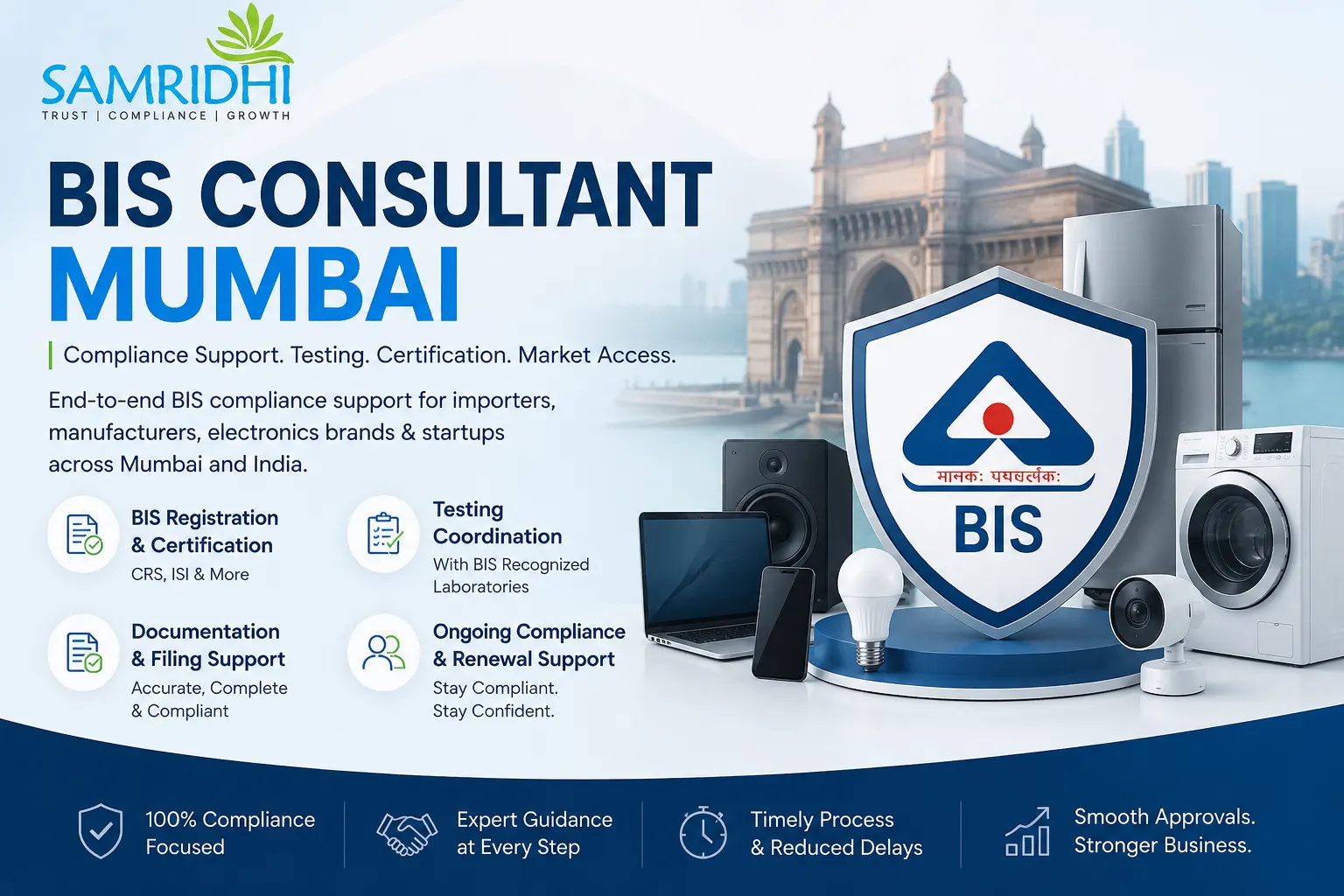
BIS Certification for Importers in India is a regulatory requirement that ensures imported products meet Indian quality, safety, and performance standards before they enter the domestic market. BIS stands for the Bureau of Indian Standards, the national standards body of India. For importers, this certification confirms that goods manufactured outside India comply with the same standards applicable to domestic products. In simple terms, it protects Indian consumers, supports fair trade, and prevents the entry of substandard or unsafe products into the country.
Under Indian regulations, bis certification for import is not optional for notified products. If an imported product falls under a mandatory category, it cannot be cleared at customs or sold in India without valid BIS approval. This makes compliance a critical responsibility for importers, distributors, and brand owners operating in the Indian market.
Why BIS Certification Is Mandatory or Important for Imports
India has steadily strengthened its regulatory framework to ensure product quality, consumer safety, and traceability. As a result, mandatory bis for import applies to a wide range of products, including electronics, steel items, chemicals, toys, batteries, and household goods. The objective is to ensure that imported goods are not inferior to locally manufactured products.
Bis required for import helps the government control unsafe imports, reduce quality-related disputes, and maintain uniform standards across industries. For importers, BIS approval is often the final clearance checkpoint at customs. Without it, shipments can be detained, rejected, or even ordered for re-export or destruction, leading to heavy financial losses.
Who Needs BIS Certification for Importers in India
Manufacturers
Overseas manufacturers supplying goods to India must obtain BIS approval if their products fall under mandatory certification. In such cases, certification is usually issued under specific BIS schemes applicable to foreign manufacturing units, ensuring that production processes and product quality align with Indian standards.
Importers & Exporters
Importers are directly responsible for ensuring that bis certificate required for import is obtained before shipment arrives in India. Even if the manufacturer holds certification, importers must ensure it is valid, updated, and applicable to the exact product model being imported.
MSMEs & Startups
Small businesses and startups often enter the import market with limited regulatory knowledge. However, bis certification for indian importers applies equally to MSMEs. Early compliance helps these businesses avoid delays, penalties, and reputational damage during market entry.
Foreign Manufacturers
Foreign manufacturers exporting to India must comply with bis certification for imported goods if their products are regulated. This ensures a level playing field between domestic and international suppliers and supports India’s quality-first manufacturing ecosystem.
India as a Highly Regulated Import and Manufacturing Market
India is one of the most regulated markets globally due to its large consumer base, diverse product usage conditions, and safety priorities. Regulatory authorities closely monitor imports to ensure public safety, environmental protection, and technical compliance. Bodies such as BIS, WPC, TEC, CPCB, MeitY, and DoT collectively shape India’s compliance ecosystem.
For example, BIS focuses on product quality standards, WPC manages wireless and radio frequency compliance, TEC oversees telecom equipment approvals, CPCB regulates environmental norms, and MeitY and DoT supervise electronics and digital infrastructure. This multi-authority structure explains why bis certification for import is treated as a non-negotiable requirement for regulated products.
Importance of Compliance for Manufacturing Approvals and Imports
Compliance with BIS standards is not limited to customs clearance. It directly impacts manufacturing approvals, distribution partnerships, and long-term business continuity. Products listed under the bis mandatory list for import must meet specific Indian Standards (IS) before they can be sold, advertised, or used in industrial projects.
For importers dealing in metals and construction materials, bis certification for import of steel is particularly important. Steel products are heavily regulated due to their structural and safety implications. Non-compliant imports can compromise infrastructure quality and pose serious safety risks, which is why enforcement in this segment is strict.
Understanding the BIS Certification Process for Importers
The bis certification process for importers typically involves identifying applicable standards, coordinating product testing in BIS-recognized laboratories, submitting technical documentation, and obtaining approval from BIS. Importers must ensure that the product specifications, labeling, and test results match Indian requirements exactly.
If a product appears in the bis certificate required for import item list, certification must be completed before import. Attempting to apply after shipment arrival often leads to detention and costly delays. This is why proactive compliance planning is essential for import-focused businesses.
Role of BIS Certification in Market Access and Brand Trust
BIS approval is more than a regulatory formality. It signals quality assurance to distributors, retailers, government buyers, and end consumers. Products with BIS marks are perceived as reliable and safe, which strengthens brand credibility and supports long-term growth in the Indian market.
For bis certification for imported goods, compliance also simplifies future expansions. Once a product is certified, importers can scale distribution, participate in tenders, and enter organized retail channels without repeated regulatory hurdles.
Bis certification for import is a foundational requirement for any business bringing regulated products into India. Whether you are importing consumer goods, industrial materials, or electronic products, understanding and complying with BIS rules is essential. With India expanding its bis mandatory list for import regularly, staying informed and compliant is the only way to ensure smooth customs clearance, uninterrupted sales, and sustainable business operations.
By aligning with BIS standards early, importers protect their investments, maintain regulatory confidence, and build a strong foundation for growth in one of the world’s most dynamic markets.
Get Certified with Confidence – Your One-Stop Compliance Partner
From BIS, WPC, TEC, BEE, EPR, LMPC, CDSCO, FSSAI, ISO, MSME to PESO, NABL testing, Startup India, Make in India, and Lab Setup, we handle all your regulatory approvals, certifications, and documentation needs with precision and speed. Partner with Samridhi Compliance Certification and simplify your journey to full compliance—so you can focus on growing your business.
Business Landscape & Industry Context of BIS Certification for Importers in India 🏭📦📡
Understanding the Business Impact of BIS Certification for Importers
BIS certification for import plays a decisive role in shaping how businesses enter, operate, and scale within the Indian market. As India continues to strengthen its quality and safety regulations, importers are no longer seen as mere traders but as responsible market participants accountable for product compliance. This regulatory shift directly affects multiple business segments, from manufacturing-linked imports to finished consumer goods, making certification an unavoidable part of import strategy.
For businesses importing regulated products, bis certification for import is not just a clearance requirement but a market-access gateway. Without it, supply chains break, investments stall, and commercial plans face uncertainty. As enforcement becomes stricter, compliance is now a business necessity rather than a regulatory formality.
Impact on Manufacturing Units Linked to Imports
Manufacturing units that rely on imported raw materials, components, or semi-finished goods are directly impacted by BIS norms. Many such inputs fall under the bis certificate required for import item list, especially steel products, electronic components, and industrial materials. If these imports lack certification, production schedules can be disrupted, leading to downtime and cost overruns.
In sectors like infrastructure, automotive, and heavy engineering, bis certification for import of steel is particularly critical. Steel used in construction and manufacturing must meet Indian standards to ensure safety and durability. This makes mandatory bis for import an operational requirement for manufacturers who depend on foreign suppliers.
Impact on Importers & Exporters
Importers are the most directly affected stakeholders in the compliance ecosystem. Indian regulations place the responsibility of certification squarely on the importer, even if the manufacturer is overseas. This is why bis certification for indian importers has become a core compliance obligation.
Export-oriented companies importing components for assembly or re-export also need to comply if goods are cleared for domestic use. Customs authorities verify whether bis required for import applies to the product category before allowing clearance. Any mismatch between product specifications and BIS approval can result in shipment detention, making bis certification process for importers a critical business workflow.
Impact on Electronics & IT Companies
Electronics and IT companies face one of the highest compliance burdens in India. A wide range of electronic products fall under mandatory BIS schemes, and many also require parallel approvals from other authorities. For such companies, bis certification for imported goods ensures that products meet Indian safety, performance, and quality benchmarks.
Electronics importers must carefully track the bis mandatory list for import, as new products are frequently added. Non-compliance can lead to blocked consignments, delayed launches, and loss of competitive advantage in fast-moving technology markets.
Impact on Startups & MSMEs
Startups and MSMEs often enter the import business with innovative products or niche offerings. However, limited regulatory awareness can become a growth barrier. Bis certification for import applies equally to small businesses, regardless of scale or turnover.
For MSMEs, early compliance planning reduces risk and builds credibility with distributors, investors, and customers. Understanding whether a product appears in the bis certificate required for import item list helps startups avoid unexpected compliance costs and operational delays that can strain limited resources.
Impact on Foreign Manufacturers Entering India
Foreign manufacturers looking to access the Indian market must align with Indian standards through their importer or authorized representative. Bis certification for imported goods ensures that overseas products compete fairly with domestic manufacturers while maintaining safety and quality consistency.
As India positions itself as a regulated yet opportunity-rich market, foreign brands that proactively address mandatory bis for import gain smoother entry, faster approvals, and stronger partnerships with Indian importers and distributors.
Why Certification Is Unavoidable for Businesses
Certification is unavoidable because Indian regulators increasingly link compliance to consumer safety, infrastructure reliability, and national quality objectives. Products listed under the bis mandatory list for import cannot legally enter the market without approval, regardless of international certifications or testing done abroad.
Customs clearance systems are now digitally integrated with regulatory databases, making it easier to flag non-compliant imports. This is why bis required for import is treated as a gatekeeping mechanism rather than a post-import formality.
Industrial Hubs and Compliance Demand
India’s industrial ecosystem includes manufacturing clusters, electronics hubs, ports, and Special Economic Zones (SEZs) that handle high volumes of imports. These zones experience higher compliance scrutiny because of the scale and diversity of goods entering the country.
Ports handling steel, electronics, and consumer goods imports frequently encounter products covered under bis certification for import of steel and other regulated categories. As a result, importers operating through these hubs must ensure documentation and certification are in place before shipment arrival to avoid bottlenecks.
Sector-Specific Compliance Pressures
Different industries face different compliance pressures. Electronics imports require BIS approval alongside other technical clearances. Industrial materials like steel and chemicals face product-specific standards. Consumer goods imports are closely monitored for safety and labeling compliance.
Across sectors, bis certification for import acts as a common regulatory foundation. Businesses that understand sector-specific standards and integrate certification into their sourcing strategy are better positioned to manage risk and scale operations.
Strategic Importance for Long-Term Business Growth
From a business perspective, compliance enables predictability. Companies that align with bis certification process for importers can plan inventory, pricing, and distribution more effectively. Certified products gain easier acceptance across retail, government procurement, and institutional sales channels.
In contrast, ignoring mandatory bis for import exposes businesses to regulatory shocks, financial losses, and reputational damage. As India continues expanding its regulatory scope, compliance will increasingly define which importers succeed sustainably in the market.
Business Insight
Bis certification for import is now embedded in India’s business and industrial ecosystem. Whether you are a manufacturer dependent on imports, a technology company, an MSME, or a foreign brand entering India, certification determines market access and operational continuity. Understanding industry-specific requirements and the locations where compliance demand is highest allows businesses to treat certification not as an obstacle, but as a strategic enabler for growth in India’s regulated economy.
Process, Cost, Validity & Digital Compliance for BIS Certification for Importers in India 📄💻⚙️
Understanding the BIS certification for import process is essential for businesses that want smooth customs clearance and uninterrupted market access in India. The system is structured, documentation-heavy, and increasingly digital. Importers who clearly understand the steps, costs, timelines, and compliance platforms are better prepared to avoid delays, penalties, and shipment holds.
Step-by-Step BIS Certification Process for Importers
The bis certification process for importers follows a defined workflow, starting from product applicability and ending with license or registration approval. While the exact route depends on the product category, the core stages remain similar.
1️⃣ Applicability Assessment
The first step is identifying whether the imported product falls under mandatory bis for import. Indian authorities notify regulated items through official orders and updates. Importers must verify if their product appears in the bis certificate required for import item list or the bis mandatory list for import.
This step helps determine:
-
Applicable Indian Standards
-
Certification scheme (ISI, CRS, FMCS, etc.)
-
Whether testing in India or abroad is required
2️⃣ Product Standard Identification
Once applicability is confirmed, the relevant Indian Standard is identified. This is critical because bis required for import is linked to exact technical specifications. Any mismatch between the product and the standard can lead to rejection or re-testing.
3️⃣ Sample Testing & Evaluation
Product samples are tested in BIS-recognized laboratories. Testing ensures that the imported goods meet Indian quality, safety, and performance benchmarks. For regulated materials like steel, bis certification for import of steel involves strict mechanical and chemical testing.
For electronics or consumer products, testing validates electrical safety and performance, which is essential for bis certification for imported goods.
4️⃣ Documentation & Application Filing
After successful testing, importers submit the application along with technical documents, test reports, factory details, and authorization letters. This step formally initiates the bis certification for import approval process.
Accuracy in documentation is critical, as incomplete or inconsistent records are one of the most common causes of delays for bis certification for indian importers.
5️⃣ Scrutiny, Clarifications & Approval
BIS reviews the application, may seek clarifications, and verifies compliance with standards. Once satisfied, approval is granted in the form of a license or registration, allowing legal import and sale in India.
Indicative Timelines (Non-Guaranteed)
Timelines for bis certification for import depend on product type, testing duration, and documentation readiness. On average:
-
Applicability assessment: 5–7 working days
-
Product testing: 2–4 weeks
-
Application review & approval: 3–6 weeks
Delays can occur if products fall under frequently updated categories in the bis mandatory list for import or if re-testing is required.
Common Challenges Faced by Importers
Despite a defined framework, importers often face challenges during the bis certification process for importers, such as:
-
Misinterpretation of whether mandatory bis for import applies
-
Delays in laboratory testing slots
-
Rejections due to minor documentation errors
-
Frequent updates to the bis certificate required for import item list
-
Coordination issues with overseas manufacturers
These challenges highlight why early compliance planning is essential for bis certification for imported goods.
Cost Components Involved in BIS Certification
The cost of bis certification for import is not a single fixed amount. It depends on multiple components, including:
🔹 Testing Costs
Laboratory testing charges vary by product type and standard. Products like steel, electronics, or safety-critical goods usually have higher testing requirements.
🔹 Government Fees
BIS charges application fees, license or registration fees, and annual marking fees where applicable. These are mandatory costs for bis certification for indian importers.
🔹 Coordination & Compliance Costs
These include expenses related to document preparation, follow-ups, technical clarifications, and coordination with laboratories and authorities.
Because cost varies by product and scheme, businesses importing items under the bis mandatory list for import should budget for compliance early in their import planning.
Validity, Renewal & Modification Requirements
The validity of bis certification for import depends on the certification scheme:
Importers must apply for renewal before expiry to avoid suspension. Any change in product design, manufacturer details, or specifications may require modification approval, even during validity.
Failure to renew on time can invalidate bis required for import, leading to shipment holds or legal action.
Digital Compliance Ecosystem in India
India’s compliance framework has moved rapidly toward digital governance. Importers now interact with multiple online portals during the bis certification process for importers.
🔹 BIS Online Systems
BIS applications, tracking, renewals, and communications are managed digitally. Importers can monitor application status and respond to queries online, making bis certification for import more transparent but also more documentation-driven.
🔹 WPC Portal (Contextual)
Products with wireless or radio features often require WPC approval in parallel. Importers dealing with electronics must align bis certification for imported goods with WPC clearance timelines.
🔹 CPCB & Environmental Platforms
Certain imports may also require environmental approvals, especially products with batteries or hazardous components. Coordination between BIS and CPCB portals is increasingly common.
🔹 TEC Systems (Telecom Products)
Telecom and networking equipment may require TEC approvals alongside BIS compliance, adding another digital layer for bis certification for indian importers.
Why Digital Compliance Demands Precision
Digital portals reduce manual intervention but increase the importance of accuracy. Incorrect uploads, inconsistent data, or missed deadlines can stall approvals. As authorities cross-verify data across systems, compliance errors are easier to detect.
For businesses importing products listed in the bis certificate required for import item list, digital preparedness is now as important as technical compliance.
Practical Compliance Insight
The bis certification for import process is systematic but unforgiving of errors. Importers who understand applicability early, plan testing timelines, and manage digital documentation carefully experience smoother approvals. With expanding product coverage under the bis mandatory list for import, compliance should be treated as a core business process rather than a last-minute requirement.
By aligning cost planning, renewal tracking, and digital portal management, importers can turn certification into a predictable and manageable part of their India entry strategy, ensuring long-term operational stability in a highly regulated market.
Advantages, Risks & Future Potential of BIS Certification for Importers in India ⚖️📈⚠️
The Indian import ecosystem is becoming more regulated every year, with quality, safety, and standardization placed at the center of trade policy. In this environment, bis certification for import is no longer a procedural formality but a strategic business requirement. Understanding its advantages, risks of non-compliance, and future scope helps importers make informed, long-term decisions.
Advantages of BIS Certification for Importers
1️⃣ Legal Market Entry and Continuity
The most direct advantage of bis certification for import is legal permission to bring regulated products into India. When a product falls under mandatory bis for import, certification becomes the foundation for customs clearance and domestic sale. Without it, shipments can be detained, rejected, or ordered for re-export.
For businesses importing regulated products regularly, certification ensures continuity of operations and prevents sudden disruptions.
2️⃣ Faster Customs Clearance
Customs authorities increasingly rely on digital compliance checks. Products with valid BIS approval move faster through clearance because documentation aligns with the bis certificate required for import item list. This reduces demurrage costs, port storage charges, and delivery delays.
For high-volume importers, time saved at ports directly impacts profitability.
3️⃣ Quality Assurance and Reduced Liability
Compliance confirms that imported goods meet Indian safety and quality standards. This reduces the risk of product failures, recalls, or consumer complaints. For sensitive categories such as steel, electrical goods, or consumer products, bis certification for imported goods protects importers from legal disputes and reputational damage.
4️⃣ Business Credibility and Trust
Importers holding valid certification are viewed as reliable by distributors, retailers, and institutional buyers. For bis certification for indian importers, this credibility often translates into easier partnerships, better contract terms, and long-term business relationships.
Benefits Across Different Business Types
🔹 Importers & Traders
For importers, bis certification for import provides operational certainty. It enables predictable supply chains, stable pricing, and confidence when expanding product portfolios under the bis mandatory list for import.
🔹 Manufacturers (Domestic & Overseas)
Manufacturers supplying to India depend on their import partners’ compliance. Certification helps manufacturers avoid shipment rejections and ensures uninterrupted access to one of the world’s fastest-growing markets.
🔹 MSMEs & Startups
Although compliance may seem complex initially, early adoption of mandatory bis for import helps MSMEs avoid costly mistakes. Certified imports allow startups to scale confidently without regulatory surprises.
🔹 Foreign Companies Entering India
For foreign brands, bis required for import is a gateway to the Indian market. Certification demonstrates commitment to Indian regulations, helping brands establish trust with regulators and consumers alike.
Risks and Disadvantages of Non-Compliance
Ignoring bis certification for import exposes businesses to significant operational and financial risks.
1️⃣ Shipment Detention and Rejection
Products listed under the bis certificate required for import item list are subject to strict scrutiny. Non-compliant shipments may be detained indefinitely or rejected outright, leading to heavy losses.
2️⃣ Financial Penalties and Losses
Authorities can impose penalties for violating mandatory bis for import rules. Importers may also face costs related to re-testing, re-export, destruction of goods, or contractual penalties from buyers.
3️⃣ Business Reputation Damage
Repeated non-compliance affects credibility with customs officials, logistics partners, and customers. For companies dealing in regulated goods like steel, lack of bis certification for import of steel can severely impact brand trust.
4️⃣ Operational Disruptions
Without proper planning for the bis certification process for importers, businesses face unpredictable delays. This disrupts inventory planning, supply commitments, and cash flow.
Compliance vs Non-Compliance: A Clear Comparison
| Compliance with BIS Certification |
Non-Compliance with BIS Rules |
| Legal import and sale in India |
Shipment detention or rejection |
| Faster customs clearance |
Delays, port storage costs |
| Reduced legal and safety risks |
Exposure to penalties and disputes |
| Improved market credibility |
Damage to brand reputation |
| Long-term business stability |
Unpredictable operational losses |
Future Regulatory Trends and Enforcement Expansion 📈
🔮 Expanding Product Coverage
India continues to expand the bis mandatory list for import, bringing more products under regulation. Categories like consumer goods, construction materials, electronics, and industrial inputs are increasingly monitored.
Importers who already follow bis certification for import will adapt more easily to new inclusions.
🔮 Stronger Enforcement at Ports
Customs and BIS coordination is becoming tighter. Digital data sharing allows authorities to instantly verify whether bis required for import conditions are met. This means fewer exceptions and stricter enforcement.
🔮 Focus on Consumer Safety and Quality
Government policy increasingly prioritizes consumer protection. Products failing quality benchmarks face swift action, making bis certification for imported goods a core compliance pillar rather than a secondary requirement.
🔮 Greater Accountability for Importers
Authorities are shifting responsibility toward importers, not just manufacturers. This places bis certification for indian importers at the center of regulatory accountability, especially for products sourced from overseas.
Strategic Outlook for Importers
In the coming years, compliance will become more integrated with business strategy. Importers who treat bis certification for import as an early-stage planning activity rather than a reactive task will gain a competitive edge.
The bis certification process for importers is evolving into a structured, predictable system for those who understand it, while remaining a major risk area for those who ignore it. As India tightens quality controls and expands regulatory coverage, certified importers will be better positioned to grow, diversify, and build sustainable operations.
Compliance is no longer optional or avoidable. Mandatory bis for import is shaping the future of international trade with India. Businesses that invest in certification today reduce risk, improve efficiency, and secure long-term access to a regulated but high-potential market.
Role of Professional Compliance Consultants in BIS Certification for Importers ✅📄🏭
Navigating bis certification for import involves legal interpretation, technical documentation, coordination with testing labs, and interaction with authorities. Professional compliance consultants play a critical role in simplifying this journey. Unlike agents who often focus only on submission, consultants provide end-to-end advisory support—right from product applicability under the bis mandatory list for import to post-approval compliance.
Consultants vs Agents
Consultants analyze whether a bis certificate required for import applies to your product, explain regulatory intent, and guide strategic decisions. Agents usually follow instructions without interpreting risks or future implications. For complex categories like steel or regulated consumer goods, this difference directly impacts timelines and approvals.
DIY vs Expert-Managed Compliance
While online portals exist, DIY attempts at bis certification for import often fail due to incorrect classification, missing test parameters, or poor documentation. Expert-managed compliance reduces rejection risk, ensures alignment with the bis certification process for importers, and helps businesses stay compliant even as regulations evolve.
Experienced consultants also track updates affecting mandatory bis for import, ensuring importers are not caught off-guard by new inclusions or enforcement changes. One such professional consultancy supporting businesses in this space is Samridhi Compliance Certification (SAMCC), known for its structured, regulation-focused approach.
Get Certified with Confidence – Your One-Stop Compliance Partner
From BIS, WPC, TEC, BEE, EPR, LMPC, CDSCO, FSSAI, ISO, MSME to PESO, NABL testing, Startup India, Make in India, and Lab Setup, we handle all your regulatory approvals, certifications, and documentation needs with precision and speed. Partner with Samridhi Compliance Certification and simplify your journey to full compliance—so you can focus on growing your business.


 Grab Your Certified Now
 +91 8799708673
 WhatsApp