BIS Certification Process in India – requirements, approval steps, and compliance rules for manufacturers and importers
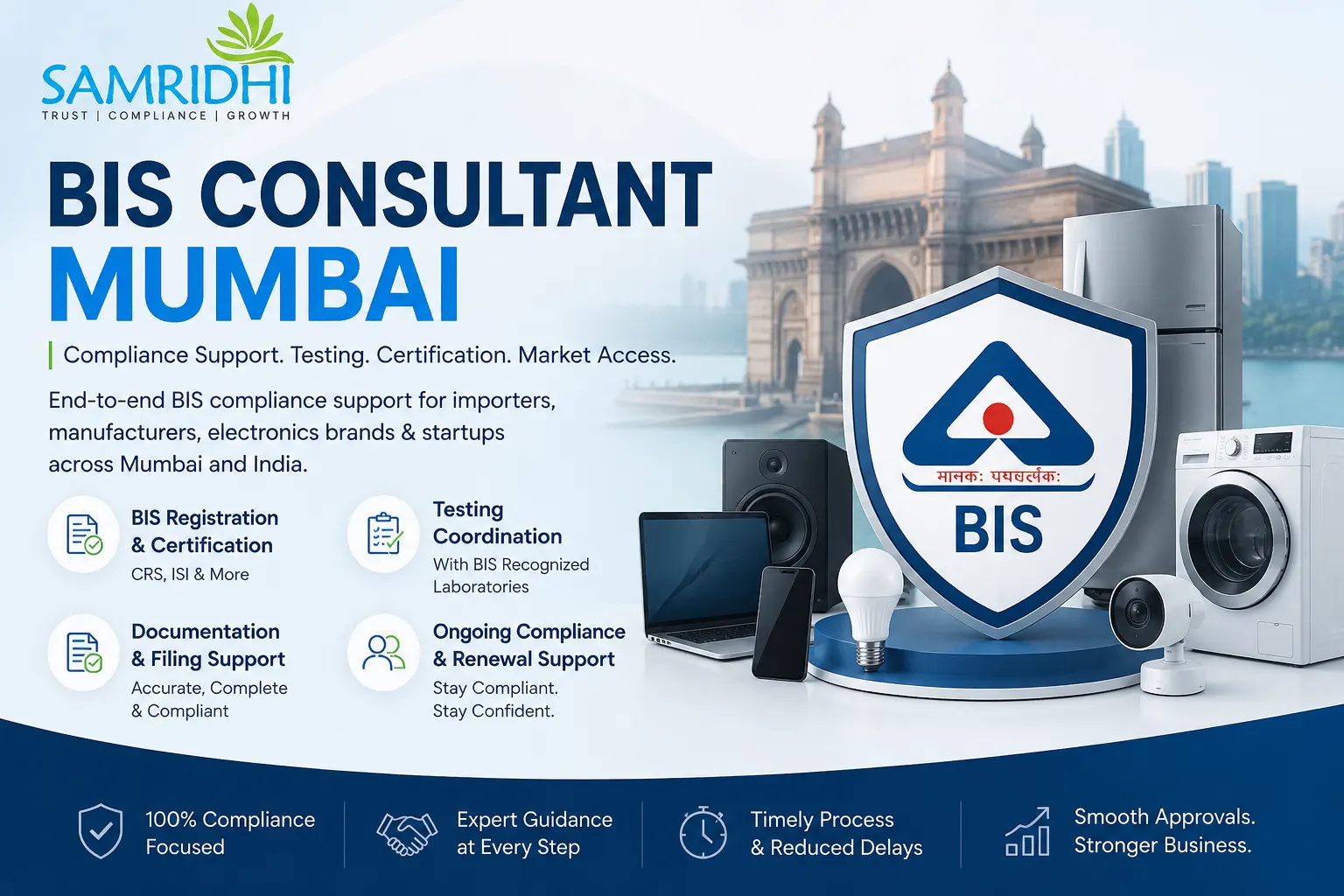
The BIS Certification Process in India is a mandatory compliance procedure that ensures products meet Indian quality, safety, and performance standards before they are manufactured, imported, or sold in the country. This service helps manufacturers, importers, startups, MSMEs, and foreign companies understand whether BIS approval is required, identify applicable standards, complete product testing, prepare accurate documentation, and successfully obtain certification without delays or rejection. Proper compliance through the BIS certification process allows businesses to operate legally, avoid penalties, import issues, and product seizures, and build long-term trust with regulators and customers. Samridhi Compliance Certification (SAMCC) provides expert guidance to simplify this complex process and ensure smooth approvals. For professional assistance, call +91 8799708673.
 Get Certified with Confidence – Your One-Stop Compliance Partner
From BIS, WPC, TEC, BEE, EPR, LMPC, CDSCO, FSSAI, ISO, MSME to PESO, NABL testing, Startup India, Make in India, and Lab Setup, we handle all your regulatory approvals, certifications, and documentation needs with precision and speed. Partner with Samridhi Compliance Certification and simplify your journey to full compliance—so you can focus on growing your business.
BIS Certification Process in India 📄⚖️🏭
The BIS Certification Process in India is a structured regulatory mechanism designed to ensure that products manufactured, imported, or sold in the country meet prescribed Indian quality, safety, and performance standards. BIS certification is governed by the Bureau of Indian Standards and applies to a wide range of products across electronics, consumer goods, industrial items, and more. Understanding the bis certification process in India is essential for businesses that want to operate legally, avoid penalties, and gain market credibility.
From a regulatory perspective, the bis certification meaning goes beyond a formal approval—it represents compliance with national standards that protect consumers and promote fair trade. For manufacturers, importers, foreign manufacturers, and brand owners, following the correct bis certification procedure is a mandatory step for market entry in many product categories.
Why the BIS Certification Process Is Mandatory and Important ⚖️
The bis certification process is mandatory for products notified under various BIS schemes. These requirements exist to ensure:
-
Product safety and reliability
-
Standardization across industries
-
Consumer protection and quality assurance
The bis certificate requirement applies to:
-
Indian manufacturers producing regulated products
-
Importers bringing goods into India
-
Foreign manufacturers supplying to the Indian market
-
Brand owners marketing products under private labels
Failure to follow the bis approval process can result in penalties, import rejections, or sales bans. This is why understanding requirements for bis certification is a critical compliance responsibility.
India as a Highly Regulated Business & Manufacturing Market 🇮🇳📈
India is one of the most regulated markets globally, particularly in manufacturing and imports. Regulatory compliance is tightly monitored to maintain safety, quality, and accountability.
Compliance under the bis certification process in India is essential for:
-
Manufacturing – production cannot legally begin without BIS approval for notified products
-
Imports – customs authorities verify bis approval during clearance
-
Market access – distributors and e-commerce platforms require proof of compliance
-
Risk avoidance – preventing penalties, seizures, recalls, and shipment delays
In addition to BIS, authorities such as WPC, TEC, and CPCB may apply depending on product functionality. This layered framework makes accurate understanding of the bis certification procedure vital for businesses.
Industry & Product Context for BIS Certification 📡🔌
The bis certification process india applies across multiple industries and product categories.
Electronics, IT & Wireless Products
Products such as adapters, power supplies, LEDs, IT equipment, and smart devices fall under compulsory BIS schemes. For these products, bis product certification is required before sale.
Mobile Phones, CCTV & Batteries
These products involve safety-critical components. The bis approval process ensures electrical safety, performance consistency, and compliance with Indian standards.
Wireless & RF-Enabled Devices
While BIS covers safety and quality, products with wireless features may also require additional approvals. However, bis certification details remain the foundation for market entry.
Other Regulated Products
Cement, steel, packaged drinking water, toys, and industrial products also fall under various BIS certification schemes. Each category has specific requirements for bis certification.
Step-by-Step Overview of the BIS Certification Process 📄✅
Understanding the bis certification process in India step by step helps businesses plan timelines and budgets effectively.
Step 1: Product Identification
Determine whether the product falls under mandatory BIS certification and identify the applicable Indian Standard. This step clarifies the bis certificate requirement.
Step 2: Product Testing
Samples are tested at BIS-recognized laboratories as per the applicable standard. Testing scope directly impacts timelines and cost under the bis approval process.
Step 3: Documentation Preparation
This includes technical specifications, test reports, factory details, labeling information, and declarations required for bis product certification.
Step 4: Application Submission
Applications are submitted through BIS systems for review. This is a critical stage in the bis certification procedure, as authorities may raise queries or seek clarification.
Step 5: Evaluation & Approval
After successful review, BIS grants approval and issues the certification. This finalizes the bis certification process india.
Indicative timelines vary based on product type, testing readiness, and documentation accuracy. Common challenges include incomplete documents, incorrect standards selection, and delays in testing.
Cost, Validity & Key Compliance Factors 💰📊
Cost Components
The bis certification process cost generally includes:
Costs vary depending on product category, standard, and number of models.
Validity & Maintenance
BIS certification remains valid as long as compliance conditions are maintained. Any change in product design, manufacturing location, or specifications may require modification or re-approval under the bis certification procedure.
Penalties for Non-Compliance
Non-compliance with the bis approval process can lead to:
Role of Professional Certification Consultants 🧭
Although the bis certification process in India is supported by online systems, professional expertise plays a critical role.
Consultants vs Agents
-
Consultants provide regulatory interpretation, testing strategy, and end-to-end compliance management
-
Agents typically focus only on form submission
DIY vs Expert-Managed Compliance
Working with experienced professionals helps:
-
Interpret bis certification details correctly
-
Select the right standard and testing scope
-
Prepare accurate documentation
-
Reduce delays in the bis approval process
Professional handling ensures that requirements for bis certification are met correctly the first time.
Recent & Trending Updates in BIS Compliance 🔍📈
The BIS regulatory environment is continuously evolving:
-
Expansion of mandatory product lists
-
Increased enforcement at ports and marketplaces
-
Greater scrutiny of imports and foreign manufacturers
-
Shift toward digital filing and centralized compliance systems
Businesses that stay updated on these changes reduce risk and ensure continuity under the bis certification process india.
Why Understanding the BIS Certification Process Matters 📈
For businesses, the bis certification meaning extends beyond compliance—it enables legal operations, smoother imports, and market credibility. Companies that understand the bis certification procedure early can:
-
Plan launches confidently
-
Control compliance costs
-
Avoid regulatory disruptions
-
Scale faster in the Indian market
Conclusion
The BIS Certification Process in India is a mandatory and structured pathway that ensures products meet Indian quality and safety standards. With expanding regulatory coverage and stricter enforcement, accurate and timely compliance has become essential for manufacturers, importers, and brand owners.
By offering expert guidance on documentation, testing coordination, and regulatory interpretation, Samridhi Compliance Certification supports businesses in navigating the bis certification process correctly. A clear understanding of requirements for bis certification and a structured approach to the bis approval process allow businesses to focus on growth while remaining fully compliant with Indian regulations.
Get Certified with Confidence – Your One-Stop Compliance Partner
From BIS, WPC, TEC, BEE, EPR, LMPC, CDSCO, FSSAI, ISO, MSME to PESO, NABL testing, Startup India, Make in India, and Lab Setup, we handle all your regulatory approvals, certifications, and documentation needs with precision and speed. Partner with Samridhi Compliance Certification and simplify your journey to full compliance—so you can focus on growing your business.
BIS Certification Process for Business & Industry Landscape in India
The BIS Certification Process in India is a structured regulatory system that ensures products meet Indian quality, safety, and performance standards before they are manufactured, imported, or sold in the Indian market. With India emerging as a global manufacturing and consumption hub, regulatory compliance has become a core business requirement rather than a formality. Understanding the bis certification meaning, scope, and future relevance is essential for businesses planning sustainable growth in India.
Business & Industry Landscape in India 📈
The bis certification process in India impacts a wide range of businesses across industries due to India’s strong focus on standardization and consumer safety.
Manufacturing Units
Indian manufacturers producing regulated products must follow the bis certification procedure to ensure their goods comply with notified Indian Standards. Without meeting the bis certificate requirement, manufacturing and distribution can be legally restricted.
Importers & Exporters
Importers bringing products into India must complete the bis approval process before customs clearance. BIS approval is often verified at ports, making bis product certification critical for uninterrupted imports and exports.
Electronics & IT Companies
Electronics and IT products fall under strict compliance categories. These businesses must carefully follow the requirements for bis certification to ensure product safety, reliability, and legal market access.
Startups & MSMEs
For startups and MSMEs, early understanding of the bis certification process helps avoid redesign costs, re-testing delays, and compliance gaps that can affect time-to-market and funding timelines.
Foreign Manufacturers Supplying to India
Foreign manufacturers exporting to India are equally bound by the bis certification process india. Even globally certified products must meet Indian standards and obtain bis approval to be legally sold in India.
Key Business & Industrial Locations Driving BIS Compliance 🏭🚢
The demand for the bis certification process in India is higher in major industrial and commercial hubs due to concentrated manufacturing and import activity.
Manufacturing Clusters
Regions with dense manufacturing units require strict adherence to the bis certification procedure to maintain supply chain continuity and regulatory acceptance.
Electronics & Technology Hubs
Electronics-focused zones generate high demand for bis product certification, as regulatory checks are stringent for safety and performance standards.
Ports, SEZs, and Logistics Zones
Ports and SEZs are critical checkpoints where the bis approval process is enforced. Import-heavy regions face frequent scrutiny of bis certification details during customs clearance.
The emphasis in these locations is not geography alone, but business volume, regulatory oversight, and risk exposure—making compliance a strategic necessity.
Future Growth Potential & Regulatory Expansion 📊✅
The future scope of the bis certification process in India is expanding rapidly due to evolving policy priorities.
Stricter Enforcement
Authorities are increasing checks on manufacturing units and imports, making non-compliance with the bis certificate requirement more likely to result in penalties and disruptions.
Expansion of Regulated Product Categories
More products are being added under mandatory BIS schemes. Businesses that understand the bis certification meaning early can plan compliance before enforcement becomes stricter.
Focus on Quality, Safety, and Standardization
India’s regulatory direction emphasizes traceability, safety, and uniform quality standards. The bis certification process india plays a key role in aligning businesses with these national goals.
Early compliance with the bis certification process enables businesses to scale faster, enter new markets confidently, and avoid legal risks that hinder growth.
How Professional Compliance Services Support Business Growth 🧭📄
Navigating the bis certification procedure requires technical accuracy, regulatory interpretation, and timely execution.
Reducing Approval Delays
Professional handling of the bis approval process ensures correct standard selection, complete documentation, and faster resolution of regulatory queries.
Avoiding Rejection Due to Errors
Incorrect bis certification details are a common cause of rejection. Expert review minimizes errors and rework.
Managing Testing, Licensing, and Renewals
The bis certification process involves coordination with testing laboratories, managing approvals, and maintaining ongoing compliance for certified products.
Staying Updated with Regulatory Changes
The requirements for bis certification evolve over time. Professional support helps businesses stay compliant with new notifications and enforcement trends.
In this context, Samridhi Compliance Certification supports businesses with structured guidance across documentation, testing coordination, approval management, and long-term compliance planning—helping organizations focus on growth while remaining compliant.
Digital & Online Compliance Ecosystem in India 💻📡
India has significantly modernized its regulatory systems, including the bis certification process in India.
Shift to Online Portals
Digital filing has streamlined application submission, tracking, and approvals under the bis approval process.
Centralized Compliance Systems
Integration with other regulatory bodies improves traceability and enforcement, making accurate bis product certification more critical than ever.
Why Expert Guidance Still Matters
While portals simplify submissions, they do not eliminate complexity. Correct interpretation of the bis certification meaning, documentation standards, and testing requirements still requires expert oversight to avoid delays or rejection.
Professional consultants play a vital role in bridging the gap between digital systems and regulatory expectations.
Why the BIS Certification Process Matters for Long-Term Growth 📈
The bis certification process in India is no longer just a regulatory obligation—it is a growth enabler. Businesses that understand and implement the bis certification procedure early gain:
By meeting the bis certificate requirement and maintaining accurate bis certification details, organizations can confidently expand operations, attract partners, and build trust in the Indian market.
The BIS Certification Process in India is a cornerstone of India’s regulatory and quality assurance framework. It impacts manufacturers, importers, startups, MSMEs, and foreign companies across industries. With expanding enforcement, growing product coverage, and increasing digital oversight, timely and accurate compliance is essential.
Understanding the bis certification meaning, following the correct bis certification process, and planning for future regulatory expansion allows businesses to turn compliance into a strategic advantage—supporting sustainable, compliant, and scalable growth in the Indian market.
BIS Certification Process in India - Advantages and Disadvantages
The BIS Certification Process in India is a mandatory regulatory framework that ensures products meet Indian quality, safety, and performance standards before they are manufactured, imported, or sold. Understanding the bis certification meaning and following the correct bis certification procedure helps businesses operate legally, avoid enforcement actions, and build long-term trust with regulators and customers. For many product categories, meeting the bis certificate requirement is a prerequisite for market access and uninterrupted operations.
Advantages of Using the BIS Certification Process for Businesses ✅
Following the bis certification process in India delivers practical, business-focused benefits across the value chain.
Operate Legally in India
-
Compliance with the bis certification process enables lawful manufacturing, import, and sale.
-
Meeting the requirements for bis certification ensures products align with notified Indian Standards.
-
A completed bis approval process prevents regulatory interruptions.
Avoid Penalties, Seizures, and Delays
-
Proper bis approval reduces customs holds and market surveillance actions.
-
Accurate bis certification details lower the risk of objections and rework.
-
Timely bis product certification supports predictable launches.
Build Trust with Customers and Authorities
-
Certification signals adherence to national standards and safety norms.
-
Consistent compliance under the bis certification process india improves distributor and marketplace acceptance.
-
Long-term credibility grows when bis certificate requirement is met consistently.
Enable Smooth Imports, Manufacturing, and Sales
-
Manufacturers plan production confidently under the bis certification procedure.
-
Importers clear shipments faster with completed bis approval process.
-
Sales continuity improves with approved bis product certification.
Advantages by Business Type
Manufacturers
-
Clear standard mapping and testing under the bis certification process in India.
-
Fewer stoppages with compliant bis approval.
-
Better planning using accurate bis certification details.
Importers
-
Faster customs clearance with completed bis approval process.
-
Lower risk of detention due to unmet bis certificate requirement.
-
Predictable supply chains supported by bis product certification.
Startups & MSMEs
-
Early clarity on requirements for bis certification prevents costly corrections.
-
Faster go-to-market using the correct bis certification procedure.
-
Controlled compliance costs and timelines.
Foreign Companies Entering India
-
Local regulatory alignment through the bis certification process india.
-
Reduced enforcement risk with proper bis approval.
-
Scalable entry as portfolios expand under bis product certification.
Disadvantages of NOT Using the BIS Certification Process ⚠️
Ignoring or delaying the bis certification process in India exposes businesses to tangible risks.
Legal Penalties and Notices
Import Clearance Issues
Product Seizures or Bans
Business Reputation Damage
Financial and Operational Losses
Compliance vs Non-Compliance: Quick Comparison 📊
| Benefits of Compliance / Certification |
Drawbacks of Non-Compliance |
| Legal operations via bis certification process in India |
Penalties and legal notices |
| Faster imports with completed bis approval |
Shipment delays or rejection |
| Predictable launches using bis certification procedure |
Uncertain timelines |
| Controlled costs through clear bis certification details |
Higher corrective expenses |
| Strong trust with authorities and buyers |
Reputation damage |
| Scalable growth with bis product certification |
Sales bans and disruptions |
This snapshot helps decision-makers quickly assess why following the bis certification process protects continuity while non-compliance creates avoidable risk.
Why Decision-Stage Compliance Planning Matters 🧭
Businesses preparing launches or imports typically look for:
-
Clear requirements for bis certification,
-
Step-by-step clarity on the bis certification procedure,
-
Timelines within the bis approval process,
-
Accurate bis certification details to avoid rework.
Addressing these early stabilizes budgets, protects schedules, and ensures a smooth bis certification process india from planning to approval.
The BIS Certification Process in India is a structured pathway that safeguards quality, safety, and legal market access. By understanding the bis certification meaning, meeting the bis certificate requirement, and executing the bis approval process correctly, businesses can avoid penalties, speed up operations, and build lasting trust.
With an advisory-led approach to documentation, testing coordination, and regulatory interpretation, Samridhi Compliance Certification supports manufacturers, importers, startups, and foreign companies in completing the bis certification process efficiently—so they can focus on growth while remaining fully compliant.
Why the BIS Certification Process in India Is Important for Businesses ⚖️📄🏭
India is one of the fastest-growing manufacturing and import markets in the world. With this growth comes strict regulatory oversight to protect consumers, ensure product quality, and maintain standardization. The BIS Certification Process in India plays a central role in this ecosystem. It defines how products must be tested, approved, and certified before they can be manufactured, imported, or sold legally in the country.
Understanding the bis certification meaning is essential for any business entering the Indian market. BIS certification is not just a document—it is a legal confirmation that a product meets Indian quality and safety standards. For many categories, following the correct bis certification procedure is mandatory and directly linked to market access and business continuity.
Importance of the BIS Certification Process for Businesses ✅
The bis certification process in India helps businesses operate smoothly and confidently in a regulated environment.
Operate Legally in India
-
Many products cannot be sold without meeting the bis certificate requirement.
-
Completing the bis certification process ensures lawful manufacturing, import, and distribution.
-
Proper bis approval protects businesses from regulatory action and forced shutdowns.
Meet Indian Quality, Safety, and Regulatory Standards
-
The requirements for bis certification are designed to ensure product safety and performance.
-
Certified products comply with national standards under the bis certification process india.
-
This alignment improves acceptance by authorities, distributors, and buyers.
Avoid Penalties, Seizures, and Operational Delays
-
Failure in the bis approval process can lead to shipment holds, recalls, or sales bans.
-
Accurate bis certification details reduce objections and re-applications.
-
Timely bis product certification supports predictable business timelines.
Build Long-Term Brand Trust
-
Compliance under the bis certification process in India builds credibility with regulators.
-
Customers associate certification with safety and reliability.
-
Long-term trust supports repeat sales and partnerships.
India’s Growing Regulatory & Compliance Landscape 📈🇮🇳
India’s manufacturing and import ecosystem has expanded rapidly across electronics, consumer goods, industrial products, and infrastructure materials. To manage this scale, the government has intensified its focus on:
-
Product quality to raise industry benchmarks
-
Consumer safety through mandatory conformity
-
Standardization and traceability to improve accountability
As enforcement tightens, non-compliance risks are increasing. Authorities now rely on digital systems, port-level checks, and market surveillance to verify bis approval status. Businesses that delay the bis certification process in India face higher chances of penalties and disruptions. Early compliance with the bis certification procedure is becoming a strategic advantage, not just a legal requirement.
Business Impact Across Industries (Practical Examples) 🏭📡
Electronics & IT Manufacturers (CRS, BIS)
Electronics and IT products are often covered under mandatory schemes. Manufacturers that follow the bis certification process early can plan testing, documentation, and launches more efficiently. Proper bis product certification enables faster market entry and fewer regulatory hurdles.
Mobile Phones and Wireless Devices (BIS + WPC)
Mobile and wireless devices involve complex safety and performance standards. The bis approval process ensures these products meet Indian norms before sale. Completing the bis certification process india early helps avoid duplication, delays, and compliance gaps.
Importers and Foreign Manufacturers (FMCS)
Importers and overseas manufacturers must comply with Indian standards regardless of approvals elsewhere. Meeting the bis certificate requirement ensures smooth customs clearance and predictable supply chains. Clear bis certification details reduce port-level delays and rejections.
Startups & MSMEs Entering Regulated Sectors
For startups, understanding the requirements for bis certification at an early stage prevents costly redesigns and re-testing. A structured bis certification procedure allows MSMEs to launch compliant products faster and scale with confidence.
Across industries, certification directly enables market access, scalability, and credibility in India.
Role of Professional Compliance Consultants 🧭📄
Although the bis certification process in India uses online portals, expert guidance remains critical.
Why Expert Support Is Essential
-
Portals accept applications but do not validate strategy.
-
Choosing the wrong standard can delay the bis approval process.
-
Incomplete bis certification details often lead to rejection.
How Consultants Support Businesses
-
Correct documentation: Accurate technical files and declarations
-
Testing coordination: Right labs and scope for bis product certification
-
Timely approvals: Faster resolution during the bis certification procedure
-
Ongoing compliance: Amendments, renewals, and surveillance readiness
In practice, professional consultants act as risk reducers and growth enablers, ensuring the bis certification process is completed correctly the first time.
Decision-Stage Clarity Businesses Look For 🔍
Companies preparing to launch or import products often seek:
-
Clear bis certification meaning and applicability
-
Step-by-step guidance on the bis certification procedure
-
Transparency in the bis approval process
-
Accurate requirements for bis certification to avoid rework
Addressing these points early stabilizes budgets, protects timelines, and ensures a smooth bis certification process india from planning to approval.
Compliance Is Non-Negotiable—and Strategic 📈✅
The BIS Certification Process in India is a mandatory pathway that safeguards product quality, consumer safety, and legal market access. By understanding the bis certification meaning, meeting the bis certificate requirement, and executing the bis approval process correctly, businesses can avoid penalties, speed up operations, and build long-term trust.
With an advisory-led approach to documentation, testing coordination, and regulatory interpretation, Samridhi Compliance Certification supports manufacturers, importers, startups, and foreign companies in navigating the bis certification process in India effectively—allowing them to grow confidently while staying fully compliant with Indian regulations.
Get Certified with Confidence – Your One-Stop Compliance Partner
From BIS, WPC, TEC, BEE, EPR, LMPC, CDSCO, FSSAI, ISO, MSME to PESO, NABL testing, Startup India, Make in India, and Lab Setup, we handle all your regulatory approvals, certifications, and documentation needs with precision and speed. Partner with Samridhi Compliance Certification and simplify your journey to full compliance—so you can focus on growing your business.
Frequently Asked Questions
The BIS certification process in India is mandatory for products notified by the government under different BIS schemes. Manufacturers, importers, and foreign brands must check the bis certificate requirement for their product category. If applicable, completing the bis approval process is compulsory before manufacturing, import, or sale to avoid penalties and market restrictions.
The bis certification process applies to Indian manufacturers, importers, MSMEs, startups, and foreign companies supplying products to India. Any business placing regulated products in the Indian market must meet the requirements for bis certification and obtain bis approval to operate legally and ensure smooth market access.
The bis certification procedure includes identifying applicable standards, product testing at approved labs, preparing technical documents, submitting the application, and receiving approval. The bis certification process india may vary by product type, but accurate bis certification details and documentation are critical to avoid delays or rejection during review.
Timelines under the bis certification process in India depend on product category, testing readiness, and documentation accuracy. Delays often occur due to incomplete bis certification details or incorrect standard selection. Planning early and understanding the bis certification meaning helps businesses manage approvals and launch schedules more efficiently.
Ignoring the bis approval process can result in penalties, import rejection, product seizures, and sales bans. Non-compliance with bis product certification requirements can also damage brand reputation and disrupt operations. Meeting the bis certificate requirement on time protects businesses from legal and financial losses in India.



 Grab Your Certified Now
 +91 8799708673
 WhatsApp