 Get Certified with Confidence – Your One-Stop Compliance Partner
From BIS, WPC, TEC, BEE, EPR, LMPC, CDSCO, FSSAI, ISO, MSME to PESO, NABL testing, Startup India, Make in India, and Lab Setup, we handle all your regulatory approvals, certifications, and documentation needs with precision and speed. Partner with Samridhi Compliance Certification and simplify your journey to full compliance—so you can focus on growing your business.
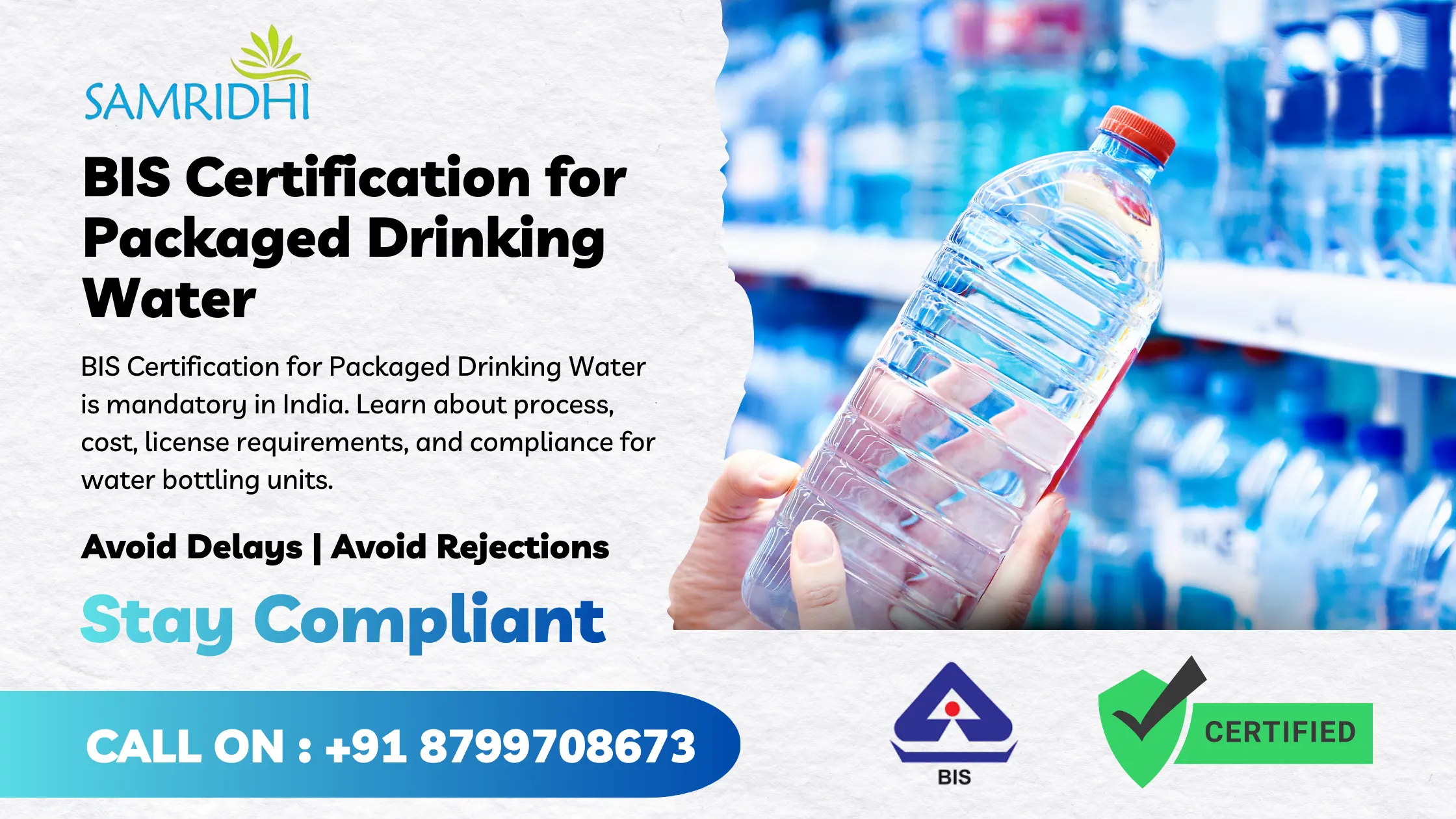
BIS Certification for Packaged Drinking Water – Introduction & Regulatory Landscape 📄⚖️🏭
What is BIS Certification for Packaged Drinking Water?
BIS Certification for Packaged Drinking Water is a mandatory quality and safety approval issued by the Bureau of Indian Standards (BIS) for businesses involved in manufacturing or selling packaged drinking water in India. This certification ensures that the water supplied to consumers meets strict Indian standards for purity, hygiene, and safety.
Packaged drinking water is directly linked to public health. Unlike many other consumer products, even small quality lapses can lead to serious health risks. That is why packaged drinking water BIS certification is not optional. Without a valid BIS approval, packaged water cannot be legally manufactured, distributed, or sold in the Indian market.
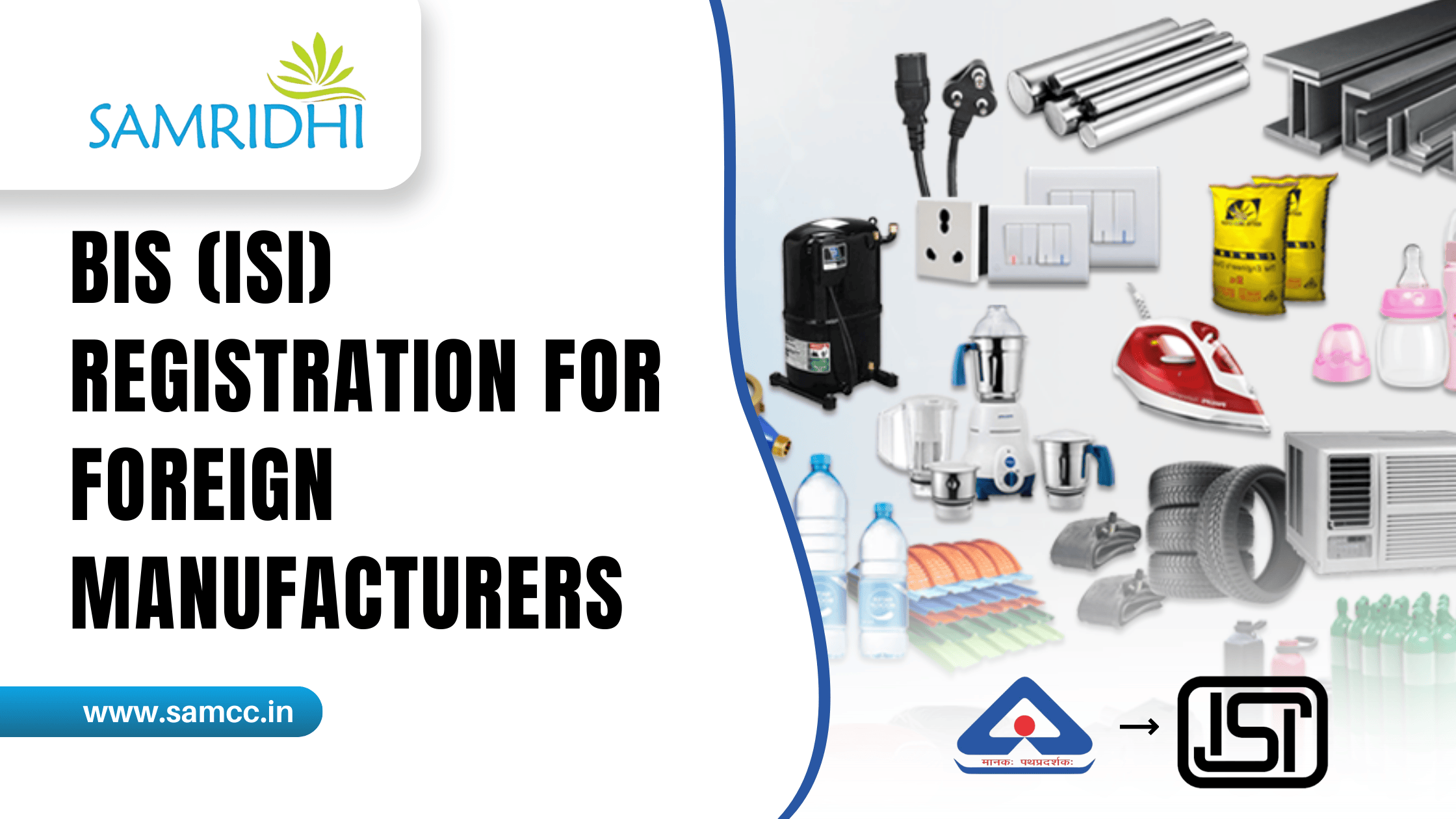
The certification confirms that the water has been tested for chemical, microbiological, and physical parameters as prescribed by Indian standards. Only after compliance verification can a company use the ISI mark on packaged drinking water bottles.
Why BIS Certification for Packaged Drinking Water Is Mandatory in India
India treats packaged drinking water as a high-risk consumable product, which is why BIS Certification for Packaged Drinking Water is compulsory under Indian law. The government has made this certification mandatory to protect consumers from unsafe water and misleading quality claims.
The bis license for packaged drinking water is required because:
-
Water is consumed daily by people of all age groups
-
Contamination risks are high if standards are not followed
-
Unregulated water units can cause serious public health issues
-
Quality consistency must be maintained across batches
The absence of a valid bis water license can lead to:
This strict approach explains why bis registration for packaged drinking water is closely monitored by authorities and enforced across India.
Who Needs BIS Certification for Packaged Drinking Water?
The scope of BIS Certification for Packaged Drinking Water covers multiple types of businesses operating in or entering the Indian market.
Manufacturers
Any company that manufactures packaged drinking water in India must obtain a valid bis license for packaged drinking water before starting commercial production. This applies to both large bottling plants and small-scale water units.
Importers & Exporters
Importing packaged drinking water into India without BIS approval is not permitted. Importers must ensure that the product complies with packaged drinking water BIS certification requirements before customs clearance.
MSMEs & Startups
Startups and MSMEs often enter the packaged water segment due to rising demand. However, bis registration for packaged drinking water is mandatory regardless of business size. Compliance helps small businesses build trust and scale legally.
Foreign Manufacturers
Foreign companies supplying packaged drinking water to India must comply with Indian standards and obtain BIS approval through the appropriate certification route. Indian regulations do not allow exemption for overseas manufacturers.
This wide applicability highlights why BIS Certification for Packaged Drinking Water is a critical compliance requirement across the supply chain.
India as a Highly Regulated Manufacturing & Import Market
India is one of the most regulated consumer markets globally, especially for products linked to health and safety. The packaged water sector falls under strict scrutiny due to its direct impact on human consumption.
The government has strengthened regulations to:
This regulatory framework explains the importance of bis certification process compliance, especially for consumable products like packaged drinking water.
Role of Regulatory Authorities in Packaged Drinking Water Certification
Multiple government bodies are involved in the compliance ecosystem for packaged drinking water:
-
BIS (Bureau of Indian Standards): Primary authority issuing certification, defining standards, and granting the ISI mark.
-
CPCB (Central Pollution Control Board): Oversees environmental compliance related to water extraction, waste disposal, and effluent treatment.
-
State Pollution Control Boards: Monitor local environmental and water usage permissions.
-
MeitY & DoT (contextual): In cases where digital monitoring, traceability, or plant automation is involved.
-
WPC & TEC (contextual): Relevant when packaged water plants use wireless monitoring or communication equipment.
This multi-authority involvement makes bis registration a structured and compliance-driven process rather than a simple application.
Importance of Compliance for Manufacturing Approvals
Obtaining BIS Certification for Packaged Drinking Water is a prerequisite for setting up or operating a packaged water manufacturing unit in India. Without it:
-
Manufacturing licenses may be denied
-
Factory approvals can be suspended
-
Expansion plans may be blocked
Compliance ensures that water sourcing, treatment processes, bottling, and storage meet prescribed Indian standards. This is why the bis certification process is detailed and inspection-driven.
Importance of Compliance for Imports & Market Access
For importers, bis registration for packaged drinking water is essential for customs clearance. Products without BIS approval are treated as non-compliant and may be:
-
Detained at ports
-
Rejected or destroyed
-
Subject to legal action
From a market perspective, retailers, distributors, and institutional buyers prefer bis certified packaged drinking water companies because certification assures safety, quality, and regulatory compliance.
Cost & Compliance Awareness in the Industry
Many businesses underestimate the bis certification cost for packaged drinking water and delay compliance planning. However, early understanding of bis certification cost helps businesses:
While costs vary based on plant size, testing frequency, and compliance readiness, proactive planning makes certification smoother and more predictable.
Why BIS Certification is Critical for Long-Term Business Growth
Beyond legal compliance, BIS Certification for Packaged Drinking Water plays a key role in:
-
Building consumer trust
-
Enhancing brand credibility
-
Enabling nationwide distribution
-
Supporting exports and institutional sales
Certified products gain easier acceptance in organized retail, government tenders, hotels, hospitals, and corporate supply chains. This is why experienced bis consultants are often engaged to manage the certification journey professionally.
Regulatory Foundation for Safe Drinking Water in India
In India’s compliance-driven ecosystem, BIS Certification for Packaged Drinking Water is not just a regulatory formality—it is a safeguard for public health and business sustainability. From manufacturers and MSMEs to importers and foreign suppliers, every stakeholder must adhere to BIS standards to operate legally and responsibly.
Understanding the regulatory landscape, authorities involved, and compliance importance helps businesses approach certification with clarity and confidence. When managed correctly, packaged drinking water BIS certification becomes a strong foundation for quality assurance, market access, and long-term growth.
Get Certified with Confidence – Your One-Stop Compliance Partner
From BIS, WPC, TEC, BEE, EPR, LMPC, CDSCO, FSSAI, ISO, MSME to PESO, NABL testing, Startup India, Make in India, and Lab Setup, we handle all your regulatory approvals, certifications, and documentation needs with precision and speed. Partner with Samridhi Compliance Certification and simplify your journey to full compliance—so you can focus on growing your business.
Business Impact & Industrial Ecosystem of BIS Certification for Packaged Drinking Water 🏭📦📡
Understanding the Business Relevance of BIS Certification for Packaged Drinking Water
BIS Certification for Packaged Drinking Water plays a decisive role in shaping how businesses operate, scale, and compete in the Indian packaged water industry. Unlike many other consumer products, packaged drinking water falls under a mandatory certification regime because it directly affects public health. As a result, regulatory approval is not a choice but a business necessity.
From manufacturing units and MSMEs to importers and foreign manufacturers, packaged drinking water BIS certification influences entry barriers, operational planning, cost structures, and long-term market access. Businesses that understand this ecosystem early are better positioned to grow sustainably in India’s regulated market.
Impact on Manufacturing Units
Manufacturing units are the most directly affected stakeholders when it comes to BIS Certification for Packaged Drinking Water. Without a valid bis water license, a manufacturing unit cannot legally bottle, store, or sell packaged drinking water in India.
Key business impacts on manufacturers include:
-
Mandatory compliance before commercial production
-
Regular testing and quality audits under the bis certification process
-
Ongoing surveillance by regulatory authorities
-
Investment planning linked to bis certification cost for packaged drinking water
Manufacturers must also factor in infrastructure readiness, water source approvals, hygiene controls, and testing timelines. Many bis certified packaged drinking water companies treat certification as a core operational requirement rather than a one-time approval.
For manufacturing clusters, compliance is unavoidable because local authorities often verify bis registration for packaged drinking water before issuing factory or trade licenses.
Impact on Importers & Exporters
For importers, packaged drinking water BIS certification is a gatekeeping requirement at Indian ports. Products entering India without proper BIS approval are likely to be detained or rejected during customs clearance.
Business implications for importers include:
-
Advance planning of bis registration before shipment
-
Coordination with foreign suppliers to meet Indian standards
-
Risk management related to delays and re-export costs
-
Understanding bis certification cost as part of import budgeting
Exporters supplying packaged drinking water from India to regulated markets also benefit from BIS Certification for Packaged Drinking Water, as it strengthens credibility and aligns products with recognized quality benchmarks.
In port-led logistics zones and SEZ-linked import hubs, compliance checks are stricter, making certification unavoidable for smooth trade operations.
Impact on Electronics & IT Companies (Indirect but Relevant)
While electronics and IT companies are not direct producers of packaged drinking water, many operate large campuses, data centers, and manufacturing parks that require in-house packaged drinking water solutions for employees and operations.
These businesses often:
-
Source water only from bis certified packaged drinking water companies
-
Require suppliers to hold a valid bis license for packaged drinking water
-
Include BIS compliance as a vendor qualification criterion
In industrial zones dominated by electronics and IT manufacturing, demand for certified water suppliers is higher. This indirectly increases compliance pressure on water manufacturers operating near such hubs.
Impact on Startups & MSMEs
Startups and MSMEs frequently enter the packaged drinking water segment due to growing urban demand. However, BIS Certification for Packaged Drinking Water significantly impacts their business planning.
For MSMEs and startups:
-
bis certification cost for packaged drinking water affects initial capital allocation
-
Certification timelines influence go-to-market strategies
-
Compliance determines eligibility for institutional and B2B contracts
-
bis registration for packaged drinking water builds early market trust
Many small businesses underestimate the complexity of the bis certification process, leading to delays or rejections. This is why startups often rely on experienced bis consultants to navigate documentation, testing, and audits efficiently.
Impact on Foreign Manufacturers Entering India
Foreign manufacturers looking to supply packaged drinking water to India face one of the strictest compliance regimes. Indian regulations do not permit sale or import without packaged drinking water BIS certification, regardless of approvals held in other countries.
Key challenges for foreign manufacturers:
-
Alignment with Indian quality standards
-
Appointment of authorized Indian representatives
-
Managing bis registration from overseas
-
Understanding local enforcement practices
For foreign brands, BIS Certification for Packaged Drinking Water becomes the foundation for market entry, distributor onboarding, and brand acceptance. Non-compliance can permanently block access to the Indian market.
Why Certification Is Unavoidable Across the Industry
The packaged drinking water industry is treated as a high-risk consumer sector in India. Certification is unavoidable because:
-
Water quality directly impacts public health
-
Past cases of contamination have increased enforcement
-
Consumer awareness around safety has grown
-
Regulatory bodies actively monitor non-compliant units
The government uses the bis certification process as a preventive mechanism rather than a corrective one. This is why operating without a valid bis water license is not commercially viable in the long term.
Industrial Hubs & Compliance-Driven Locations
Certain industrial and commercial zones experience higher compliance demand for BIS Certification for Packaged Drinking Water due to concentrated business activity.
Manufacturing Clusters
Large manufacturing clusters require reliable, certified water suppliers for workers and production support. Local authorities often verify bis registration for packaged drinking water before approving vendor operations in these areas.
Ports & Logistics Zones
Ports, inland container depots, and logistics corridors see stricter checks on imported consumables. Importers operating here must ensure packaged drinking water BIS certification is completed well in advance.
SEZs & Industrial Parks
SEZs and industrial parks follow centralized compliance norms. Only vendors with valid bis license for packaged drinking water are allowed to operate within these zones.
Urban Commercial & Institutional Zones
High-density commercial zones, hospitals, and institutions demand water only from bis certified packaged drinking water companies, increasing compliance-driven demand in surrounding areas.
Cost Sensitivity & Business Planning
The bis certification cost plays a strategic role in business decisions. While costs vary depending on plant size and testing scope, businesses that plan certification early benefit from:
Understanding bis certification cost for packaged drinking water helps businesses price products realistically and avoid non-compliance penalties that are far more expensive than certification itself.
Strategic Role of Compliance in Market Positioning
In a competitive market, BIS Certification for Packaged Drinking Water is not just a legal requirement but a market differentiator. Certified businesses:
-
Gain easier access to distributors and retailers
-
Face fewer regulatory disruptions
-
Build stronger consumer trust
-
Scale operations across regions more smoothly
This is why many companies view bis registration as a strategic investment rather than a compliance burden.
Certification as a Business Enabler
Across manufacturing units, importers, MSMEs, and foreign suppliers, BIS Certification for Packaged Drinking Water defines how businesses operate within India’s regulated ecosystem. Industrial hubs, logistics zones, and institutional markets amplify compliance demand, making certification unavoidable.
Businesses that align early with the bis certification process, understand bis certification cost, and work with knowledgeable bis consultants are better positioned to grow, compete, and sustain operations in India’s packaged drinking water industry.
Process, Cost, Validity & Digital Compliance for BIS Certification for Packaged Drinking Water 📄💻⚙️
Understanding the Compliance Framework
BIS Certification for Packaged Drinking Water is governed by strict quality, safety, and hygiene standards because the product directly affects public health. Unlike optional certifications, this approval is mandatory before manufacturing, bottling, or selling packaged drinking water in India. The entire system is structured to ensure that only safe, tested, and regulated water reaches consumers.
To successfully obtain packaged drinking water BIS certification, businesses must clearly understand the process flow, cost components, validity requirements, and the role of India’s digital compliance ecosystem.
Step-by-Step Process for BIS Certification for Packaged Drinking Water
The bis certification process follows a structured and sequential approach. While timelines may vary, the steps remain largely consistent across applicants.
1️⃣ Applicability Assessment
The first step is confirming whether the product falls under mandatory certification. Packaged drinking water is a notified product, meaning BIS Certification for Packaged Drinking Water is compulsory for all manufacturers and importers.
At this stage, businesses evaluate:
This step helps avoid incorrect applications and unnecessary delays in bis registration for packaged drinking water.
2️⃣ Infrastructure & Facility Readiness
Before applying, the manufacturing unit must be operationally ready. BIS does not grant approval to incomplete or trial-stage facilities.
Key readiness requirements include:
-
Approved water source
-
Treatment and purification systems
-
Hygienic bottling and storage areas
-
In-house or external testing arrangements
Many bis certified packaged drinking water companies invest heavily in facility planning before submitting applications, as gaps at this stage often lead to rejection.
3️⃣ Product Testing & Quality Evaluation
Testing is a critical component of packaged drinking water BIS certification. Samples are tested as per Indian Standards to verify safety, chemical composition, and microbiological parameters.
Testing generally covers:
This stage directly impacts both timelines and bis certification cost for packaged drinking water, as repeated testing increases expenses.
4️⃣ Application Submission & Documentation
Once testing is completed, the applicant submits the application through the BIS digital system. This includes detailed documentation such as:
This stage formally initiates bis registration, and accuracy is critical. Even minor documentation errors can delay approval.
5️⃣ Factory Inspection & Audit
BIS conducts an on-site inspection to verify whether the actual manufacturing process matches submitted documents.
Inspectors assess:
This inspection is often the most challenging step in the bis certification process, especially for first-time applicants.
6️⃣ Grant of BIS License
If all requirements are met, BIS issues the bis water license, allowing the manufacturer to legally use the BIS Standard Mark on packaged drinking water.
Only after this stage can businesses sell products as certified in the Indian market.
Indicative Timelines (Non-Guaranteed)
While timelines vary, a general estimate for BIS Certification for Packaged Drinking Water is:
-
Infrastructure & preparation: 1–2 months
-
Testing & evaluation: 3–4 weeks
-
Application review & inspection: 1–2 months
-
License grant: Subject to compliance clearance
Delays often arise due to documentation gaps, testing failures, or inspection observations.
Common Challenges Faced by Applicants
Despite clear guidelines, many businesses face hurdles during packaged drinking water BIS certification.
Frequent challenges include:
-
Incomplete facility readiness
-
Failure in initial water testing
-
Poor documentation quality
-
Delays in inspection scheduling
-
Misunderstanding of standard requirements
Startups and MSMEs often struggle with regulatory interpretation, which is why many rely on experienced bis consultants to streamline the process.
Cost Components Involved in Certification
Understanding the bis certification cost is essential for financial planning. Costs vary based on plant size, testing scope, and location, but broadly include the following components:
🔹 Testing Charges
Laboratory testing is a major part of the bis certification cost for packaged drinking water, especially if re-testing is required.
🔹 Government Fees
BIS charges application fees, license fees, and marking fees, all of which form part of bis registration expenses.
🔹 Inspection & Audit Costs
Inspection-related expenses, including coordination and compliance preparation, add to the overall cost.
🔹 Consultancy & Coordination
Many businesses engage bis consultants to manage documentation, testing coordination, and audit preparation, which adds professional service costs but often reduces delays.
Overall, bis certification cost for packaged drinking water should be viewed as a long-term compliance investment rather than a one-time expense.
Validity, Renewal & Modification Requirements
Once granted, the bis water license is not permanent.
🔹 Validity
The license is typically valid for a defined period, subject to ongoing compliance and surveillance.
🔹 Renewal
Renewal requires:
Failure to renew on time can result in suspension, impacting the ability to sell products legally.
🔹 Modification
Any changes in:
-
Manufacturing location
-
Water source
-
Process flow
-
Product packaging
must be reported to BIS. Modifications without approval can invalidate BIS Certification for Packaged Drinking Water.
Role of Digital Compliance Portals
India’s regulatory system has moved significantly toward digital governance. The bis certification process is now largely managed through online platforms.
🔸 BIS Portal
The BIS portal handles:
-
Application submission
-
Document uploads
-
License tracking
-
Renewal management
This portal forms the backbone of bis registration for packaged drinking water.
🔸 CPCB (Contextual Role)
For water extraction, waste management, and environmental compliance, CPCB norms may apply, especially for groundwater usage.
🔸 WPC & TEC (Contextual Use)
While not directly involved in packaged drinking water certification, these authorities become relevant if manufacturing facilities use regulated communication or monitoring equipment.
Digital systems improve transparency but also require precise data entry, making expert guidance valuable.
Importance of Structured Compliance Planning
Businesses that treat packaged drinking water BIS certification as an early-stage planning activity experience fewer disruptions. A structured approach helps:
-
Control bis certification cost
-
Reduce approval timelines
-
Avoid inspection failures
-
Maintain long-term license validity
Most bis certified packaged drinking water companies integrate compliance into daily operations rather than treating it as a one-time task.
BIS Certification for Packaged Drinking Water is a detailed, multi-stage compliance process involving testing, inspections, documentation, and ongoing regulatory oversight. Understanding the bis certification process, cost components, license validity, and the digital compliance ecosystem is essential for manufacturers, importers, and startups entering this sector.
With proper preparation, realistic budgeting for bis certification cost for packaged drinking water, and informed use of digital portals, businesses can achieve certification efficiently and sustain compliant operations in India’s tightly regulated packaged drinking water market.
Advantages, Risks & Future Potential of BIS Certification for Packaged Drinking Water ⚖️📈⚠️
Understanding the Strategic Importance of Compliance
BIS Certification for Packaged Drinking Water is not just a legal requirement; it is a strategic safeguard for businesses operating in one of India’s most sensitive consumer sectors. Since packaged drinking water directly affects public health, regulators enforce strict standards on quality, hygiene, and traceability. As enforcement tightens, the gap between compliant and non-compliant businesses continues to widen, making certification a long-term business necessity rather than a short-term formality.
Advantages of BIS Certification for Packaged Drinking Water
1️⃣ Legal Market Access & Business Continuity
The biggest advantage of BIS Certification for Packaged Drinking Water is legal permission to manufacture, distribute, and sell products in India. Without valid approval, operations can be halted at any stage—manufacturing, storage, or sale.
Holding a valid bis water license ensures uninterrupted business continuity and protects companies from sudden regulatory actions.
2️⃣ Strong Consumer Trust & Brand Credibility
Consumers are increasingly aware of safety standards. Products carrying BIS marking are widely perceived as safe and reliable.
This is why bis certified packaged drinking water companies enjoy:
Over time, packaged drinking water BIS certification becomes a trust symbol that differentiates regulated brands from informal players.
3️⃣ Reduced Regulatory & Operational Risk
Compliance reduces uncertainty. Businesses that follow the bis certification process face fewer inspections, lower chances of penalties, and smoother renewals.
Proactive compliance also helps manage bis certification cost effectively by avoiding repeated testing, re-inspections, and corrective actions.
4️⃣ Advantages for Different Business Categories
🔹 Manufacturers
Manufacturers benefit from predictable operations and long-term scalability. A valid bis license for packaged drinking water allows expansion into new distribution zones without regulatory barriers.
🔹 Importers
For importers, BIS Certification for Packaged Drinking Water is essential for customs clearance and lawful market entry. Certified products face fewer delays at ports.
🔹 MSMEs & Startups
Although bis certification cost for packaged drinking water may appear high initially, compliance builds a strong foundation for sustainable growth and investor confidence.
🔹 Foreign Companies
Foreign brands entering India must comply with local regulations. BIS Certification for Packaged Drinking Water ensures alignment with Indian safety norms and smoother entry into the domestic market.
Risks & Disadvantages of Non-Compliance
1️⃣ Legal Penalties & Business Shutdowns
Operating without packaged drinking water BIS certification can result in:
-
Heavy fines
-
Seizure of stock
-
Factory closure orders
Non-compliance is treated as a serious offense because of public health implications.
2️⃣ Product Seizure & Market Bans
Authorities have the power to seize non-certified products from warehouses, distributors, and retail outlets. Without bis registration for packaged drinking water, entire consignments may be destroyed or banned from sale.
3️⃣ Loss of Reputation & Consumer Confidence
Once a business is flagged for non-compliance, regaining trust becomes extremely difficult. Consumers, distributors, and partners often avoid brands without a valid bis water license.
4️⃣ Higher Long-Term Costs
Ironically, avoiding certification often increases costs. Emergency compliance, repeated inspections, and legal disputes significantly inflate the overall bis certification cost compared to planned compliance.
Compliance vs Non-Compliance: Quick Comparison
| Compliance Benefits |
Non-Compliance Risks |
| Legal manufacturing and sales approval |
Fines, penalties, and notices |
| Strong consumer trust and brand value |
Reputation damage |
| Predictable inspections and renewals |
Sudden inspections and shutdowns |
| Smooth supply chain operations |
Product seizures and bans |
| Controlled bis certification cost over time |
High unplanned financial losses |
Future Growth Potential of BIS Certification for Packaged Drinking Water 📈
1️⃣ Expanding Regulatory Coverage
The government is steadily expanding the scope of regulated food and water products. BIS Certification for Packaged Drinking Water will remain central as authorities push for uniform quality standards across urban and rural markets.
2️⃣ Increased Surveillance & Enforcement
Future enforcement will focus more on:
Businesses without proper bis registration will find it increasingly difficult to operate unnoticed.
3️⃣ Digital Compliance & Traceability
The integration of digital platforms into the bis certification process allows regulators to track licenses, renewals, and compliance history more effectively. This reduces manual intervention but increases accountability.
Companies working with experienced bis consultants are better equipped to adapt to these digital systems.
4️⃣ Rising Consumer Awareness
Consumers are becoming more conscious of health and safety. Demand for products from bis certified packaged drinking water companies is expected to rise as buyers actively avoid uncertified brands.
5️⃣ Long-Term Cost Optimization
While bis certification cost for packaged drinking water may seem significant initially, early compliance helps businesses:
-
Avoid emergency penalties
-
Plan renewals efficiently
-
Spread compliance costs over time
Strategic planning with knowledgeable bis consultants can further optimize compliance expenditure.
Strategic Role of Compliance Advisors
As regulations evolve, navigating certification alone becomes increasingly complex. Professional bis consultants help businesses:
-
Interpret regulatory updates
-
Manage documentation
-
Control bis certification cost
-
Maintain uninterrupted bis registration
For growing businesses, expert support transforms compliance from a burden into a competitive advantage.
BIS Certification for Packaged Drinking Water is no longer just about meeting minimum legal requirements—it is about building a resilient, trusted, and future-ready business. Compliance delivers clear advantages such as legal security, consumer trust, and operational stability, while non-compliance exposes businesses to severe financial and reputational risks.
With stricter enforcement, digital monitoring, and rising consumer awareness, the future strongly favors certified operators. Businesses that invest early in packaged drinking water BIS certification, understand the bis certification process, and manage bis certification cost strategically will be best positioned to grow sustainably in India’s regulated water industry.
Role of Professional Compliance Consultants for BIS Certification for Packaged Drinking Water ✅📄🏭
Obtaining BIS Certification for Packaged Drinking Water is a structured but highly regulated process that involves technical standards, documentation accuracy, factory audits, and ongoing compliance. As regulations tighten and enforcement becomes more digital, professional guidance plays a critical role in helping businesses stay compliant without operational disruptions.
Consultants vs Agents
Compliance consultants focus on end-to-end regulatory understanding. They interpret BIS standards, assess product applicability, coordinate testing, and ensure long-term compliance. In contrast, agents usually handle form submission only, without accountability for errors, rejections, or future renewals. For sensitive sectors like packaged drinking water, relying only on agents increases regulatory risk.
DIY vs Expert-Managed Compliance
Many businesses attempt a DIY approach to reduce bis certification cost, but often face delays, repeated testing, or application rejections due to minor documentation gaps. Expert-managed compliance helps control timelines, avoids rework, and ensures the bis certification process is handled correctly from the first submission. This approach is especially valuable for MSMEs and new manufacturers unfamiliar with BIS systems.
Working with an experienced firm like Samridhi Compliance Certification (SAMCC) ensures regulatory clarity, accurate filings, and smoother coordination with authorities, while allowing businesses to focus on production and distribution.
Get Certified with Confidence – Your One-Stop Compliance Partner
From BIS, WPC, TEC, BEE, EPR, LMPC, CDSCO, FSSAI, ISO, MSME to PESO, NABL testing, Startup India, Make in India, and Lab Setup, we handle all your regulatory approvals, certifications, and documentation needs with precision and speed. Partner with Samridhi Compliance Certification and simplify your journey to full compliance—so you can focus on growing your business.


 Grab Your Certified Now
 +91 8799708673
 WhatsApp