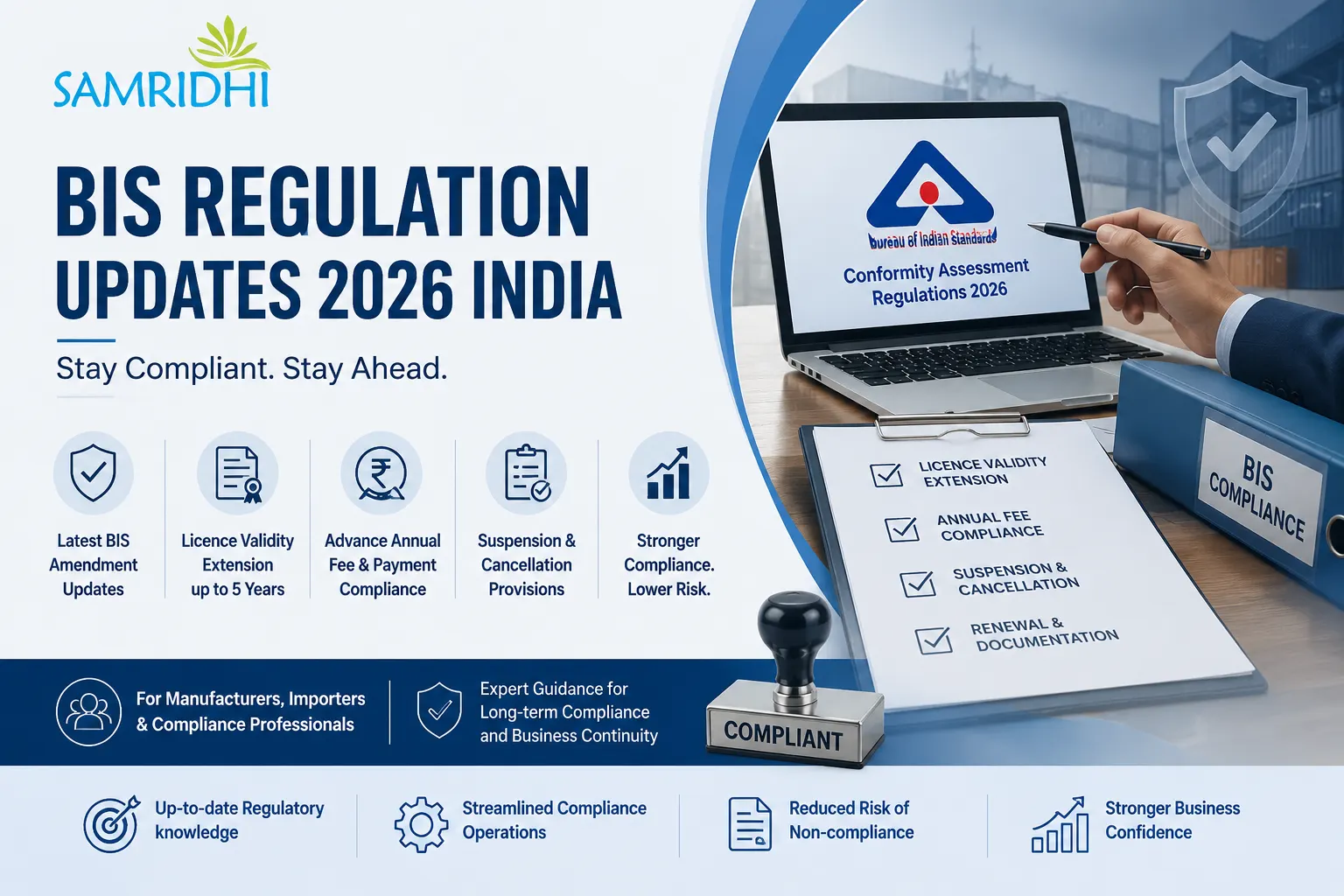
What Are the Latest BIS Conformity Assessment Regulation Changes in India 2026
The BIS compliance framework in India is going through a noticeable transition.
And for many manufacturers and importers, the 2026 amendments are not just procedural updates.
They are changing how long-term compliance management actually works.
Earlier, many businesses approached BIS certification mainly as:
- an approval process
- a testing requirement
- or a licence renewal activity
But the latest BIS regulation updates 2026 India are pushing companies toward more continuous compliance monitoring, financial planning, and operational accountability.
That shift is becoming increasingly important for businesses dealing with:
- electronics
- industrial products
- consumer goods
- imported products
- regulated manufacturing operations
Why the 2026 BIS Amendments Matter
The latest changes under the updated BIS conformity assessment framework focus on improving:
- licence monitoring
- fee management
- renewal control
- suspension handling
- long-term compliance oversight
This forms the core of the recent BIS conformity assessment scheme changes India.
The broader direction appears to be moving toward:
- stronger regulatory visibility
- reduced administrative gaps
- more structured licence management systems
For businesses, this means compliance responsibilities are becoming more operational rather than only documentation-based.
Licence Validity Extensions Are One of the Biggest Changes
One of the most discussed updates is the extension of BIS licence validity periods.
Previously, businesses often dealt with shorter renewal cycles.
Under the revised framework, licence validity may now extend up to five years in certain cases, depending on:
- product category
- compliance history
- applicable scheme conditions
- ongoing regulatory obligations
This is closely related to BIS validity extension for manufacturers India.
While the longer validity period reduces frequent renewal pressure, it also increases the importance of maintaining ongoing compliance consistency throughout the licence duration.
Advance Annual Fee Changes Are Reshaping Compliance Planning
Another major operational change involves annual fee management.
The revised structure places greater emphasis on:
- advance fee submission
- timely compliance payments
- financial tracking for active licences
This aligns with updated BIS annual fee late payment penalty India discussions.
Many businesses previously focused heavily on initial certification costs while treating annual obligations as secondary.
That approach is becoming riskier under the revised compliance framework.
Suspension and Cancellation Provisions Are Becoming More Structured
The updated framework also introduces clearer operational consequences for non-compliance situations.
This includes stronger focus on:
- delayed fee payments
- incomplete compliance submissions
- non-maintenance of licence conditions
- regulatory violations
- unresolved compliance observations
This directly relates to evolving BIS licence suspension rules India and BIS certificate cancellation provisions India.
The overall system appears increasingly focused on active compliance maintenance rather than passive licence holding.
Importers Are Also Being Affected by the New Changes
The revised BIS framework is not impacting only manufacturers.
Importers handling regulated products are also facing increased compliance expectations involving:
- product traceability
- document consistency
- licence monitoring
- renewal tracking
- supplier coordination
This reflects broader BIS regulatory changes for importers India.
Imported products are increasingly being reviewed within a more structured compliance ecosystem.
Documentation Expectations Are Increasing
The updated BIS compliance structure is also reinforcing the importance of:
- accurate technical documentation
- product consistency
- updated testing records
- licence-linked compliance monitoring
Businesses increasingly need stronger internal systems for:
- document management
- audit readiness
- regulatory communication
- operational traceability
This aligns with the evolving updated BIS compliance framework India.
Long-Term Compliance Is Becoming More Important Than Initial Approval Alone
One important shift businesses are beginning to notice is that regulatory attention is increasingly extending beyond the initial certification stage.
Authorities now appear more focused on:
- ongoing compliance continuity
- payment discipline
- renewal consistency
- operational accountability
- licence condition maintenance
This is changing how businesses approach BIS certification renewal changes 2026.
Earlier, renewal preparation often happened only near licence expiry.
Now, ongoing compliance management is becoming more important throughout the licence lifecycle itself.
Manufacturers May Need Better Internal Compliance Systems
As regulatory monitoring becomes more structured, many businesses are realizing that manual compliance tracking creates operational risks.
Common issues now include:
- missed renewal timelines
- delayed annual fee payments
- outdated documentation
- inconsistent product records
- poor coordination between departments
The 2026 amendments indirectly increase the need for:
- centralized compliance management
- internal audit systems
- regulatory monitoring processes
- better operational visibility
Why Businesses Are Paying More Attention to Regulatory Updates
For many companies, the impact of the new BIS framework goes beyond certification itself.
These changes can affect:
- import planning
- production continuity
- licence maintenance
- financial forecasting
- operational risk management
That’s why manufacturers and importers are increasingly tracking BIS certification amendment notification 2026 developments more actively than before.
The Practical Takeaway
The latest BIS conformity assessment regulation changes in India are shifting compliance from a periodic activity toward continuous operational management.
- Licence validity extensions reduce renewal frequency but increase ongoing responsibility
- Advance annual fee rules strengthen financial compliance monitoring
- Suspension and cancellation provisions are becoming more structured
- Importers and manufacturers both face higher operational accountability
- Long-term compliance maintenance is becoming more important than initial certification alone
And since:
- regulatory obligations vary by product category and BIS scheme
- operational expectations depend on licence conditions
- final regulatory actions remain subject to BIS authority review
businesses should strengthen compliance monitoring systems early rather than waiting until renewal or inspection stages.
Because under the updated BIS framework…
maintaining a licence is increasingly becoming just as important as obtaining it.
BIS CRS Registration supports product compliance, testing coordination, and regulatory certification management for electronics and regulated products in India.
BIS Licence Validity Extension to 5 Years: What Manufacturers and Importers Should Know
One of the biggest operational changes under the latest BIS amendments is the extension of licence validity periods.
At first glance, many businesses viewed this as simply a reduction in renewal frequency.
But in reality…
the change is doing something much larger.
It is shifting the BIS compliance framework from short-cycle renewals toward long-term compliance management.
That’s why the topic of BIS validity extension for manufacturers India is becoming important not only for manufacturers, but also for importers, compliance managers, and regulatory teams handling BIS-certified products.
Earlier Renewal Cycles Created Frequent Administrative Pressure
Under older licence structures, businesses often managed:
- repeated renewal filings
- recurring documentation submissions
- short-cycle compliance tracking
- frequent operational follow-ups
For many companies, this created:
- administrative workload
- renewal-related delays
- fragmented compliance planning
The revised structure attempts to reduce some of this repetitive renewal pressure.
What the 5-Year Validity Extension Actually Means
Under the updated framework, eligible BIS licences may now remain valid for up to five years depending on:
- applicable BIS scheme
- product category
- compliance history
- regulatory conditions
- ongoing fee obligations
This forms a key part of recent BIS regulation updates 2026 India.
However, the extension does not mean businesses can ignore compliance activities during the licence period.
In fact…
continuous compliance monitoring is becoming even more important now.
Longer Validity Does Not Reduce Compliance Responsibility
One common misunderstanding is assuming that longer licence validity automatically reduces operational obligations.
That is not how the revised system works.
Businesses are still expected to maintain:
- ongoing product conformity
- updated compliance records
- annual fee obligations
- testing consistency
- licence condition adherence
This aligns with the broader updated BIS compliance framework India.
The licence duration may be longer…
but regulatory accountability continues throughout the validity period.
Annual Compliance Obligations Are Becoming More Important
The revised framework increases focus on continuous licence maintenance.
This includes:
- annual fee management
- timely submissions
- record maintenance
- operational compliance monitoring
This is closely related to BIS annual fee late payment penalty India concerns.
Delayed payments or incomplete compliance obligations may now create larger operational risks even when the licence itself remains technically valid.
Importers Are Also Affected by the New Structure
The updated validity system is not limited to domestic manufacturers.
Importers managing BIS-certified products must also maintain:
- product consistency
- supplier coordination
- documentation alignment
- renewal tracking systems
This reflects broader BIS regulatory changes for importers India.
Importers increasingly need stronger visibility into supplier-side compliance because long-duration licences still require ongoing regulatory discipline.
Businesses Need Better Long-Term Compliance Planning
Earlier, many businesses approached BIS compliance reactively.
The process often looked like:
- obtain licence
- maintain minimum records
- prepare again near renewal
That operational model is becoming weaker under the revised framework.
The longer licence cycle now encourages businesses to build:
- continuous monitoring systems
- centralized documentation management
- internal compliance review processes
- renewal tracking mechanisms
Suspension Risks Still Exist Despite Longer Validity
A longer licence period does not eliminate suspension or cancellation risks.
Businesses may still face regulatory action because of:
- non-payment of annual fees
- product non-conformity
- incomplete compliance obligations
- unresolved audit observations
- inconsistent documentation
This connects directly with BIS licence suspension rules India and evolving BIS certificate cancellation provisions India.
In practice, the licence duration extension increases the importance of operational discipline throughout the validity period.
Renewal Management Is Becoming More Strategic
Under shorter renewal cycles, businesses often treated renewal as a periodic administrative task.
Now, BIS certification renewal changes 2026 are gradually turning renewal management into a long-term compliance strategy.
This includes:
- tracking annual obligations
- maintaining updated records
- ensuring product continuity
- monitoring operational changes
- preparing for future audits or inspections
The focus is shifting from “renewal preparation” to “continuous licence management.”
Operational Visibility Is Becoming More Important
As licence periods extend, businesses increasingly need stronger internal systems to monitor:
- licence status
- fee schedules
- product updates
- testing validity
- documentation changes
- regulatory communication
Without structured tracking systems, longer licence periods can actually increase operational risk because businesses may lose visibility over ongoing obligations.
Why the New Framework Changes Compliance Culture
The extension of licence validity is not only an administrative change.
It also changes the mindset around compliance.
The BIS framework appears to be moving toward:
- fewer short-cycle renewals
- greater long-term accountability
- stronger operational monitoring
- continuous compliance management
This reflects broader BIS conformity assessment scheme changes India.
The Practical Takeaway
The BIS licence validity extension to five years reduces frequent renewal pressure but increases the importance of long-term compliance management.
- Businesses still need continuous compliance monitoring
- Annual obligations remain operationally important
- Importers and manufacturers both face ongoing accountability
- Suspension risks continue despite longer validity periods
- Documentation and fee management are becoming more critical
And since:
- licence eligibility conditions vary by scheme and product category
- operational obligations depend on applicable BIS requirements
- compliance status remains subject to BIS authority review
businesses should strengthen long-term compliance systems rather than relying only on periodic renewal preparation.
Because under the updated BIS structure…
a longer licence period now requires stronger operational discipline—not less.
BIS ISI Domestic Manufacturers certification supports ongoing product compliance, factory audit readiness, and long-term BIS licence management in India.
New BIS Advance Annual Fee Rules and Compliance Payment Changes in 2026
One of the less visible—but operationally significant—changes under the updated BIS framework involves annual fee management.
At first, many businesses focused mainly on the larger headlines:
- licence validity extensions
- revised suspension provisions
- updated conformity assessment rules
But for manufacturers and importers managing active BIS licences, the revised annual fee structure may have an equally important long-term impact.
Because under the updated system…
financial compliance is becoming more tightly connected with licence continuity itself.
That’s why the discussion around BIS advance annual fee payment rules India is becoming increasingly important for compliance teams and operational managers.
Earlier Fee Management Was Often Handled Reactively
In many organizations, annual BIS fee payments were treated as administrative follow-up tasks.
Typically:
- finance teams handled payments separately
- compliance teams focused on certification
- renewal activities happened near deadlines
This fragmented approach often worked under older operational models.
But the revised structure is gradually pushing businesses toward more proactive compliance payment management.
Advance Fee Compliance Is Becoming More Structured
The updated framework places stronger emphasis on:
- advance annual fee submissions
- timely payment tracking
- ongoing financial compliance monitoring
This forms an important part of broader BIS regulation updates 2026 India.
The system increasingly appears designed to reduce:
- delayed payments
- inactive licence situations
- administrative non-compliance gaps
For businesses, this means compliance management is becoming more integrated with operational financial planning.
Why the New Payment Structure Matters Operationally
Many companies still think BIS compliance ends after obtaining certification.
But the revised rules reinforce that maintaining a licence also requires:
- regular compliance monitoring
- annual payment discipline
- continuous licence management
This aligns with the evolving updated BIS compliance framework India.
The operational focus is gradually shifting from one-time certification activity toward ongoing licence maintenance.
Late Payment Risks Are Becoming More Serious
One major concern under the revised framework is delayed annual fee payment.
Businesses increasingly need to monitor:
- payment due dates
- licence-linked obligations
- pending compliance activities
- documentation alignment
This directly relates to BIS annual fee late payment penalty India.
Delayed or missed payments may create operational consequences such as:
- compliance interruptions
- licence-related observations
- additional regulatory follow-ups
- risk of suspension proceedings
The New Rules Encourage Better Internal Coordination
One practical issue many businesses face is poor coordination between:
- finance departments
- regulatory teams
- compliance managers
- external consultants
- manufacturing operations
Under the revised framework, disconnected workflows create larger risks because payment management now directly affects licence continuity.
This is one reason companies are increasingly building:
- centralized compliance tracking systems
- renewal calendars
- payment monitoring workflows
- internal audit checkpoints
Importers Also Need Stronger Payment Monitoring
The updated fee structure affects not only Indian manufacturers but also importers holding BIS-linked responsibilities.
Importers increasingly need visibility into:
- supplier-side compliance status
- active licence conditions
- annual fee obligations
- validity periods
This reflects broader BIS regulatory changes for importers India.
Imported product compliance is increasingly tied to stronger operational oversight.
Licence Validity Extensions Increase Long-Term Financial Responsibility
With licences now potentially extending for longer durations, businesses may mistakenly assume compliance pressure decreases.
In reality, the opposite may happen operationally.
Longer licence periods mean:
- more annual monitoring cycles
- longer-term fee management responsibilities
- continuous operational accountability
This is closely linked with BIS validity extension for manufacturers India.
Businesses now need stronger systems for maintaining compliance throughout the licence lifecycle—not only near renewal stages.
Suspension Risks Are Connected to Compliance Management
The revised BIS framework increasingly connects operational discipline with licence stability.
Failure to maintain:
- timely fee payments
- ongoing compliance conditions
- required documentation
may increase regulatory risk exposure.
This relates directly to:
- BIS licence suspension rules India
- BIS certificate cancellation provisions India
The system appears increasingly focused on active compliance behaviour rather than passive licence holding.
Renewal Planning Is Becoming More Financially Integrated
Under earlier models, many companies treated:
- renewal management
- fee management
- documentation tracking
as separate activities.
That separation is becoming operationally inefficient under the revised framework.
Now, BIS certification renewal changes 2026 increasingly require businesses to integrate:
- financial planning
- regulatory monitoring
- documentation management
- compliance tracking
into a single operational system.
Why Businesses Are Paying More Attention to Compliance Administration
One noticeable trend is that businesses are now realizing operational compliance failures often happen because of:
- missed internal communication
- delayed financial approvals
- incomplete tracking systems
- fragmented responsibility allocation
The revised framework indirectly encourages organizations to improve internal governance systems.
The Practical Takeaway
The new BIS advance annual fee rules are changing how businesses manage long-term licence compliance in India.
- Annual fee tracking is becoming operationally critical
- Late payment risks are receiving greater regulatory attention
- Financial compliance is becoming connected with licence continuity
- Importers and manufacturers both require stronger monitoring systems
- Renewal planning increasingly depends on integrated compliance management
And since:
- payment obligations vary by licence scope and applicable BIS scheme
- operational requirements depend on product category and certification conditions
- regulatory actions remain subject to BIS authority review
businesses should strengthen compliance-payment coordination systems well before due dates arise.
Because under the revised BIS structure…
maintaining payment discipline is increasingly becoming part of maintaining regulatory credibility itself.
BIS ISI Foreign Manufacturers certification supports overseas manufacturers exporting BIS-regulated products to the Indian market.
BIS Suspension and Cancellation Provisions Under the Updated 2026 Regulations
One of the most important changes under the revised BIS framework is the growing focus on licence maintenance and regulatory accountability.
Earlier, many businesses viewed BIS certification mainly as:
- a testing-based approval
- a licence issuance process
- or a renewal formality
But the updated 2026 framework is changing that approach significantly.
Now, regulators are increasingly emphasizing continuous compliance behaviour throughout the licence lifecycle.
That is why businesses are paying closer attention to:
- suspension risks
- cancellation provisions
- delayed fee consequences
- ongoing compliance obligations
under the evolving BIS suspension and cancellation provisions 2026 framework.
Suspension Is No Longer Seen as a Rare Compliance Event
In the past, many companies assumed licence suspension happened only in serious or exceptional cases.
But the revised framework appears to treat suspension more as an operational enforcement mechanism tied to ongoing compliance management.
This aligns with evolving BIS licence suspension rules India.
The focus is gradually shifting toward:
- continuous regulatory discipline
- timely compliance maintenance
- active licence monitoring
rather than only initial certification approval.
What Can Trigger BIS Licence Suspension
Under the updated structure, suspension risks may arise from multiple operational and compliance-related situations.
These may include:
- delayed annual fee payments
- non-maintenance of licence conditions
- product non-conformity
- incomplete documentation
- unresolved compliance observations
- failure to respond to regulatory communication
The exact trigger conditions may vary depending on:
- product category
- applicable BIS scheme
- licence scope
- authority review findings
This reflects broader BIS conformity assessment scheme changes India.
Delayed Fee Payments Are Becoming a Major Compliance Risk
One of the most operationally important changes is the stronger linkage between financial compliance and licence continuity.
Many businesses previously treated annual fee management as a low-priority administrative activity.
That is becoming increasingly risky under the revised framework.
This directly connects with:
- BIS annual fee late payment penalty India
- advance fee management obligations
- ongoing licence maintenance requirements
Delayed payments may now create:
- compliance observations
- suspension risk exposure
- operational interruptions
- additional regulatory scrutiny
Cancellation Risks Extend Beyond Financial Non-Compliance
While fee-related non-compliance is important, cancellation risks are not limited to payment issues alone.
Authorities may also examine:
- product consistency
- misuse of BIS marking
- testing non-conformity
- inaccurate declarations
- repeated operational violations
- unresolved corrective actions
This relates directly to BIS certificate cancellation provisions India.
The revised framework increasingly emphasizes long-term operational reliability.
Manufacturers Need Continuous Compliance Monitoring
One major shift businesses are noticing is that compliance can no longer be handled only during:
- renewal periods
- inspections
- or certification filing stages
Manufacturers increasingly need systems for:
- ongoing documentation review
- internal audit monitoring
- payment tracking
- product conformity management
- regulatory communication handling
This forms an important part of the broader updated BIS compliance framework India.
Importers Also Face Higher Operational Accountability
The revised rules are affecting importers as well.
Importers managing BIS-certified products increasingly need visibility into:
- supplier compliance status
- licence validity conditions
- annual fee obligations
- testing consistency
- product conformity continuity
This reflects broader BIS regulatory changes for importers India.
Import compliance is increasingly becoming part of a larger regulatory accountability structure.
Corrective Compliance Expectations Are Increasing
Another noticeable change is the growing expectation that businesses respond proactively to compliance observations.
Authorities increasingly expect companies to:
- investigate non-conformities
- maintain corrective action records
- improve operational controls
- resolve documentation gaps
- strengthen compliance systems
The focus appears to be shifting toward preventive compliance rather than reactive response management.
Longer Licence Validity Does Not Reduce Suspension Risk
Some businesses assume that longer licence validity periods reduce operational pressure.
But under the revised system, the opposite may happen.
Because BIS validity extension for manufacturers India also means:
- longer operational monitoring periods
- extended compliance accountability
- more annual obligations
- greater need for internal tracking systems
The licence duration may increase…
but continuous compliance discipline becomes even more important.
Internal Coordination Failures Often Lead to Compliance Problems
Many operational issues happen not because businesses intentionally violate requirements…
but because internal systems are fragmented.
Common problems include:
- finance teams missing payment timelines
- quality teams not updating records
- compliance departments lacking visibility
- supplier coordination gaps
- delayed response to regulatory notices
The revised BIS structure indirectly pushes organizations toward stronger centralized compliance management.
Why Businesses Are Reassessing Their Compliance Strategy
The 2026 amendments are encouraging companies to rethink compliance as:
- an ongoing operational system
- not only a certification activity
Businesses increasingly realize that:
- suspension risks affect product continuity
- cancellation impacts market operations
- operational compliance gaps create long-term business risk
This is why many organizations are now strengthening:
- compliance monitoring systems
- internal audit practices
- regulatory tracking workflows
- documentation management structures
The Practical Takeaway
The updated BIS suspension and cancellation provisions are increasing the importance of continuous compliance management.
- Delayed fee payments now create larger operational risks
- Suspension triggers extend beyond technical non-conformity alone
- Manufacturers and importers both face stronger accountability expectations
- Corrective compliance systems are becoming more important
- Internal coordination failures increasingly affect regulatory stability
And since:
- suspension conditions vary by licence scope and BIS scheme
- operational obligations depend on product category and regulatory requirements
- final actions remain subject to BIS authority review
businesses should strengthen long-term compliance monitoring systems instead of relying only on renewal-stage preparation.
Because under the updated BIS framework…
keeping a licence active increasingly depends on how consistently compliance is maintained after approval—not just before it.
ISO Certification supports structured quality management systems, operational consistency, and compliance-focused business processes.
How the New BIS Amendment Rules Are Changing Compliance Planning for Manufacturers
The latest BIS amendments are doing more than changing regulatory procedures.
They are changing how manufacturers plan compliance internally.
Earlier, many factories approached BIS certification as a sequence of separate activities:
- product testing
- licence approval
- periodic renewal
- document submission
But the updated framework is gradually pushing manufacturers toward something much broader:
continuous compliance management.
That shift is becoming increasingly visible under the latest new BIS compliance rules for manufacturers India.
And for many businesses, the operational impact is already noticeable.
Compliance Is Becoming a Continuous Process
One of the biggest changes under the revised framework is that compliance can no longer be managed only during:
- certification stages
- audits
- or renewal periods
Manufacturers increasingly need systems capable of handling:
- ongoing licence monitoring
- annual obligations
- documentation maintenance
- product conformity tracking
- regulatory communication management
This aligns closely with evolving BIS regulation updates 2026 India.
The operational focus is moving from periodic compliance activity toward long-term regulatory discipline.
Documentation Management Is Becoming More Important
The updated BIS framework is increasing the importance of structured documentation systems.
Manufacturers now need stronger control over:
- testing reports
- technical records
- licence documents
- product specifications
- renewal records
- compliance communication
Many factories still rely heavily on:
- fragmented spreadsheets
- manual files
- department-specific records
That approach is becoming harder to sustain under the revised compliance environment.
Renewal Planning Is No Longer a Last-Minute Activity
Earlier, many companies prepared for licence renewals only near expiry dates.
But under the updated structure, BIS certification renewal changes 2026 are encouraging businesses to monitor compliance throughout the licence lifecycle itself.
This includes:
- tracking annual obligations
- maintaining updated technical records
- ensuring conformity continuity
- monitoring fee schedules
- preparing for operational reviews
The longer licence validity periods indirectly increase the need for continuous monitoring.
Audit Readiness Is Becoming Operationally Critical
Modern BIS compliance increasingly overlaps with broader audit readiness expectations.
Businesses may now need stronger systems for:
- internal compliance reviews
- documentation traceability
- testing consistency
- corrective action management
- operational record maintenance
This reflects the growing role of the updated BIS compliance framework India.
Manufacturers are gradually realizing that operational readiness matters long before inspections occur.
Financial Compliance Is Now Part of Compliance Planning
One important operational shift is the integration of financial compliance into licence management.
Businesses now need better visibility into:
- annual fee obligations
- payment schedules
- late payment risks
- licence-linked financial tracking
This directly relates to:
- BIS annual fee late payment penalty India
- revised advance fee management expectations
Earlier, payment tracking was often treated separately from technical compliance.
That separation is becoming operationally risky.
Suspension Risks Are Changing Internal Monitoring Practices
The revised framework is also increasing awareness around:
- licence suspension risks
- cancellation exposure
- operational non-compliance consequences
This connects directly with:
- BIS licence suspension rules India
- BIS certificate cancellation provisions India
Manufacturers increasingly understand that:
- delayed internal coordination
- missing records
- unresolved compliance gaps
- inconsistent documentation
can create long-term operational problems.
Importers and Manufacturers Now Share Similar Compliance Pressure
The updated framework is affecting both:
- domestic manufacturers
- importers managing BIS-certified products
Importers increasingly require:
- supplier-side compliance visibility
- document alignment
- licence tracking systems
- conformity continuity management
This reflects broader BIS regulatory changes for importers India.
Compliance planning is becoming more interconnected across the supply chain.
Internal Compliance Teams Are Becoming More Important
Many organizations are now expanding the role of:
- regulatory teams
- compliance managers
- quality departments
- internal audit systems
because the revised BIS structure requires stronger coordination between:
- operations
- documentation
- finance
- testing
- regulatory management
Without centralized coordination, compliance gaps can accumulate quietly over time.
Digital Tracking Systems Are Becoming More Useful
As compliance obligations expand, manufacturers increasingly use:
- digital renewal trackers
- compliance dashboards
- centralized documentation systems
- audit management tools
to improve operational visibility.
This is becoming important because longer licence periods and ongoing obligations are harder to manage manually.
Why Manufacturers Are Reassessing Their Compliance Strategy
Many businesses are realizing the updated BIS framework changes compliance from:
into:
- an operational management system.
This affects:
- production planning
- regulatory monitoring
- internal audits
- supplier management
- financial tracking
- documentation control
The broader direction appears to encourage stronger long-term compliance culture within manufacturing operations.
The Practical Takeaway
The new BIS amendment rules are significantly changing how manufacturers approach compliance planning in India.
- Documentation management is becoming more structured
- Renewal planning now requires continuous monitoring
- Financial obligations are becoming operationally important
- Audit readiness expectations are increasing
- Suspension risks are encouraging stronger internal controls
And since:
- compliance obligations vary by product category and BIS scheme
- operational requirements depend on licence scope and manufacturing structure
- regulatory observations remain subject to BIS authority review
manufacturers should strengthen compliance systems early instead of relying only on reactive renewal or audit preparation.
Because under the updated BIS framework…
compliance planning is gradually becoming part of everyday manufacturing operations—not just a regulatory formality.
NABL Testing supports accredited product testing, technical validation, and compliance-oriented quality assurance for manufacturers.


 Get Certified with Confidence – Your One-Stop Compliance Partner
 Grab Your Certified Now
 +91 8799708673
 WhatsApp